weather posts
It belts out severe weather alerts as storms are barreling towards your domicile. It acts as a decent bedroom stereo. And it wakes you and the SO up to your own favorite jams -- all while charging your iPod or iPhone throughout the night. If those amenities sound like must-haves in your own life, you might be interested in knowing that iLuv's iMM183 dual dock alarm clock is now shipping, nearly a full year after being originally announced at CES. The pain? $149.99 -- but hey, that's a small price to pay to keep your dear media player / handset out of a tornado's eye, right?
Infrared sensors hit 16 megapixels, can now spy on an entire hemisphere
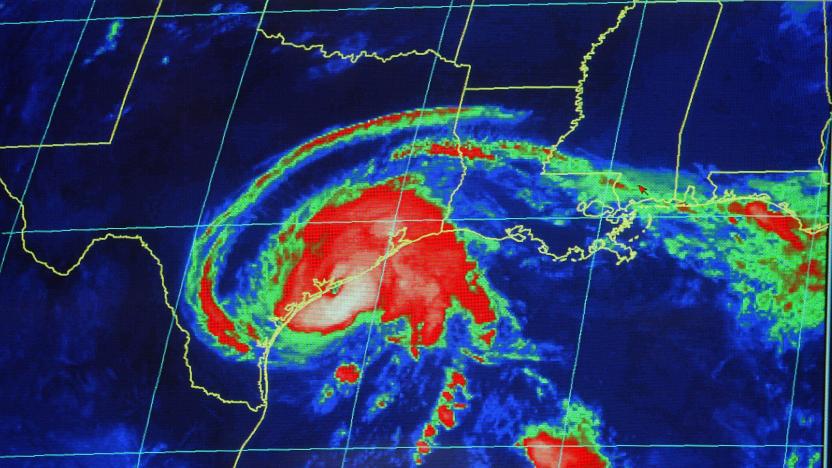
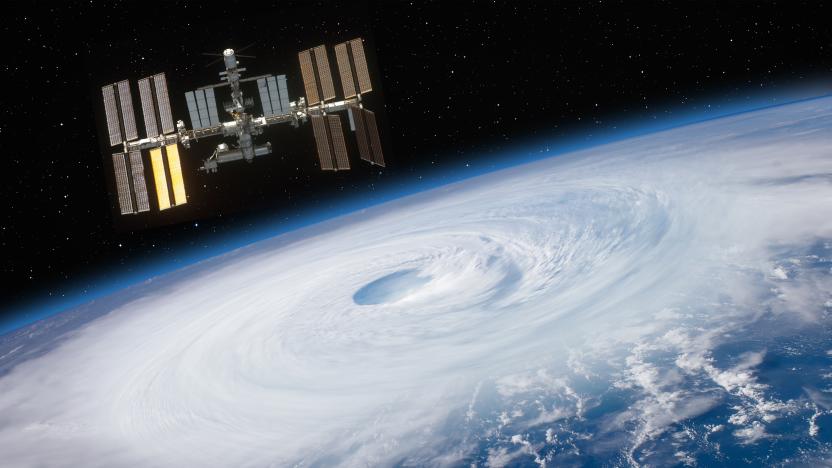
Aerospace and defense manufacturer Raytheon wants everyone to know it has developed the world's first 16 megapixel infrared sensor, which is set for a life of orbiting the Earth and generally being a lot more useful than lesser models. With its higher resolution, the unit is able to cover an entire half of the planet without "blinking" to relocate its focus, and should be warmly received by meteorologists, astronomists and military types, all craving for a bit more real-time reconnaissance. We advise wide-brimmed tin foil hats to shield your body heat from these Sauron-like satellites while working on those plans for a global uprising of the proletariat.
[Via TG Daily]
[Via TG Daily]
Woodstation acts like a weather station, looks like a dead tree

Usually the intersection of woodcraft and gadgetry consists of little more than taking a piece of gear and putting it in a box. Woodstation may be no different, but at least it does its thing with some style, placing its LED display beneath the surface, allowing it to seemingly display weather data on the wood itself. And if that weren't enough, the device contains a motion sensor (it turns itself on when you enter the room) as well as date, time, and alarm functions. Available in a maple or walnut finish, this bad boy is currently available in the UK for £89.95 (about $147). And unlike the Amazon Kindling, this thing actually works.
[Via Pocket-lint]
[Via Pocket-lint]
Oregon Scientific introduces solar-powered +ECO Clima Control weather station
It may not be the snazziest thing to ever leave the labs at Oregon Scientific, but it's still a new take on the average desktop weather station that Ma Earth would certainly appreciate. The sun-powered +ECO Clima Control weather station is equipped with a built-in solar panel and enables users to monitor the current temperature and humidity in up to four locations within the home and outdoors. The device relies on remote wireless sensors, and considering that it can operate for up to three months with just an eight hour charge, even folks under the clouds in Seattle can take advantage. Those interested in bringing one home can do so for $119.99, and if you're still not convinced of the value proposition here, you can look forward to two more +ECO wares this September. Tap that read link for more information on the both of those.
Oregon Scientific's RMR500 weather display includes integrated solar panels
Well, hello Oregon Scientific! Outside of those few mentions made at CES last week, we were beginning to wonder if you had any new tabletop displays in the pipeline. Apparently, you do. The RMR500 Eco Clima Control doesn't deviate too drastically from the company's past weather displays, but it does do something a little different than just inform users of temperature and humidity in four separate locations. What, you ask? It gets its juice from integrated solar panels -- three whole months of power after just eight hours in the sun. Look for it to splash down this Spring for $99.
iLuv's iMM183 dual dock iPod alarm clock also does weather alerts

CarTel uses wardriving for science, better driving directions
If you're not satisfied with the driving directions you get on Google Maps, a few smart guys at MIT have created an elaborate new toy called CarTel just for you. They've equipped a fleet of Boston-area cars with computers that automatically connect to any 802.11 access points detected in transit, then send home data recorded by their on board diagnostic systems, all in just a few hundred milliseconds. The result: a website that gives you directions based on information gathered in real-time so you can avoid high-traffic areas or say, if it's raining, roads which have historically been congested in adverse weather conditions -- no GPS required. The project also keeps a record of all access points detected, so think of it as wardriving for the good of humanity -- and you (probably) wouldn't even get arrested for participating!
[Via PhysOrg]
[Via PhysOrg]
CASA network aims to identify tornadoes more quickly
The recent tornado tragedy in Iowa underscores the necessity to replace our aging NEXRAD detection system, and thankfully, a team of scientists from various universities are already working to find a suitable replacement. The Collaborative Adaptive Sensing of the Atmosphere (CASA) satellite network would theoretically be installed on existing infrastructure, and it would purportedly scan areas more quickly and target the bottom of storms -- something the current system falters at. The so-called "gap filling radars" could be used to scrutinize the regions where NEXRAD radars can't see, and better still, it will likely be able to more accurately predict the storm path in order to more effectively alert those who may be in harm's way. On the downside, said network isn't expected to be implemented and ready for use until 2013, so we wouldn't go converting that basement into a home theater just yet.[Thanks, Matt]
Oregon Scientific's Weather In Motion clock touts proximity sensor
Just in case you've no real need for a seven-day forecast integrated into your timepiece, Oregon Scientific is hoping to lure you in with its proximity-sensing Weather In Motion clock. This stylish device sports a sexy black frame and an infrared motion sensor that changes the display based on how close / far away you are. When you're at a distance, expect to see the "current time, day and weather forecast displayed in large digits and icons," while walking up on it persuades it to show the "indoor and outdoor temperature readings, while the time and weather forecast icons automatically reduce in size." Furthermore, you can enable an automatic scroll mode that will "smoothly shift the information every five seconds." No word on when shipments will arrive, but it'll cost you $64.99 when it becomes available.
[Via Technabob]
[Via Technabob]
Ambient Devices updates 5-day Forecaster, unveils 7-day version
While we'd surely balk if Ambient Devices simply added two measly (albeit potentially important) days to its forecaster, the outfit made sure to update the overall look / feel of its weather display for good measure. The revamped devices will reportedly "receive updates from weather sources throughout the day via the Ambient Infocast Network," which currently reaches about 90-percent of US households. The 5-Day Forecaster will sport a four- by four-inch display while the 7-Day Forecaster boasts a six- by six-inch screen, and both units will show "current conditions and an extended multi-day forecast for 150 locations in the United States." Notably, the units will even feature "a color-changing backlight to indicate the current temperature at a glance (i.e. blue for cold, red for warm)," and those springing for the week-long version will be blessed with information about the UV Index, wind speed and direction, pollen alerts and air quality alerts. Look for the new Forecasters to land this winter for $149.99 and $199.99, respectively.
[Via SlashGear]
[Via SlashGear]
Oregon Scientific Crystal Weather Station brings some flair to the forecast
Oregon Scientific has been busting out some pretty slick gear lately, and its new BA900 Crystal Weather Station is no exception. The acrylic block features three laser-engraved 3-D icons that light up in color to represent sunshine, precipitation, or cloudy skies, while the radio-controlled atomic clock in the base switches to a temperature readout with just a wave of your hand. We're hearing this thing will ship in December for about $60 -- just in time for that rain icon to be rendered totally inaccurate.
[Via Red Ferret]
[Via Red Ferret]
Ambient Devices' slew of conceptual displays
Although we've already been up close and personal with a number of Ambient's unique devices, a recent conference at the Ambient Information Systems Workshop brought a bevy of new (and old) conceptual devices back to the limelight. Aside from the Google Clock and Ambient Orb, David Rose spoke about the opportunity to present a multitude of interfaces with varying resolutions in a number of environments so that individuals could get updates on what's important to them with "just a glance." Among the ideas was a Weather Watcher display that could be tailored for sailors by divulging forecasts and current wind information, a Sailing Zone display that could easily pinpoint the "ideal situation for boating," and a thin wallet-infused display that could crank out pertinent information to the owner. Additionally, a energy tracking Home Joule is currently being trailed in New York that uses color to quickly convey data about how much juice is being consumed in a home. So if you're intrigued in the slightest, and can't wait to see how ubiquitous displays and the human race will inevitably work and play together in perfect harmony, be sure to hit the read link and cringe as you read over things you thought of years ago but kept to yourself.
Weather forecasts could be aided by sensor-laden aircraft
We know, it's rather disappointing to check the local forecast on your Melitta MS1MSB or Wii weather channel, only to find the conditions completely not as you expected once you stroll outside, but those guesstimates could be getting a bit of help from weather tracking airplanes. Boeing has filed a patent application that would "using airborne radars to measure wind vectors," essentially strapping weather-sensing nodes onto an airplane so that it collects real-time data whilst passing across remote regions of the planet that typically get ignored. Better yet, the data could even be cross-referenced with nearby planes in order to estimate the best actual forecast for a given region based on numerous information sources, potentially yielding a more accurate look at forthcoming weather. Of course, all logic here would point to humanoid meteorologists being established to interpret and disseminate the information, but until all this gets real, we'll be playin' it safe with the weather forecasting umbrella.[Via NewScientistTech]
Experience a world of weather under one umbrella

"Weather Explorer Umbrella" is an installation project that clues you in on current weather conditions worldwide using a souped-up 'brella and an outlined world map. As you scamper about the "world," your weather "experience" changes according to each unique location that the umbrella captures with a tracking camera. An XML feed provides real-time weather data, altering the actions of a fan, speakers, and LEDs installed on the underside of the umbrella. Wind data adjusts the speed of the fan while other weather patterns are expressed with white (lightning / thunderstorm), blue (rain), and yellow (sun) lights. Definitely not as practical as the news or the internet, but with a little imagination (okay a lot of imagination) it might be fun to try. If you're looking for a dorky umbrella that's actually useful in real life, this one might be more your style.
[Via Hackaday]
[Via Hackaday]
XM vehicle to showcase real-time "infotainment"
Although XM's supererogatory features that compliment the actual music transmissions have been available for awhile, the company is apparently going all out to demonstrate its latest inclusions at CES. Dubbed the "infotainment" concept vehicle, this mysterious whip will reportedly feature the "first personal weather tracking system for GPS navigation," which is intended to compliment XM's real-time traffic service (NavTraffic). The system is designed to focus on weather patterns for your specific route, and also provides short-term forecasts to help you decide whether the scenic route would suit you better. Partnering with Baron Services, XM plans to bring the WxWorx technology already used in "airplanes, boats, and emergency responders" to the comforts of your ride. Additionally, the company is set to showcase "in-car video systems" co-developed by On2 Technologies that can not only receive audio, but even video (sound familiar?) from the same satellites and ground repeaters that XM already delivers tunes by. Of course, we can expect to see a fleshed-out demonstration of the parking locator technology (dubbed ParkingLink) that has been in the works, and XM even plans to demonstrate a voice-recognition control scheme developed by VoiceBox Technologies. Notably, XM suggested that its weather-tracking system should be officially available "this summer," while the other introductions might just hold off until this whole "sorta maybe merger" thing gets ironed out.