

ASUS ROG Zephyrus Duo review: Outrageously expensive, totally awesome
My wallet is saying no, but my heart is saying yes.
- Fantastically unique design
- Brilliant dual OLED displays
- Surprisingly good speakers
- Great performance
- Stupendously expensive
- Big and bulky
- Maxes out at 32GB of RAM and 1TB of storage
When you're buying a laptop and trying to figure out how to spec it, there's a line you sometimes cross after you make sure all your core requirements are met. You start adding things that are just nice to have, like extra memory and more storage. However, with the ROG Zephyrus Duo, it feels like ASUS is trying to push that boundary into another dimension because there isn't really a situation where a $4,500 gaming notebook with dual OLED displays and up to an RTX 5090 GPU can really be considered a normal desire.
That's precisely what I like about what might be ASUS' wildest laptop to date. Even though this thing is outrageously expensive, it's also a fantastic example of the glorious overkill you get when a company focuses on making something that's more powerful than practical.
Design and displays
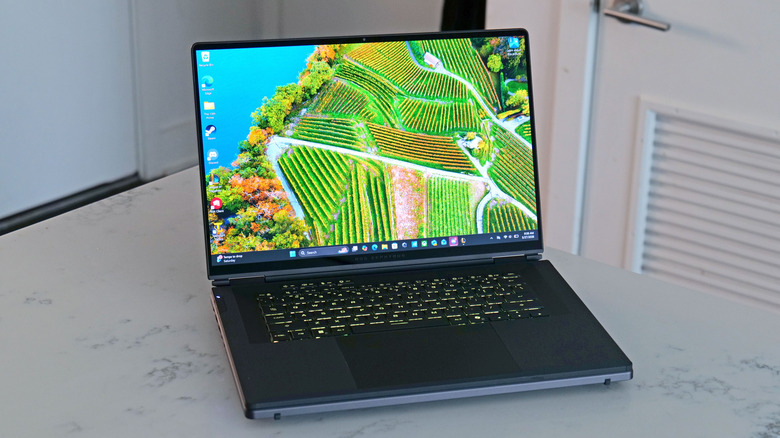
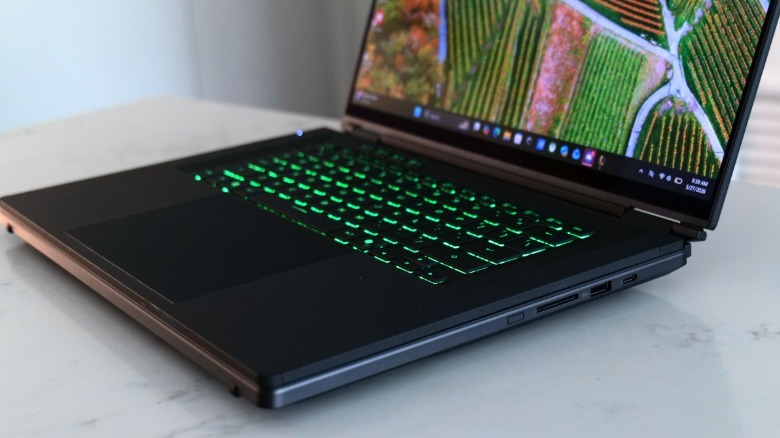
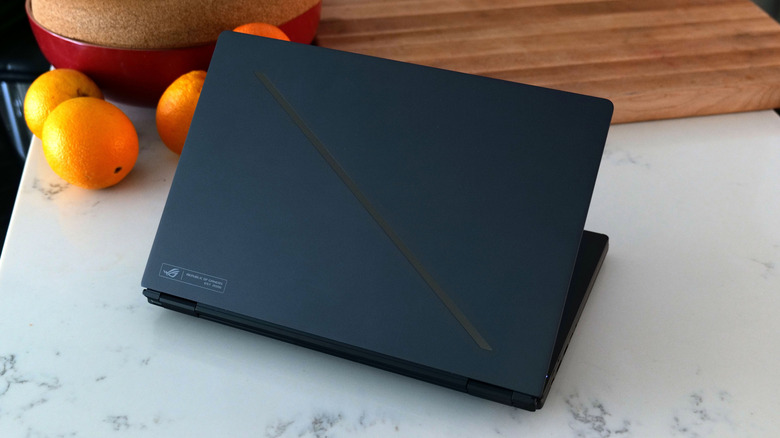
One of the most surprising things about the Zephyrus Duo is that when closed, it doesn't really look that different from one of ASUS' regular gaming laptops, like Zephyrus G16. It's definitely a touch thicker at 0.98 inches (compared to 0.7 inches for the G16) and it's significantly heavier too (6.2 pounds vs 4.3 pounds). But you still get a very familiar design with a single slash across its lid with embedded LEDs and a boxy, minimalist chassis with subtly rounded corners. That mimicry continues on the inside, where the Duo looks nearly indistinguishable from a typical clamshell thanks to its RGB-lit keyboard and absolutely massive touchpad. However, if you look closely, you will notice some small differences, like the presence of speakers positioned on the sides of its frame instead of the typical up-firing audio, and a side-mounted power button.
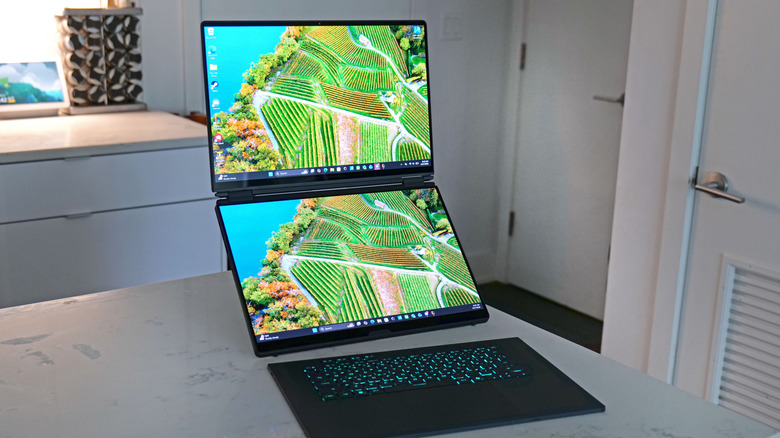
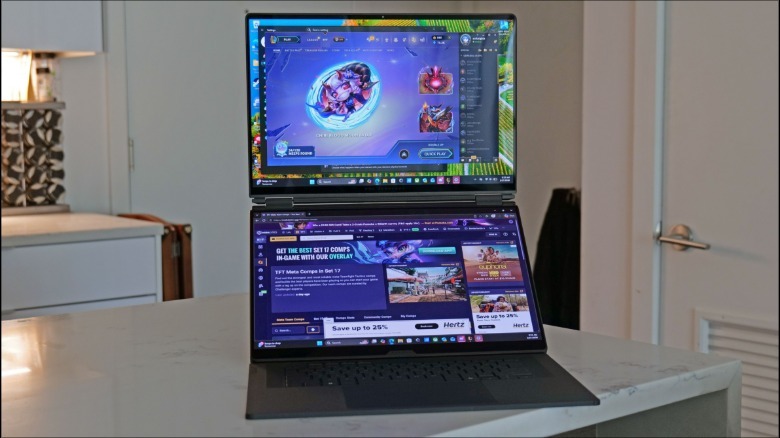
The Zephyrus Duo's true form only begins to emerge after you realize that its keyboard is only held on by magnets. You can yank it off to reveal a second 16-inch 3K OLED display identical to the one up top. It's time to prepare for trouble and make it double. In clamshell mode, you can use the upper display for gaming while the lower half becomes a place to keep widgets (news, weather, etc.), stash extra browser tabs or display a virtual keyboard and/or mousepad. ASUS smartly included handy gestures like touching the title bar on an app before sending it to the other screen with a flick of your finger. While I did notice that a couple of keys felt slightly mushy, for a detachable keyboard that measures just 5mm thick, you still get a nice bounce with ample key travel. And because ASUS included a row of pogo pins on the bottom edge of the laptop, the keyboard automatically recharges when you reattach it.
 Sam Rutherford for Engadget
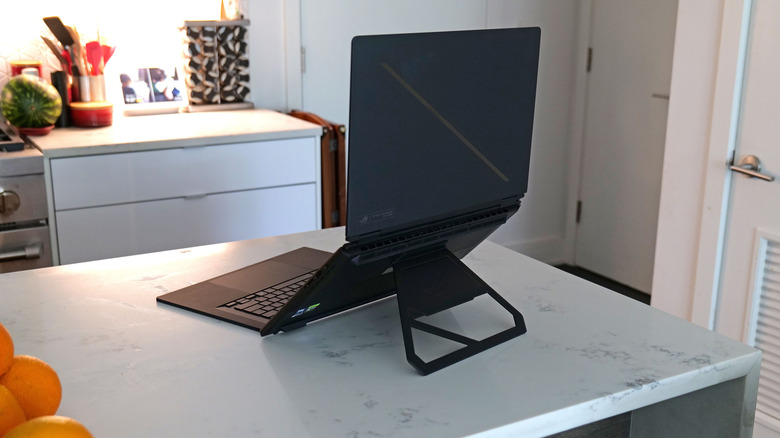
However, the real magic happens when you fold out the Duo's built-in kickstand and prop the whole system up to create a stacked dual-screen all-in-one with its detached keyboard laying flat out in front. The only thing you'll really need to bring is a mouse, because as big as its touchpad is, it's still not a proper alternative to a detached pointer. From here, you can continue gaming on the top screen, while the bottom serves as a second monitor for Discord, guides, walkthroughs or any other app (or apps) you need. It's a veritable gaming fortress that you can still fold up and easily stash in a backpack.
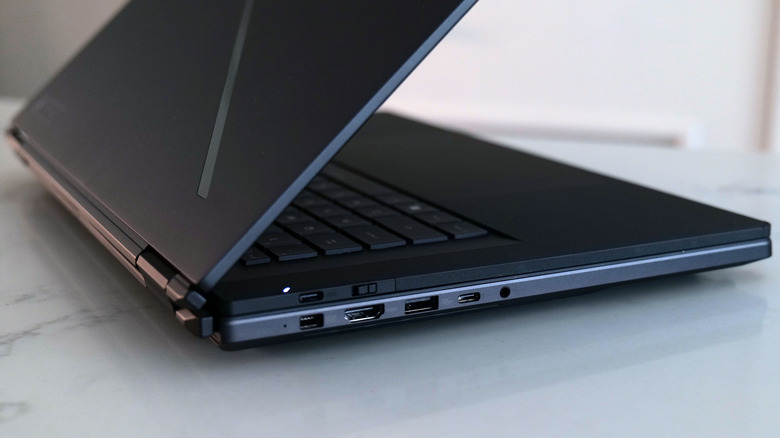
The main downsides to the Zephyrus Duo's design, aside from its extra bulk, are that its fans can get noisy under load. It doesn't come with support for Thunderbolt 5 or a dedicated Ethernet jack either, the latter of which would come in handy for demanding competitive gamers. Thankfully, ASUS' six speaker setup is surprisingly boomy, allowing it to easily drown out the whirring when you don't feel like wearing headphones. Meanwhile, the rest of its connectivity is quite ample, as the Duo supports Wi-Fi 7, Bluetooth 6.0, full-size HDMI, a combo 3.5mm audio jack, an SD card reader and a total of four USB ports (two Thunderbolt 4 and two USB3.2 Type-A).
Performance
The base configuration for the ROG Zephyrus Duo costs $4,500 for an Intel Core Ultra 9 386H CPU, 32GB of RAM, 1TB of storage and NVIDIA RTX 5070 Ti graphics. However, if you're feeling extra spendy, you can fork over another $1,000 to upgrade to an RTX 5090, which is the model I tested for this review. Sadly, this spec bump doesn't come with any extra RAM or storage, which feels a bit skimpy on a laptop this expensive. But with RAM prices like they are today, there's a good chance that would push the price of a fully loaded Duo close to $7,000. That's probably a bit too rich even for the kind of folk that don't have problems splurging on tech like this.
Given the Duo's top-notch components, it had no problems with performance. In Cyberpunk 2077 at 1080p on the Ultra RT preset, the Zephyrus pushed out 75 fps. Meanwhile, in Control at 1080p on Epic graphics, it fared even better hitting 124 fps. That means there's plenty of room to pump up the resolution to something closer to the laptop's native 3K spec. In fact, when I re-ran the benchmark at QHD (2,560 x 1,440) and the same Epic settings, it was clear there was still plenty of juice left to spare as it hit 95 fps.
 Sam Rutherford for Engadget
Unsurprisingly, the Duo makes mincemeat of lesser tasks like photo and video editing. When used for that, the laptop's onboard SD card reader becomes even more useful while its Pantone-validated displays (100 percent coverage of DCI-P3) ensure that you're always looking at bright and accurate hues. So while this is geared towards gamers, it can really handle practically anything you throw at it.
Battery life
For a system with maxed out components and not one but two displays, you might expect it to be a real battery hog. However, as long as you're not using it like an iron-tier feeder in League of Legends, its longevity is surprisingly good. On PCMark 10's Modern Office rundown test (with only one screen enabled), the Zephyrus Duo lasted 13 hours and 10 minutes, and that was with it set to Performance mode in ASUS' Armoury Crate app. Now obviously that number takes a hit when you're gaming or have both displays going, but thanks to its 90Whr cell, I found I could still get two hours or more of untethered gaming, depending on the title of course.
Wrap-up
The ASUS ROG Zephyrus Duo is about as close to a hyper gaming laptop as you can get, similar to how a Lamborghini Urus or a Ferrari stacks up against your typical crossover or coupe. It's ridiculously expensive and it comes with a handful of special considerations due to its unique design. But at the same time, it's really powerful and its dual displays allow for setups that traditional clamshells can only dream of. And unlike your typical hypercar, its efficiency is better than expected while it also offers a strong selection of ports and connectivity.
Sometimes I think the Zephyrus Duo could have used a better name because it's an even better transformer than some of ASUS' previous devices, like a tablet that converted into a laptop, that bore that designation. If Hasbro wanted to reimagine its iconic G1 bots as modern gadgets, I can't help but think that this laptop would be the perfect design for an updated take on Blaster or Soundwave. There's a childlike joy I get every time I open up the Duo to reveal its two displays, and as an adult I really appreciate the extra screen space you get with its design — not to mention its excellent performance. Unfortunately, its price means that most of the people who might also enjoy it probably can't afford one. But if you can, the ROG Zephyrus Duo is exceedingly cool and there's really nothing else like it available today.