

James Webb telescope spots supermassive black hole that formed before its galaxy
This could completely change what we know about the formation of these astronomical bodies.
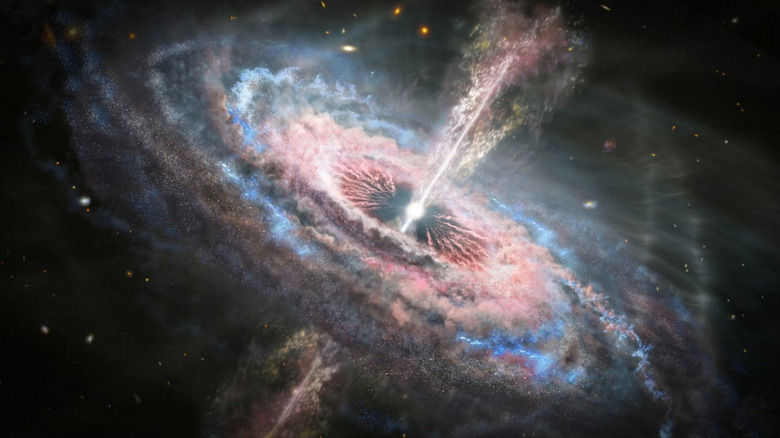
The James Webb Space Telescope has observed evidence of a supermassive black hole that was enormous from inception and did not seem to undergo a stellar collapse phase, in which a black hole feeds on a host galaxy to increase its size. Professor Roberto Maiolino from Cambridge's Cavendish Laboratory and Kavli Institute for Cosmology, who co-authored a recent study on the phenomena, calls the findings "a total revisiting of the classical scenarios of how black holes form and grow."
For decades, it has been conventional scientific wisdom that large stars within an existing galaxy eventually collapse, gobbling up nearby materials in the process. This leads to a black hole. Now we have evidence of a black hole that's millions of times larger than our sun that grew relatively quickly without going all Galactus on the surrounding environs.
Researchers have made the first direct mass measurement of a black hole in the early universe using #NASAWebb. The supermassive black hole in Abell2744-QSO1 seems to predate its galaxy and may have formed within the first second after the big bang: https://t.co/TiRs3ZBBnq pic.twitter.com/8fuiVQYYEV
— Space Telescope Science Institute (@SpaceTelescope) May 27, 2026
The researchers conducted detailed observations of Little Red Dot QSO1. Most of these little red dots are thought to be supermassive black holes surrounded by thick gas from the early universe. This particular little red dot likely existed just 700 million years after the Big Bang. It has long been thought that it took at least a billion years for a supermassive black hole to form.
The astronomical body is 40 million times the size of our sun, and is located 13 billion light-years away. The discovery marks the very first direct measurement of a black hole mass within the first billion years after the Big Bang.
James Webb has been spotting potential evidence of these early black holes for years, but there has been no direct measurements until now. This is because the gas comprising QSO1 has a Keplerian rotation, holding a central point in the same way planets in our solar system orbit the Sun. This allowed scientists to calculate the mass, as Keplerian motion is governed by simple laws of gravity.
"This is important because it tells us that most of the mass of QSO1 is concentrated in the black hole at the center," said researcher Ignas Juodžbalis. "If the mass were more distributed, as it would be if there were a lot of stars, the gas would not have this perfect Keplerian rotation."
Study co-author Dr. Francesco D'Eugenio added that "before now, all of the mass measurements of black holes in the early universe have been indirect, based on assumptions from what we know about them in the local universe."
Does this type of discovery negate the entire idea of the Big Bang? Not really. Yes, James Webb has discovered supermassive black holes that existed not that long after the Big Bang, but there's a bit more to the story. Astrophysicists at UCLA have suggested that dark matter could solve this particular quandary.
This is because when dark matter decays, it has been posited that emitted photons get extremely hot. This could speed up the whole formation process, as the hydrogen gas could get hot enough for gravity to gather it into giant clouds. These clouds could condense into a supermassive black hole at a much quicker rate than what we normally see.
However, this is all very theoretical. We don't exactly know if dark matter actually exists and, therefore, we also don't have any concrete information regarding its makeup. We do need something, however, to make the math make sense and calculations paint dark matter as the most likely culprit.