

Canon EOS R6 V review: A pro vlogging camera at a mirrorless price
With a 33MP sensor, RAW video, open gate and active cooling, it has few video limitations.
- Great handling
- Excellent autofocus
- Powerful RAW video capabilities
- Solid video stabilization
- Not the best for photography
- No electronic viewfinder
- Occasional rolling shutter issues
Sony put the "V" in vlogging with cameras like the ZV-E1 and ZV-E10 II, carving out a creator niche that rivals failed to match for many years. However, Canon carefully bided its time; after releasing the R50 V last year, it recently unveiled the powerful 33-megapixel, full-frame EOS R6 V. It's a camera with pro video intent in a mirrorless body, with features like RAW and open gate video that Sony's rival ZV-E1 noticeably lacks.
With the same sensor as Canon's mainstream R6 III and pro-oriented C50, the R6 V slots neatly between those two models, offering stabilization like the former plus the latter's active cooling. There are some compromises at the $2,500 price point, though, with the biggest one being the lack of an electronic viewfinder. I took the camera out in Paris and the French countryside and found it to be impressive for video, but not as great for photos.
Design and body
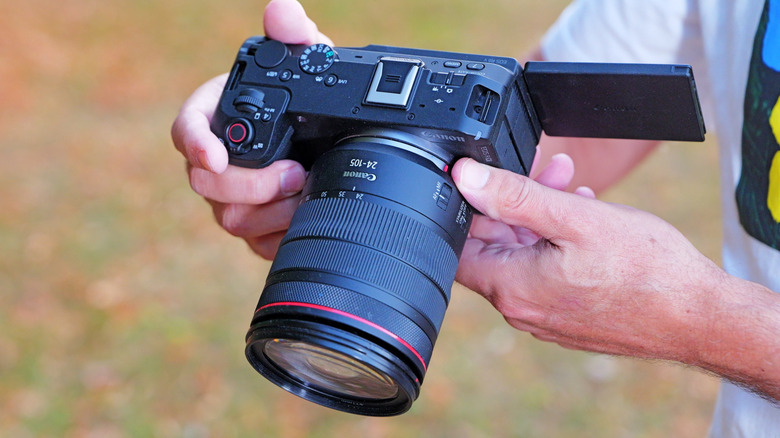
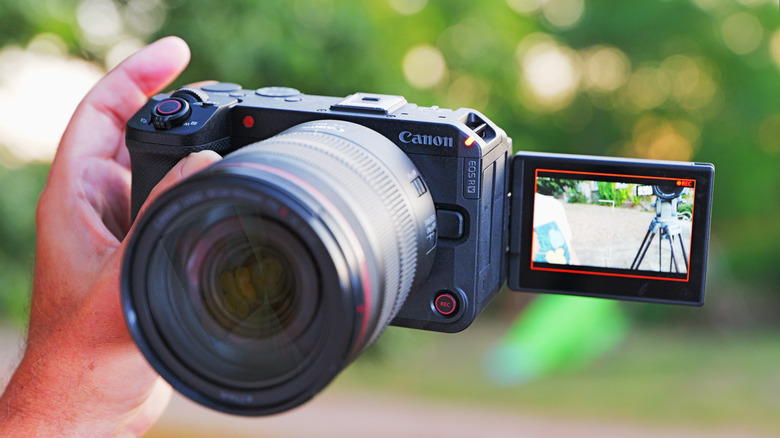
The first thing that struck me about the R6 V was a significantly chunkier body than I expected, largely due to the active cooling fan and dust- and water-resistant design. It's quite a bit thicker than the R6 III, though less slab-like than the C50. The magnesium and polycarbonate body is relatively light though at 688 grams, a touch less than the R6 III.
The R6 V has a relatively generous complement of manual controls, including two dials on top, a joystick, a control wheel at back, a dedicated photo/video switch and a mode selector. Thanks to Canon's slick new button numbering scheme, a quick glance shows that it has exactly seven programmable buttons. By comparison, Sony's ZV-E1 is downright sparse with just a single control dial on top, a control wheel at back and no joystick.
The extra controls make the R6 V a delight to use, allowing full manual operation with little need to dive into menus. The video and photo settings are firewalled from each other, so switching modes doesn't mess with your favorite settings. Canon's menu system is still old-school and a bit clunky compared to Sony's more modern menus, though, which makes finding some settings a chore if you're not used to Canon cameras.
The R6 V has a rear three-inch display that flips out for multi-angle shooting and vlogging. The display's resolution is good at 1.62 million dots, but the screen is slightly lacking in brightness. As mentioned, though, it has no EVF, which makes shooting in sunlight difficult at times.
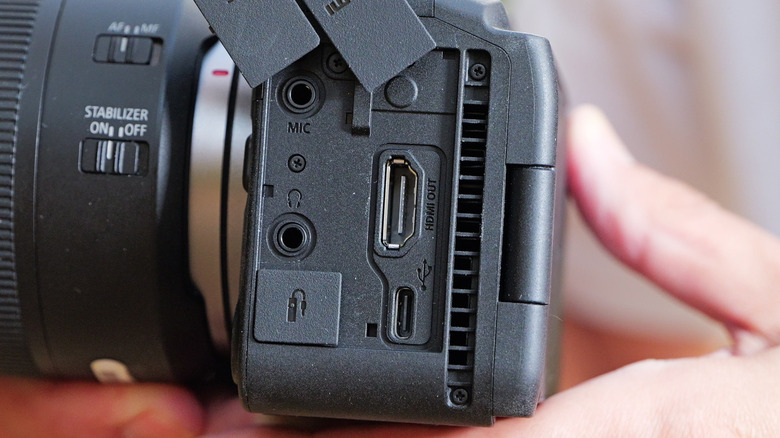
To handle 7K RAW and C-RAW up to 2,600 Mbps, the camera comes with a single CFexpress Type B slot, along with an SDXC UHS II card slot for proxies and other less demanding formats. There are also microphone, headphone and full-sized HDMI ports, along with a USB Type C 3.2 Gen 2 connector for charging and file transfers. The R6 V is missing the timecode port found on the C50 and other pro cameras, however.
Video
The R6 V offers no-compromise video options, matching many pro cinema models feature for feature. You can shoot up to 7K 12-bit RAW video either in 3:2 open gate mode (6,960 x 4,640 at 30 fps) or 17:9 (6,960 x 3,672 at up to 60 fps) using RAW or RAW light codecs. 4K DCI RAW is also supported with a 1.5x crop, though I preferred shooting RAW at 7K to give myself cropping options and the sharpest possible video.
If RAW footage takes too much card space, you can also use Canon's much lighter XF-HEVC S or XF-AVC S 10-bit formats in open gate 3:2 at up to 6,912 x 4,608, or 4K DCI at up to 120 fps with no cropping. If you do shoot RAW but also want a lighter option for editing, you can capture RAW on the CFexpress card and HD proxies on a UHS-II card simultaneously.
With active cooling, overheating is mostly a non-issue with this camera unless you're filming when it's really hot outdoors. I tested the R6 V in demanding conditions, filming 7K light RAW at 60 fps at about 85 degrees Fahrenheit with the fan set to "high." Capture continued for 80-plus minutes with no issues until the battery died.
Video autofocus is excellent, on par with the AF in Sony's new A7 V. In normal mode, the AF can quickly and accurately switch from one subject to another, thanks to the Dual Pixel AF II system. Subject tracking automatically detects people, animals and vehicles. Like the R6 III, you can register specific people if you want to prioritize them for autofocus. Another setting is "AF for close-up demos" that will quickly focus on a product put in front of the camera, much like Sony's "Product Showcase" feature.
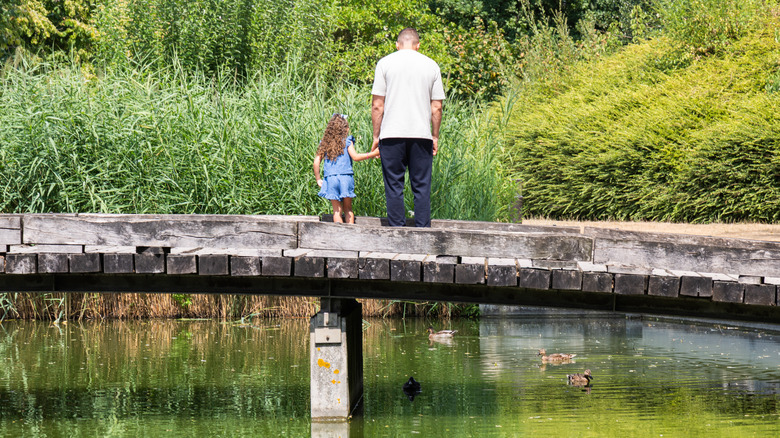
To test the subject AF, I found some ducks and other waterfowl at a park. The R6 V was swiftly able to detect and stay locked on the birds' eyes. When some ducks swam under a bridge, it instantly picked them up again when they emerged on the other side. It worked even better with people, locking tenaciously onto faces. I took closeup video portraits and it kept the eyes (not the eyelids or lashes) in sharp focus, even at a shallow f/1.4 aperture.
Stabilization is also a strong point. The 7.5 stops of shake reduction is slightly less than the R6 III's 8.5 stops, but engaging the digital IS makes it highly effective for things like panning or even walking.
There is one downside: The 33-megapixel sensor isn't stacked, so rolling shutter distortion can be an issue if you jolt the camera or pan too quickly. However, the sensor readout speeds are among the fastest for any non-stacked sensor, so I saw very few skewed and unusable shots.
Video on the EOS R6 III was extremely sharp in the 7K RAW and the 4K HQ modes, though other 4K modes weren't quite as detailed due to pixel binning. When shooting people, wildlife and landscapes, Canon's color science was on point, delivering warm skin tones and accurate colors. In one tricky sunny day scenario, shooting birds on a pond and under a bridge, the RAW video allowed me to reduce bright areas and boost shadows with no noticeable loss in sharpness or color accuracy. Low-light shooting was also top notch, with noise under control up to ISO 6,400 and (provided exposure was correct) ISO 12,800.
Photo performance and quality
If you're a hybrid shooter that favors photography over video, I'd recommend the EOS R6 III or another camera like Nikon's Z6 III over the R6 V — mainly due to R6 V's lack of an EVF and mechanical shutter. That said, the R6 V isn't bad for photography in a pinch. Like the R6 III, the R6 V can shoot RAW bursts at up to 40 fps and allows pre-continuous shooting of 20 shots (0.5 seconds) before the shutter button is fully pressed. That was particularly handy when I was shooting birds that could move or fly unexpectedly.
Autofocus for photography is also excellent. As with video, it includes automatic subject detection for people, animals and vehicles. It generally locked on to subjects quickly and reliably, even when I shot high-speed bursts of fast-moving subjects. However, Sony's A7 V AF is slightly better in photography mode, as I found it gave me fewer out-of-focus shots.
Photos are sharp but dynamic range isn't on par with the R6 III. That's because the R6 V only has an electronic shutter that captures 12-bit RAW, not 14-bit RAW like the R6 III can in mechanical shutter mode. The result, I noticed, was more noise in shadow regions. In comparison, Sony's A7 V offers 14-bit RAW photos with both the electronic and mechanical shutter, and therefore delivers superior dynamic range.
The 33MP sensor did deliver sharp photos, though, and the RAW mode allowed me to tease a lot of detail out of high-contrast shots with bright and shadowy areas. Low-light photos looked clean up to ISO 6,400, with skin tones more flattering than I saw with Sony and Nikon cameras. JPEG photos were sharp and true-to-life straight out of the camera as well, with nicely balanced sharpening and noise reduction.
Wrap-up
Some hybrid mirrorless cameras like Sony's A7 V are better at photography than video, but Canon's R6 V is squarely in the opposite camp. It's an outstanding vlogging and creator camera thanks to the stellar RAW video quality, excellent handling, in-body stabilization and reliable video autofocus. Photography isn't a strong point, though, and should only be used sparingly..
Competition is now fairly deep in this segment. Sony's aforementioned ZV-E1 is a decent full-frame creator camera, but its lack of RAW and open-gate video, along with the mediocre handling, puts it at a disadvantage to the R6 V. Panasonic's $3,200 S1 II offers RAW video, a partially-stacked sensor and creator-centric features but is significantly more expensive. Another solid option is Nikon's $2,200 ZR, which has the benefit of a partially-stacked sensor and RAW video, but the 24MP resolution limits video capture to 6K.
If I were shopping for a vlogging camera in this price range, I'd be torn between Nikon's ZR and Canon R6 V. If higher 7K resolution and more reliable autofocus top your list of needs, choose the R6 V. However, if reduced rolling shutter and RED cinema camera compatibility are more important, the Nikon ZR is your best bet.