

Google open-sources an AI model it says can help with earlier hurricane warnings
WeatherNext can deliver a 15-day forecast predicting storms’ track and intensity.
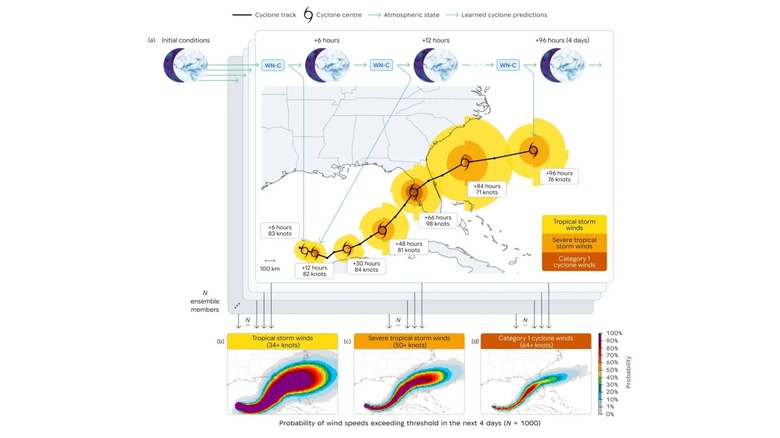
Researchers from the Google DeepMind and Google Research teams have helped train the WeatherNext AI weather prediction model to offer improved cyclone warnings. The National Hurricane Center, the Cooperative Institute for Research in the Atmosphere, the UK Met Office and other weather agencies around the world also contributed to the model's development. Both the code and the model weights behind the project are being made open source on GitHub, so other scientists can also take advantage of this work.
A study about WeatherNext was published in the journal Nature, and a more layperson version was also shared in a blog post from Google. Tropical cyclones, also known as hurricanes or typhoons depending on where you are in the world, pose a unique challenge to predict because global atmospheric currents that determine a storm's path have traditionally been best analyzed by coarser global models. In contrast, a storm's intensity is best predicted by specialized local models that can assess the thermodynamics processes at the cyclone's core. WeatherNext trained on nearly 20 terabytes of global atmospheric data and historic information collected by the International Best Track Archive for Climate Stewardship to predict both a cyclone's track and intensity with a single model.
"We can now generate a single 15-day forecast in less than a minute on a TPU, empowering forecasters to quickly evaluate the probability distribution of potentially devastating tail-risks," the WeatherNext researchers wrote.
Google introduced the second generation of WeatherNext last year. The company's research teams have also worked on using AI to help predict flash floods.