

You can use your Starlink Mini at home, but it'll cost you
How do Starlink's two service types compare?
The Starlink Mini is built to travel, but nobody is going to confiscate it if it spends six months sitting in the same backyard. Starlink says its compact dish supports fixed and portable use, which means you can absolutely use one as your main home internet connection. The only problem, at least in the US, is what happens next.
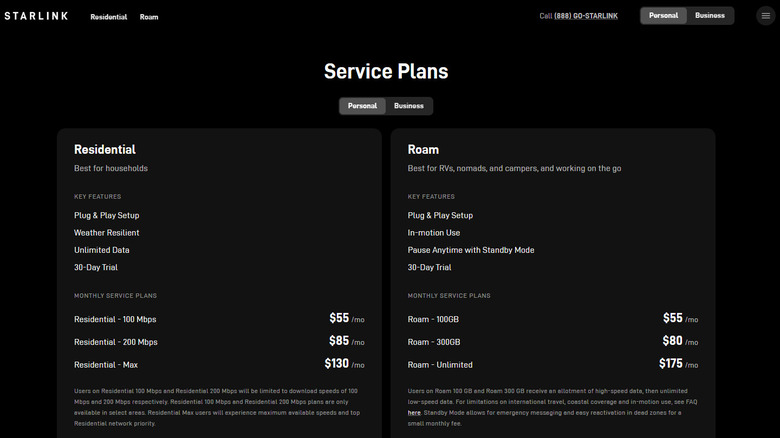
Starlink Mini is generally tied to the company's Roam plans rather than its Residential service. Roam starts at $55 per month for 100GB of high-speed data, rises to $80 for 300GB and costs $175 for unlimited service. Residential plans offer unlimited data and also start at $55 for 100 Mbps, while the 200 Mbps tier costs $85 and Residential Max is $130 per month.
So while the dish won't complain, your bill might.
The cheaper Roam plans come with a catch
For a cabin, the occasional road trip or a household that barely dents its monthly data allowance, Roam 100GB or 300GB could be perfectly workable. The equation changes once the Mini becomes the connection handling everything at home.
Use up your high-speed allowance, and Starlink drops your service to unlimited low-speed data for the rest of the billing period. That leaves a Roam 100GB customer paying the same $55 starting price as Residential 100 Mbps while getting a limited high-speed data pool. And anybody wanting to sidestep the cap entirely has to spend $175 on Roam Unlimited, $45 more than Residential Max.
Apart from all that, there is another wrinkle. Starlink gives Residential Max customers its highest Residential network priority, while it warns that Roam speeds can slow during congestion. So someone using a Mini permanently at home can wind up paying more for unlimited data while receiving service that was designed around portability rather than sitting beside the same porch every day.
That's not a particularly glamorous trade. Roam does earn its name, at least. The plans support travel and can be paused, which makes considerably more sense for a Mini being tossed into an RV than one gathering dust beside your house. Starlink opened the Mini to standalone Roam customers in the US in 2024, removing the original requirement for an existing Residential subscription.
A dedicated home setup avoids most of the compromise
For primarily home use, Starlink positions its Standard hardware toward higher-demand everyday internet such as streaming, gaming and video calls, while Mini is aimed at more basic use and portability. One big catch in the US is that Starlink sells the Mini around its Roam service rather than its Residential plans, so leaving one permanently at home still means paying Roam rates. The company has also started rolling out a smaller V5 residential dish in select US regions.
Some existing customers have a much nicer arrangement. Anyone who claimed Starlink's optional Mini kit or bought Residential Max before June 6 can keep a Mini as a no-cost hardware rental and receive 50% off Roam service while maintaining the qualifying Max subscription. Starlink does say that the offer is no longer available to new customers.
The US restriction isn't necessarily universal. Starlink says Mini hardware can use Residential service in limited regions, although the company does not identify which markets currently support the combination. The Mini's integrated Wi-Fi covers up to 1,200 square feet, compared with 3,200 square feet for Standard.