

Vine reboot Divine is now open to everyone, no invite code required
The app now has more than 2 million videos from Vine's original archive.
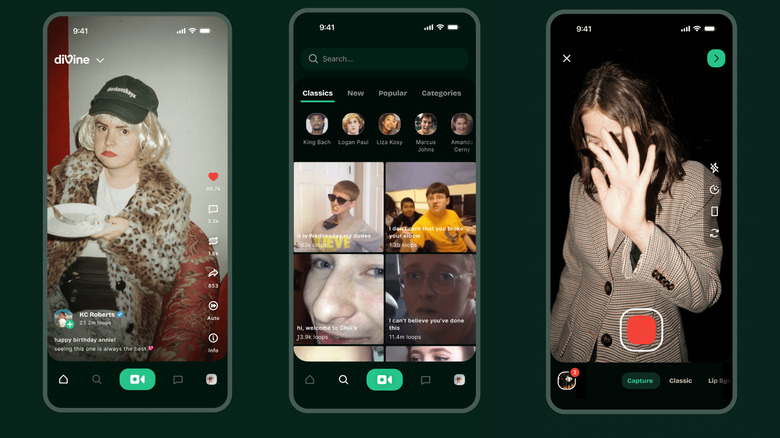
Divine, the Vine reboot led by one of Twitter's earliest employees, is finally open to anyone who wants to join. A little more than three months after launching its app in invitation-only mode, Divine is eliminating sign-up codes as it looks to draw a new wave of enthusiasts for 6-second videos.
While not officially affiliated with the much-loved app that folded nearly a decade ago, Divine will feel familiar to fans of the original. It relies on the same 6-second looping video format that once inspired so many memes. The app even has a "classic" feed of clips from Vine's original archive; the company has so far managed to restore more than 2 million original videos. There are other ties to the OG version: Divine is funded by Twitter co-founder Jack Dorsey, though the company says he has no equity or ownership in the venture.
Other elements are much more relevant to the current social media environment. Behind the scenes, Divine is decentralized and powered by the open-source nostr protocol (which Dorsey has also funded). And the app aims to offer a safe haven from AI content of any kind. Users can only share videos that were recorded with Divine's in-app camera and the app has built-in AI detection tools for added verification.
The result, according to Divine's creator Evan "Rabble" Henshaw-Plath, is an app with "lots of weird stuff" that is also completely unique. "A whole bunch of what you see on social media is people clipping content and moving it around between things," Henshaw-Plath tells Engadget. "None of the stuff you see on Divine was ever on other platforms before, it was either on Vine originally or it's now on Divine. You're not going to see the same thing that you see on TikTok and Instagram."
Much of Vine's original success was due to the creativity of its creators. But many of those same creators eventually left the app, frustrated that its leaders weren't doing enough to support them. Henshaw-Plath is already thinking about how Divine can provide creators with the kinds of monetization tools that were never available on Vine. "We don't know exactly how it's all going to work, but we do know that as creators grow, as they build an audience, they want the ability to make money," he says.
Divine's public launch comes at a time when there's increasing nostalgia for "old" social media platforms. A brief comment in a recently-released documentary about Myspace has prompted weeks of headlines and speculation about a supposed comeback of the site. (No specific plans have been announced.) Smaller apps have also tried to recreate the vibes and simplicity of early social media. That type nostalgia could benefit Divine as it opens to the public.
Henshaw-Plath suspects some of that nostalgia is driven by the "hope and excitement" once associated with social media. "With Divine, our theory is that part of the problem is that we centralize power in a few people's control," he says. "Our solution is: let's not put ourselves in charge again. Let's bring back the old content. Let's empower people to not have AI slop, and let's design it this way so that it can't be enshittified in the future."