

Panasonic Lumix L10 review: A stylish and capable compact camera
The LX100 II successor offers good speed and image quality at a fairly high price.
- Fast shooting speeds
- Excellent photo quality
- Solid video capabilities
- Nice handling
- A bit expensive
- Lens-only stabilization is mediocre
Not long ago the camera market was in a doom spiral. Then, seemingly out of nowhere, demand for compact cameras exploded. The craze kicked off on TikTok, but for users looking to improve their photos, compacts were a logical jump from smartphones.
At the forefront was Fujifilm's iconic X100 VI, along with models from Ricoh, Leica and others. However, the fixed focal lenses on those models can make it difficult to get just the right composition. Now, Panasonic has jumped in with the Lumix L10, a 20.3-megapixel compact camera with a 24-75mm equivalent zoom. That lens makes it more practical for casual users who want to shoot at events, parties or while traveling.
To see how the L10 fared at those jobs, I took one on a trip to northern Canada. The zoom lens was indeed very handy and the photos and video I shot looked great. As with other high-end compact cameras, though, I do wish that the $1,500 asking price was a bit lower.
Design and controls
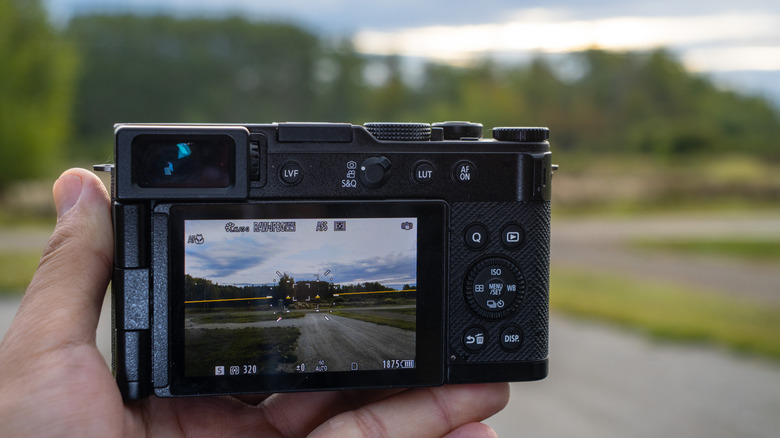
The L10 is a successor to Panasonic's LX100 II, but there are some differences. The new model is significantly heavier at 508 grams compared to 392 grams for the LX100 II, and not nearly as pocketable due to its increased bulk. The grip is small but deep enough to give shooters a decent hold.
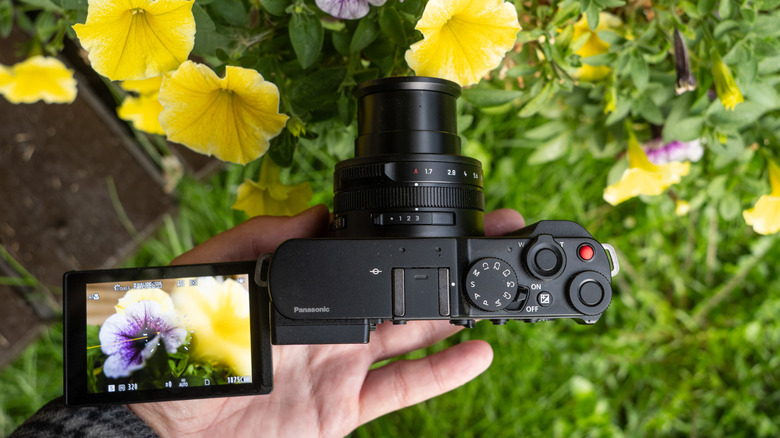
While not dripping with manual controls, the L10 has enough for its intended market. Those include two dials on the top and back to adjust key settings, a photo/video/S&Q (slow and quick) switch and a dozen programmable buttons. There's also a four-step switch to adjust the aspect ratio (more on that shortly). Shutter speed and exposure compensation dials from the LX100 are gone, but not missed.
Unlike Fujifilm's X100 VI and other models with fixed focal lengths, the Lumix L10 has a 24-75mm f/1.7-2.8 equivalent Leica zoom lens. Panasonic recycled this one from the LX100 II, because it's still fast and relatively sharp. What's more, it can focus to just 3 cm in macro mode at 24mm equivalent, or 30 cm when fully zoomed in.
The fully articulating 1.8-million-dot rear display is a big improvement over the fixed one on the LX100 II, making the L10 more useful for video and selfies. While the electronic viewfinder is not amazingly sharp at 2.34 million dots, at least the L10 has one, unlike Canon's PowerShot V1.
The L10 has a couple of unusual but welcome features for a compact. The first is a full-sized DMW-BLK22 battery that's compatible with most other Panasonic cameras, giving it excellent battery life. You'll get 420 shots, or up to 1,000 in power-saving mode, plus 100 minutes of 4K 60p shooting on a charge. The other is a separate compartment for the SD UHS II slot, which makes it easier to swap out cards.
Performance

The biggest updates to the L10 are inside with the new sensor and image processor. It's now equipped with a slightly cropped version of the 26.5-megapixel Four Thirds sensor from the GH9 II, one of my favorite Panasonic cameras. This helps it deliver higher resolution photos up to 20.3MP compared to 17MP before.
The L10 is also fast, with 9 fps burst speeds in mechanical shutter mode with continuous autofocus, or 30 fps in electronic mode. Those speeds are a significant increase from the LX100 II's 5.5 fps speeds and beat most of the camera's primary rivals, including the RX100 VII (20 fps max) and Fujifilm X100 VI (20 fps).
Speed means nothing if your photos aren't in focus, and the L10 delivers there as well. Unlike the LX100 II which used Panasonic's wobbly contrast-detect autofocus system, the L10 offers the company's phase hybrid AF with 779 points. As I've seen with recent cameras like the G9 II, this system is much faster and more reliable in continuous AF mode.
I was able to shoot wildlife and human subjects in burst mode with a good percentage of sharp shots, though it's still not quite up to the reliability of the latest Sony or Canon cameras. The L10 also supports AI subject recognition for people, animals and vehicles. The system reliably locked onto humans, along with dogs and deer, though it was occasionally confused in a complex forest scene.
If you enjoy shooting insects, flowers or other subjects up close, just flick the macro switch and you can get sharp shots within nearly an inch of your subject. I put this to good use in British Columbia, capturing nice shots of dragonflies, wildflowers and other fauna.
The L10 does have optical lens shake reduction, but unlike the X100 VI, it lacks in-body stabilization. The system is useful for shake reduction at slow shutter speeds down to about a fifth of a second, but isn't ideal for video stabilization as I'll explain soon.
Image quality

As is the case with several other compacts, including the Fujifilm GFX 100RF, the Panasonic L10 has a dedicated switch that lets you choose from four aspect ratios: 4:3, 3:2, 16:9 and 1:1. Personally, I prefer to shoot using the full sensor area and crop later, but this feature is great for photographers who want to take JPEG photos and share them quickly.
If you're one of those, another control you'll like is the "LUT" button. Along with Panasonic's preset photo styles, like L.ClassicGold (above) and Leica Monochrome, you can download or create your own photo and video styles (called LUTs) and apply them to your shots in real time. These LUTs can be downloaded from Panasonic's Lumix Lab app.
 Steve Dent for Engadget
With its updated sensor, the L10 delivers sharper photos with less noise at lower ISO levels than the LX100 II. The extra resolution also lets you crop into photos a bit more than before without loss of detail.
JPEG colors straight out of the camera look great and require little retouching. The dual-gain sensor also delivers surprisingly good low-light performance for a Micro Four Thirds Camera. Very little noise is visible up to ISO 2,500, and it's well managed beyond that up to about ISO 12,800. That said, it's always better to have more light with a small-sensor camera, as noise levels can quickly get out of control, particularly with underexposed shots.
 Steve Dent for Engadget
RAW files are relatively easy to edit and give you room to dial down highlights or bring up detail in shadows. Again, the small sensor puts the L10 at a disadvantage to full-frame cameras in that regard, as more noise will appear at higher ISOs.
At the same time, the L10 has an automatic dynamic range boost function that the LX100 II lacked. It uses both the high- and low-gain circuits, and combines them into one photo, HDR style. That helps boost dynamic range in bright sunlight and other tricky situations.
Video
Panasonic markets this camera as being primarily for photos, but the L10 is nice for video as well. You can capture 5.6K video at up to 60 fps, in both 10-bit and V-Log formats to maximize dynamic range, or 4K at 120 fps max. It supports I-frame capture for easier editing or long-GOP to save space.
The small body size and lack of a fan limits capture times, so you wouldn't want to shoot video at weddings or other extended events with the L10. However, you can still capture 4K 60 fps video for 10 minutes before it will overheat, or 20 minutes of 4K at 30 fps.
The phase-detect AF works very well for video, with none of the hunting found on the LX100 II. It offers a decently low 500 ISO floor for dynamic range-boosted V-log recording, compared to ISO 2,000 for the GH6. That makes the L10 more practical to shoot in sunlight, where the benefits of log and dual-gain are greatest.
As mentioned, video stabilization isn't a strong point. The optical mode works well enough for simple hand-held shooting, but you'll see some jerky corrections if you try to move the camera too quickly. The e-stabilization mode adds some further smoothing (with a slight crop), but isn't nearly powerful enough to smooth video while walking.
Wrap-up
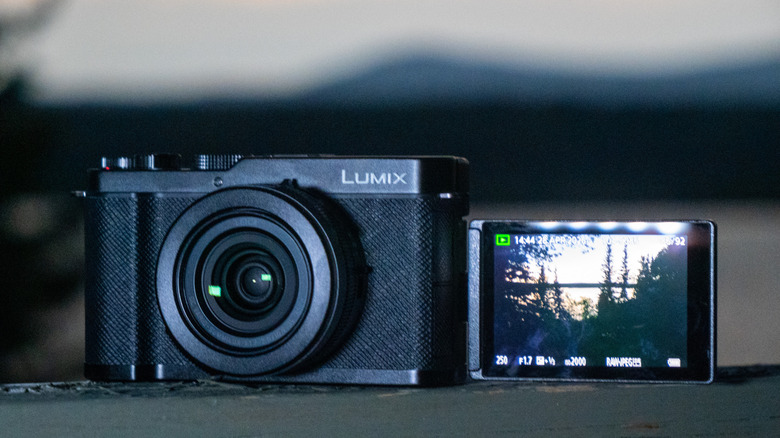
I was expecting Panasonic's Lumix L10 to be a stylish camera to take on the road for snaps and the odd video, and it does do those things well. However image quality is shockingly good even in low light, overall performance is strong and its video capabilities are well above what I expected.
Considering that the LX100 II cost $1,000 at launch, the $1,500 asking price for Panasonic's L10 seemed a bit high to me at first. However, its main rivals are priced about the same, including Sony's RX100 VII (also $1,500) and the $1,800 Fujifilm X100 VI. The X100 VI has a more robust build and a bigger sensor, but the L10 offers faster shooting speeds and better video capability. Sony's RX100 VII offers a longer 24-200mm f/2.8-4.5 lens, but relatively tiny 1-inch sensor.
If you really need the extra reach, the RX100 VII delivers that, but I hate Sony's design and I'm not a fan of the small sensor. The L10 handles better than both its rivals thanks to the manual controls and flip-out rear display. It also feels more responsive to me than both of them. Personally, of the three cameras, I'd get the L10 — it's more capable than its rivals and pretty stylish in its own way, whether you get it in the black, silver or platinum colors.