

SpaceX's recovered Starship 40 will take months to get back to Texas
The rocket spent 24 days at sea before recovery efforts began.
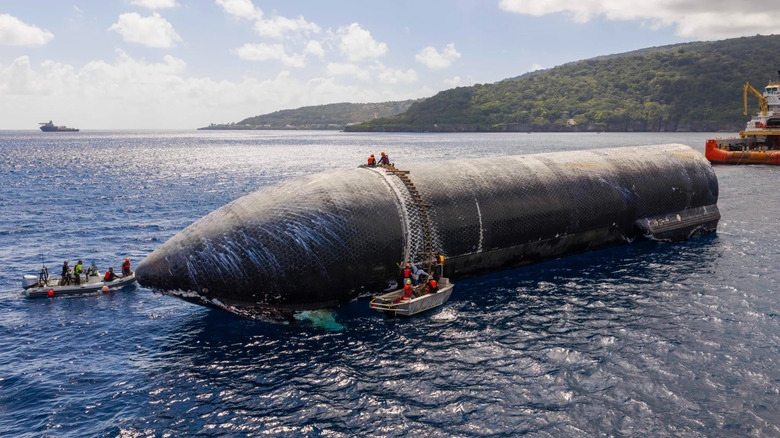
SpaceX's Starship 40 is one fast rocket, having traveled thousands of miles from Texas to the Indian Ocean in around 65 minutes. Its journey home is, well, slightly slower: The company says it will take several months.
Starship 40 launched from SpaceX's Starbase in South Texas on July 24. The spacecraft deployed 20 Starlink V3 satellites during its roughly 65-minute flight. However, this was a suborbital mission, and after briefly linking up with SpaceX's network, the satellites reentered and burned up about 20 minutes after deployment. That was the intended result as it wasn't an operational satellite launch. Instead, it was designed to test Starship's payload deployment system (among other things) as SpaceX inches toward a fully reusable launch system.
What came as a surprise was that, unlike previous Starship upper stages, Starship 40 survived its splashdown intact. Although it's likely in no shape to be reused, the salvaged spacecraft gives engineers something to study in detail rather than deduce from telemetry or scraps of debris.
Lifting Starship out of the water
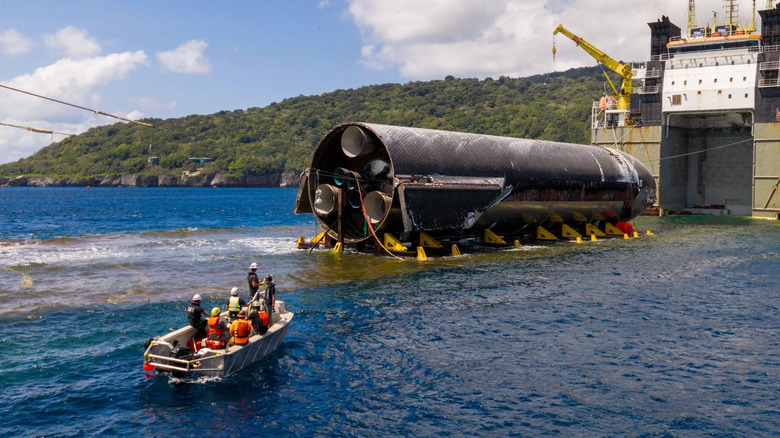
Getting the 171-foot spacecraft from the Indian Ocean to Texas is a massive undertaking. Step one was moving it into calmer waters. After about 24 days at sea, SpaceX's recovery team guided Starship 40 toward the coast of Christmas Island, an Australian territory that lies south of Indonesia. The almost 300-foot Normand Ranger, which tugged the spacecraft from its splashdown site, held Starship 40 near the island until a 710-foot-long transport ship named Forte arrived to take over.
Crews tethered the upper stage alongside Forte as the transport ship filled its ballast tanks, lowering its cargo deck beneath the surface. From there, it was a matter of lining up the spacecraft with a custom-built cradle on the submerged deck. Forte then pumped the ballast water back out, slowly rose beneath the spacecraft and lifted it into place.
Although performing such a feat with a rocket may be a first, shipping expert and history professor Sal Mercogliano noted that ships like Forte are no strangers to such tasks with other cargo. "Ships like Forte do this every day," he said on his What's Going On With Shipping? YouTube channel. "This is a very common occurrence in the shipping industry, whether it's large objects like this, barges, cranes, ships — you name it."
The journey back to Texas
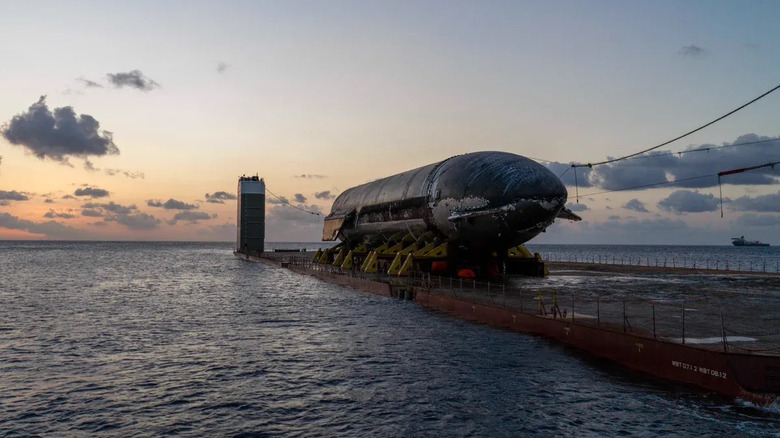
Next comes the really slow part. SpaceX hasn't shared the exact route Forte will take to get the spacecraft back to Texas, but it has described the trip as a "several month journey." Current ship tracking suggests that may be a conservative estimate, with Forte reportedly broadcasting an October 8 arrival to the Port of Brownsville, Texas. Mercogliano says the ship's westward course points toward the Cape of Good Hope as a plausible route.
Engineers have already collected heat-shield samples, gaining "vital insight" "vital insight" into how the upper stage handled reentry. The data should help the company improve future Starship designs and missions. SpaceX's goal is to eventually make Starship missions return to its Starbase Texas HQ for a tower catch rather than taking another rather considerable detour via the Indian Ocean.