

Apple's new research app is designed to make AI health tools more user-friendly
It will allow users to ask health questions and rate the responses.
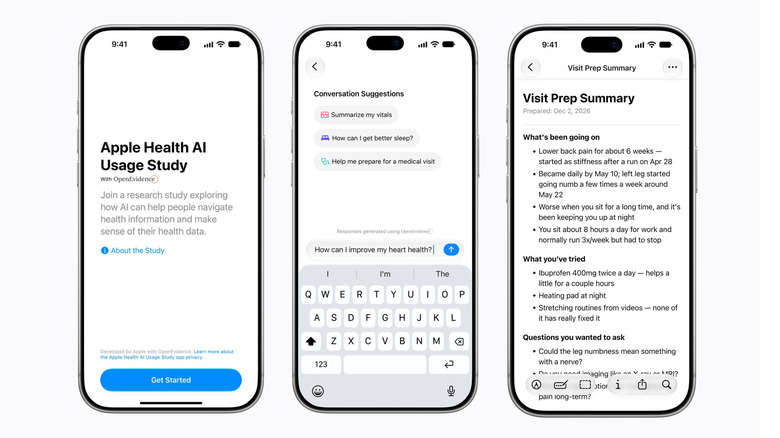
Apple has unveiled a new research study with the aim of learning how people use AI health tools in order to make them more effective and user-friendly. The company is launching the Health AI Usage Study in conjunction with OpenEvidence, a clinical AI platform used by health professionals that draws medical data from sources like The New England Journal of Medicine.
A key part of the research is a new app now available for download, with Apple aiming to have up to 200,000 participants. Users must live in the US and be 21 or older, and have an iPhone 15 Pro or later model running iOS 26 and up. They can choose to share (or not) Apple HealthKit data, including activity levels, sleep quality and lab results, for extra context around their health.
Participants will use the app to ask medical questions via text-based prompts like "how can I improve my heart health," according to the app's screen shots. They'll then receive non-jargony responses with links to peer-reviewed clinical sources. Apple's goal is to use the data to create AI health tools that deliver relevant, easy-to-understand and actionable health information.
Apple notes that the app is not integrated with Siri or Apple Intelligence, and said that participant data will remain confidential and won't be used to train AI models.
"[We] believe responsible innovation starts with scientific rigor and clinical grounding," said Apple VP of Health and fitness Sumbul Desai, MD, in a statement. "Insights from this study will help advance the broader scientific conversation and ensure that as technology evolves, we continue building trusted tools that genuinely support people wherever they are on their health journey."