

Xreal's One Pro intrigues me in ways Meta's smart glasses don't
Smart glasses with a purpose, what a concept!
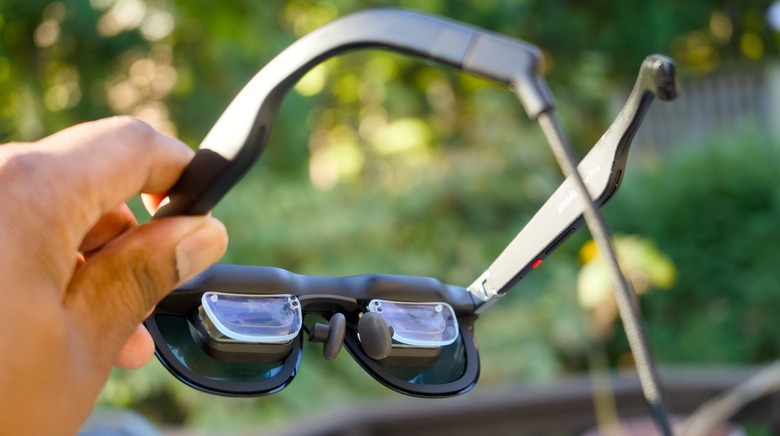
We may receive a commission on purchases made from links.
There I was, sitting on the couch in a nondescript suburban cafe, typing away on a MacBook Pro while staring off into the distance with what looked to be oversized glasses (which also were conspicuously plugged into the computer). To most people, I probably looked a bit silly. Nobody actually commented on my setup, or maybe I was just too focused to notice. From my perspective, I was looking at a massive 222-inch virtual display through Xreal's One Pro smart glasses, which was mirroring my laptop screen.
Like a visual version of noise canceling, the glasses blotted out the chaos of the cafe so that I could actually concentrate on writing this review. I could also darken the frames a bit to serve as pseudo-sunglasses, further removing distractions. This work session in particular made the idea of smart glasses seem more compelling than anything in Meta's failure-prone demo for the Ray-Ban Display. And while it's not nearly as immersive as the $3,500 Apple Vision Pro, it offers similar functionality for far less.
With the One Pro, Xreal is close to making the dream of versatile smart glasses a reality. It's not trying to be something you wear all day, an aspiration Meta is desperately chasing — instead, it's meant for specific purposes. Plug the One Pro into your laptop and you can use it as a virtual monitor nobody else can see. Connect it to your phone or tablet and you've got your very own personal theater wherever you go. You can even hook it up to some portable game consoles (but not the Switch 2, unfortunately) to play on the move.
To be clear, that lines up with the different use case for each product: The Xreal One Pro is more of a monitor you wear on your face while stationary, whereas the Ran-Ban Display glasses aim to overlay your real-time point of view with basic phone notifications and services. Those frames are also meant to be more independent, allowing you to listen to music, take calls and capture photos and videos at a whim. But after seeing Mark Zuckerberg and his team try (and mostly fail) to demonstrate the Ray-Ban Display at its Connect developer conference, I also think the camera-less Xreal One Pro avoids ethical dilemmas inherent in most smart glasses.
Should we normalize wearable devices that can covertly record us at all times? And on a practical level, do we really want to walk around with virtual notifications in our faces all day? Personally, I think we're better off with specialized tools that leave us in control, and don't upend our entire social structure.
The One Pro, and all of Xreal's frames, still let you see the real world outside of its AR screens, and they don't block out ambient light. But there are also several shades you can use to darken the glasses themselves, which make the virtual display appear brighter and more distinct. At the darkest level, the One Pro can appear almost entirely black, something that's great for movies. There's also a helpful auto transparency mode that undims the displays when you look away from your virtual screen.
Since the Xreal One Pro is fashioned after sunglasses, they can't sit atop normal eyewear like the Quest 3 and other VR headsets. If you have a glasses prescription, you'll need to buy inserts from HonsVR, which start at $50. They're a bit annoying to install, but otherwise they did a fine job of letting me see the One Pro's displays clearly. They do make sharing the glasses annoying, though, since the inserts will need to be removed every time you do so. I'd also be worried about something getting bent or broken with constant removals.
I mostly used the Xreal One Pro as a virtual display while working on laptops, but I also found them incredibly helpful for watching movies and videos when away from home. On the many occasions where I was stuck waiting for my family in the hellscape of a suburban parking lot, all I had to do was put on the Xreal One Pro, plug it into my phone and I could be watching anything on a massive virtual screen.
It was even more helpful while traveling. I could never muster the bravery to wear an Apple Vision Pro on a flight, or justify stuffing it into a bookbag. But that wasn't a problem at all with the Xreal One Pro, as its bulbous traveling case can fit almost anywhere. Having a portable virtual display you can deploy instantly honestly feels like a superpower.
In a pinch, the Xreal One Pro were helpful gaming accessories too. At home, I'd rather be staring at my 4K Alienware computer monitor, or the Steam Deck OLED's native screen. But for slower-paced titles, it was nice to game on a large virtual screen just by plugging the glasses into my Steam Deck.
Getting the device connected to the original Nintendo Switch takes some work though, as it only works when connected to a dock and using an accessory like the Xreal Hub. Unfortunately, the Switch 2 doesn't work with the One Pro at all right now (unless you start daisy chaining USB-C and HDMI adapters). Xreal says its upcoming Neo accessory will offer video pass-through for the Switch 2, but there's no word on when that will arrive.
The more I used the Xreal One Pro, the more impressed I was by its sheer versatility. Its only major downsides are its $650 price (up from $600 originally), as well as the fact that you'll never look cool wearing it. And no, you won't be walking around while wearing the One Pro, like you could with Meta's Ray-Ban Display. But hey, that also means you won't have to worry about people calling you a pervert for wearing spy glasses.