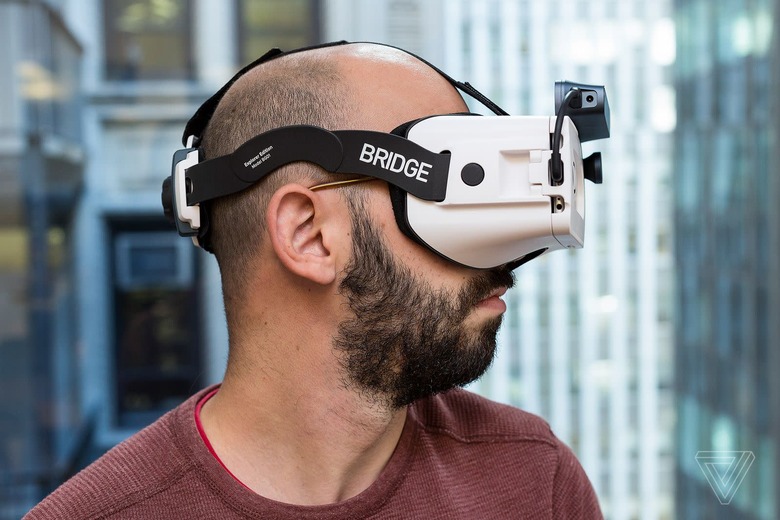
Small and Sleek, Personal 3D Scanning Is Getting Better with Bridge
Imagine a virtual world that is based on your favorite, private getaway location. Picture your child's playroom rendered in detail and used as the basis of a mobile game personalized just for him. The possibilities for augmented reality can take on a whole new meaning when the reality is yours. What might people create if they could generate 3D scans with their standard mobile device? The developers at Occipital, the company that created Red Laser and the 360Panorama application, want to know. Occipital has unveiled the Structure Sensor, a small, sleek and shiny 3D scanner that can attach to a standard mobile device such as an iPad. Their goal is to create an entirely new ecosystem of mobile applications that are based on accessible, easily generated 3D scans. Occipital is well on the way with a highly successful Kickstarter campaign that raised over $1 million in just four weeks. Structure Sensor 3D: Sleek, Small and Snappy Although 3D scanners have existed in the marketplace for a while, they are mostly desk bound; the few portable scanners are both costly and clunky. The Structure 3D is different. Small and handy, this mobile scanner can be carried around as easily as your smartphone. With a light-weight, aluminum case and a minimalist design, this scanner is also a beautiful piece of hardware. The scanner comes with four demo applications: You can create an accurate 3D rendering of your entire room simply by pointing the scanner as you walk around the room. Object detection lets you find and scan individual items. You can generate output for both CAD software and 3D printers, and you can also send your 3D object scan directly to Shapeways for printing. Bouncing balls demonstrate the physics of motion while you watch and see how moving objects interact with your scanned area. If you are in a playful mood, you can enjoy virtual pets that populate your rendered rooms. 3D Applications: A Legion of Cutting-Edge Developers These demo applications show the capability of the mobile scanner, but what Occipital really wants is an entire suite of 3D mobile applications geared for the general public. Just as Instagram and Snapchat are used across the globe by people of all ages to capture their memories in pictures, Occipital wants to create similarly popular mobile 3D scanning applications. Clearly, this suite of applications will require an large, excited group of mobile developers, and Occipital is gathering just that with its 45 day Kickstarter campaign aimed squarely at the development community. For around $300, a developer can get the Structure Sensor, SDK and demo source code, and, more importantly, be on the cutting edge of new technology. The Kickstarter campaign raised over $1 million in the first four weeks alone, amply demonstrating that the development community is sold on easily accessible, mobile 3D scanning. The scanner runs on iOS devices via the new Apple Lightning connector. However, Occipital knows that it needs to reach all of the popular mobile platforms, so the company has deliberately designed the scanner in an open fashion. It offers a Hacker Kit for developers who work on the other mobile platforms. The kit includes Occipital's USB Hacker Cable to allow developers to connect via a standard USB port, open CAD models for creating custom brackets to fit alternate devices and open source drivers for Android, Linux, Windows and OS X environments. Given Occipital's road map, it looks like the general public does not have long to wait. Occipital has launched a new project available for pre-order the Bridge. Unlike their last project the pre-ordering of Occiptal's latest contraption is not on the popular crowdfunding platforms but available on their site.
Read More