Our Search for the "Missing Link"
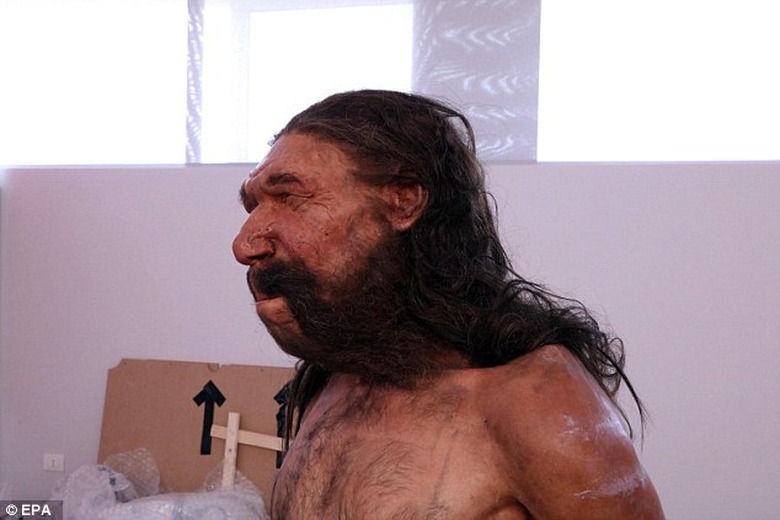
Experience your ancestry in an entirely new way; you may have genetic markers for Neanderthal Paleontologist Giorgio Manzi and David Caramelli, professor of anthropology at the University of Florence, used photogrammetry and laser scanning to create "The Altamura Man." The Neanderthal bones were found fused to cave walls in southern Italy. The reconstruction was then completed by Dutch brothers and paleo-artists Alfons and Adrie Kennis. The "missing link" or the search for how we evolved into homo sapiens continues to consume scientific thought and discourse. After decades of science that insisted modern humans and Neanderthals never met, recent studies have discovered that our human forebears interbred with Neanderthals and Denisovans – lineages that went extinct tens of thousands of years ago. What casts even more ambiguity on the proceedings is the fact that Africans don't carry DNA from Neanderthals while Europeans and Asians do. As more and more of our fossil record comes to light and scientists continue to sequence genomes, each new discovery adds to the complexity. A Neanderthal genome extracted from a toe bone found in a Siberian cave in 2013, confirms that modern humans did indeed interbreed with our cave dwelling ancestors. The toe fossil eventually provided a complete Neanderthal Genome. Also in 2013, excavations of caves in northern Spain revealed hominin fossils that date from the early Pleistocene to the Holocene - over 300,000 years ago. This destroys previously held scientific belief that hominins were not in the fossil record until 100,000 years ago. We were, indeed, here and much earlier than first thought. Scientists confirm that the fossils display distinct Neanderthal-derived traits and this in turn, suggests a much more complicated evolutionary path than we imagined. Data also reveals that there are likely other extinct hominin species we have yet to discover. Advances in technology over the past 20 years have made retrieving ancient DNA, and its interpretation, more precise. However, along with that precision, more questions arise. One major discovery indicates that our inheritance of certain Neanderthal traits puts us at higher risk for specific genetic diseases such as autism, but it doesn't stop there. Our genetic legacy has had significant ramifications according to a evolutionary geneticist John Capra of Vanderbilt University: "We discovered associations between Neanderthal DNA and a wide range of traits, including immunological, dermatological, neurological, psychiatric and reproductive diseases." While scientists debate such findings, Single Molecule, Real-Time (SMRT®) Technology continues to advance. Pacific Biosciences of California introduced the Sequel™ System in 2015 and offered labs a more scalable and affordable platform. Compared to their previous genome sequencing system, PacBio RS II, Sequel™ is less than one-third the weight and size with an improved workflow and the opportunity to "observe and record DNA sequencing in real time." Not only can Sequel™ assist with in vitro diagnostics, evolutionary geneticists will be able to more precisely annotate and decipher genomic structures to identify how our ancient ancestors developed. There also exists the potential to more quickly identify and isolate aberrant genes. Genome scientist, Evan Eichler, and his team discovered that chromosome 16, designated 16p11.2, is specifically involved in autism and the gene first appeared in our ancestral genome about 280,000 years ago, just prior to the emergence of Homo sapiens. Eichler hopes that genetic causes of autism in children will become easier to diagnose and treat with therapies "tailored to specific children." With technology plunging forward at unprecedented rates, there is no doubt that technology, genetics and medicine will continue to dovetail. New treatments will be forged and diseases that we thought impossible to treat may find a cure. But the question remains: will we find our missing ancestral link? Gene splicing in labs and paleoanthropologists working in the field may one day reveal something concrete. Until then, a direct link from our ancient past to our human present remains a mystery.
Read More