The Death of the Smart Home
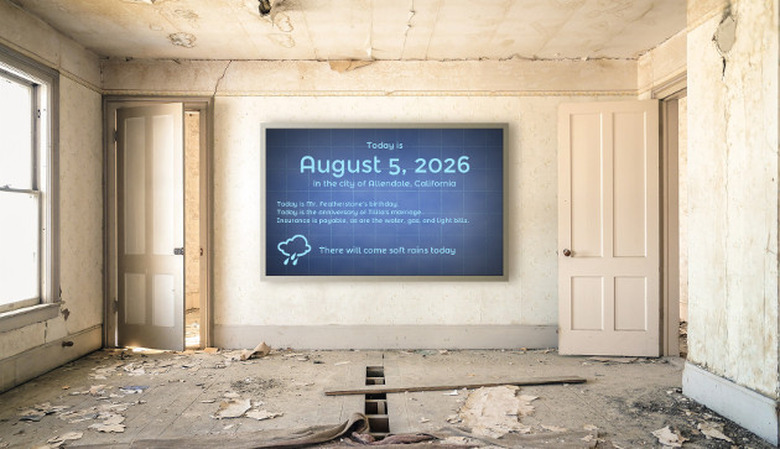
"Eight-one, tick-tock, eight-one o'clock, off to school, off to work, run, run, eight-one!" But no doors slammed, no carpets took the soft tread of rubber heels. It was raining outside. The weather box on the front door sang quietly: "Rain, rain, go away; rubbers, raincoats for today..." And the rain tapped on the empty house, echoing. Outside, the garage chimed and lifted its door to reveal the waiting car. After a long wait the door swung down again. In his 1950 short story There Will Come Soft Rains, Ray Bradbury imagined the mechanized home of the not-so-distant future. In many ways, his vision was an extrapolation of the exploding array of labor saving devices becoming widely available in post-war America, and certain elements—like the swarm of vacuuming mice that today's consumers would probably refer to as "micro-Roomba's"—are downright prescient. Like many of Bradbury's short stories however, the fantastical house is a canvas on which to paint a much grimmer theme: the occupants are absent, having been instantaneously vaporized by a blast from the recent nuclear war. But in watching the "smart" home soldier on without masters to serve, we may see in that conceit one of the most accurate foretellings of the near-future home. (Spoiler: the house doesn't fare well.) I first "read" There Will Come Soft Rains at the age of about ten from a cassette tape audiobook of The Martian Chronicles my mother checked out from the library. Having been raised on this and other science fiction, decades later I find myself living in a house with about as near a whole-home automation setup as can be economically obtained. I can say to the watch on my wrist, "Turn on the stereo in the living room," and music begins to play. "I'm leaving" and that and most lights shut themselves off. I am very nearly living in Bradbury's future. And after living in this future for a few months, the behavior of the vacant Allendale, California house keeps coming back as a fitting fable for the biggest failings of today's "smart" home. It may surprise you that someone that invested in the concept would be writing like this. Don't get me wrong, I'm very excited about what's happening with home automation, and have been since I started messing with used X10 wall-plugs bought on eBay fifteen years ago. But in getting close to the goals that home automation enthusiasts have been working toward for so long, I've come to see that the concept is going to have huge problems with unmeetable pre-existing expectations. The Smart Home is Dead The dinner dishes manipulated like magic tricks, and in the study a click. In the metal stand opposite the hearth where a fire now blazed up warmly, a cigar popped out, half an inch of soft gray ash on it, smoking, waiting. The fire burned on the stone hearth and the cigar fell away into a mound of quiet ash on its tray. The empty chairs faced each other between the silent walls, and the music played. When "Smartphone" became a label for a class of things, the term brought no baggage with it. Futurists and science fiction writers haven't generally envisioned telephones with intelligence. If something like an iPhone appeared in science fiction it would probably be called a "comm pad" or "datatab" and probably wouldn't do much without direct instruction from its user. The future home is a completely different story, literally. From Asimov to The Jetsons, the homes of fictional future characters have played a perfect supporting role to most narratives, filling in the gaps of the prophetic vision. That in itself isn't fatal—the "smart watch" has a similar handicap, authors having targeted wrist-worn devices for technological magic powers for about as long. The true problem is the model for the fully automatic home: like the electric appliances and other modern conveniences of the 1950s, the evolution of the home itself has been presumed to one day replicate the domestic servant. If the flying cars of sci-fi replace the pokey Model T, the futurists' home supplants the butler, cook, maid, valet, groundskeeper, and more. The unspoken assumption is that technology will grant to all the household staff of the 19th century gentry—the whole Downton Abbey downstairs, without the drama. Unfortunately, when we realize that the sales pitch is based on replicating human intelligence, it becomes easy to see that the goal is much farther off than the current narrative and marketing hype acknowledges. Bradbury's empty house, besides its eeriness, shows us a few things about where these technological marvels fall short of the mark. Awareness Until this day, how well the house had kept its peace. How carefully it had inquired, "Who goes there? What's the password?" and, getting no answer from the only foxes and whining cats, it had shut up its windows and drawn shades in an old-maidenly preoccupation with self-protection which bordered on a mechanical paranoia. All the concerns over computers with self-awareness seem that much farther away when we realize what a long road lies before systems with meaningful external awareness. Really, in Bradbury's story, that the house wouldn't be at all aware of its lack of occupants is more a deliberate oversight so that the storytelling device works—nevertheless the fundamental problem is far from solved today. My house knows when the front door or the garage door is opened. It knows if someone is moving outside the front door. It can know reasonably well whether I'm within 100 feet of the property. It knows if I turn on a light in the bedroom or adjust the thermostat. But when you consider the amount of "sensors" and information that are needed to really be usefully aware of a home-sized area, the answer is at least one or two orders of magnitude greater than what marketable devices can currently provide. Someone is moving at the front door, but are they going or coming? How many people? Is there a recognized occupant? Are their hands full? My home's awareness of my location—within or without—is largely a product of the location of my phone or watch. What about my wife, whose phone might stay in her purse? What about my younger kids, who don't have anything in their pockets or on their wrists? Does the playroom heat get turned off if the room is "vacant"? But this is what we expect of our invisible domestic staff. The ears of a maid or governess can likely tell what room the children are in while standing in any part of the house. Your Raspberry Pi won't be able to answer that question reliably for quite some time. With the proliferation of personal sensors and the rise of the "quantified self," we may become irrationally exuberant about the amount of data we think we have, but in truth it's still nowhere near enough. It's worth noting that many of these questions become far easier to answer for the bachelor in a one-bedroom apartment. Cut down the number of occupants, rooms, and egress points, and you can make far many more assumptions based on less data. But making things work for that simpler scenario doesn't demonstrate wider feasibility, quite the contrary. All the challenges exponentially increase when you add people, places, and "smart" things. Reliability and Independence But too late. Somewhere, sighing, a pump shrugged to a stop. The quenching rain ceased. The reserve water supply which filled the baths and washed the dishes for many quiet days was gone. A butler doesn't stop working because the power flickers, and repeatedly falling asleep on the job is grounds for dismissal. But my "connected" doorbell doesn't ring if my internet connection is down or my WiFi router freezes up. Bradbury's house gets into trouble when the municipal water supply fails, but the house has kept running (at least in the context of The Martian Chronicles) for twenty years unattended before that becomes a problem. So, we acknowledge that a lot will be lost if the power to our house fails. But the rest of the tech underlying the connected home is still far, far from utility-grade, especially when you tally all the system components—WiFi routers, DNS, DHCP, firewalls, manufacturer software and firmware, cloud services, etc.—that are in the critical path. You may think your residential internet connection and home network is reliable, but most of us don't truly rely on it—yet. if your home internet goes out while you're on vacation, it hasn't mattered. But now it will. Just looking at the easiest of these to "fix", either our Internet services will have to dramatically change ("The doorbell's broke? Call the ISP!") or the "brain" of the home will have to stay there on-premise. The modern love affair with cloud-connected gadgets aside, let's be frank: no one in their right mind is designing a driverless car or (somewhat ironically) pilotless airplane with "cloud-based" intelligence—that would be madness. Even if you could argue that the life-safety issue isn't there (and you could argue that it is), just looking at it from a marketability standpoint the user frustration factor rises fast if they have to stumble around in the dark one morning because their co-dependent light bulbs lost their IP addresses. The Allendale house's brain was in the attic, and "in the walls, relays clicked, memory tapes glided under electric eyes." In an odd twist of attitudes over time, if a science fiction writer of fifty years ago were writing about a home whose sensors funneled all their observations to a remote central brain, which processed the data and sent instructions back to the house on how it should react, they'd certainly be writing about a dystopian world akin to Madeleine L'Engle's planet Camazotz, not a marvelous fantasy home. In such a totalitarian arrangement, the stability of the control connection would be of paramount importance and assurance. We (unfortunately?) don't enjoy that level of service. Intelligence Nine-five. A voice spoke from the study ceiling: "Mrs. McClellan, which poem would you like this evening?" The house was silent. The voice said at last, "Since you express no preference, I shall select a poem at random." Quiet music rose to back the voice. "Sara Teasdale. As I recall, your favorite..." This is an area where surprising progress toward the fantasy seems to have been made, albeit with many caveats. We probably would reasonably expect a Google-powered voice in the study to be able to select our favorite poem—with all the implications that brings. But if the model neural networks and algorithms that make this possible are a glimmer on the horizon, our expectations for our intelligent homes exceeds glaring, equatorial noonday sun. If we imagine ourselves in our near-future homes, we predict that when we leave for work the house turns down the heat or cooling, shuts off the lights, arms the alarm system, and watches for our return to reverse the process. It organically combines sensor knowledge (e.g. location), time of day, day of week, to figure out what we're up to. Just considering the other data points really required to begin this computation exposes the futility of it: calendar appointments, holiday schedules, road conditions, mass transit updates, vehicle health—what if some days you drive and some days take the train? And the algorithm has to weigh all its knowledge and come up with the correct conclusion. All signs point to you being gone, but your phone is still here...did you stay home sick, or forget your phone? Your phone has left the network and it's 8am...did you leave or did you forget to charge last night and your battery just died? Trust me, it will arm your alarm with you inside the house at least one day. That will be a bad day. The dark comedy of Bradbury's house comes from the rigid scheduling that makes the machinery work—but we know too well that running everything based on a strict timeline is a ridiculous and futile way to work. It takes far less than thermonuclear catastrophe to throw off our morning routine. The same happens when trying to naïvely add rule-based logic to the mix: the exceptions, the outliers, destroy the magic of the intelligent home very quickly. But we think—without having the experience—that this can all be done. Authors and marketers have been telling us so our whole lives. But there aren't enough lines of code in the world to do what we really want: to give us our country manor staff. It's really the same problem as getting to your humanoid robot butler; assuming you could conscript an Asimo, Nao, or Pepper and dress it in tails, the illusion gets quickly shattered because it couldn't come close to doing the job. Perhaps soon it could respond to the doorbell and greet visitors, but it will be a long time before it can adjust the dinner hour based on the anticipated guests' known proclivity for being fashionably late, anticipate their departure with accuracy, proactively gather their coats and hail an Uber, and all the while watch to make sure they keep their sticky fingers off your fine silver. In other words, we acknowledge that it will be a long time before Edwin Jarvis becomes J.A.R.V.I.S.—we're not even nearing the uncanny valley there. But we will unconsciously expect similar intelligence from our intelligent home because it doesn't have feet or fingers, even though making something that walks and bows deferentially is the easy half of that formula. The depressing truth is, we don't just want an artificially intelligent home, we want our "smart home" to be able to read our minds. That sounds ridiculous until you realize that this is exactly how Bertie Wooster would describe Jeeves, or how a 19th century baron might describe his fourth-generation housekeeper of thirty years. Back in reality, instead we'll be cursing the world when our house locks us out one morning as we take the rubbish bins to the curb in our pajamas. Surely, it should have known we were COMING RIGHT BACK! Managing Expectations Dawn showed faintly in the east. Among the ruins, one wall stood alone. Within the wall, a last voice said, over and over again and again, even as the sun rose to shine upon the heaped rubble and steam: "Today is August 5, 2026, today is August 5, 2026, today is..." You may say, "But I don't want a robot butler! I just want to turn lights on and off with my phone." Then good for you: your future is here. But be prepared to be disappointed when things you may take for granted can't be done. I was thrilled when I got my garage door opener communicating with my iPhone. I jumped straight to the conclusion most people would when obtaining such a piece of kit: "I want the garage door to open as soon as I drive up to the house!" I could totally do that. But, of course, I didn't want that. I really didn't want that. What that really means is, "when my phone comes within 100 feet of the house, the garage door will open." But what if I'm driving the other car that doesn't go in the garage? What if I just turned around because I forgot my wallet? What if I'm coming back from a walk? "Don't do what I said, do what I meant!" As a developer, I could more quickly grasp my own folly—the kind of illogic that I instead usually get from other people I'm trying to write software for. It's much like what most people experience the first time they're exposed to the concept of motion-sensitive light fixtures. "That's brilliant! Put them in every room in the house. I'll never have to touch a light switch again!" Luckily nobody gets to that point before discovering why it doesn't work that way. So, the myth of the smart home can't be allowed to continue. The decades of science fiction writing, the century of progression of home appliances, and the inexorable, class-busting drive of all people to lay hands on the conveniences of the wealthy have ruined our ability to see the usefulness of what we can have without longing for what we can't. So the smart home has to die. Burn it with fire.
Read More