

HTC RE Camera review: a fun personal shooter with room to grow
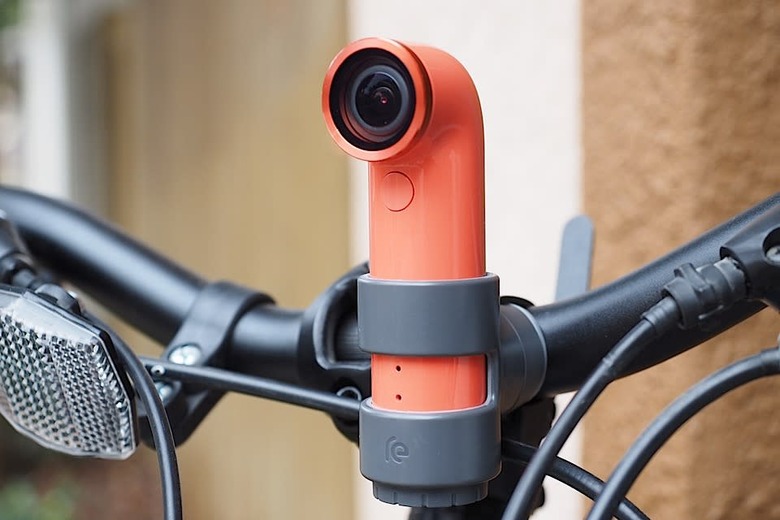
My father's camcorder was a common sight on childhood vacations. Trips to Mount Rainier, the Oregon Coast, Disneyland, skiing, weddings — you name it, there's video evidence of my siblings and I enjoying time together. I'm lucky to have grown up in an era where this technology was available, but today these memories can be captured more easily and with less sophisticated (read: less expensive) equipment. We have quick and easy access to cameras at a moment's notice, thanks to smartphones and tablets, and now another form factor is starting to gain momentum: personal cameras. With the exception of the GoPro, this genre is now seeing an influx of small, hand-held devices that are small enough to put in your pocket or bag and can still take decent photos and videos.
HTC is one of the companies rushing to get into this space with the RE camera (pronounced "Ree"), an awkwardly named gadget that's shaped like a tube, packs a 16-megapixel camera and 1080p HD video capture and features cross-platform support so Android and iOS users alike can take advantage of it. Can this tiny camera take the place of my father's camcorder? What else is it good for? And is it worth paying $200 even if you already have a smartphone camera? Keep Reading to find out.
Hardware
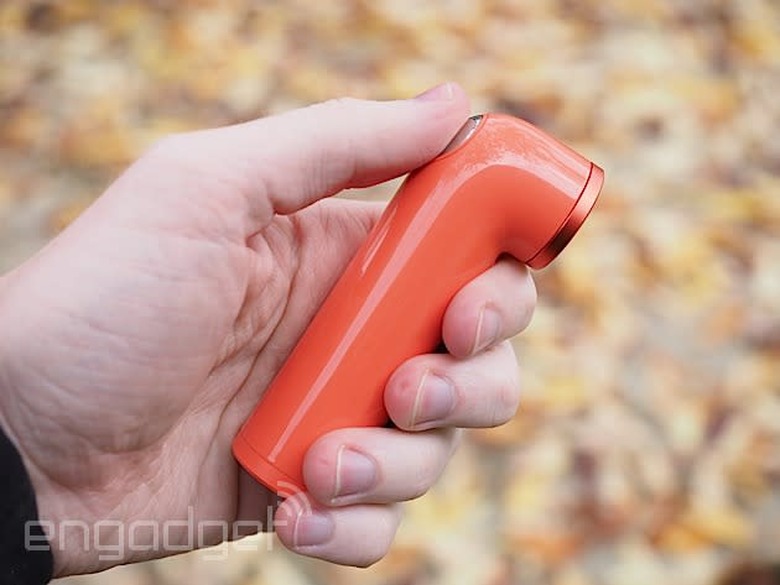
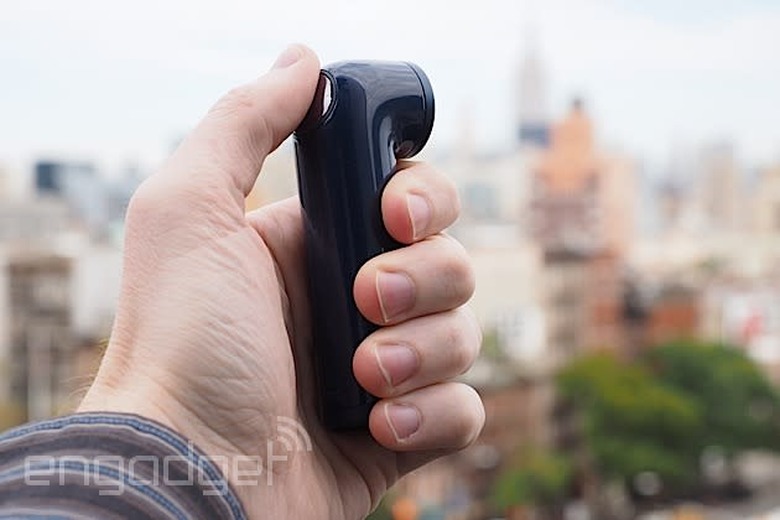
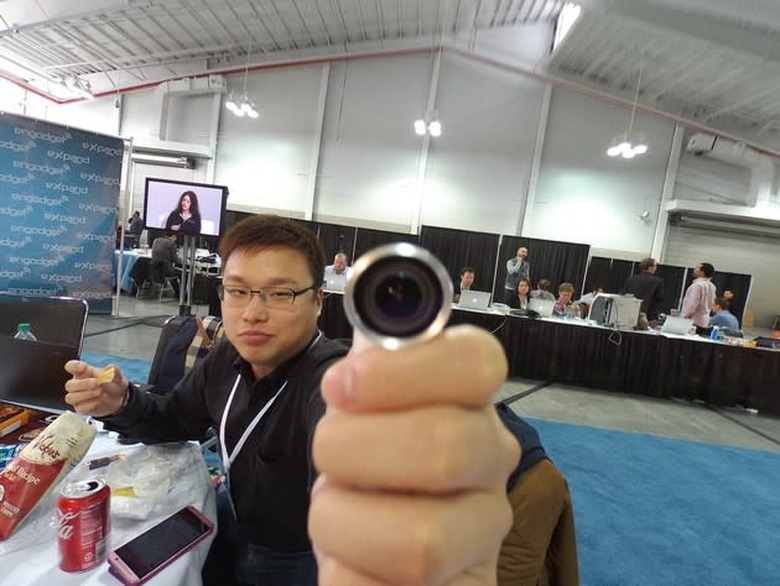
Warning: If you buy the RE, you will frequently be asked, "Is that a camera?" Roaming the hall at Engadget Expand, waiting in line at Six Flags, walking down city streets, attending social events and, well, everywhere, I was approached by people eager to see why I was pointing an upside-down asthma inhaler at things. Its tube-like design makes it easy to grip and an instant icebreaker.
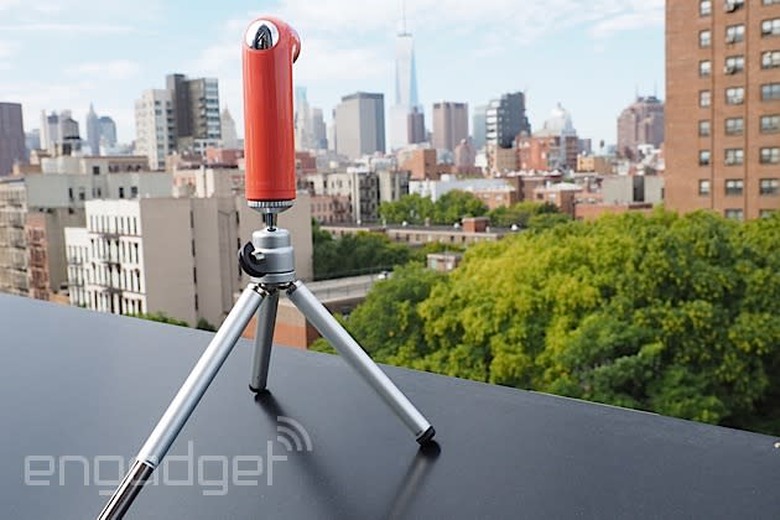
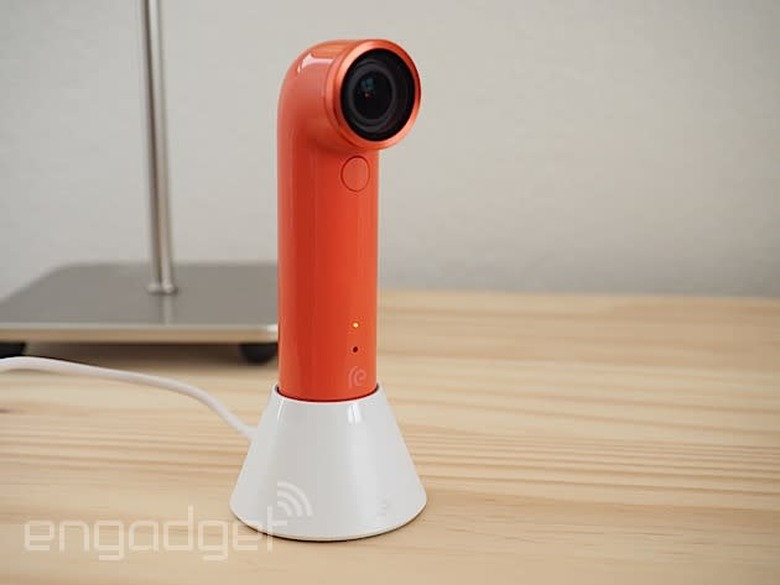
No matter how much I like to poke fun at its looks (periscope? A piece of PVC pipe?), HTC had the right idea here: A camera like this has to be small, lightweight and easy to hold. It can't be unwieldy. It needs to be something you want to use often and share with others. HTC's answer is an L-shaped trinket that weighs 66.5 grams (2.35 ounces) and measures 96.7mm in length and 26.5mm in width. It's short enough that it gets obscured in my right hand as I hold it, but long enough that I never feel like it's going to slip out of my grasp.
The RE, which comes in white, orange, blue and teal, has a simple design with just two buttons. The shutter button sits near the corner of the device, which feels like a natural fit when I place my thumb there. Pressing this button takes a picture, while holding it down for two seconds prompts the device to start recording video (there's an LED light to indicate when the shutter goes off or when you're recording). The second button, located on the backside, is a toggle allowing you to switch to slow-mo video capture. Farther down, there's an unseen grip sensor that's supposed to detect when you're holding onto the RE so it doesn't snap shots by accident. Meanwhile, another LED shows battery status, and there's a speaker near the bottom, which emits shutter sounds and other signals. Finally, the all-important microphone sits along the top side.
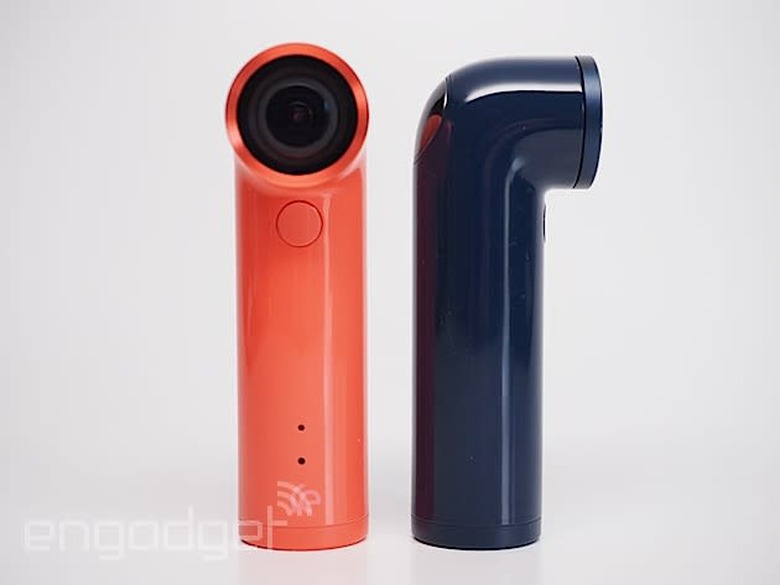
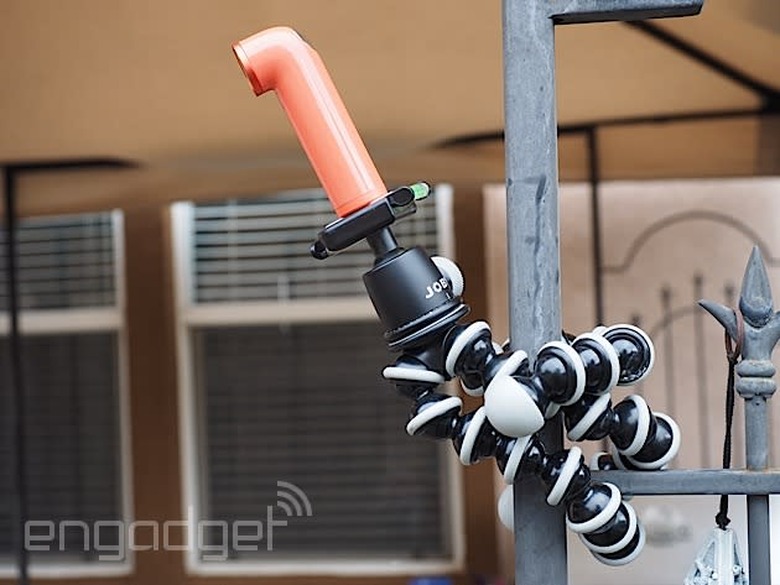
The busiest part of the RE is the bottom side. This is where you'll find a 1/4-inch tripod socket for additional accessories, a standard micro-USB charging port and an 8GB microSD card (you can replace it with one as large as 128GB). The camera is powered by an 820mAh battery and comes with a waterproof rating of IP57, which ensures that your device will be safe in a meter of water for up to 30 minutes. HTC will offer a protection pack (sold separately) that increases the rating to IP58 and keeps the RE safe in three meters of water for 120 minutes. A company spokesperson also confirmed that the RE can handle exposure to sand and seawater, though you should still be careful, as it's not indestructible.
The RE also has a gyroscope that can detect when the device is upside down, so it'll automatically flip the resulting images so they're facing right side up. Of course, you can also turn off that setting in case you actually want to capture footage this way.
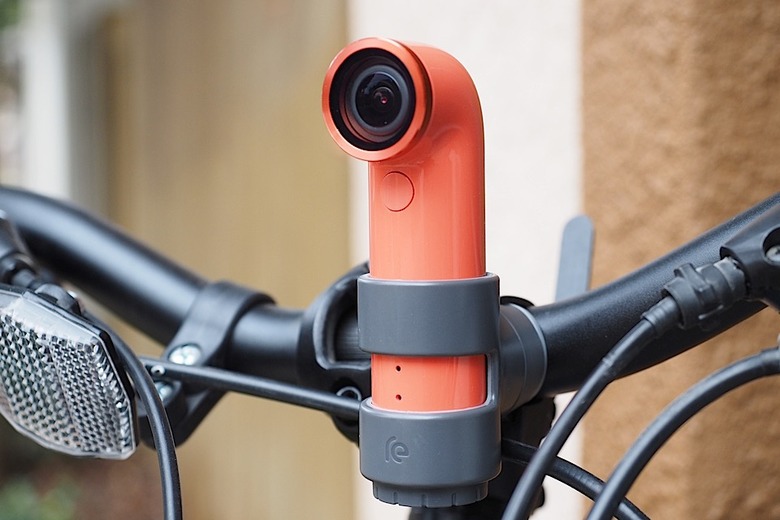
Plenty of accessories abound for the RE. In addition to the aforementioned protection pack, HTC offers bike mounts, suction cups, external battery packs and a pyramid-like charging stand.
Software

(Image credit: Daniel Bader)
HTC has lately been trying to expand its brand beyond hardware, and so it's working on creating cross-platform services, like the Zoe app, that work on both Android (4.3+) and iOS (7+) devices. The RE is no different: It's not restricted to HTC-made devices, so as long as you're using either Android or iOS, you'll be able to purchase the camera and download the companion app.
In the case of the RE, the software isn't absolutely essential, per se. The camera's capable of storing photos and videos locally on a microSD card, so you could technically use it without ever connecting it to a smartphone — just plug the device or the card into your computer and transfer the files directly.
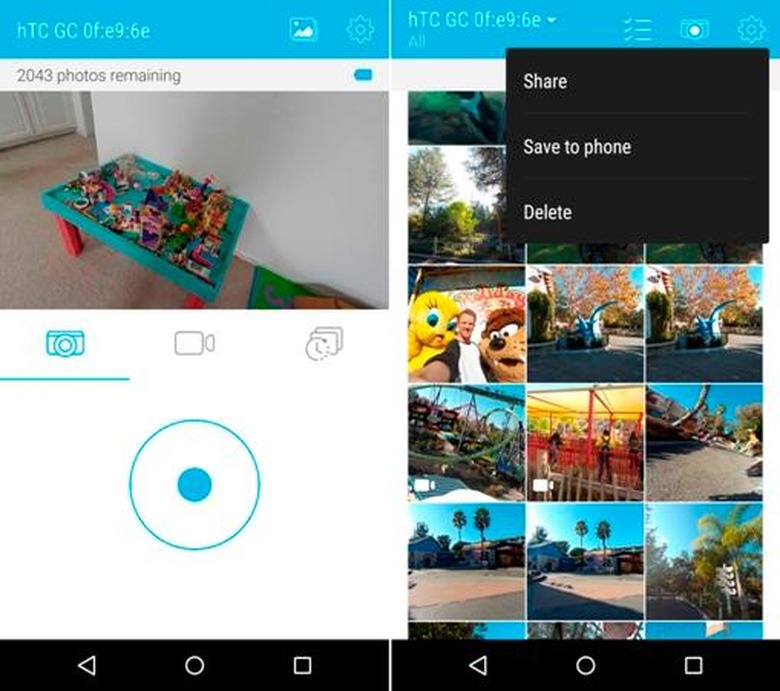
However, forsaking the smartphone app means you'll be missing out on a few key features, like a real-time viewfinder, remote shutter key and time-lapse video, as well as the ability to update the camera's firmware easily (there's a way to sideload the file onto the SD card, but it's more complicated). The latter option is arguably the most critical, especially as HTC rolls out bug fixes, performance improvements and new features over the device's lifetime. So while it's technically possible to use the RE as a standalone camera, I'd advise against it. Even so, it's good to know you can take the RE with you anywhere and not have to always be tethered to your phone at the same time.
The UI is nearly the same on both the Android and iOS versions. After you connect the device, which involves pairing using Bluetooth Low Energy, you'll be presented with a viewfinder and three remote shutter options: stills, videos and time-lapse. This makes it much easier to frame the kind of shot you want, if you don't want to do the point-and-pray approach.
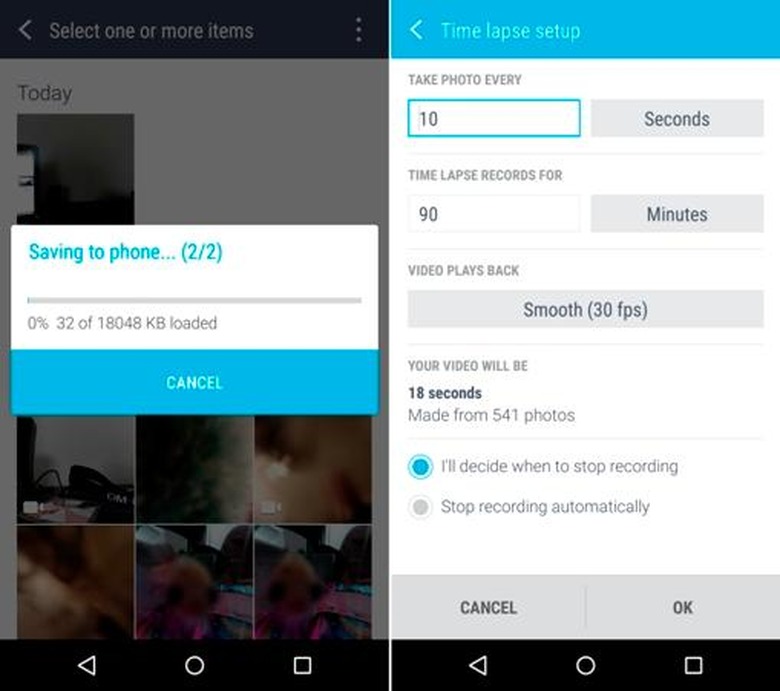
Near the top, you can access the camera roll, which consists of all the images currently stored on the microSD card. You can back all of them up to your phone (every time you go into the app and connect the RE) or pick and choose specific ones, depending on how much space you have; there's also the option to upload all of your stuff to Dropbox or Google Drive anytime you're connected to a WiFi network.
There are plenty of other niceties in the settings menu. Here you can toggle ultra-wide-angle mode, change camera resolution, soften or turn off the shutter sound volume and, finally, power off your device (that's important, since there's no other way to do it besides letting the battery die). Speaking of the sound, by the way, I recommend leaving it on because the LED indicator isn't always easy to see. There's also the creep factor to consider.
Although the interface is roughly the same on both platforms, the user experience is better on the Android app. The RE uses WiFi Direct to transfer photos and videos to the phone, and while both mobile OSes support the tech, iOS handles it a little differently. Each time you want to connect to the RE, the app will ask you to go into your WiFi settings and connect to the RE's ad hoc network. Once that link is established, you're good to go — at least, until you exit the app or become idle for longer than three minutes. This is a huge interruption and takes up a lot of extra time, and if you're trying to frame a shot in a hurry, it's an inadequate solution. The Android app, on the other hand, establishes a connection with the RE in-app while maintaining your phone's existing WiFi link. It's a much more seamless experience.
One other thing: If you try to watch a RE video on the app without downloading it to the phone first, it's almost impossible to get through more than 10 seconds without the stream either hiccuping or just completely stopping. Sometimes the video will stop while the audio plays on. If HTC can't get this right, I'm not sure how it plans to make its upcoming Live Broadcast to YouTube feature (which the company says is coming at a later date) a seamless experience for viewers.
Use cases
Unless you have plenty of money burning your pockets, $200 for a personal camera can be difficult to justify, especially since most of us already have a perfectly capable camera phone, and maybe even a tablet too. We've already mastered the perfect selfies, and phone makers have done an excellent job at shortening the time it takes to pull out our devices and start snapping. So why bother trying to juggle yet another device? It's a valid argument, and indeed, I was skeptical about the RE's usefulness before I played with one. Now I totally understand why it makes sense... in certain situations, at least.
For one thing, it's just fun to use. It's a fantastic social tool; I handed it to friends, co-workers and family members to see what they would do with it (answer: take a lot of close-ups of their eyes, nose and other body parts). We'd take selfies together and find other ways to use it to pass the time.
Also, with the RE in-hand, I discovered I was taking more pictures than ever before. It's ridiculous how quickly I reached my 600th shot. I took several times more images on the RE than I usually do on smartphones. Suddenly, I found myself looking for ways to come up with creative new photo opportunities and even took pictures of things that weren't all that interesting — you know, just in case I needed the shots for my next great masterpiece. I tried different angles; I raised the RE far above my head to catch a new perspective on something cute my kids were doing; I even took it on a roller coaster and filmed my rides (only try this if you're confident in your grip). It reminded me of the first time I used a digital camera instead of film: I had an epiphany that I could take as many pictures as I wanted to and just discard the bad ones. The only limitation was the size of my external storage card. It was as if a huge burden had been lifted off of my shoulders. Now in 2014, I get a similar feeling from the RE.
The camera is also easy to use one-handed, so I could take a picture of my daughter as she and I walked in the rain under umbrellas; without the RE, it would've been a struggle to take my phone out of my pocket, get into camera mode and then take the picture, all with only one hand. The biggest exception to this rule is the shake feature on the Moto X, but it's still a few seconds faster to pull out the RE and press the button. Had it been warmer, too, I would have jumped into a pool with the RE or used it at the beach. It's a lot handier to carry this petite camera than a bulky phone, so you can take pictures and videos of what's happening without worrying about getting your handset wet or full of sand. And since you're less tempted to look at your phone, chances are you're a lot less distracted.
Which brings me to my next point. It's not difficult to take pictures with my phone, but it also involves more fiddling around with the app, tweaking settings, making sure the focus is just right and other tasks. Say what you will about not having a viewfinder on the RE, but it's one less distraction keeping you from being focused on what's really important: the actual thing you're seeing with your own eyes. It's easier to focus on what you're capturing, rather than the process of capturing it. After all, I can't enjoy my child's recital as much when I'm hiding behind a screen. Is there a chance my pictures and videos end up off-center? Sure, but the more I used the RE, the more I understood what its boundaries and limitations were, so I developed a sense of how to take better photos.
The RE is great for vacations and travel, hiking and camping, concerts (for video, at least), the beach and any impromptu moment that comes and goes in a matter of seconds — y'know, the cheesy stuff you see in commercials. In my preview, I called the RE "the GoPro for NoPros," and the nickname still rings true. But this is all contingent upon actually having the device handy, which is easier said than done. If it's in your backpack or purse, you'll likely spend countless seconds trying to dig it out. It's also small enough that you'll accidentally leave it at home or in the car on several occasions (this happened to me a few times). In the most ideal situation, which involves me having it in-hand or at least in my pocket ready for a quick draw, it's a huge timesaver; for every other moment in which it's not, you'll probably default to grabbing your phone.
Performance

The RE takes 16-megapixel still photos with a 4:3 aspect ratio, though you can drop the resolution down to 12MP if you prefer to shoot in 16:9. Videos max out at 1080p/30 fps, though slow-motion capture comes in at 720p. Thus, images taken with the RE pack the same number of pixels as the Samsung Galaxy Note 4 and Galaxy S5, but it lacks UHD video capture, which is quickly becoming a standard on flagship smartphones.
Of course, just because the RE has the same resolution as high-end handsets doesn't mean they're going to be of the same quality. There are a few key factors that make the RE different. The RE's aperture is much smaller at f/2.8, making it more difficult to use in low-light scenarios; default images use a 100-degree wide-angle shot, increasing to 146 degrees on ultra-wide photos (videos are 86 degrees); and there's no autofocus, manual settings or HDR to enhance your images in any way. So how much of an impact do these factors have?

You know how car mirrors say objects are closer than they appear"? The wide-angle lens on the RE makes some images turn out exactly the same way; the stuff I shot wound up looking more distant than they really were. In addition, distortion is easy spottable on the outer edges of most photos: Street poles look curved (#bendgate2); people get stretched; and so on. Thus, you'll get images taken from an entirely different perspective than you normally would get on a smartphone camera. It makes for some really creative shots, but keep the wide-angle aspect in mind when you're trying to set up the perfect selfie. And even if you think you're close enough to the photo's subject (and aren't looking at the remote viewfinder), you may want to inch a little closer just in case.
The kicker is that while it's good to get closer, you don't wanna get too close. When I tried to take close-up shots of anything, the object would appear slightly blurry, while everything farther away remained in focus. Figuring out how to frame your shots on this device is a learned skill, but over time, you'll get better as you discover the best angles and distances for each type of situation.
Of the roughly 600 photos I took during the course of my review, at least 15 percent of my camera roll consisted of blurry, unusable shots that looked like I'd been shaking the device when the shutter went off. One of the primary culprits here is shutter lag. From a cold start (if you haven't taken pictures in a little while), it takes around two seconds for the RE to fire off a shot. Most of the time, I forgot to stay perfectly still; the idea of this camera is to shoot something quickly and move on to the next thing, so when I would go out for a walk, I would tend to press the button and keep walking. As a result, quite a few of my photos were taken as I was dropping my arms. Eventually I got in the habit of taking two shots, since the second shot's shutter delay is much shorter — just a half a second or so.
About 15 to 20 pictures in my camera roll were taken in my pocket. This was unexpected, since the RE comes with a sensor that detects when you're holding it and disables the button when you're not. Thus, there's a small chance that if you place it in the bottom of a purse next to several other small items that tend to shift around, you may find random images of nothing in particular. On one occasion, the RE dropped onto the floor of my car and presto — I now have a prized picture showing what's underneath the back seat. (Let's just say there's a reason I left that image out of the photo gallery.)
In direct sunlight on a clear day, the RE's exposure seems a little too high. The sun bleaches out the blue sky that typically shows up rich and deep on flagship phone cameras, and a lot of fine details are lost. Colors also often appear undersaturated. And given its relatively small aperture, it's no surprise that lowlight shots were disappointing; I wasn't able to capture as much light as many phone cameras. Even the few images that showed up reasonably well still suffered from a lot of noise. It was difficult to get in-focus pictures when I snapped shots of moving objects (especially evident in concerts and late-night dinners). In other words, the RE may work in a pinch, but don't rely on this camera when there's very little light to take advantage of.
(To see my full-res images, visit my Flickr page. I left in many of the blurry shots so you can get an idea of how easy it is to take them.)

Slow-motion video capture was smooth enough, but its 720p resolution took even more of a toll than I had initially expected. Most of my footage was so grainy that it didn't look anywhere close to HD quality. Again, it's great for goofing around, but it needs some improvements. There's also no way to change the speeds either; it shouldn't be difficult for HTC to add this feature to the settings menu, but the company is keeping it at 4x speed for now.
The max video capture resolution is 1080p/30fps, but you can also use 720p/30fps if you're trying to save space. At 1080p, the footage provides an overall bit rate of 17.8 Mbps, and the device comes with a video-stabilization feature that offers slightly smoother results when it's turned on. This is especially important when you're filming with the RE in-hand, because most hands are going to be at least a little shaky. (My hands can be pretty unsteady, but most of my videos still turned out smoother than I expected.) The device captures audio surprisingly well; I used the RE at a concert and the music came out clear and easy to hear. I was expecting the sound to be muffled and unusable in such a loud venue, so I was quite happy with how well it turned out. (If you want to actually see the band in your video, however, you'll want to be close to the stage because the RE has no zoom function.)
Battery life
The other key element of the RE's performance is its battery life. It's designed to be portable and handy enough for you to take everywhere you go, but what good is it going to do you if it dies halfway through the day? As with phones, mileage will vary greatly depending on how much you're using it. It could last for days on standby if you're never taking pictures or establishing a connection to your phone, but it doesn't last so long when you're snapping a whole bunch of shots of your family while on vacation. On a recent trip to Six Flags, I took photos and videos of as many things as I could think of, and got 4.5 hours of runtime before the RE needed a recharge. HTC claims it gets roughly an hour and 50 minutes of continuous video capture, and my own results didn't veer too far from that; my unit died after an hour and 35 minutes. And although I didn't test out HTC's estimate that you can take 1,200 photos in one charge, I spent an entire day at Engadget Expand taking a total of 110 images, 15 videos and 10 slow-motion videos before it powered off — a healthy mix, to be sure, but if you plan to use the RE a lot in one day, you'll want to get the optional extended battery pack.
Wrap-up
The RE isn't the only personal camera on the market, but it's the handiest to use. For $100 you can get the Polaroid Cube, a small cube-like device with a 6MP camera, 1080p video capture and magnets for attaching to metal objects. However, it's not very comfortable or easy to hold for long periods of time. There's also the flagship GoPro Hero series, which is primarily an action camera catered to athletes, filmmakers and other professionals that starts at $200 (the Hero4, which comes with a 12MP camera and 4K video resolution, goes for $400+; there's also a lower-end Hero model with 5MP and 720p max res at $130). The RE, on the other hand, is $200 and is meant to be used by the everyday consumer — parents, travelers and anyone else interested in documenting their life. In fact, HTC doesn't even look at GoPro as a direct competitor for that reason.
On paper, the RE's price isn't so ridiculous. It seems to fit right in-between the Cube and GoPro, but HTC's target market won't be as easily convinced. It's geared toward the average Joe, who will likely scoff at the $200 price tag because he has a phone camera that can do a lot of the same stuff. It comes down to the value of convenience over image quality and cost: The RE is great in a pinch and takes plenty of good shots, but most of your images won't be better than on many flagship and mid-range phones. So anytime you want to fire off a quick picture, you'll find yourself deciding between the speed and ease of use of the RE and the better quality of your smartphone.
It's a tough sell for most, but I did find the RE quite enjoyable to use. It encouraged me to be more creative with my photography, and I took a lot of images of things I wouldn't have otherwise. There's a lot of potential with this form factor, and with a lower price and improvements to the image quality, the camera could be very successful. But until then, it's simply a first-generation product with some cool use cases that just happens to be a little rough around the edges.