

Lotus will return to combustion engines for its cars
A few years ago, Lotus announced it would end production of gas-powered vehicles to become a pure EV company. Since then, the world has solved climate change, found a way to produce clean gas from air and ended all geopolitical crises threatening access to global fuel supplies. Consequently, Lotus has announced its long-telegraphed plan to resume building cars with internal combustion engines. The Geely-owned outfit has today unveiled Focus 2030, its plan to use ICE, hybrid and electric powertrains across its range.
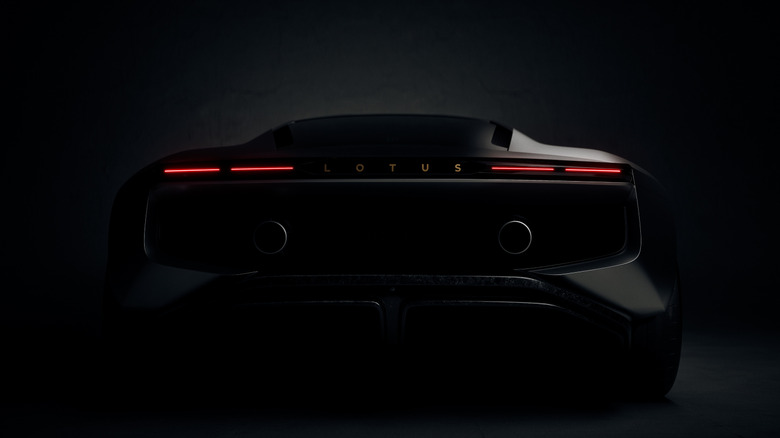
Hybrids will likely take most of the focus, and Lotus is proud of the Hybrid-X technology found in the China version of the Eletre, the Eletre X. (Given the company's love of faux-Latin names beginning with E, Eletre is the glorious SUV you can throw around a track like a sports car.) Hybrid-X will also be a key pillar of the new Type 135, its new supercar expected to debut in 2028, of which we only have the above teaser image. The 135 will be an all-new flagship, equipped with a hybrid V8 capable of 986 horsepower that it's hoped will be manufactured in Europe.
Given this pivot, Lotus is also gearing up to announce an update to its last gas-powered car, the Emira, in the coming weeks. The company said the update will show off "the most powerful and lightest Emira built," to cater for seemingly insatiable demand for gas-powered sports cars. It'll be interesting to see how the Emira evolves in contrast with the Type 135, too, given the last time Lotus made a V8 supercar, it was the Esprit. Although by the time the Esprit finally ended production In 2004, it was a shadow of the car James Bond drove underwater in 1977.
The announcement also lays out a new vision for the company in the run-up to the end of the decade with a focus on reduced expectations. Back in those optimistic pre-2020 days, Geely was hoping to turn Lotus into a giant selling 150,000 units a year. Now, it's scaling that target down to 30,000 units with the hope of finally reaching sustained profitability, but given the company's annual sales sometimes measure less than 10,000 still pretty ambitious. Still, the world needs Lotus a lot more than it often lets on, and hopefully the unification of its UK and Chinese divisions will help speed up the company's ability to innovate.