

The HDMI ARC port on your TV has a very specific job

By now, most people are familiar with HDMI (High-Definition Multimedia Interface), the connector that lets you plug a single cable from your Nintendo Switch, Roku, Amazon Fire Stick and various other boxes to your TV to display whatever you want. TVs offer more than just one type of HDMI port, however, and many specifically include HDMI ARC and HDMI eARC, versions of the interface that support soundbars for higher-quality audio. The distinction between various flavors of HDMI can get a bit technical, but if you can understand the difference, it's possible to unlock improvements like more immersive audio from Dolby Atmos just by plugging in the right cable into the right port.
What is HDMI ARC?
HDMI ARC or HDMI Audio Return Channel was introduced into the HDMI specification (in this case HDMI 1.4) in 2009 with a specific purpose: simplifying and improving the experience of getting audio from your TV to a speaker. Historically, soundbars and other audio equipment have used optical cables to transfer digital audio, which meant introducing yet another cable to your TV or routing everything through a dedicated, expensive home theater receiver. ARC lets an HDMI port do the heavy lifting, eliminating the need for a separate audio cable and giving you access to the sort of high-quality audio that was previously locked behind specialized equipment.
Can you still use optical audio if you have HDMI ARC?
While some soundbars, such as Sonos' Beam and Arc Ultra, default to HDMI ARC or HDMI eARC connections to offer crisper, more immersive audio, that doesn't mean you have to switch. If you're happy with what you get from your TV's built-in speakers, a soundbar might not be for you at all. And if you already have a soundbar that only offers optical audio out (also known as a TOSLINK port), the vast majority of TVs made today still offer that connection. The only disadvantage is that optical audio cables can't handle as much data as HDMI cables can. TOSLINK has been around since the '80s, after all, and with just 384kbps of data bandwidth, the connector caps out at a compressed 5.1 or 7.1 surround sound, whereas HDMI ARC can handle higher-quality audio standards like Dolby Atmos, and the larger speaker layouts they enable.
What is HDMI eARC?
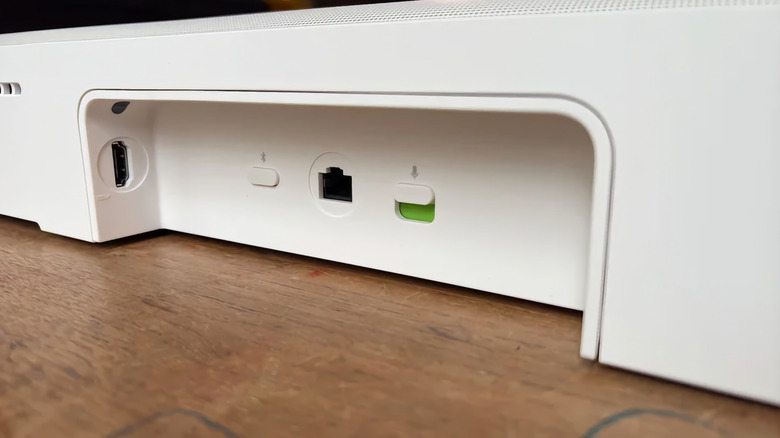
HDMI eARC, or HDMI Enhanced Audio Return Channel, is an even more capable version of HDMI ARC that was formally introduced with the HDMI 2.1 specification in 2017. HDMI eARC has begun to replace HDMI ARC on some newer TVs because of the expanded number of audio formats it supports. In comparison to ARC audio, which is bandwidth-limited and in many cases still sends compressed audio to your speakers, eARC has the bandwidth to handle completely uncompressed, lossless audio, even when dealing with complex multi-speaker standards.
The HDMI Forum says that HDMI eARC "supports the latest high-bitrate audio formats up to 192kHz, 24-bit, and uncompressed 5.1 and 7.1, and 32-channel uncompressed audio," along with branded audio formats like DTS:X, Dolby Atmos and Dolby TrueHD. It's plainly better, though using HDMI eARC does mean making sure you have a high-speed, properly rated HDMI cable to reap all of the benefits.
What comes after HDMI eARC?
At least so far, HDMI eARC is the cutting edge when it comes to using an HDMI cable to transfer audio from your TV to a speaker. The newest HDMI specification, HDMI 2.2, includes HDMI eARC, but unchanged from its previous iteration. The rest of HDMI 2.2 is concerned with improving bandwidth, and offering higher resolution and higher framerate video, rather than expanding the audio capabilities of the standard. HDMI eARC seems like it will be the go-to for the foreseeable future.