

Google shoves more AI into Search, including a dynamic Search box and agentic features
You can kiss the classic Google Search goodbye.

Google Search is becoming even more of a showpiece for its AI ambitions. Today at Google I/O 2026, the company announced that Search has been upgraded to the Gemini 3.5 Flash model, which it says offers faster inferencing, smarter results and the ability to process different types of media. As a result, Google is also launching a new Intelligent Search Box that can dynamically get larger to fit complex queries, as well as use videos, images, files and even Chrome tabs as inputs. None of this is a surprise, though.
Over the past year, we've seen Google slowly upgrade the AI mode in Search — now, the company is just making an AI a more essential part of searching the web. That's good news for users who like the more conversational capabilities of Google's AI, but it's even worse news for the people who are trying to maintain the simple purity of Google's original search engine. There's no word on if you'll be able to turn off any of the new AI features — it was already tough to get rid of earlier AI search capabilities.
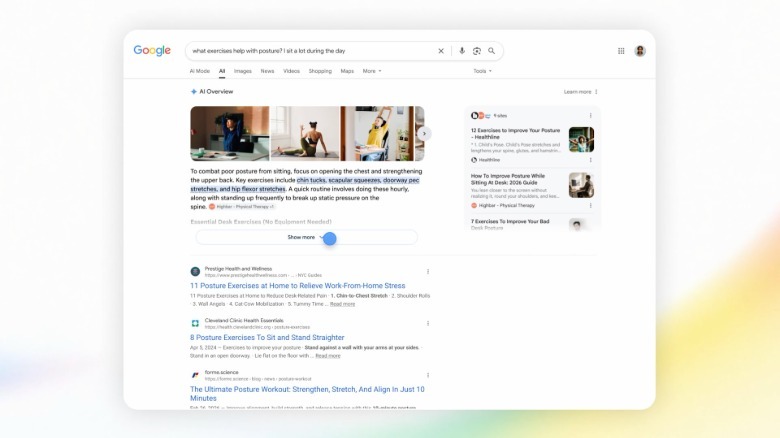
The new Google Search features, which the company says are its biggest changes to the search box in 25 years, are available to use today. "It's more intuitive than ever, dynamically expanding to give you space to describe exactly what you need," Liz Reid, Google's head of Search, said in a blog post. "Designed to anticipate your intent, it also helps you formulate your question with AI-powered suggestions that go beyond autocomplete."
As you'd expect, your AI queries won't be as ephemeral as old school search prompts. The company says you'll be able to continue asking questions after your initial prompts, and that doing so should lead to more refined results. We'll need to take a closer look at Google's revamped Search to see if the company's claims are true, but at first glance, it sounds like it could be a smart way to entice users to spend more time with the its AI tools.That's exactly what Google wants, of course.
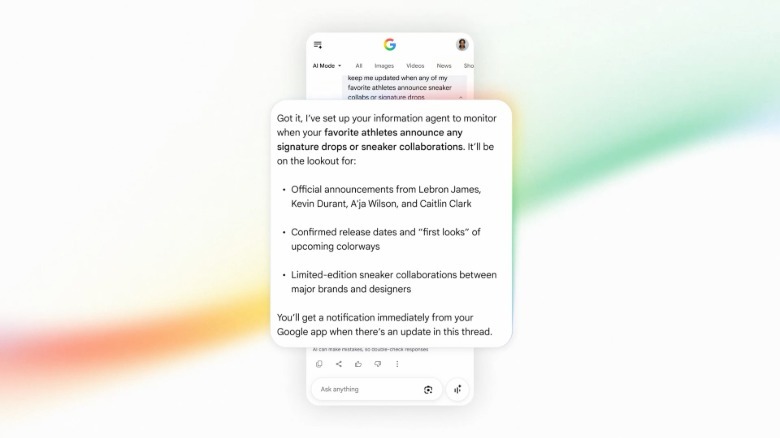
For its paying Gemini Pro and Ultra users, the company also plans to launch a slew of new agentic capabilities this summer. Like other agentic AI features, these are meant to run on their own after initial prompting. Upcoming information agents, for example, should be able to scour the web for specific apartments after you've told Search what you're looking for. The agents will be able to view "everything" on the web, according to Reid, including "blogs, news sites and social posts, plus our freshest data, such as real-time info on finance, shopping and sports."
In a way, the new agentic Search sounds like a souped-up version of Google Alerts, which has been one of the easiest ways to keep track of keywords popping up on the web for the past two decades. The big difference now is that you're looking for more complex information than a mere text string, and Google's AI should be able to format its findings in more useful ways.
Free users will get a handful of agentic updates in the summer, as well, including the ability to book "local experiences and services." The company claims you'll be able to search for something like a karaoke room, find accurate pricing and complete your booking. You can also have Google call certain businesses for appointments, similar to the Duplex AI feature that launched with Google Assistant back in 2018. Let's just hope it's less jarring — Duplex AI sounded far too robotic, and it could be confusing to local business owners who have no idea why a Google robot is calling them.
The company also plans to bring its agentic coding app, Antigravity, into Search this summer. You'll be able to have Antigravity build generative UI elements to answer questions, like understanding how your watch works, according to Google. Even more intriguing, the company claims you can use Antigravity to build "mini apps" within Search, which could do something like build a custom fitness tracker just for you. That feature will initially head to Google AI Pro and Ultra users in the US "in the coming months.
Clearly, the goal for Google is to turn Search into more of a centerpiece of your life, instead of just being a thing you use briefly to find other websites. We've already seen this in action with existing AI summaries, which recap information without even needing to visit another site. Again, I haven't tested any of the new Search features, so I can't quite judge if they live up to Google's expectations. But bringing Antigravity into Search could be an easy way to make users accustomed to the idea of generative coding. It won't be for everyone, but I could see power users leaning into it.
The company says it's also expanding its Personal Intelligence in AI Mode to nearly 200 countries and 98 languages, without the need for a subscription. The feature lets you connect Gemini to your Gmail, Photos and Calendar information, with the goal of delivering more accurate results. The company stresses that "you're always in control" of these features, since you can specifically choose to connect your accounts. But given how much Google wants to take the lead in consumer AI, I wouldn't be surprised if the company starts opting in all of your accounts by default.