

Why is the internet so upset about NVIDIA's DLSS 5?
NVIDIA calls it the biggest graphics breakthrough since ray tracing; critics call it an AI slop filter.
NVIDIA announced DLSS 5 at its GTC conference on March 16, describing the fall release as its most significant graphics breakthrough since real-time ray tracing was launched in 2018. NVIDIA claims DLSS 5 will deliver "photoreal" image quality with AI by repainting a game's lighting and materials in real time, but backlash followed within hours, with gamers and devs accusing the GPU giant of creating and pushing a filter that overwrites games' art direction.
The situation reignited on August 28, when an early leak of NVIDIA's DLSS 5 escaped through an early-access PC copy of NBA 2K27 and modders began forcing it into games that were never meant to run it.
What is DLSS 5, and how is it different from previous versions of DLSS?
Every DLSS release since 2018 has had broadly the same, single job: make games run faster. The original model rendered games at a lower resolution and used AI to reconstruct a sharper image, with later versions adding AI-generated frames between rendered ones. DLSS 4.5 with Dynamic Multi Frame Generation, announced at CES back in January, draws 23 out of every 24 pixels on screen through that combined pipeline, according to NVIDIA. In all those cases, the underlying image belonged to the game's developers; the AI simply produced it more cheaply.
DLSS 5 is much different in that it alters the image itself. NVIDIA says the technology feeds each frame's color and motion vector data into a real-time neural rendering model that "infuses pixels with photoreal lighting and materials," redrawing elements like skin, hair, fabric and lighting while staying anchored to the game's 3D scene and consistent from frame to frame.
The company claims it runs in real time at up to 4K, and CEO Jensen Huang called the technology "the GPT moment for graphics" during NVIDIA March GTC event. Bethesda, Capcom, Ubisoft, Tencent, NetEase and Warner Bros. Games are among the publishers signed up from day one to support it.
So, why are people upset?
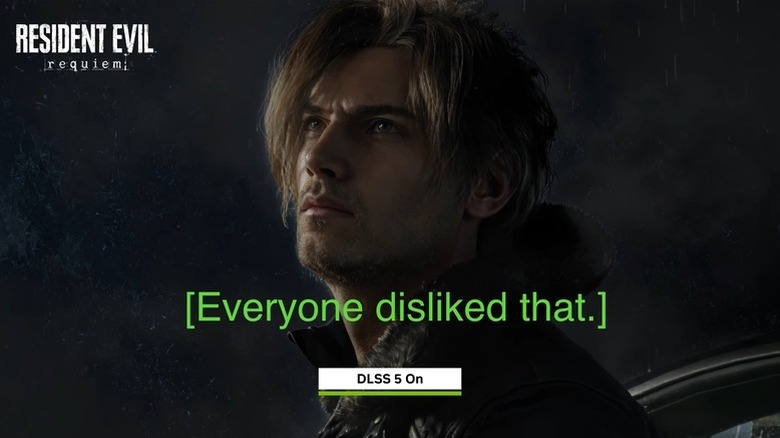
NVIDIA's DLSS 5 demonstrations have done most of the damage so far. During the GTC showcase back in March, DLSS 5 was run over Resident Evil Requiem and Starfield, but viewers immediately noticed that characters like Requiem's Leon Kennedy and Grace Ashcroft came out with smoothed, glossy faces that, instead of being photorealistic, looked like a beauty filter, with "yassified" becoming the Internet's term for the effect. The most-liked comment under NVIDIA's reveal video, comparing the output to an AI-generated image, outnumbers the video's own likes, with another user quipping, "We have achieved it, everything looks like a YouTube thumbnail now." Within a day, arguments that gamers are right to be disgusted by NVIDIA's DLSS 5 were everywhere the demos were shared.
Responding to the backlash on its reveal video, an NVIDIA representative wrote that "game developers have full, detailed artistic control" over DLSS 5 to "ensure they maintain their game's unique aesthetic."
The backlash against DLSS 5 extends well beyond aesthetics, though, with several notable artists and developers having questioned NVIDIA's intent with the software. Karla Ortiz, an artist who has worked with Ubisoft and Blizzard, wrote on Bluesky that the technology is "so disrespectful to the intentional art direction of devs," arguing studios that wanted hyperrealism would've built it themselves. Valid points have also been made about convergence: if hundreds of games pass through the same model trained on the same idea of realism, their distinct looks start to blur together. Bethesda responded to early Starfield footage by saying its art teams will tune the effect and that it will be optional for players, while Capcom reportedly wasn't aware(!) its game would appear in the demo at all.
Huang unfortunately made things much, much worse before he made them better, responding that "Well, first of all, they're completely wrong," when asked about the criticism during a GTC Q&A. His argument was that DLSS 5 operates at the geometry level under full developer control rather than as a filter slapped over finished frames.
Since the build leaked in late August, players have injected it into everything from Control to Monster Hunter Rise. Early testers criticized the Control mod's image quality and performance cost, but the same clips impressed enough gamers that TechRadar reported the first signs of the "negative tide turning." DLSS 5 is scheduled to be officially released this fall, with developer-tuned implementations that'll show whether NVIDIA's claims about developer control hold up better than its demos did.