

The new Resident Evil movie captures the survival horror magic of the games
The director of Weapons has crafted a new horror classic.

Despite touting the name "Resident Evil," the movie adaptations of Capcom's series have mostly ignored the best elements of survival horror games: the sense of dread as you creep into a new location; the desperation you feel when you're running low on ammo and health items. The six Resident Evil movies starring Milla Jovovich were more interested in bombastic action. So leave it up to Zach Cregger, the director of Barbarian and Weapons, to crack the code of making a genuinely great adaptation: Just make it feel like the best games in the franchise.
And to be clear, I'm not talking about delivering fan service. There are a slew of terrible CG Resident Evil movies that exist to do just that, including the failed 2021 live action reboot, Welcome to Raccoon City. Cregger's secret weapon is that he's both an excellent horror filmmaker — someone who knows how to write interesting characters, build tension and deliver scares in unique ways. And he's a fan of the franchise who understands the true magic of survival horror games.
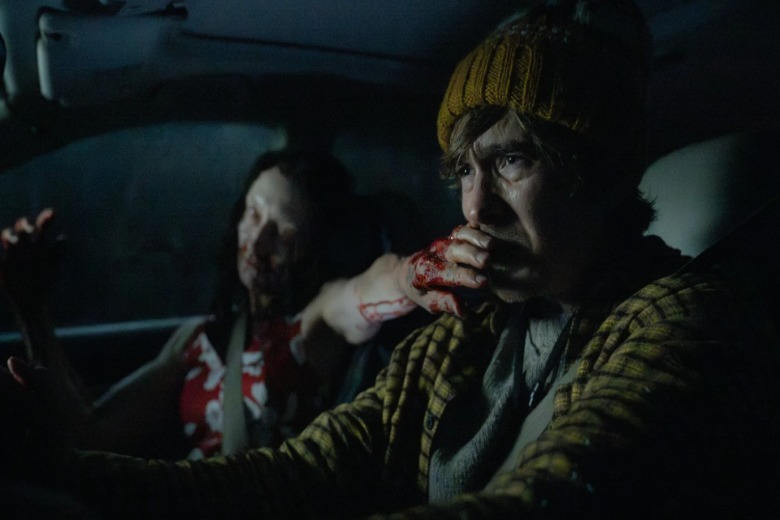
Resident Evil centers on Bryan (Austin Abrams), a medical courier tasked with making a last-minute run to a remote mountainside town. Of course, that's Raccoon City. Along the way, he's also dealing with the anxiety of potentially becoming a father after his girlfriend discovers she's pregnant. He's an everyman with deep flaws, the ideal protagonist for a Resident Evil story.
After an accident on a snowy road, we shift into a first-person view as Bryan creeps towards an injured woman, much like the camera slowly approaching the first zombie in the original Resident Evil. Once the victim reveals herself to be some sort of crazed monster (not a zombie), it almost feels as if we're controlling Bryan over the shoulder as he tries to avoid her around an overturned police car. Of course, the film can never deliver the interactivity of the games, but Cregger's camera gets close. Throughout the film, we're often following Bryan from directly behind, or right over the shoulder, evoking the iconic camera angle of Resident Evil 4.
 Sony Pictures
Bryan finds a conveniently placed pistol and manages to take down the crazed woman, but of course, that's only the beginning. A mad dog chases him into a barn, where he encounters (and fails) a classic ladder puzzle. He finds an even more conveniently placed shotgun when he seeks refuge in an abandoned farm house, but it's useless to him until he finds shells. (In one of the few overt callbacks, he encounters a room with a lone typewriter, like the classic Resident Evil save rooms.)
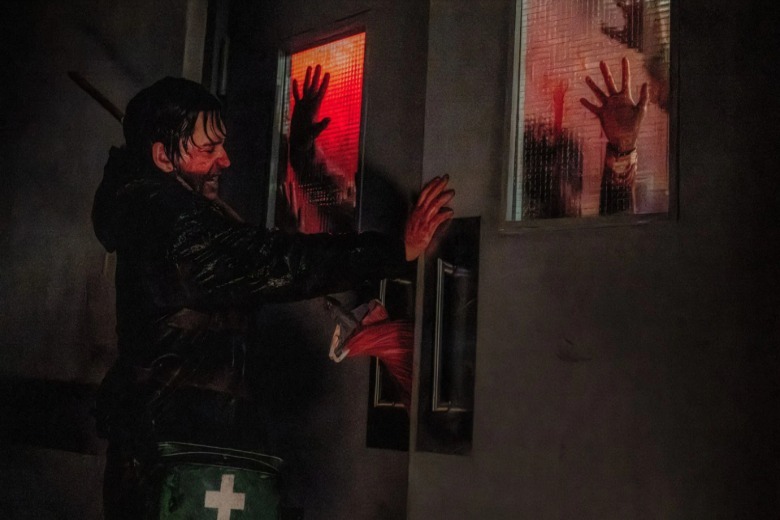
Anyone unfamiliar with the games would have no problem enjoying this film. But Cregger's understanding of the series also makes it feel like a true survival horror game. We're viewing every new room and dark corner from Bryan's perspective, and the sense of dread is palpable. Even though it doesn't take long for Bryan to snag a few guns, he's also always aware of the precise amount of ammunition he's holding. Much like the games, resource scarcity is a constant source of tension. He masterfully uses the first-person perspective several more times throughout the film, and at times the camera jerkily shifts in different directions, as if someone is quickly pushing a gamepad's right stick for camera controls.
 Sony Pictures
Cregger's Resident Evil is a lesson in making a good video game adaptation. You can't just slavishly recreate things the fans want to see – like the atrocious Super Mario Galaxy or the forgettable Uncharted – but you also shouldn't completely reject the best elements of the games, like the terrible '90s Super Mario Bros. film. A small amount of creativity and effort managed to make the Sonic and Minecraft movies watchable. With Nintendo spinning up a Legend of Zelda movie and Hollywood broadly eager to crib from video game source material, I hope more creatives take notes from this reboot.