

NVIDIA GTC 2025 live: News and announcements from CEO Jensen Huang's annual keynote
Expect to hear more about NVIDIA's vision around AI, robotics and automotive tech.
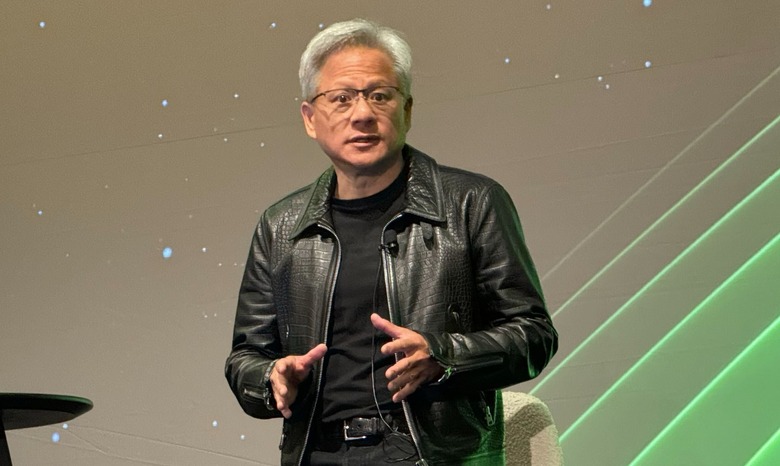
After a jam-packed CES 2025 session, NVIDIA CEO Jensen Huang is kicking off the company's GTC 2025 AI conference with a two-hour-long keynote in just a few hours. Expect to hear more about the company's expansive AI plans, which will likely cover everything from robots to in-car technology. Basically, the keynote will likely be an expansion of themes Huang has already discussed at CES. But since GTC is NVIDIA's own conference, he'll be free to get even nerdier and more specific (something the CES audience didn't seem to appreciate). Also, the GTC schedule has March 20 carved out as "Quantum Day," with a two-hour panel hosted by Huang starting at 1pm ET, so we can probably expect some discussion around that later this week.
Given the rocky launch of NVIDIA's Blackwell GPUs — from its pricey RTX 5090 to the more attainable RTX 5070 — NVIDIA also plans to unveil more details around its next-generation graphics architectures, Blackwell Ultra and Vera Rubin. Huang confirmed that Blackwell Ultra cards are coming in the "second half" of this year in a recent earnings call, and he added, "The next train [is] Blackwell Ultra with new networking, new memory, and of course, new processors." Additionally, he noted "The click after that is called Vera Rubin and all of our partners are getting up to speed on the transition to that." Those Vera Rubin GPUs will offer a "big, big, huge step up," Huang extolled to investors and analysts.
Considering NVIDIA stock recently took a dip ahead of GTC, the company has quite a lot riding on today's keynote. Redditors from the subreddit r/NVDA_Stock are saying the scene at GTC is, as of the afternoon of March 17, "an absolute madhouse." Stick around as we see what NVIDIA has up its sleeve.
Join us at 1PM ET for Jensen Huang's GTC 2025 keynote, and we'll also be covering NVIDIA's pre-show on the liveblog ahead of that.
182 Updates
-
That's it from our liveblog today. Thanks again for joining us, and we hope your AI endeavors are fruitful.
-
NVIDIA's Spark desktop AI supercomputer arrives this summer
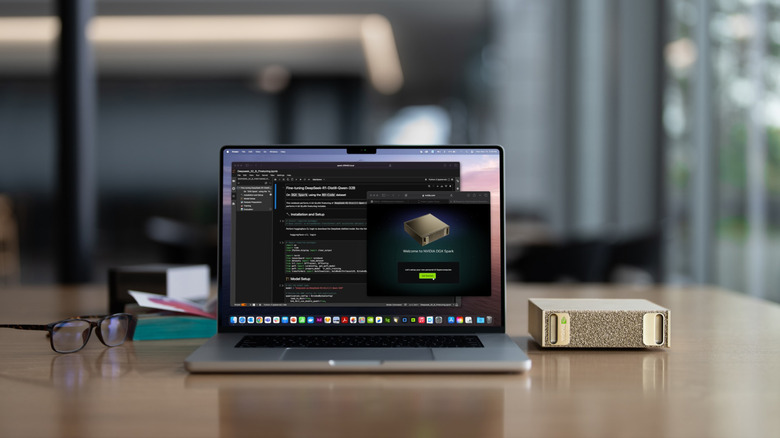
A DGX Spark workstation sits next to a MacBook Pro.
One of the more interesting announcements out of the show today is that NVIDIA is building a desktop supercomputer. We already learned about the DGX Spark at CES 2025 when it was revealed as Project Digits, but today Jensen Huang shared the actual names of the products. And you can actually pre-order a DGX Spark already.
Here's Igor with more:
"It features a GB10 Grace Blackwell Superchip NVIDIA has shrunk down to fit inside an enclosure about the size of the previous generation Mac mini. NVIDIA says the GB10 can run up to 1,000 trillion operations per second of AI compute, making it ideal for fine-tuning the latest AI reasoning models, including the GR00T N1 robot system Huang announced at the end of his GTC keynote."
The company also announced the DGX Station, which offers even more AI processing power.
Read more about the DGX Spark and DGX Station AI supercomputers.
-
I'm on my couch giving Devindra and Igor a faux standing ovation. That was a whopper of a presentation, clocking in at about two hours and 20 minutes! And both Devindra and Igor have been here liveblogging for at least an hour before that.
To repeat what Devindra said, thanks everyone for joining us today! We're working on a post or two on some of the news out of GTC 2025, so definitely keep an eye on Engadget for that. Plus, GTC itself is not over, and there may be news from the conference later this week, too.
-
We're watching a wrap-up video now. Thanks again for joining us folks!
-
I'm still creeped out by humanoid robots, but I'm pretty sure everyone would welcome an adorable Star Wars bot in their home.
-
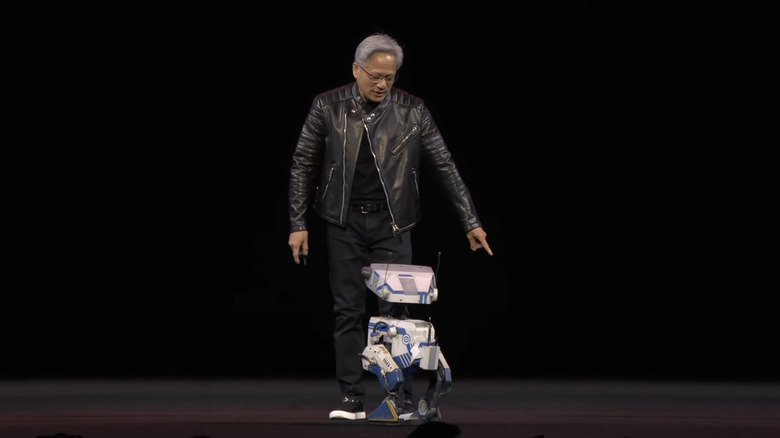
Huang on stage with Blue, the robot.
-
And the robot appears on stage and starts walking towards him. It moves like a Star Wars bot, with adorable sounds and a natural walking motion. Huang is calling it Blue. I wonder if it's actually an AI-driven bot, or just something being remotely controlled.
-
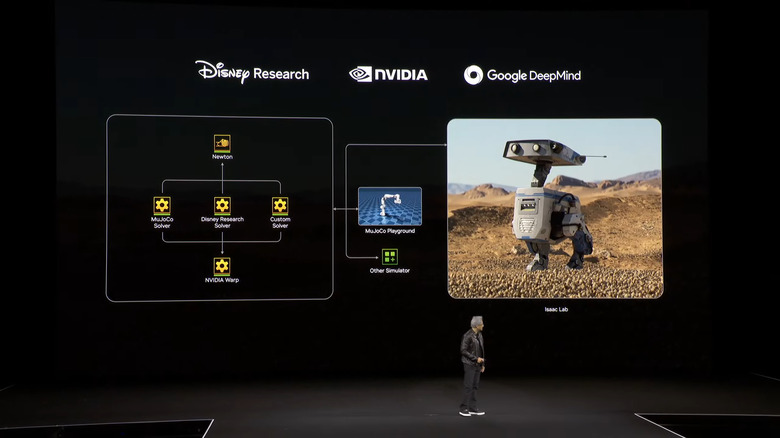
NVIDIA collaborated with Disney Research, Isaac Lab and Google DeepMind to create this cute little robot.
-
Huang reveals that NVIDIA, DeepMind and Disney are working together on a robotics platform called Newton. We're watching a Star Wars robot hop around a desert (we're just assuming it's Tatooine).
-
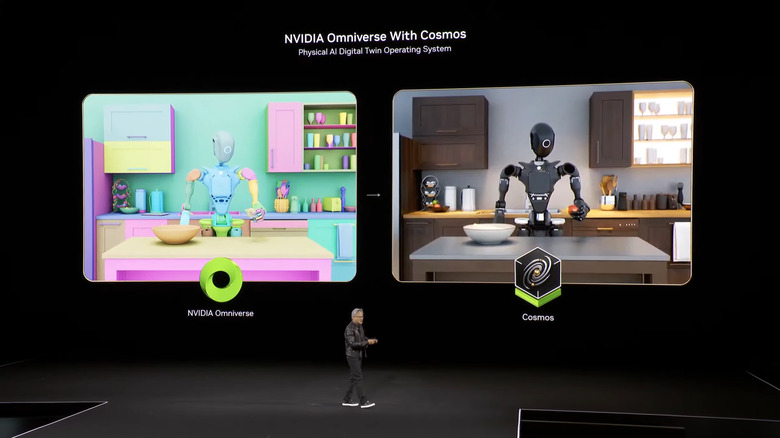
The NVIDIA Omniverse with Cosmos.
-
"Everyone pay attention to this space, this could very well be the largest industry of all," Huang says, referring to the untapped potential of the robot market.
-
NVIDIA is also announcing GR00T N1, a general foundation model for robots. It seems like it's unifying a lot of the training work NVIDIA has been exploring for years.
-
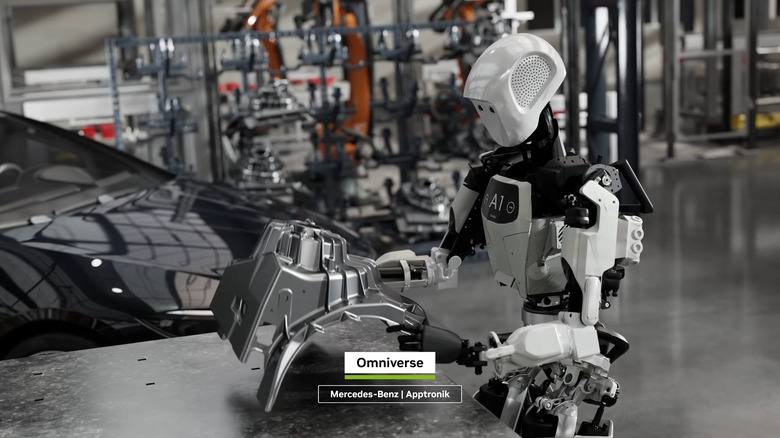
A video showing robots working.
-
Now we're watching a video showing how NVIDIA is exploring robots. It's basically everything we saw at CES: NVIDIA is using Omniverse and Cosmos to virtually train the robot's AI using digital twins, learn from sensor simulation, and then turn those into real-world action tokens.
-
Gonna drop to write a story about DGX Spark and DGX Station. Thanks everyone for joining me for my first liveblog. Dev, you did an amazing job making sense of a very dense keynote.
-
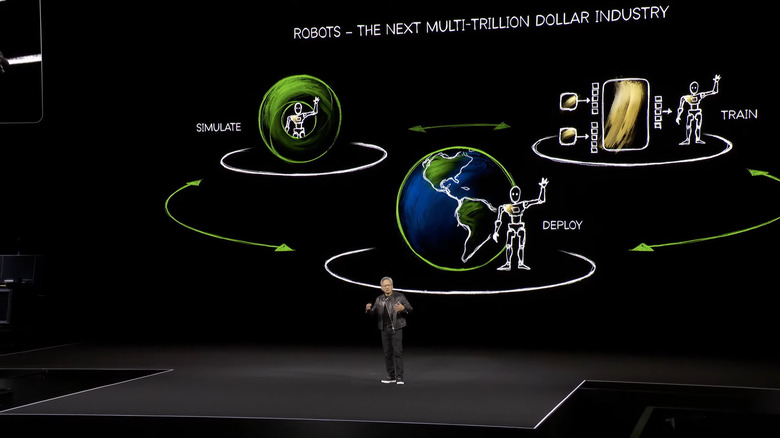
Huang is now discussing robots.
-
And now we're finally onto robots! We've passed the two-hour mark, and yet Huang still has energy.
-
I get the feeling Huang has been told to wrap up.
-
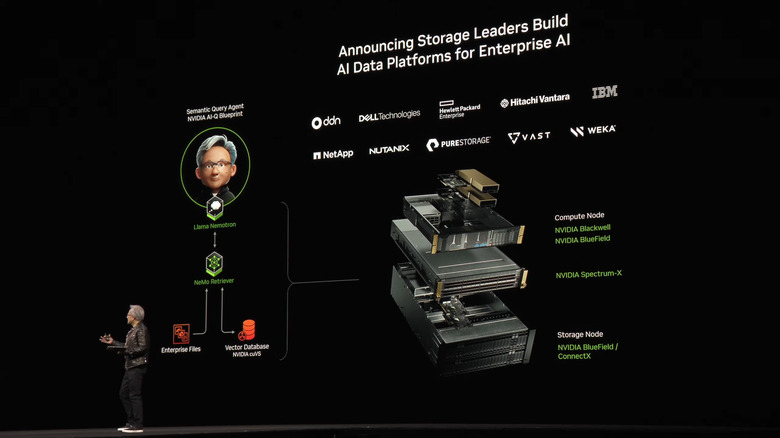
Huang talking about Enterprise AI storage.
-
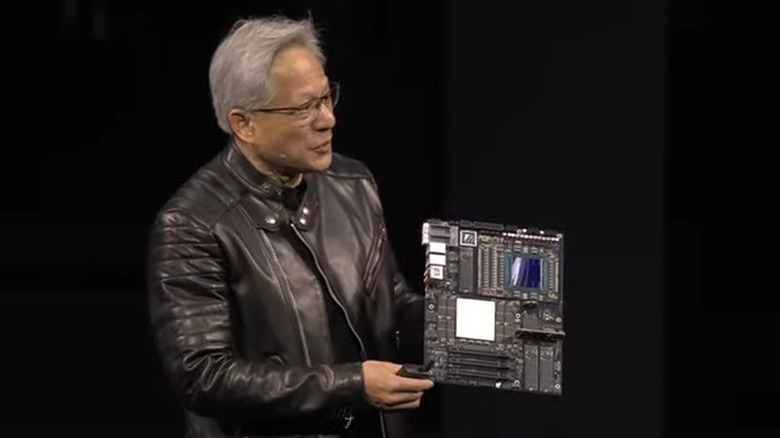
Huang showcasing DGX Station.
-
"This is the computer of the age of AI," he says. I don't even want to think about what that costs. It also seems like they announced DGX Spark, a 1 petaflop system.
-
Huang has reappeared holding a 20 petaflop computer, the DGX Station.
-
I imagine someone else will be sacked for scheduling that stream to end at 2:55PM. Anyway, seems like it's a wrap for now! Unless the stream magically reappears soon...
Thanks for joining us folks!
-
Dear readers, you're not the only ones. The stream just died for Dev and I — and just as Huang was about to announce something potentially juicy.
-
And it seems like the keynote stream has died... Are we free?
-
Not sure why the Quantum-X slide says it'll arrive in the second half of 2025, that may be a mistake. Huang also says NVIDIA's next generation following Rubin will be named after physicist Richard Feynman.
-
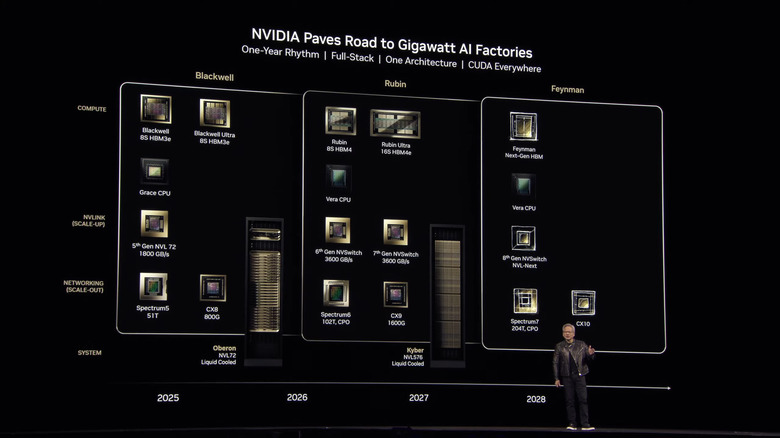
NVIDIA's road map.
-
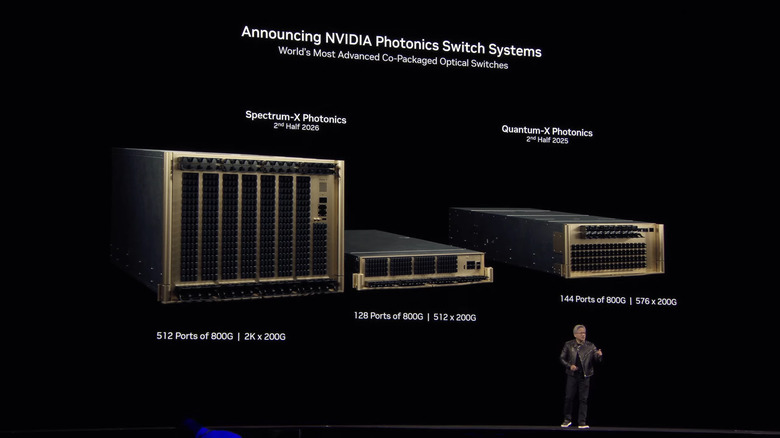
Spectrum-X Photonics and Quantum-X Photonics coming in the second half of 2026.
-
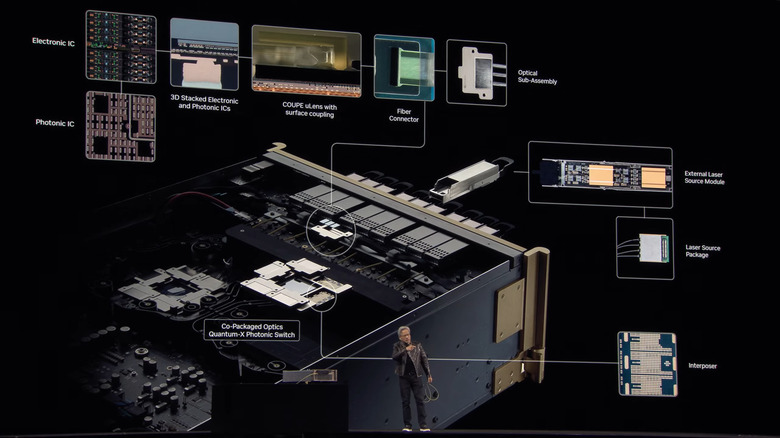
Quantum-X Photonic switch.
-
While we watch this video, I imagine Huang is about to fire the person who tangled the cables.
-
Dev, your guess is as good as mine.
-
Seems like they made Ethernet with frickin lasers? That's really all I can absorb at this point.
-
Huang is announcing NVIDIA Photonics, which appears to be its most powerful Spectrum-X Ethernet product yet. And we have some products on stage, that he seems to be getting tangled up in. The person who tangled those cables will be sacked, most likely.
-
I just wanted to point out that we are now an hour and about 45 minutes into this keynote, and that's excluding the pre-show that started around an hour before 1pm ET.
-
Huang is diving into why NVIDIA jumped into the Ethernet world: Basically, they've been able to make high performance Ethernet solutions with low latency to help transfer data between its supercomputers.
-
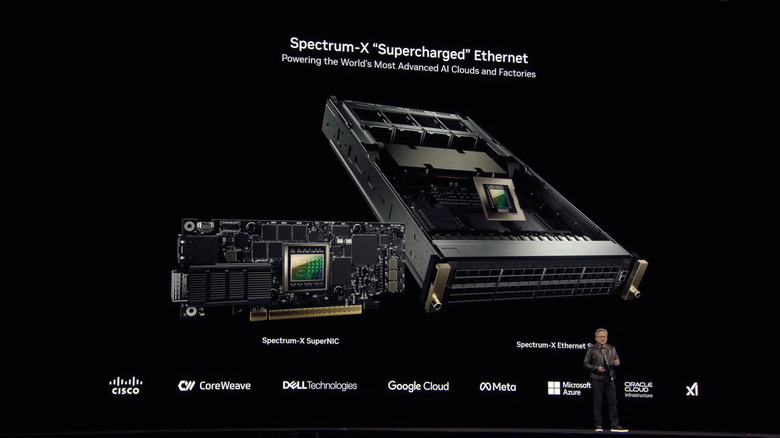
Huang showing the Spectrum-X "supercharged" ethernet.
-
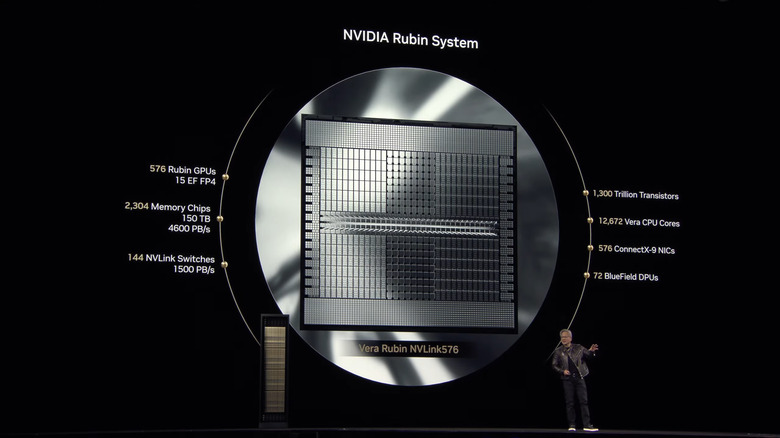
The NVIDIA Rubin System.
-
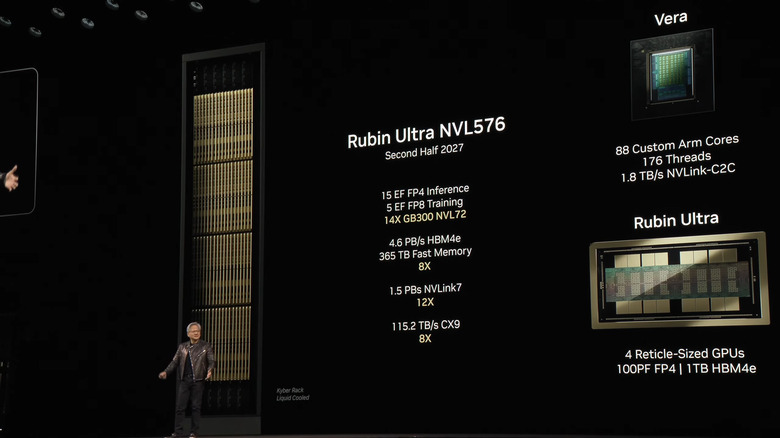
Rubin Ultra NVL576 will become available the second half of 2027.
-
Vera Rubin, NVIDIA's next platform named after the scientist who discovered black holes, is coming in the second half of 2026. Vera Rubin features NVLink 144, and it'll be followed by Rubin Ultra in the second half of 2027. It's honestly hard to think that far ahead.
-
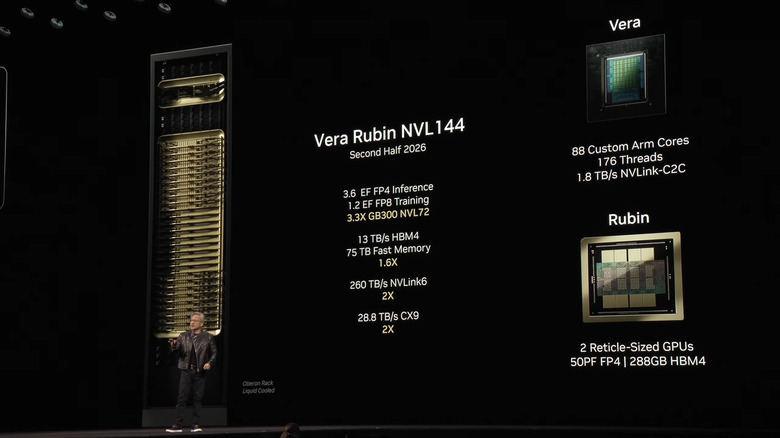
Vera Rubin BVL 144 will come in the second half of 2026.
-
For context, we already knew NVIDIA was planning to release Blackwell Ultra in the second half of 2025.
-
Now we're looking at the future. Now that NVIDIA is in full production with Blackwell, Huang says the Blackwell Ultra NVL72 platform is coming in the second half of 2025. It has two times more bandwidth and 1.5X faster memory.
-
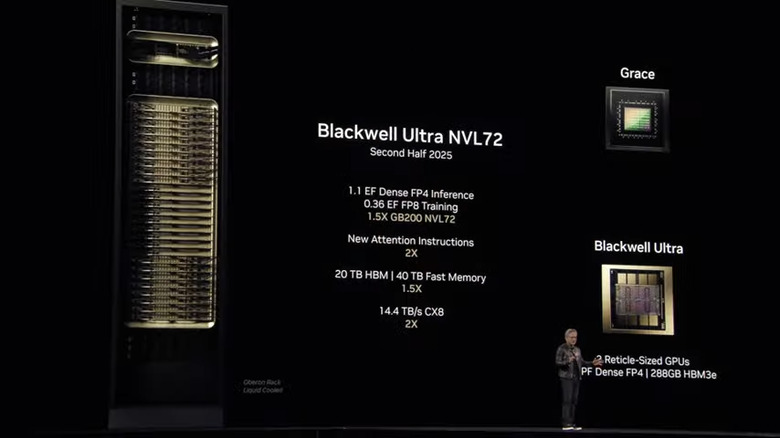
Huang provides an update on the Blackwell hardware.
-
NVIDIA has 3D tools, like Cadence Reality's digital twin platform, to help plan out massive Blackwell installs. There are also tools for planning upgrades and predicting downtime.
-
Now we're going to take a look at what an AI factory looks like. I assume, a giant server room? That's what it seems like.
-
"Anyway, the more you buy, the more you save," Huang says, really trying to get those Blackwell sales up. (And sort of tanking Grace Hopper sales in the process.)
-
Huang adds some much-needed levity to this presentation, making a joke about Grace Hopper being enough for some tasks. "I'm the chief revenue destroyer," he quips.
-
"In a reasoning model, Blackwell is 40 times the performance of hopper, straight up," Huang says. It took 20 minutes to get to that point, I think.
-
"We are now a power-limited industry," says Huang. It's nice to see a company tackle this problem from a power efficiency front.
-
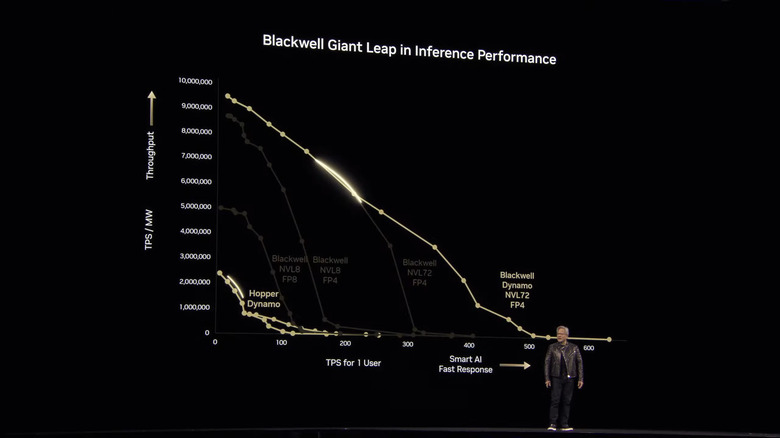
Blackwell Dynamo NVL72 on the inference chart, in comparison to Hopper Dynamo.
-
Huang is showing off how NVIDIA's Blackwell architecture surpasses its Hopper supercomputers, first with NVLINK 8, and soon with its newer NVLINK 72 technology with Dynamo. All I understand is that the graph gets bigger.
-
"Only at NVIDIA do you get tortured with math," Huang says, as we stare slack-jawed a comparison chart between Grace Hopper and Blackwell.
-
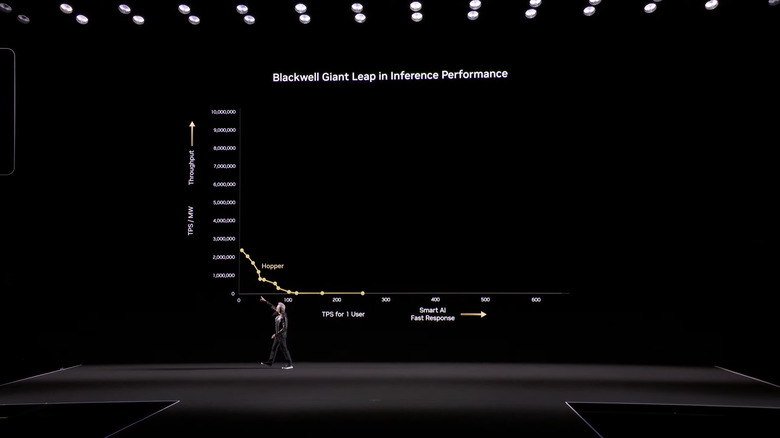
Huang showing how Hopper performs on the inference chart.
-
Now this is something cool. It looks like NVIDIA has a fair few partners onboard for Dynamo, including Microsoft and Perplexity.
-
Dynamo is a "distributed inference serving library." Basically, it's an open source solution for that problem between having users demanding tokens and not being able to make enough of them.
-
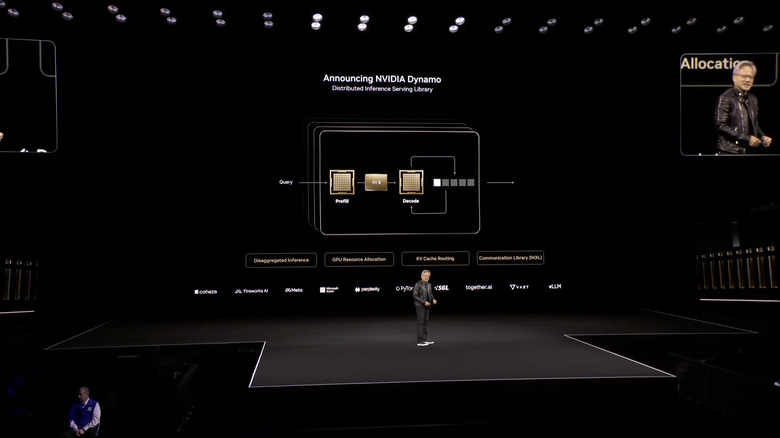
Huang just announced NVIDIA Dynamo.
-
Huang announced NVIDIA Dynamo, "the operating system of an AI factory."
-
We're finally returning to what got us started on this tangent on scaling inference in the first place: NVLINK.
-
Here's the reveal: The traditional model was Meta's Llama 3.3, whereas the "reasoning" model was DeepSeek's R1.
-
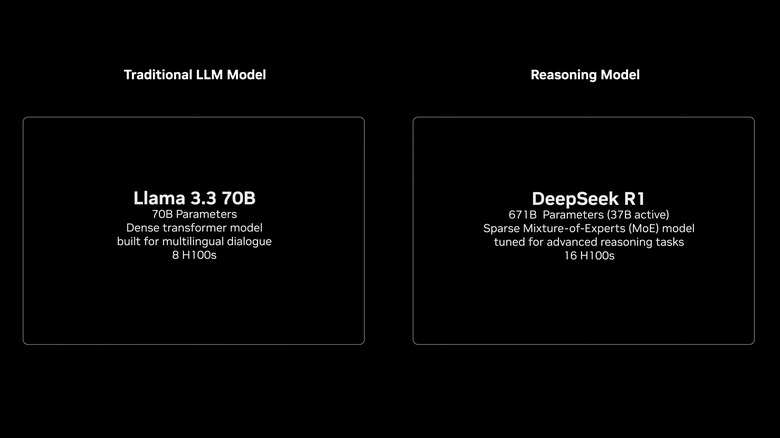
Huang comparing traditional LLM models to reasoning models.
-
Huang is showing off how a traditional LLM tackled the problem of optimizing a wedding table for seven guests, versus a newer "reasoning" model. The last-gen LLM delivered 439 tokens, but they were all wrong. the "reasoning" model deliver 8,559 tokens, but took a lot longer and more computation.
-
Yah people have learned to wait Igor, but I think they'll be more impatient if they're waiting for a virtual assistant to speak to them.
-
This problem involves having lots of FLOPS and lots of bandwidth, something NVIDIA's Blackwell system aimn
-
The chart he's showing off has two axes, one line showing tokens per second for the user and another for the factory. Basically, it's the problem of delivering AI-generated answers for users versus producing them.
-
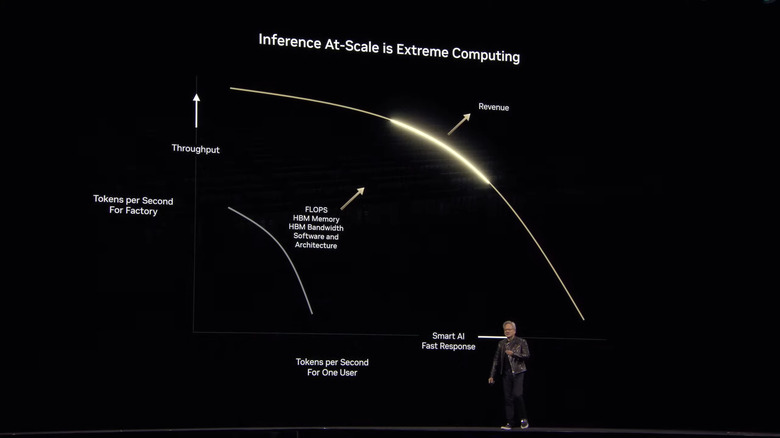
A chart on inference.
-
Huang is discussing inference at scale, perhaps the most complex computing problem NVIDIA has tackled yet.
-
I was just about to say, the amount of electricity and water required to power these systems is scary to even think about.
-
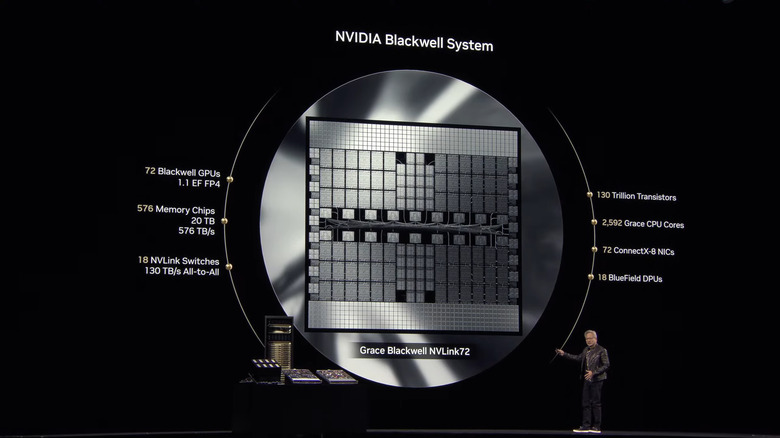
Huang showing the Grace Blackwell NVLink72.
-
Huang says there are around 20 cars worth of parts in one of its Blackwell supercomputers.
-
So much concentrated power, what's not to love? (Except for potentially disastrous environmental costs.)
-
We're seeing a deep dive into how the Grace Blackwell hardware works, in particular, we're looking at the NVLINK switches giving users access to multiple GPUs at once.
-
Dev, I don't know about you, but I love seeing all those GPU clusters.
-
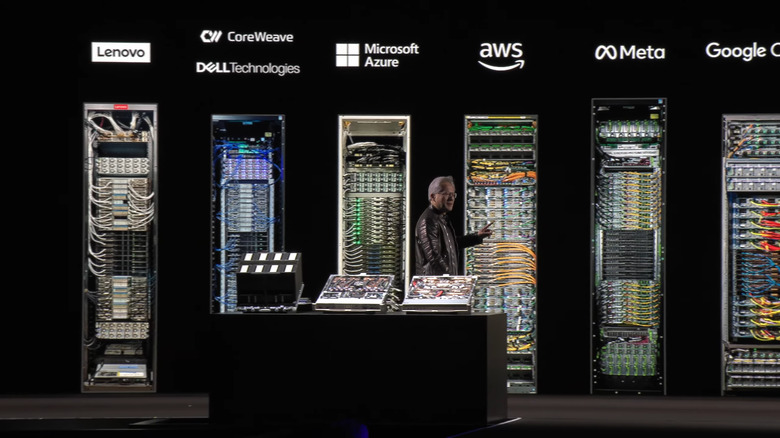
Huang showing Blackwell data centers.
-
He says NVIDIA's Grace Blackwell solution is in full production. Sounds like we'll be hearing more about what's next soon.
-
And now we're moving onto everyone's favorite topic: data centers!
-
We're watching a promo video showing how NVIDIA Omniverse and Cosmos has been training self-driving solutions.
-
It's true, there are a lot of issues with the self-driving car industry, but NVIDIA has definitely been chipping away at it. Personally, I'm for anything that makes the hellscape of driving safer for us.
-
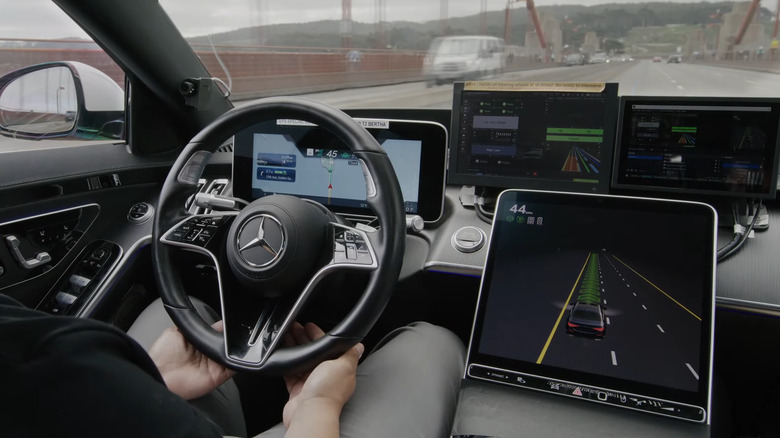
Video now showing on how Cosmos works.
-
To Huang's point, the work NVIDIA has done on self-driving cars really does go unnoticed.
-
"We're the first company in the world, I believe, to have every line of code safety assessed," Huang says.
-
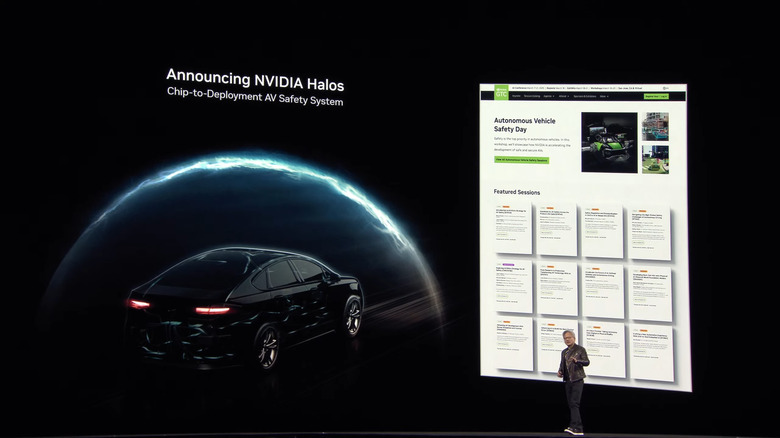
Huang is announcing NVIDIA Halos.
-
Huang is announcing NVIDIA Halos, which is an AI solution focused on automotive safety.
-
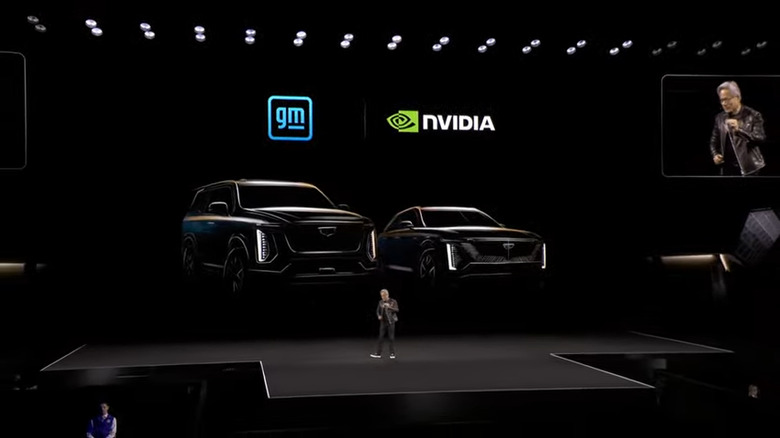
Huang announces a partnership with GM to put NVIDIA AI technology in the company's autonomous vehicles.
-
"The time for autonomous vehicles" has arrived. I feel like we've heard that said by many different people every year for the last decade.
-
GM has partnered with NVIDIA to build GM's future self-driving fleet. Again, we'll see.
-
Hmm. "AI is going to go into every industry," yet the pie chart only has six industries listed.
-
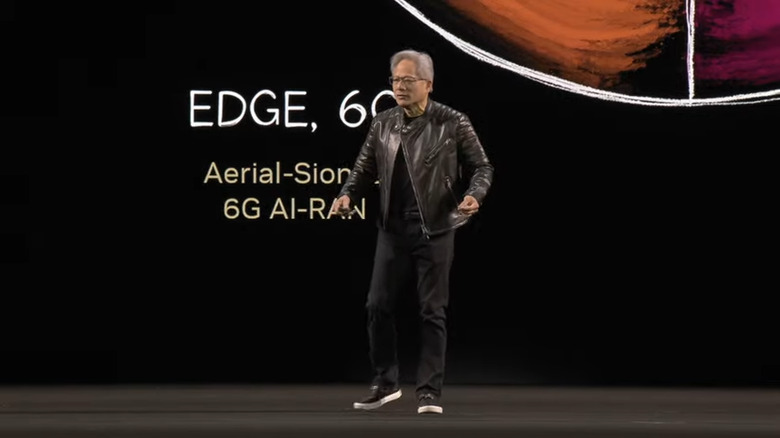
Huang is providing details on how AI can help mobile wireless networks.
-
Huang says NVIDIA, Cisco and T-Mobile are partnering on a "full stack" 6G AI-RAN solution. That's all about AI edge computing.
-
You're right Igor, it's the thing AMD can't quite touch.
-
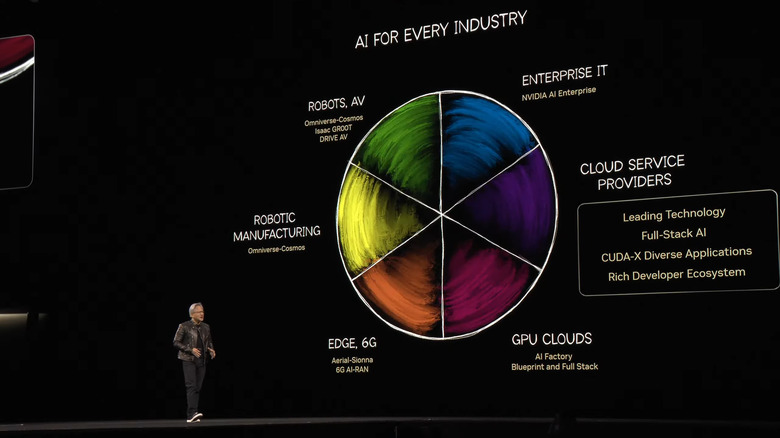
Huang discussing AI for every industry.
-
If you joined us for the preshow, a question was asked about what NVIDIA's "moat" around its castle is, and if you ask me, it's CUDA. So it's not surprising to see Huang spend some time talking about the platform now.
-
Now we're focusing on AI proper. Huang points out that AI started in the cloud, because cloud datacenters had the infrastructure to support it.
-
It's strange to think we've been counting CUDA cores in graphics cards for two decades.
-
Now we're watching an ode to CUDA, NVIDIA's parallel computing cores that arrived in 2006.
-
"This is just a sampling of the libraries that made possible accelerated computing," Huang says. All of these libraries rely on NVIDIA's CUDA cores to do their work, and of course, those are the key to their GPUS.
-
If my posts stop making sense, it's because my cat Celine has joined the liveblog. So apologies for that in advance.
-
OpenAI and Softbank teamed up for a $500 billion AI data center venture

OpenAI CEO Sam Altman appears during a news conference with U.S. President Donald Trump in the Roosevelt Room of the White House on January 21, 2025. (Photo by Andrew Harnik/Getty Images)
As a reminder, OpenAI and SoftBank announced in January that they have teamed up to establish a new company called the Stargate Project to build AI data centers for the ChatGPT maker. According to their announcement, it will "secure American leadership in AI" as well as "create hundreds of thousands of American jobs." SoftBank will finance the project, while OpenAI will be in charge of its operations. Masayoshi Son, the CEO of SoftBank, will serve as its chairman.
Several other companies are involved in the initiative too. From our article:
"In addition to OpenAI, Arm, NVIDIA, Oracle and, of course, Microsoft will be its key initial technology partners. The company's official announcement says OpenAI, NVIDIA and Oracle will work together to "build and operate this computing system," though it didn't expound on what that means."
Read more on the Stargate Project and its data center buildouts.
-
At this point Huang is well into industries beyond me, but he says this is the first time they're anounced cuDSS for computer
-
There's also cuOPT for decision optimization, something NVIDIA will be open-sourcing, as well as Earth-2 for weather nnalytics and MONAI for medical imaging.
-
Huang is discussing CUDA X libraries, AI acceleration for multiple industries. That includes cuPYNUMERIC for NumPy. He believes every company will have two factories in the future, one for their products and another for AI math.
-
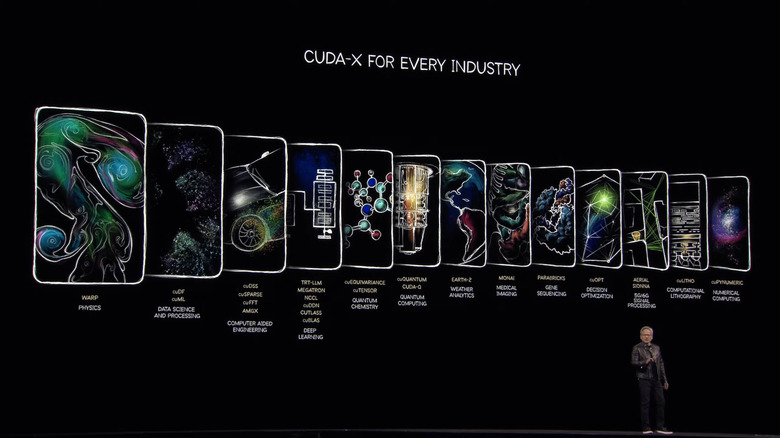
Huang talking about the libraries used among different industries.
-
To Huang's point, OpenAI's Kevin Weil recently predicted AI will surpass human coders by the end of the year.
-
We're also transitioning from using software that's mostly written by humans, to software being run by AI models. "In the future, the computer is going to generate the tokens for the software... and not [be] a retriever of files."
-
Provided OpenAI can find the capital, a big part of that $1 trillion will come from the company's Stargate project with Softbank.
-
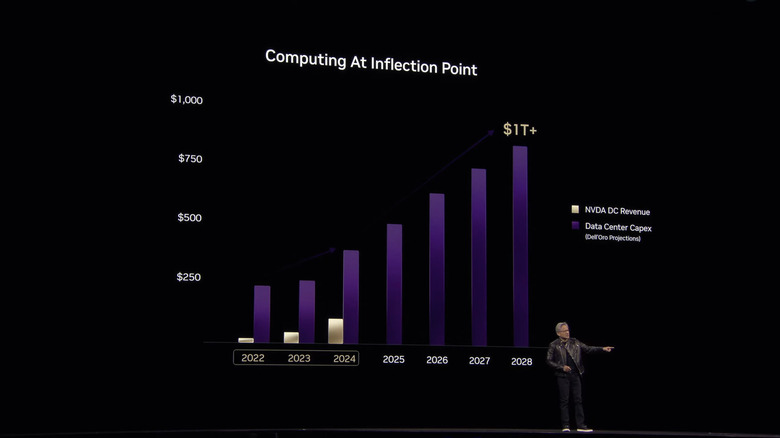
NVDA DC revenue since 2022.
-
He expects datacenter build-out to reach $1 trillion soon.
-
AI has become more useful because it's "smarter and can reason," he says, and it's becoming more used. The amount of computation necessary to train those models and inference them has also grown significantly.
-
Speaking of context, something tells me all of this is leading to Huang announcing NVIDIA's new architecture.
-
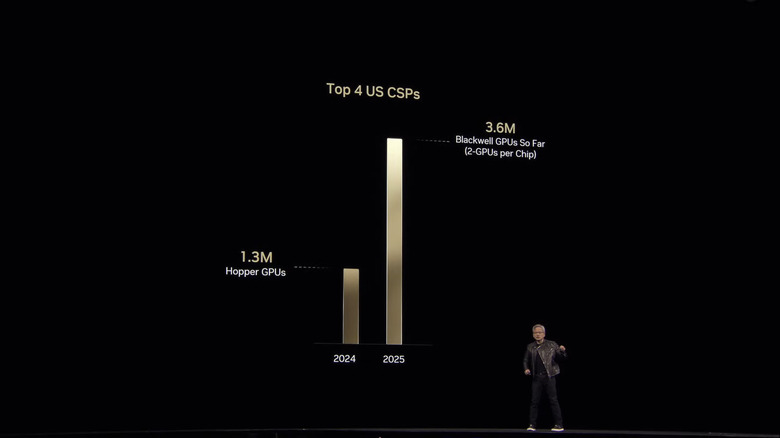
Top four US CSPs.
-
Huang is now discussing alternative ways to self-train models, specifically, synthetic generation based on running known tasks like Sudoku.
-
In speaking to some AI developers, I've also heard that sometimes it's useful to limit how much "context" a reasoning model can access. Like humans, reasoning models can "overthink" problems.
-
"There's only so much data and so much human training we can perform."
-
"The amount of computation we have to do for inference is dramatically higher than it used to be," Huang said.
-
We really have to stop using words meant for human consciousness and learning when it comes to AI.
-
That's what all of these companies are referring to when they talk about "reasoning" models.
-
You may have heard of "chain-of-thought" models, that's what Huang is talking about right now. They're at the forefront of AI technology, with OpenAI o3-mini being an example of one.
-
And that's a great point, Igor. Training is a better term than "learning."
-
Now we're getting a primer of how you scale AI. AI relies on data as a computer science problem, but then you have to worry about training and scaling the AI models you build.
"The scaling law of AI is more resilient, and in fact hyper-accelerated," he says, after claiming the industry got the computing demands wrong last year.
-
I want to point out how AI models "learn" is fundamentally different from how we as humans learn.
-
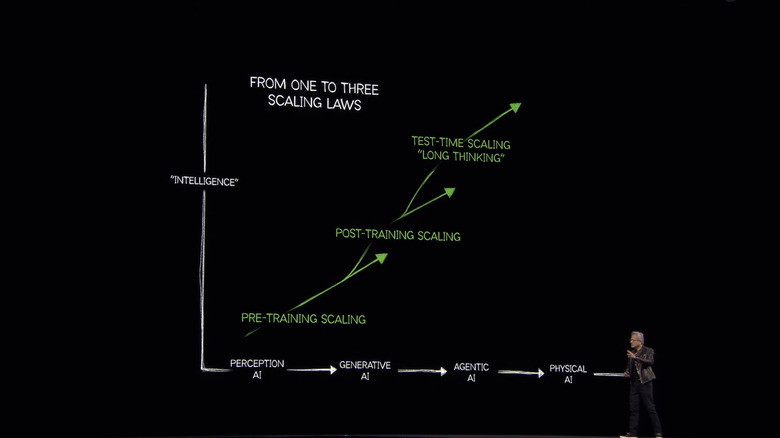
Huang discussing "scaling laws."
-
He says GTC used to be called the Woodstock of AI, now it's the Super Bowl of AI. There's that wishful thinking again.
-
Not many fans of San Jose, it seems.
-
"Each one of these waves opens up new market opportunities for us," Huang says. Hurray for market opportunities, folks!
But seriously, Jensen once again seems a lot more excited than the crowd he's speaking to.
-
Reasoning is a new capability in the Agentic AI era, he says. That's a strong word to use for slightly better generative AI.
-
And there's your first mention of agentic AI.
-
Now we're in the Generative AI phase, but according to Huang's chart, we're heading to an Agentic AI era, followed by Physical AI. And that's where robots come in.
-
"AI really came into the world's consciousness about a decade ago," it started with Perception AI and computer vision, Huang said. It's either to forget a lot of computer vision technology led directly to today's AI tools.
-
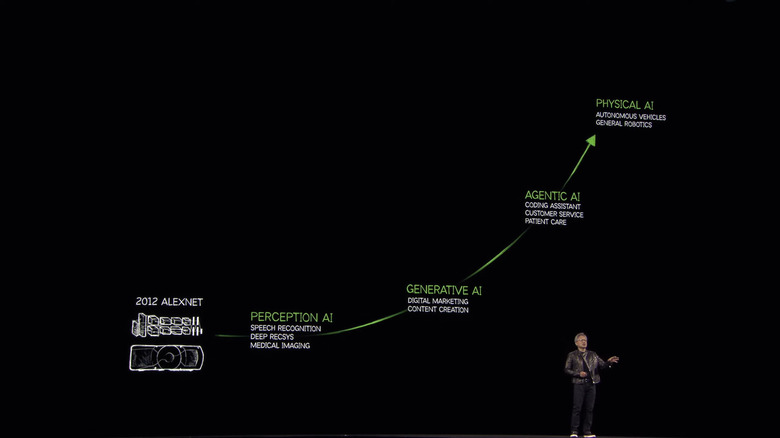
NVIDIA CEO Jensen Huang discussing how AI has evolved.
-
So far, most of this is a repeat of Jensen's CES presentation. We saw this Assassin's Creed path tracing demo then too.
-
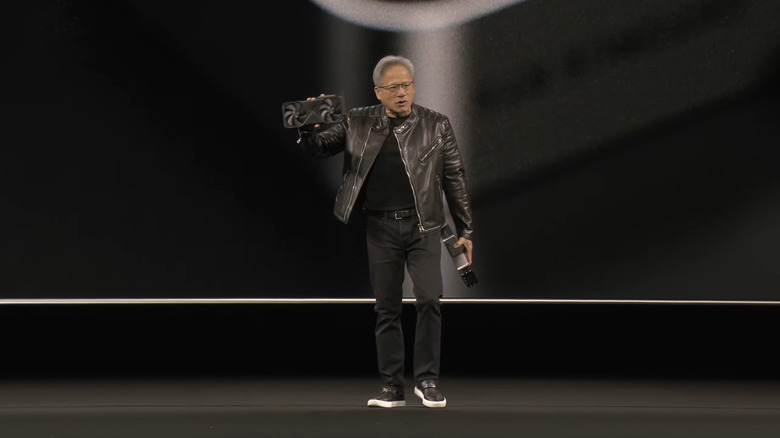
NVIDIA CEO Jensen Huang on stage at the GTC AI conference.
-
Well, you know it's easy to sell out of an GPU when you don't have much stock to sell in the first place.
-
Today's jacket? Simple, clean, better than snakeskin.
-
Jensen Huang is on stage, and he says he's doing with "without a net," meaning no script or teleprompter. The guy's a good public speaker, but can he make NVIDIA's AI dreams interesting to watch? We'll see!
-
What do we think of today's leather jacket?
-
The NVIDIA GTC AI conference has officially started.
-
"We wanted to do this at NVIDIA, so through the magic of artificial intelligence, we're going to bring you to NVIDIA's headquarters." Cue delayed video transition.
-
You know, they had me almost drinking the token Kool-Aid until the prosthetic arm bit.
-
This short intro really shows off the wishful AI thinking we've been talking about. Hopefully tokens and NVIDIA's AI technology can actually do all these things, like power robotic arms. But we're still waiting for proof.
-
We're watching an ode to tokens, which I think is very close to what we saw ahead of NVIDIA's CES keynote.
-
Here we go!
-
Looks like we're running a few minutes late here. I wonder if Jensen is freaking out about the on-stage speaker audio as he did during our CES media breakfast. (That poor audio engineer sure took a thrashing!)
Oh and yes, I'm personally a tee-eye guy too.
-
Sorry, Dev. Tee-Eye all the way.
-
Either works!
-
Wait so is it Tee-Eye or Tie because I'm a "Tee-Eye" girl.
-
They can say "en-vidia" or "in-vidia" in my book! But let's keep "nuh-vidia" out of here.
-
Did we just see another "Tee Eye" vs "Tie" moment with someone on the preshow pronouncing NVIDIA as "En-vidia"?
-
I think they meant Demis Hassabis, the CEO of DeepMind. But yes, I'm also hungry.
-
Did they say that Jensen stopped by with Denny's... Because now I'm hungry again.
-
The hosts are from the Acquired podcast by the way. It's always interesting when independent podcasters get tapped to work for companies they cover!
-
It looks like we're about to start.
-
Dell killing the XPS name is an unforced error
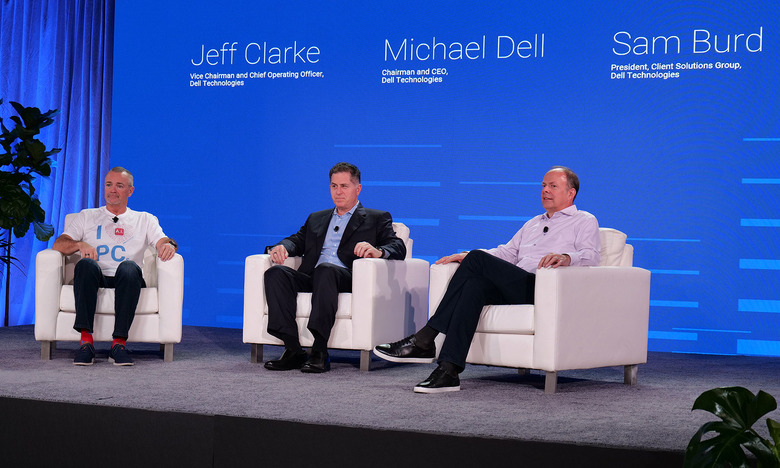
At a CES 2025 preview in early December, Dell leadership including CEO Michael Dell and President Sam Burd shared news of the company's big PC rebranding.
Michael Dell's appearance on the pre-show was interesting, to say the least, but it also reminded us of Dell's controversial announcement at CES 2025 in January. Devindra and our senior reviewer Sam Rutherford teamed up on a piece about how Dell deciding to get rid of the XPS brand name was "an unforced error."
In fact, Devindra said then:
"The company's argument that this name change is all about simplicity falls apart once you start looking at sub-tiers for each brand. "Dell Pro Max" seems clear enough, but when you try comparing "Pro Max Plus" and "Pro Max Premium" systems, all logic is lost. We've launched ourselves out of the orbits of normal consumers and towards over-priced consultants who likely suggested this name change. Doesn't Max already mean best?"
Read more on why Dell's decision to kill the XPS brand is a mess.
-
Bingo!
-
Speaking of Michael Dell, I think the fact he's being so vague about his response to the question of what AI workloads he uses is really telling. Truly, we're still at the "magical thinking" stage of the AI hype cycle.
-
The hosts ask Michael Dell what AI features he uses personally, and he says "All of them!" Really sounds like a guy who isn't using AI tools at all.
-
I stand corrected! Jensen is about to start his keynote, according to the preshow hosts.
-
It's interesting to see Dell CEO Michael Dell at this keynote, shortly after that company's PC rebrand at CES. We weren't fans, as you'll recall.
-
RTX Voice is a part of Broadcast! But it's also a plugin that can be deployed for streams like this.
On another note, be wary of people saying "magical" around AI experiences. I've been hearing it far too much in this pre-show, and it sounds more like magical thinking than anything else. We're still waiting for AI to do the things these folks are claiming, like simplifying insurance claims for doctors.
-
Yeah, regarding his CES performance, I wonder if NVIDIA's marketing department went back to the drawing board. I think the claims the company made about the 5070 offering 4090-like performance left a sour taste for many people.
-
Ahem, you mean NVIDIA Broadcast, right?😉
-
It's also really rough to record anything in the middle of a big conference hall. These mics should be using NVIDIA RTX Voice for noise canceling!
-
Funny thing to point out: there aren't any NVIDIA devices on their pre-show table. Just two iPads.
-
Oh we'll hit 100 "agentic" shout outs, for sure. I also wonder if Jensen has chilled out a bit after CES. He was really stiff on stage, once he noticed the audience wasn't really onboard with him. And he also apologized for his performance in a meeting with press the following day. The pressure of being so dependent on the AI hype wave seems to be getting to him.
-
For anyone who has yet to tune into the livestream, former Intel CEO Pat Gelsinger made a guest appearance.
-
Dev, care for a friendly bet? How many times will Jensen say "agentic"?
-
I have a strong suspicion NVIDIA will have updates on its DRIVE AGX platform. Self-driving car tech seems to be one of the those things the company invests a lot of money into with little fanfare in return.
-
While we're waiting for NVIDIA to start, can you experts tell me — apart from GPUs, what else does NVIDIA make? ELI...25..?
-
I wonder if NVIDIA has tried to train an AI on Derek Guy's tweets? I would let that AI automate my wardrobe decisions.
-
I have to wonder if the snakeskin texture was a reference to how, at the time, it was almost the Year of the Snake!
-
Another note on Jensen's leather jacket, I must say I wasn't a fan of the snakeskin-like one he wore at CES.
-
After CES, I think he basically has to debut a new jacket for every event. Maybe he should let AI pick his ideal wardrobe?
As for what to expect, we'll definitely hear more about the company's AI ambitions, the real question is how much that will differ from CES. That was just a few months ago, and that keynote went on forever. Like Igor, I'm hoping we'll see a surprise RTX 5060 drop, and I'd love to hear more details about their future GPU architectures.
-
Hey, Cherlynn! I'm hoping NVIDIA has an update on the 50-series. So far, I think it's fair to say this has been the company's weakest GPU generation in recent memory.
-
Before we get started, any predictions on what NVIDIA will announce today? More importantly, will Jensen debut a new leather jacket?
-
Hi Igor!! What are you looking forward to out of GTC today? You're our AI reporter but also a GPU nerd right?
-
Hi everyone. Igor here. This is my first liveblog, so please wish me luck 😅
-
Yes, more on how the AI trade is faltering, please
-
It's a bit strange to me that in addition to the typical tech audience that gathers for the events we cover, there's a sizable group of people from the finance industry watching GTC eagerly too. I'm not surprised, of course. The fact that NVIDIA has been called a "Wall Street bull" is not lost on me, and even my friends and family started talking about NVIDIA in recent years. I do love this headline over atYahoo Finance though: "Nvidia's GTC event could be a 'wake-up moment' for investors as the AI trade falters."
(Disclosure: Yahoo Finance is owned by Engadget's parent company Yahoo.)
-
For a taste of what Jensen Huang might discuss or announce later today, here's our article on what we expect to see at NVIDIA's GTC AI conference. Spoiler alert: Get ready to hear the words "AI" and "Blackwell" tossed around a lot. In fact, if you wanted to make yourself a bingo card right now, I wouldn't judge you.
-
That article also says San Jose is the "land of orange sauce, fish sauce — and so much more." I support it. But San Jose is also the land of tech ventures, where Samsung has chosen to host at least two of its recent Galaxy Unpacked launch events that focused on its Galaxy AI rollout. If AI isn't the biggest topic of conversation at Huang's keynote today, I don't know what else to expect.
-
By the way, it appears GTC attendees have already descended upon San Jose and, uh, of all the articles with "NVIDIA GTC" in the headline, I have to say my favorite is "NVIDIA GTC: Where to eat in San Jose this week" — priorities!
-
If you were curious about how the RTX 5090, RTX 5070 and RTX 5070 Ti performed, you can check out Devindra's reviews, which I've linked. You should also check out his review of AMD's Radeon 9070 and 9070 XT, which he said are "hitting NVIDIA where it hurts." I'm assuming most people reading this liveblog are curious about graphics processors... And AI? Quantum computing? Stocks?
-
On our liveblog today will be senior reviewer and in-house GPU expert Devindra Hardawar, as well as our AI reporter Igor Bonifacic. It has only been about two months since NVIDIA's keynote at CES 2025, where Devindra joined a group of reporters to chat with Jensen Huang. Since then, the company has released its GeForce RTX 50-series of GPUs and Devindra has reviewed three of them. To be fair, "released" is a strong word in this case, since the number of units that actually seem to be available appears to be fairly limited, and retailers are regularly out of stock.
-
Hello and welcome to Engadget's liveblog of the NVIDIA GTC 2025 keynote. Thanks for joining us today, it's always great to virtually say hi to our readers. In just a few hours, we expect to hear from NVIDIA's CEO Jensen Huang, as he delivers his speech at what the company is billing as an AI conference for developers. That's starting at 1pm ET (10am PT), and might last for about two hours. Definitely worth scheduling a reminder to take a toilet break before things kick off.