William Wright

Engadget Editorial Policies

The unique content on Engadget is a result of skilled collaboration between writers and editors with broad journalistic, academic, and practical expertise.

In pursuit of our mission to provide accurate and ethical coverage, the Engadget editorial team consistently fact-checks and reviews site content to provide readers with an informative, entertaining, and engaging experience. Click here for more information on our editorial process.

Stories By William Wright

  • Rocketeer! flies, but not exactly out of this world

    Rocketeer! is a free in the App Store for iPhone and iPad users, and features a little rocket, perpetually moving forward through space, dodging craggy rock formations and doing what we all try to do in our real lives: get money and keep the fuel tank full. This game is a perpetual-mover, scrolling upwards with an overhead view of your tiny rocket ship. Golden coins are each worth 1 point on your score, and they spin in various formations throughout your path. Your secondary goal is to, naturally, not crash into the rocks. This task is made easier and more difficult by blue "fast-forward" icons and orange "slow-down" icons, which also are dispersed throughout the course. Lastly, in order to continue going, you must keep your fueling your rocket. The fuel comes in the form of green jewels, which you can collect while sliding back and forth collecting coins and dodging land formations. The classic arcade-style animation and controls in this game are both extremely basic, making this game suitable for kids. Your rocket ship doesn't really change appearance ever, and the backgrounds are static. The spinning coins are animated, but even they are very basic. There are two controls, a left arrow and a right arrow. You have no ability to move forward or backward in this game, just to slide left and right, while collecting and dodging things. The most challenging part of this game is trying to decide when to collect the various fast-forward and slow-down icons, and when not to. During some passes, you must be going faster, in order to reach the next fuel jewels. In other passages, you must slow down, because the course becomes more treacherous, requiring you to get left and right faster. If you go slow or fast at the wrong times, you will certainly crash and have to begin again. While the game's challenge to stay alive is solid, nothing else about this game is particularly fun. The play is just back and forth, there is no sound, there are minimal animations, and the perpetual motion without the option of moving around the screen in multiple ways, is frustrating. This game will also be frustrating to the fans of the popular 1980's comic franchise and beloved Disney movie The Rocketeer who will inevitably download this game, expecting a new riff on an old favorite, but instead getting a totally unrelated game. It is possible that accidental cross-over was the idea when naming this game, but that's doubtful. The name makes sense, in that you are a person operating a rocket, for what it's worth. With all that considered, I wouldn't say that Rocketeer! is a game that I recommend, except for young children. The simplicity of the controls should make this game fun and easy to figure out, for the youngest users of the iPhone or iPad. Otherwise, there is just not quite enough going on to hold the attention of most users, beyond the old-school arcade appeal. There are plenty of better options, if that's what you're after.

    By William Wright Read More
  • Kunin - Ninja in Training: high flying, sword swinging addiction

    Released today for iPhone and iPad users is the newest member of the "ninja cutting things up" family of games, Kunin - Ninja in Training. In the game, our little ninja perches on a single stalk of bamboo in the middle of a misty lagoon, while unseen folks throw all manner of blades at him, including throwing-stars, throwing-knives, scythes, which the little ninja must jump up to fend off with his sword, or at least avoid being hit by. The process is brutally addictive. Part of the success of this game is the simplicity. You touch either side of the screen and your ninja will jump. He can actually jump upwards 4 times, before descending back to his bamboo perch. You touch the right side of the screen, he look/slashes right, and the same thing for the left. That is the entirety of the controls. The ninja only jumps straight up, so there's nothing to consider, outside of "is the danger on the left or the right?" and to keep moving. If you park on the bamboo too long, it will sink into the lagoon and then you're all wet (aka dead). Another major success for this game is the use of sound and music. The backing track is a percussive, up-tempo, and (naturally) very Asian and appropriate to a game about ninjas. The sound effects, meanwhile, are mixed very loud and impactful, making the game even more stimulating and intense. I highly recommend experiencing this game with headphones, instead of your device's internal speakers. The music and sound effects come together occasionally, with each successful strike by your ninja being accompanied by a melodic tone that fits into the soundtrack. This was a particularly nice touch. The game offers unlimited lives (though your score does return to zero), and the music is not interrupted between tries. This only adds to the addictiveness of the game. Besides the dangerous objects, magical scrolls are also thrown back and forth, which help our ninja in various ways. Some scrolls are worth points, which earn you medals at the end of each turn. Some scrolls give you a boost in "overdrive" which makes you jump higher. Best of all the scrolls, are the scrolls that turn all the dangerous projectiles into harmless rice balls. The pace of play is very fast and requires full concentration and timing, or you will die very quickly. The game starts awarding you with wooden medals after 10 points, and continues up into the thousands, eventually awarding medals made of pearl and unobtainium. The game offers other awards for various accomplishments, such as the "Bushi Master," awarded if you can stay scoreless for 25 seconds. Because your ninja automatically strikes any danger it faces, this is particularly challenging. One of the obvious drawbacks with this game is that, simply put, it is a ninja game. Everybody loves ninjas, but a simple search for the word "ninja" in the App Store will illustrate how unoriginal it is to create a game, in which a ninja hits things with a sword. Again, it is awesome to be a ninja and to hit things with a sword, but to call the idea "saturated" would be grossly understated. That said, this game is so fun, and so well delivered, that the lack of creativity on the concept side of things is eclipsed by the playability, replayability, and general excellence of the whole package. Kunin - Ninja in Training, which is free in the App Store, is highly recommended. Controls are simple enough for anyone. It looks and sounds great. It is challenging to master, but doesn't require mastery to be enjoyed. It can entertain for as short or as long as you want; a regular turn is usually less than 10-15 seconds. Be warned, though, that it is hard to put down once you begin playing. This game is well executed and seriously addictive.

    By William Wright Read More
  • War Memory: A Battle To Remember is somewhat forgettable

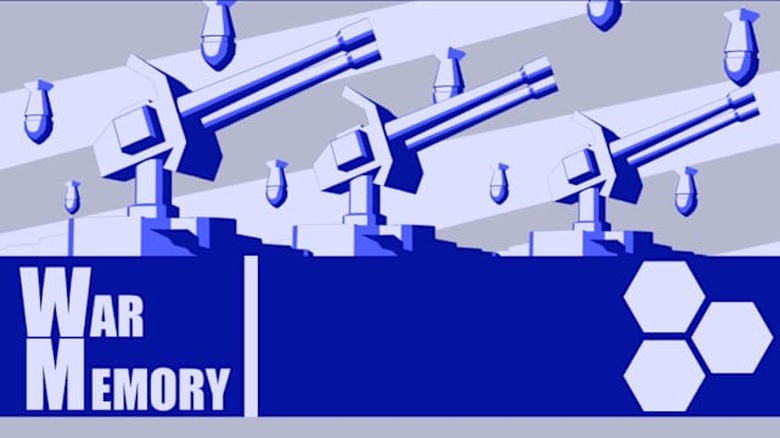
    War Memory: A Battle To Remember ranks among the most literal titles for any game in history. This game, which is free to users of iOS 6.0 (or later) on the iPad, iPod touch, and iPhone, takes the classic exercise of flipping over panels that display various shapes on the hidden side, in order to test your memory, and literally takes it into an actual war zone, thus the very self-explanatory name. The game takes place on the sandy ground in the middle of a battle. A grid of 24 hexagons lie on the ground, each of which displaying war items, such as gas masks, rocket launchers, tanks, and so on. Each turn is two flipped tiles, whether you find a match or not. If you do happen to find a match, the battle intensifies, as tiny animations of fighter planes, soldiers, or whatever you happened to match are lowered onto their respective tiles. The best, and most effective, part of this game is the intensification of the battle elements. As you collect matches, bullets fly by and loud explosions become more frequent. Especially with headphones or earbuds, this element is the part of this game that makes it uniquely challenging and interesting. The violent noises and distractions make remembering where each tile is hidden very challenging. This effect is lost, unfortunately, when the game is silenced or played with only the device's internal speaker. Another effective part of this game is that each game is best 2 out of 3, with the board shifting left or right. It is as if the person who won the last board were advancing, like an army, towards the loser. Unfortunately, this is the last of the interesting characteristics in the game. War Memory: A Battle To Remember is a fine and familiar experience, and the war elements elements are somewhat fun, but the whole thing feels disjunct, with no real link between memory and war, except that it is a head to head competition, but even that feels like a reach. The most clever thing about the game is probably the name. If you're looking for a free memory game, there's no reason not to choose this one. Beyond that, this game is kind of a head scratch.

    By William Wright Read More
  • Kelso's Quest: potential magic, serious flaws

    Kelso's Quest, which is free in the app store for iPhone and iPad users on iOS 5.0 or higher, is an adorable game about a Koala (Kelso), who is on the very disney-esque mission to recover his stolen cub, Nico. Kelso is assisted along the way by weird wombats, some of whom seem to be ninjas, some scientists, etc., who show up and do what they can to help out hero on his way. The game is played from above, in standard the "map game" aesthetic, with missions along as set, linear path, around a map/landscape. The maps, like everything in this game, is slick and gorgeous. There are occasional breaks in the action for word-bubble dialogue between Kelso and other characters. Once inside the missions, your view is still from above, but instead of linear paths, you can take Kelso anywhere you wish to go by drawing the path you want him to travel with your finger. When you do so, it shows a dotted line, similar to a treasure map, which is a really nice touch. Missions are typically passed by collecting various feathers. On the way through this down-under adventure, Kelso encounters many enemies, including totem poles that fire poison blow-darts (one hit will kill you), predatory vultures above head, weird lizards that sleep most of the time (but wake up and try to kill you), among other weird, slightly psychedelic, but lovable foes. In-between missions, the game even gives you fun facts about the real-life versions of the creatures in the game, largely focusing on Koalas and Wombats. The game starts you with five lives and you accumulate gold pieces for completed missions, side games, etc. Then the trouble comes in. It costs gold to immediately continue this game. If you inevitably run out of gold and lives, your options are pretty lame. You can either spend actual money on more imaginary gold, you can sign up for mailing lists and give personal information to advertisers in exchange for more imaginary gold, or (worst of all) you can take the free route: they make you wait long periods of time to continue with 1 new life. The first time you go this way, the game forces you to wait 10min to resume play, the next time 15min, and (if you're like me) your patience will be gone at that point. So, if you want to play a really well animated game with a well planned storyline and fun controls, Kelso's Quest is definitely the game for you, assuming you don't want to be thrown into the jaws of advertisers or forced to wait half an hour before continuing to enjoy it. A lot about this game could be excellent, but I cannot recommend it, unfortunately.

    By William Wright Read More
  • Cubot is a fun, minimalist puzzler

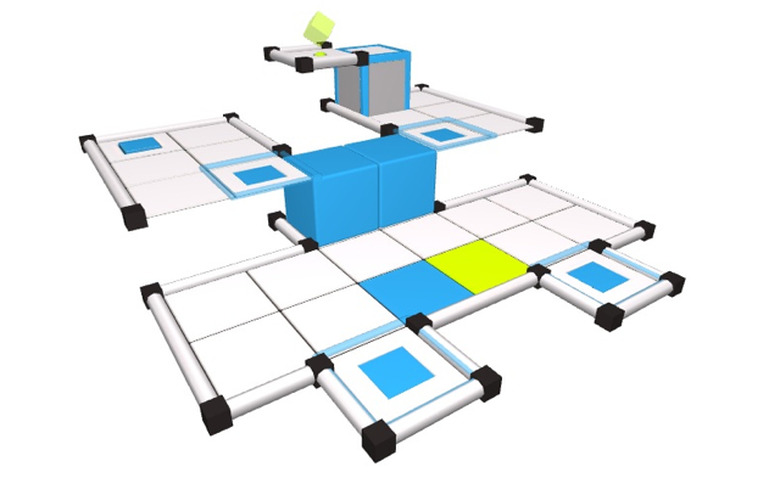
    For fans of shape-based slide puzzles, such as the Rubick's Cube and Tetris will enjoy Cubot. This game, at it's core, is simply rolling cubes around on a grid of squares, to a square that corresponds with a cube's color (the basic cubes are blue). But the difficulty comes in as cubes are added. Different colored cubes move in different ways. Even trickier, you can't simply move one cube -- all the cubes move, every time, which demands strategy and and thinking ahead. The game is broken up into 10 Episodes, each comprised of 10 puzzles. Many of the puzzles have interesting names, such as "Cube Orgy," "I love you," "Indiana Jones," and "Green Power Ranger," which I came to look forward to, as I made my way into upper levels. The increase in difficulty is gradual through the 5th episode, with the occasional introduction of new blocks that behave in different ways, and new apparatuses, such as elevators, split levels, and portals to other parts of the board. Difficulty takes a sharp turn upwards in the 7th episode. The real success in this game is its minimalism. Boards are simply comprised of grids of squares, free floating in white space. You can adjust the view of the board with simple one- and two-finger controls, and the 3D rotation of the board is very clean and exciting. Along with the minimal looks of this game is a beautiful, minimal soundtrack of ambient piano, reminiscent of Brian Eno's "Music For Airports." If there's a drawback with this game, it would be potential for repeat plays. While several of the later puzzles are challenging more than once, many of the puzzles are easily remembered. That said, the game does track your personal best, with the goal (like in traditional puzzles) being to solve in the fewest number of moves. As a whole package, this beautiful, minimal game is a ton of fun, gorgeous, and worth every bit of the $US.99 you pay for it, especially for those trying to expand their mind with very few bells and whistles.

    By William Wright Read More