

The best audio gear for students
Speakers, headphones and maybe a turntable, if you're fancy.
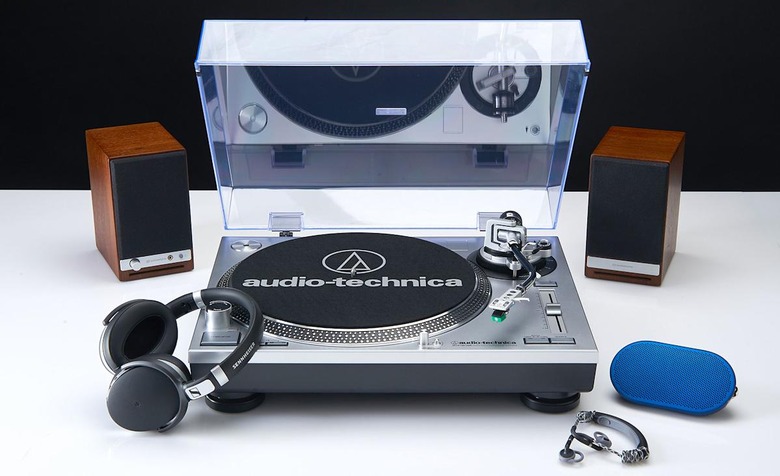
There's a strong case to be made for investing in quality audio gear at any period in your adult life. For college students in particular, though, a good set of speakers can be icebreakers as much as gateways into audiophilia. As such, we've included three options in our back-to-school buyer's guide, along with a turntable and amplifier, should you be more creatively inclined. Content to just listen to music and podcasts on the way to class? We have a few headphones you should check out, too.

Amazon - $50
Welcome to college! Get ready to be dirt poor for the next four to six years (and then some). But that’s where the Echo Dot comes in. This internet-connected home assistant leverages the power of Amazon’s Alexa assistant to do everything from play your favorite Spotify playlist and control your smart Hue lights to order you a Domino’s pizza. You just say the command. And unlike the full-sized Alexa or Google’s Home, this puck-sized smart hub costs less than a night out at the campus pub.

Audio-Technica - $299
Don’t call it a comeback. It’s been here for years, but vinyl is a tactile and social way to enjoy music. If you’re on a budget and unsure if you want to be the next big DJ or just get started on a potentially space-crushing vinyl collection, the Audio-Technica AT-LP120-USB is the perfect complement. It borrows styling from Technic’s classic 1200 series, but includes an array of modern features. For starters, there’s USB connectivity for bridging the gap to digital recording, phono and line RCA outputs, it supports 33, 45 and surprisingly even 78 rpm playback, as well as reverse play functionality. Unlike many other options out there, this deck is DJ capable with a high-torque direct drive system. So, if you want to hop on the ones and twos to get the party started, you’re good to go, but you’ll obviously need a second deck. Good thing these are relatively affordable at $300.

Audioengine - $399
Audioengine is known for its desktop speakers, but in 2017, you need your audio gear to do more than just sit pretty. The company’s $399 HD3 speakers offer both wired and wireless playback, including the analog inputs you’ll need if you’re bringing a turntable along. However, where the HD3s become even more useful in a room or an apartment is with wired headphones. The speakers have a built-in headphone amp to keep music sounding top-notch, giving you a way to blast ‘80s hair metal without disturbing your roommates. That’s a solid lineup of features if you’re willing to make the extra investment.

Bang & Olufsen - $169
By now, you’ve likely seen any of the myriad tiny Bluetooth speakers that fit your pocket. They all typically have the same problem: They sound like trash. Bang & Olufsen now has a pocketable speaker with its Beoplay P2, and this one actually sounds good. The P2 is also about the size of your phone, only thicker. That means taking it with you will seem less like a chore.
There’s a built-in microphone capable of handling the questions you pose to your virtual assistant, and the 10 hours of battery life is more than enough to power a day at the park or a late-night study session. What’s more, you tap and shake the P2 to control it, and you can customize those assignments in B&O’s mobile app.

Vizio - $215+
Wireless speakers are a dime a dozen these days, so any new contenders really need to stand out. Vizio’s Crave 360 does just that and not because it’s cylindrical frame allows it to beam sound in all directions. The speaker features both Bluetooth and WiFi connectivity, which means you can employ Chromecast Built-in to easily stream music from your phone or another device. And it will sound better when you do.
While the Crave 360 is a solid option for your dorm room or apartment, it also detaches from the charging base to become an on-the-go music box. You won’t need to make a second purchase to have mobile tunes for your outdoor activities. There’s also a touch-sensitive top panel for controlling the audio with swipes and taps while the top rotates for volume adjustments. The Crave 360 isn’t an ugly plastic box, so you won’t be ashamed to show it off when friends stop by.

Bragi - $150
Bragi’s second-generation wireless earbuds aren’t as smart as the company’s original “Dash” model, but they’re all the better for it. Instead of unnecessary fitness features, the new buds, simply called “The Headphone,” are entirely focused on delivering great wireless audio. They’re also cheaper at $149 and offer a more reliable wireless connection to your phone. They’re the ideal alternative to Apple’s EarPods though you’ll have to live with an average-sounding microphone. And since the Headphone is so inconspicuous, they’re a good choice for catching up on podcasts during that ill-advised early morning class.

Fender - $249
When you first start playing guitar, you’ll meet folks who spend hours telling you about “tone” and how to achieve the perfect sound for each song using various types of amps and pedals. The advice is wonderful information, but following it can be extremely pricey. So instead of spending thousands on amplifiers and effects pedals, you can pick up the Mustang GT 40 and get “close enough” to those perfect sounds.
The 40-watt Fender amp digitally models (read: mimics) the sounds from other amplifiers. It’s like having in your room all those amps your guitar-playing friends were telling you about. But it’s more than a sweet practice amp: Thanks to WiFi and Bluetooth connectivity, you can stream music to it and it can download new modeling profiles from artists. It’s a $249 value-packed beginner amp that gives musicians the chance to expand their sounds without busting their wallets.

Sennheiser - $199.95
If there were a sweet spot for wireless headphones, then Sennheiser’s HD 4.50 would be perched right on top of it. With active noise cancelation, NFC pairing and a solid 20 hours of battery life, these over-ear cans have everything a cable-hating music-lover wants, including a student-friendly $200 asking price.
We’re not just recommending the HD 4.50’s because of its competitive price, though. When it comes to active noise cancellation, many people look to Bose, but Sennheiser has come out fighting with this set, combining warm, crisp sound with noise-cancelling abilities usually found in a higher class of headphone. So whether you want musical motivation or just a respite from noisy classmates, the HD 4.50 should have you covered.

Sony - $348+
Much like our parents, we don’t get to choose our freshman-year roommates. And if yours is anything like mine was (he liked to fall asleep to Happy Hardcore EDM), you’re going to need an industrial-strength pair of noise-cancelling ear cans. Sony’s MDR-1000X headphones are one such pair. They offer industry-leading noise-cancelling technology, 20-hour battery life and connect to audio inputs via Bluetooth. Their Sense Engine feature is especially cool. In addition to the Quick Attention function that lets you temporarily let outside noise in -- without taking off the headphones -- simply by tapping the unit’s touchscreen. The “Personal Noise Cancellation Optimizer” will tune out the sound to your personal preferences. What’s more, the Ambient Noise function will automatically alert you to important sounds, like ambulance sirens or intercom announcements at the airport. The MDR-1000Xs are a bit pricey at around $350, but your sanity and physical safety are well worth it.

Urbanears - $99
Urbanears may not be tops on a list of audio gear options, but the company’s new wireless workout earbuds solve a major problem. There’s still a cord connecting the two earpieces, but rather than dangling in front or behind while you hit the weights or jog, the Stadion headphones wrap around the back of your head. If you need onboard controls for volume and other actions, those are here as well.
These aren’t the best-sounding wireless earbuds, but the $99 price and the rather unique design more than make up for it. Stadion is comfortable to wear during longer gym sessions and the wrap-around style means you’re a lot less likely to get caught on a piece of workout equipment. We’re all for fewer embarrassing gym fails.

Stylophone - $78 (approx)
The iconic Stylophone has been around since the 1960s. It’s weird metallic drone and stylus-metallic keyboard interface have made it a favorite of both kids and serious musicians. The Dubreq Stylophone GEN X-1 takes that original design and crams a synthesizer into the tiny silver-and-black package.
This updated Stylophone adds analog synth controls for attack and decay with adjustments for filter and delay that produce ethereal soundscapes with bite. The tiny synth also has an LFO (low-frequency oscillator) with triangle and square waveshapes for cool vibrato tones. Like its predecessor the GEN X-1 has a built-in speaker so you can sit on the couch and experiment. But the updated instrument also has a minijack audio port so you can hook it up to speakers or headphones. Coming in at under $100, the Stylophone GEN X-1 is a cheap, fun way to explore the world of synths while paying homage to one of the first consumer versions of the instrument.

Zeppelin Design Labs - $39+
The best way to learn about synthesizers is to build your own. Fortunately, a crash course in musical instrument education is affordable thanks to the Macchiato Mini Synth. This tiny instrument is available with prices ranging from $36 (wherein you build the innards and create your own case) to $96, with the tiny keyboard assembled for you. Arduino fans can take it a step further and hack the open-source software on the synth to create something wholly original. The palm-sized 8-bit gadget is controlled by a ribbon keyboard and sports an oscillator with four waveforms. And if you plan on playing with a group of friends, the audio-out port lets you connect to an amp or PA while the MIDI means it’ll work with your other electronic instruments, which is a great addition for something so inexpensive.
Echo Dot
Amazon - $50
Welcome to college! Get ready to be dirt poor for the next four to six years (and then some). But that’s where the Echo Dot comes in. This internet-connected home assistant leverages the power of Amazon’s Alexa assistant to do everything from play your favorite Spotify playlist and control your smart Hue lights to order you a Domino’s pizza. You just say the command. And unlike the full-sized Alexa or Google’s Home, this puck-sized smart hub costs less than a night out at the campus pub.