

All the news you might have missed from Google I/O 2026
Far too much AI news, and also some smart glasses.
Eyes in the tech world have turned toward Mountain View, California this week. The San Francisco Bay Area city is where Google's headquarters is located, making it a logical place to hold the company's annual developer conference. That's right, gang, Google I/O 2026 kicked off on Tuesday with the usual opening keynote, which is where the company reveals what's arguably the event's most relevant info for consumers.
Google made a ton of Android announcements last week, so its mobile ecosystem wasn't really on the agenda. But what else could the onus possibly have been on if not AI? We heard the word "Gemini" more times than I could possibly care to count, and the company had many updates to share on that front.
Search, Google's longtime bread and butter, was a big focus of the event. The company talked up a new Ask YouTube feature as well as changes to AI subscription pricing and Workspace features like Docs and Gmail.
There are many more details to go over, so let's delve into everything Google announced at its I/O 2026 keynote.
Google Search
We saw the bulk of the Android news last week, so it was time to check out what's coming to another pillar of Google's empire: Search. Perhaps the biggest change is an overhaul of the Search box, which has been the de facto front page of the internet for hundreds of millions of people for decades.
Starting today, Google is deploying "an intelligent AI-powered Search box" in all languages and countries in which AI Mode is available. The company says this will offer suggestions to users "that go beyond autocomplete," as it designed the Search box to better anticipate their intent and help them to form questions. Along with text, they'll be able to use images, files, videos and even Chrome tabs as Search inputs.
Introducing our brand new, intelligent Search box — totally reimagined with AI. This is the biggest upgrade to our Search box in 25 years and it's starting to roll out today.
Designed to anticipate your intent, the new Search box helps you formulate your question with AI-powered... pic.twitter.com/hgEI2BzhwV
— Google (@Google) May 19, 2026
Users on desktop and mobile around the world now have the option to ask a follow-up question in an AI Overview and then slide right into AI Mode. Google says that the deeper you dig, the more the links and supporting information become relevant to what you're looking for.
It's unclear as yet whether these changes will hamper workarounds that many users (*waves*) have turned to in order to avoid AI Overviews and other AI features in Search results. In any case, I wouldn't be surprised to see many more folks ditching Google Search for alternatives that offer AI-free web searches (*waves again*).
As is the way of things, Google is retooling AI Mode with yet another model change. Starting today, AI Mode will now be powered by Gemini 3.5 Flash by default. This is Google's latest Flash model (more details on that shortly).
We're bringing generative UI to everyone, free of charge, thanks to Google @Antigravity and the agentic coding capabilities of Gemini 3.5 Flash.
Search can build custom visual tools and simulations, tailored to your specific question, on the fly.
Under the hood, Search... pic.twitter.com/eb1KqRHuft
— Google (@Google) May 19, 2026
Speaking of which, Google is expanding Personal Intelligence in AI Mode. This is a feature that allows you to grant Gemini access to pull in information from apps like Gmail and Google Photos if you choose (Google Calendar integration is on the way). The idea is to enable Gemini to have a better understanding of your personal context.
Google made Personal Intelligence free for all US users in March. Starting today, it's making the tool available in 98 languages across almost 200 countries and territories.
AI agents in Google Search
Inevitably, as it's doing on Android, Google is bringing more agentic AI features to Search. Among these are information agents, which the company says can run constantly in the background to keep you updated on what you're interested in. They can seemingly keep an eye on blogs, news websites, real estate listings, social media posts and the rest of the web, as well as real-time finance, sports and shopping information to keep you up to date. (That sure doesn't sound ideal for online publications that have already seen their traffic decimated by AI Overviews and AI Mode.)
Soon, you'll be able to create and manage multiple AI agents for your many tasks — right in Search ✨
We're starting with information agents:
🔹These agents intelligently look across everything on the web, including blogs, news sites and social posts, plus real-time data on... pic.twitter.com/cVcHKrdXoW
— Google (@Google) May 19, 2026
These information agents can summarize their findings and offer actionable next steps. They'll first be available this summer to Google AI Pro and Ultra subscribers this summer.
Also this summer, all users in the US will be able to try agentic booking features in Search. Google suggests that if you, for instance, look for a private karaoke room where you'll still be able to order food late on a certain night, Search will explore the available options. It will tell you about availability and pricing, and show you where you can complete the booking. When it comes to beauty, pet care, home repair and some other categories, Google can call local businesses for you, if you prefer. The company has been working on tech like this for quite some time.
Vibe coding in Google Search
Google has a little something up its sleeve for vibe coders (and everyone else) in Search as well, as it's folding Google Antigravity into the product. As such, it says you will be able to generate custom user interfaces, such as visualizations of how things work, or whip up tables, graphs and simulations. Everyone will have access to this generative UI tool this summer and Google won't charge you for it.
Also in Search, there'll be a way to generate mini apps, such as dashboards and trackers, for certain tasks using Antigravity. Google says these can help with things like wedding planning and fitness tracking — Antigravity can harness Google data such as weather, live maps and reviews. AI Pro and Ultra users in the US will be the first to get access to this option this summer. This seems similar to the ability to create custom widgets in Android, which is something Google announced last week.
Gemini 3.5
Available today, Gemini 3.5 Flash is the new default model in AI Mode in Search for everyone globally.#GoogleIO pic.twitter.com/UhaH3fM6FO
— Google (@Google) May 19, 2026
Let's swoop back around to Gemini 3.5 for a moment. Flash is the first model that Google is releasing from this series. Beginning today, it's in AI Mode and the Gemini app for everyone, and in various tools (such as Antigravity) for developers and enterprises. Gemini 3.5 Pro should arrive in June.
Google says Gemini 3.5 Flash is its "strongest agentic and coding model yet," with the ability to help developers complete tasks "in a fraction of the time, often at less than half the cost of other frontier models." The company claims that partners such as data scientists have been using the model to garner insights from complex data.
Gemini 3.5 is less likely to generate harmful material or incorrectly refuse to answer queries that are above board, Google said. It claimed that it's employing more advanced safety measures, such as checks on the model's reasoning before it offers a response to a prompt.
Gemini Omni
Edit your own videos with Gemini Omni with just a conversation. 🎥
Prompt the changes you want to see to reimagine the action, change the point of view, or adjust the lighting over multiple turns.
Every instruction builds on the last, so your characters stay consistent, the... pic.twitter.com/irsFXVAk54
— Google (@Google) May 19, 2026
Google had another series of AI models to blab about. Gemini Omni can "create anything from any input," the company said, starting with the option to generate videos based on text, images, audio and other videos. Image and audio outputs are on the way.
This is pitched as a way for you to edit videos in a more conversational manner. For instance, Google claims that you'll be able to load in a video you shot and ask Omni to alter the environment, style, angle and other details. Because it can combine any combo of inputs "into a single, cohesive output," as Google claims, you'll seemingly be able to feed in images of characters, other scenes or drawings that Omni can use to inform its outputs.
Gemini Omni can create anything from any input, starting with video. 🪄
This means you can combine images, audio, video and text as input and generate high-quality videos.
Or use drawings to create in a way that matches your vision.#GoogleIO pic.twitter.com/JIQW7uGfAZ
— Google (@Google) May 19, 2026
The company also says you can create an avatar that has your voice and "generate videos that look and sound like you." Google notes that all videos generated with Omni will include its SynthID digital watermark to show that they were made using its AI models.
The first model to use this tech is Gemini Omni Flash, which will be available in the Gemini app and Google Flow today for Google AI Plus, Pro and Ultra subscribers. Everyone else can try it for free via YouTube Shorts and YouTube Create App this week (more on that side of things momentarily).
Gemini Spark
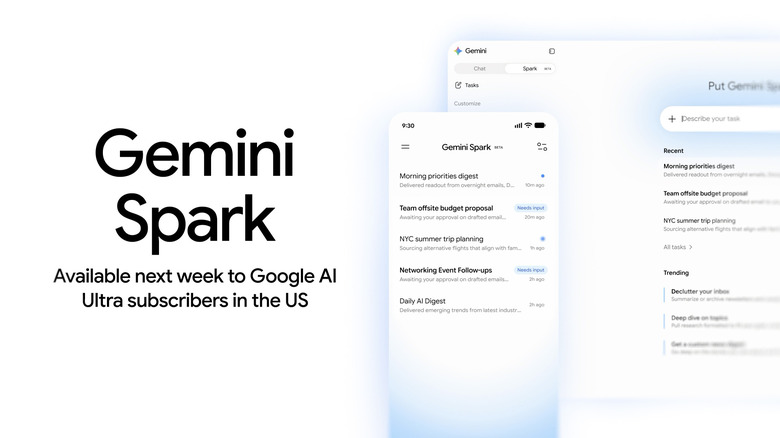
Gemini Spark is billed as a personal AI agent that can get things done for you. It runs in the cloud (so you won't need to keep your laptop or phone open for it to work) and it's based on Gemini 3.5. It can access Workspace apps like Gmail and Docs — should you actually choose to use it, of course.
Google suggests that Spark can (for instance) monitor your credit card statements for new or hidden subscription payments; track emailed updates from a child's school; and pull together notes on a project from Gmail and create a Doc with its findings. Spark will ask you for confirmation before doing something like sending an email, completing a purchase or padding out your calendar with yet another event you don't really feel like attending. Spark will be able to tap into apps from Google partners such as Canva, OpenTable and Instacart and carry out actions for you.
Trusted testers will get their hands on Spark this week and Google AI Ultra subscribers in the US will start getting access next week. Google Workspace business customers will be able to try it via the Gemini app soon. Google is also planning to bring Spark to the Gemini desktop app sometime this summer, "so it can help with tasks involving your local files and automate workflows across your desktop."
Introducing Gemini Spark ✨
It's your 24/7 personal AI agent that helps you navigate your digital life, taking action on your behalf, and under your direction.
🧠 It runs on Gemini 3.5 and is built on @Antigravity, so it can perform long-running tasks easily in the background.... pic.twitter.com/NX9CCMBGPT
— Google (@Google) May 19, 2026
Gemini app updates
On the subject of the Gemini app, Google has some updates for you there too. Along with Omni, Spark and Gemini 3.5 integration, the app is getting a visual refresh based on the Neural Expressive design language, which Google describes as vibrant and dynamic with "fluid animations, vibrant colors, new typography and haptic feedback."
The app now features Gemini Live for what Google claims is a more free-flowing chat experience with a retooled mic feature. This, the company says, will let you "tap and talk through a complex idea at your own pace without getting cut off mid-thought." In addition, you'll soon be able to pick a regional dialect for Gemini. The app will also offer responses other than text, including elements like imagery, interactive timelines and narrated videos.
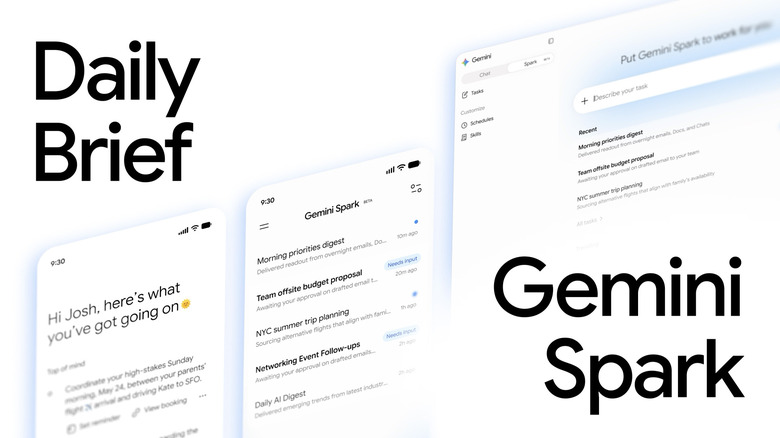
A feature called Daily Brief can give you a morning digest of what's coming up that day. If you grant it access to the likes of Gmail and Calendar, it can surface deadlines from your emails and upcoming events. Google says this AI agent will pull those details into this overview to remind you of what's on your plate. Daily Brief can suggest follow-up actions too. Google AI Plus, Pro and Ultra subscribers are the first to get access to this feature, starting today.
Ask YouTube and Omni for Shorts
YouTube Premium members in the US now have access to a new feature called Ask YouTube, which will be available to all users soon. Google is billing this as — what else? — a more conversational way to search YouTube. For example, it suggests that you can look up tips on teaching a child how to ride a bike or a creators' suggestions of cozy games to play in the evening.
"Ask YouTube will compile the most relevant videos across all of YouTube's catalogue — including long-form videos and Shorts — and provide an interactive, structured response," Google says. There's the option to refine the results with follow-up questions too.
With Ask YouTube, we're bringing a new conversational search experience to @YouTube.
Type your question, and get both relevant videos alongside text in an interactive, structured response.
Rolling out this summer in the U.S. to start.#GoogleIO pic.twitter.com/qB3mgyuxEU
— Google (@Google) May 19, 2026
As noted above, Omni will be available starting today in YouTube Shorts Remix and the YouTube Create App. Google says folks can use this to remix Shorts by adding themselves into videos alongside creators or changing the aesthetic to one from an earlier era. These remixes have AI labels and SynthID watermarks. The link back to the original video too.
Creators will be able to opt out of allowing others to remix their Shorts in this way. All creators aged 18 and older will have access to YouTube's likeness detection tool, which is said to help them manage their likeness on the platform.
AI voice feature for Gmail, Docs and Keep
Google is jamming more AI features into Gmail, Docs and Keep as well. Google says you'll be able to search your inbox using natural voice prompts with Gmail Live. It says you can ask about things like the gate number for your flight or what's happening at your child's school, and Gmail Live will delve into your emails to find the answers.
Docs Live will seemingly be able to convert your speech into a cleaner first draft of a document by arranging and structuring your thoughts. If you grant it permission to do so, the tool will be able to pull in relevant information from Gmail, Drive, your chats and the web. On a similar note, Google says Keep Live can organize rambling speech into structured lists and notes.
We're bringing conversational AI to more products 💬
With Docs Live, you'll be able to create a new doc and edit it — all with your voice. Just speak what's on your mind, and let Gemini do the rest.
These new conversational features in @Gmail, @GoogleDocs and Keep are rolling... pic.twitter.com/x5owR0U78s
— Google (@Google) May 19, 2026
Google AI Pro and Ultra subscribers will be the first to gain access to these features, which the company is starting to deploy. Google Workspace business customers will be able to start using them this summer.
Plus and Pro subscribers in the US can also start using Gmail's AI Inbox tool today. Google AI Ultra subscribers and Google Workspace Enterprise Plus customers already had access. Google is adding new features to AI Inbox today too, such as personalized draft replies, an easier way to manage tasks (such as by using a single click to mark all emails in a certain topic as read) and seemingly instant access to relevant files from Google Docs, Sheets and Slides.
Google Pics
Google Pics is a new app that's not to be confused with Google Photos. This one is built on the most recent Nano Banana model and it's all about image generation and editing. Google suggests that you can use it to design flyers for events and social media images (sorry, Canva), and to edit photos. The company says it's a cinch to move, resize or replace individual objects without impacting the rest of an image. You'll be able to edit and translate text in photos too.
Pics is integrated into Workspace apps. As such, you can use its capabilities to tweak images directly inside the likes of Drive and Slide. A small group of trusted testers are the first to gain access to Google Pics today. Google AI Pro and Ultra subscribers and Google Workspace business customers will start getting access this summer.
More ways to detect AI-generated or modified content
Google is looking to make it easier for people to find out if an image or video was generated with AI using its SynthID watermarks. Verification tools are becoming available more broadly in the likes of Search, Gemini, Chrome, Pixel and Cloud.
Starting today, you can use Gemini in Chrome and tools in Search such as Lens, AI Mode and Circle to Search to verify where an image came from. Google says that you can simply ask "Is this made with AI?" or "Is this AI generated?" and if the image was generated using Google's tools, it should tell you.
As generative media becomes more advanced, it's helpful to know exactly where content comes from — and if it's been changed. 🕵️
Today, we're expanding content verification tools across Search, @GeminiApp, @GoogleChrome and @MadeByGoogle.#GoogleIO pic.twitter.com/wZueMoUFRX
— Google (@Google) May 19, 2026
The company is adding verification for content that's watermarked with C2PA Content Credentials (an industry standard) as well. It says this can help you check whether an image or video was modified after it was captured with a camera, and what tools were used to change it. The Gemini app will be able to do this starting today, as will Search and Chrome in the coming months.
Google also noted that Pixel 10 already supports Content Credentials for images via its native camera app. Pixel 8, 9 and 10 phones will start integrating Content Credentials into video captures in the coming weeks to help folks distinguish authentic footage from AI-generated fluff.
Meta will start applying Content Credentials labels to photos and videos captured on a phone's camera in Instagram. Google also says that "authentic photos and videos shot natively on Pixel phones will soon be recognized and labeled as such when you share them on Instagram." In addition, Google noted that companies including OpenAI, Kakao and ElevenLabs are integrating SynthID watermarks into AI-generated material.
Google Play
When it comes to Google Play, the company is introducing a feature called Ask Play. This is an AI-powered chatbot (of course) that Google says you can have a conversation with in order to get tailored app recommendations. A tool called Ask Play highlights will summarize complex searches on the results page with the aim of directing you to apps and games that suit your needs faster.
An in-game overlay for Google Play titles called Play Games Sidekick is expanding with the addition of social features. Beginning in June, you'll be able to view your friends' achievements from the overlay and see who is playing the same game as you.
Universal Cart
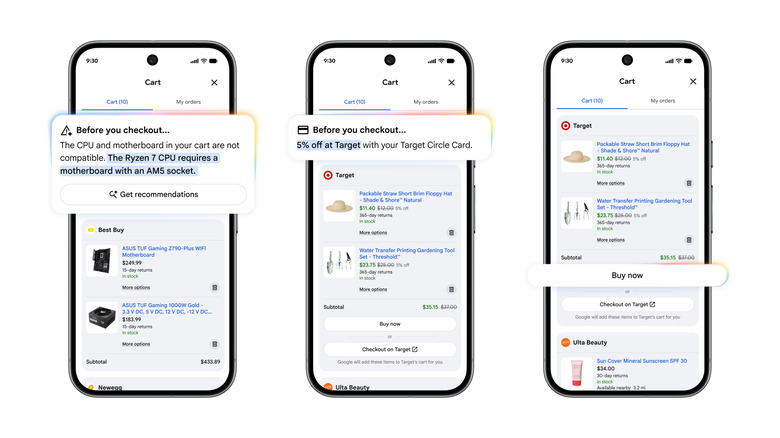
Elsewhere, Google is making a lot of updates to Shopping. Among these is what it's calling an intelligent shopping cart. This feature, dubbed Universal Cart, will allow you to add items to your cart from Search, Gemini, YouTube and Gmail, among others. When you add an item to your cart, the tool will look for deals, price history information and restocks.
Google says the cart can flag incompatibility issues, such as for components that won't work together if you're building a PC (at least if you're actually fortunate enough to be able to afford that given the skyrocketing prices of memory, GPUs and CPUs — ironically a result of AI companies driving them up). If the cart detects that parts are incompatible with each other, it will suggest alternatives.
Universal Cart was built using Google Wallet, so it will already understand your payment preferences. Google says it will be able to take advantage of loyalty programs and offers from certain retailers too.
You'll be able to complete your purchase directly using Google Pay in many cases. Otherwise, you'll be redirected to a seller's website to check out. Folks in the US will be able to start using Universal Cart across the Gemini app and Search this summer. Gmail and YouTube will be factored in later.
Updated pricing for AI plans
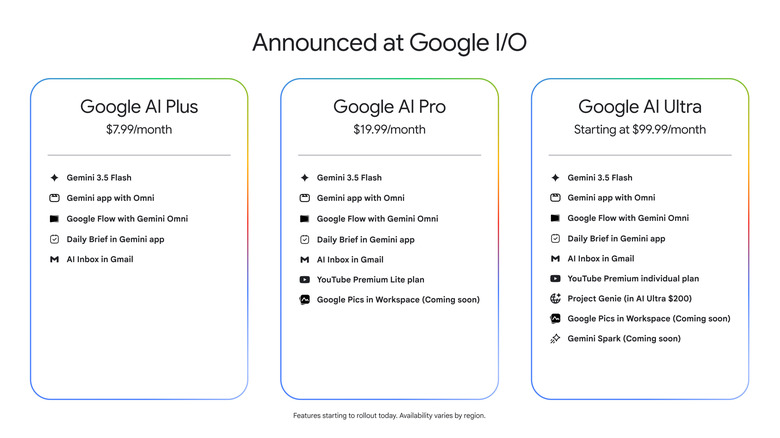
It's worth knowing how much it'll cost to access many of these features. There's now a second, lower tier of the Google AI Ultra Plan, which costs $100 per month. This includes a five times higher usage limit of Google Antigravity and the Gemini app than the $20 per month Pro plan, priority access to Antigravity, 20TB of cloud storage, YouTube Premium and more.
Google also reduced the price of its highest-end AI Ultra plan from $250 to $200 per month. This has all of the same features, along with a 20 times higher usage limit of Google Antigravity and the Gemini app than the Pro plan (four times more than the $100 AI Ultra plan).
Project Genie
This is the one thing that's exclusively available to those on the highest-end AI Ultra Plan. At least to begin with, those on the $100 tier won't have access to Project Genie.
Google introduced Project Genie, a tool that enables you to create custom 3D interactive worlds, as a research preview in January. The company is now making it available to all subscribers of its $200 plan who are 18 and older, though it's still designated as an experimental research prototype in Google Labs.
Project Genie also has a new feature, in that it integrates real-world imagery from Google Street View. As such, you can generate worlds that are based on real places in the US and, for instance, apply a different style to them (perhaps you want to cover a landscape in snow or plunge it underwater). You'll be able to generate a character with which to explore this environment too. Google says this update will enable "our models to anchor themselves in reality" as it can offer "a virtual environment for AI agents or robots to navigate and interact with the complexities of the real world."
Android XR

On the Android XR front, Google and Samsung offered up a first look at two models of smart glasses that they collaborated on with Gentle Monster and Warby Parker. They feature the ability to chat with Gemini using your voice. You can ask the assistant for help with navigation and suggestions for a place to stop for a snack or beverage.
They also offer real-time audio translations in the speaker's voice and a way to change the language of text in the camera's sightline. You can snap photos with them as well (which may not exactly sate the concerns of those worried about smart glasses users invading their privacy). These models will be available this fall in certain markets. Pricing and other details will be announced in the interim.
Since the keynote ended, our senior reporter Karissa Bell has managed to get hands-on time with Google's latest reference hardware for the platform, as well as the Xreal Project Aura, which is one of the first Android XR smart glasses.
Wear OS lives!
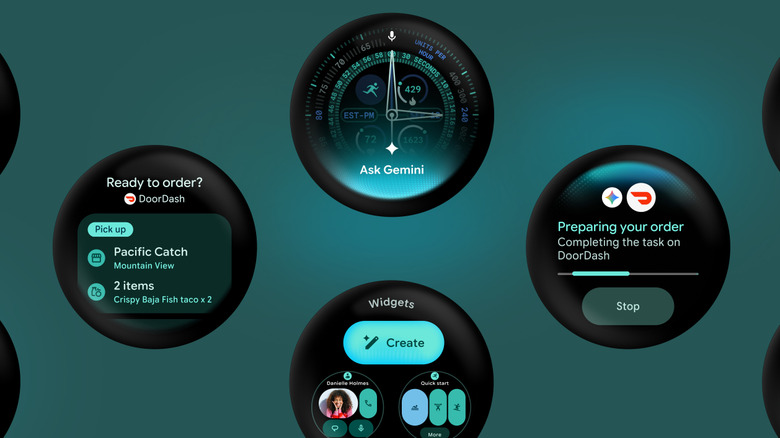
Google only made a passing mention of Wear OS during the I/O 2026 keynote, but the company actually had more announcements to share about its wearable software platform. In addition to carrying over some of the design updates coming to Android 17, Wear OS 7 will set a foundation for Gemini Intelligence. It also adds what Google is calling "Wear Widgets." These are basically more customizable and dynamic versions of the tiles that have been the backbone of Wear OS, and will mirror their counterparts on phones. Wear OS 7 will allow for the AI-powered "Create My Widget" feature that was introduced on Android and Googlebooks last week to work on watches as well.
You can already play around with a test version of the new platform on the Wear OS 7 emulator, and the software is set to roll out more broadly later this year.
Gemini for Science
Google closed out the I/O 2026 keynote presentation with a summary of the Gemini for Science program, which offers "a collection of science tools and experiments designed to expand the scale and precision of scientific exploration." These include some "experimental tools" in Google Labs, collaboration with more than 100 institutions from Stanford University and Imperial College London to The Crick Institute. Google also unveiled a set of Science Skills that can be integrated into agentic platforms like Google Antigravity, making it easier to work with and analyze information from databases and tools like UniProt, AlphaFold Database, AlphaGenome API and InterPro.
The bulk of the most immediate Gemini for Science tools seem to be three primary prototypes in Google Labs, designed to help researchers with hypothesis generation, computational discovery and literature insights. Access to these experiments will gradually open up to interested parties starting today, and you can register on Google's website for the Labs features.
Update May 20 2026, 3:10PM ET: This article was updated to add links to our Android XR hands-ons.