FlashMemory
Latest
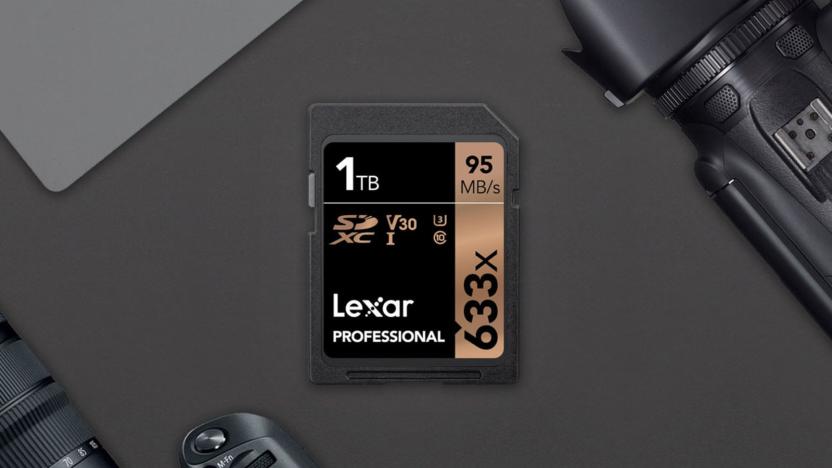
Lexar will sell the first ever 1TB SDXC card
Lexar has unveiled the first ever 1TB SDXC flash memory card for cameras that will actually go on sale to the public, the Professional 633x. It's a UHS-I rather than a much faster UHS-II model, but runs at the top limit for a UHS-I card at 95 MB/s (class 10). That should be fast enough for most cameras to capture 4K video (class V30) and a long burst of RAW photos.

Toshiba's chip drama ends with sale to a financial group
The long-running bidding war over Toshiba's flash memory business has effectively come to an end... and the winner probably isn't who you expected. Toshiba has agreed to sell its NAND division to a group led by the private equity firm Bain Capital for the equivalent of $18 billion. This isn't going to please Western Digital, Toshiba's partner in the US, but Toshiba expects the deal to survive any legal battles. The question is why -- and whether or not Toshiba's eagerness to sell might cost you in the long run.
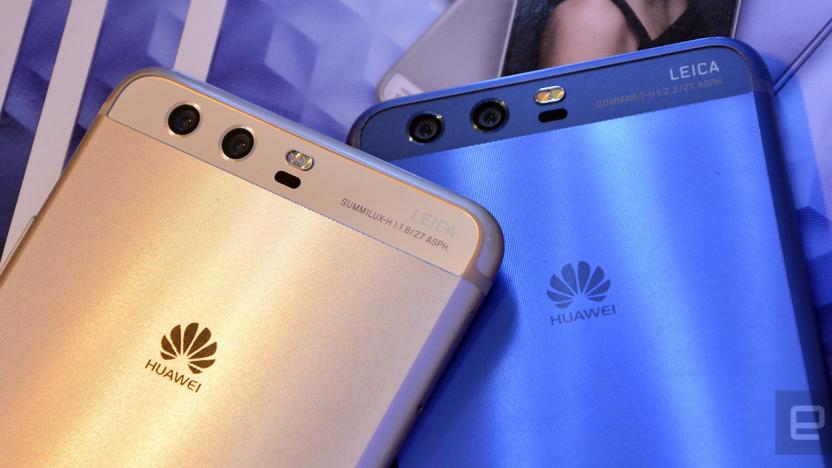
Huawei blames slower P10s on memory shortage
Memory speed isn't always something that one would pay attention to when buying a smartphone, or at least you'd expect the latest flagships to come with the fastest options available at the time, but it turns out that this isn't necessarily true. Recently, some Huawei P10 and P10 Plus users in China noticed that they were only getting eMMC 5.1 memory speeds on their devices. For instance, the sequential read speeds were in the ballpark of 250MB/s on AndroBench, whereas the luckier folks who got UFS 2.0 or 2.1 chips on their phones managed to hit around 550MB/s or even 750MB/s (our very own international unit got 786.67MB/s). Indeed, Huawei never specified the type of flash memory on its P10 spec sheets, which led to speculations that the mobile giant was intentionally misleading consumers.

Flash-based drives may soon be as cheap as the spinning kind
If you've noticed that solid-state drives (and the PCs that include them) no longer cost an arm and a leg, you're not alone. Researchers at DRAMeXchange understand that the price per gigabyte of an SSD has fallen off a cliff in the past three years, and the trend is only accelerating. If the company's estimates are on the mark, these drives could cost just 11 cents more per gig than conventional hard drives by 2017. At that rate, you might not have to choose between high capacity and breakneck speed when you're on a budget -- you could easily afford both.

Samsung can put 128GB of storage in your low-cost phone
Just because you're not splurging on a top-of-the-line smartphone doesn't mean that you have to settle for a tiny amount of storage. Samsung certainly thinks that way -- it just announced a 3-bits-per-cell flash memory chip that promises 128GB of storage in "mass market" (read: more affordable) mobile devices. It's based on the plain eMMC tech you see in most phones instead of the fast UFS format inside the Galaxy S6, but you probably won't complain about the speed when it can still read sequential data at a very respectable 260MB per second. The one catch? There's no word on when it'll be ready, so you may be waiting a while before you're carrying a budget phone with more drive space than some laptops. [Top image credit: Samsung Tomorrow, Flickr]

Samsung wants to put 128GB of fast storage in your next phone
It's no longer hard to get a hefty 128GB of storage in a smartphone, but that doesn't mean you'll enjoy it. What's the point of all that extra space if your phone chugs handling huge games and 4K videos? Samsung has clearly anticipated this problem, though -- it just outed the first 128GB flash memory chip based on the speedy Universal Flash Storage standard. The part uses tricks like command queuing and a serial interface to give you the kind of breakneck performance you'd expect from a solid-state drive in a PC, not a device that fits in your pocket. It's about 2.7 times faster at random data reads than the flash you see in many high-end phones, while its sequential speeds are "up to SSD levels." And that's while using 50 percent less power -- you won't have to take a hit to battery life.

Toshiba to buy OCZ's assets for $35 million, eyes solid-state supremacy
OCZ's memory technology won't fade into obscurity after all -- Toshiba has agreed to buy the ailing company's assets for $35 million through a bankruptcy auction. As long as the bid wins, Toshiba expects to acquire OCZ's solid-state drive businesses in January. The deal also supplies the financing that OCZ needs to fulfill customer orders during the transition. It's a quiet end for the once-popular storage brand, but the buyout is undoubtedly good news for Toshiba. The Japanese tech giant can now augment its SSD lineup with OCZ's controller chips and flash memory supply; if future Toshiba SSDs outperform their rivals, you'll know who to thank.

Crossbar's RRAM to boast terabytes of storage, faster write speeds than NAND
Hardware makers often sing the praises of their latest and greatest flash memory, but the folks at Crossbar are ready to show them up with resistive RAM (RRAM) that they've been quietly working on. Compared to NAND, RRAM comes in at half the size and boasts 20 times faster write speeds (140MB/s), reads data at 17MB per second, guzzles 20 times less power and has 10 times more endurance. Since RRAM is non-volatile memory, it can keep data even when it's powered off, á la NAND. As if that weren't enough, 3D stacking construction allows for several terabytes of storage, endowing one 200 x 200mm 200mm2 chip with one terabyte. Unlike many tech breakthroughs however -- we're looking at you, graphene -- this one is just about ready to find its way into finished products. Crossbar has manufactured RRAM within a standard chip factory, and claims that it can be churned out easily with existing production infrastructure. According to the firm, it's in the fine-tuning process and plans to introduce the tech into the world of embedded SoCs. Sure, the outfit is the exclusive holder of some RRAM patents, but it aims to license its know-how to system-on-a-chip creators. Update: Thanks to those readers who spotted our error on the silicon area -- it's now been fixed.

Samsung develops 'world's fastest' embedded memory, first with eMMC 5.0
The evolution of mobile memory chips keeps moving faster, if Samsung's progress is any indication. Not eight months since churning out those speedy eMMC 4.5 chips, and the company's next version of NAND is already here. Indeed, the South Korean company says it's now in mass production of what it deems as the world's fastest embedded memory. The new eMMC PRO chip is based on 64GB 10nm class NAND flash technology and would be the first to support the eMMC 5.0 standard. The chips will be available in the usual 16, 32 and 64GB iterations and feature an interface speed of 400MB/s. The 32 and 64GB densities in particular boast random read and write speeds of 7,000 IOPS (inputs/outputs per second) and sequential read and write speeds of 250MB/s and 90MB/s respectively. What do all of those numbers mean? Well, they should translate to much better performance when it comes to multitasking, browsing, file transfers, HD video capture, gaming and just general computing. Combined with the firm's upcoming Exynos 5 Octa 5420 SoC, and we're champing at the bit to see them implemented in Samsung's next generation of mobile devices.

Innodisk outs embedded SATA nanoSSD, nets 480MB per second from one chip
While single-chip SSDs are clearly known quantities, they usually run at a much more leisurely pace than their larger counterparts. Innodisk doesn't think size and speed have to be contradictory -- it just unveiled an embedded version of its nanoSSD that performs almost as well as its much bigger counterparts. The µSSD-based SATA chip has a tiny footprint (0.63 x 0.79 inches) and draws just 1W of peak power, but can still read at up to 480MB/s and write at 175MB/s. As such, it's one of the few SSDs that can theoretically stuff desktop-class storage into a smartphone or tablet. Whether or not it will is another matter. Innodisk hasn't named customers for the nanoSSD so far, which leaves us guessing just where or when we'll see the drive in a finished product.

EPFL mixes graphene and molybdenite to make very efficient, flexible flash memory
We've seen graphene chips, and we've seen molybdenite chips. What would happen if we combined the two? If EPFL's experimental flash memory is any clue, we might get one of the better blends since chocolate met peanut butter. The chip uses graphene's high conductivity for the memory itself, as well as for electrodes, but stuffs molybdenite in between to rapidly switch electrical states (such as what you'd see in write commands) while using little power. The hybrid is theoretically both faster and more power-efficient than conventional silicon designs, but that's just the start: the extra-thin nature of either material is better-suited to flexible electronics on top of shrinking the chip footprint. If there's anything at this stage that would sour EPFL's dreams of a storage utopia, it's time. There's no immediate mention of commercialization plans for the mutant memory, which could leave us stuck on silicon for awhile.

Fusion-io brings Fusion ioScale SSD to small, speedy server clusters
Fusion-io has made a name for its Fusion ioDrive solid-state drives by selling them to the largest of enterprises -- the sort that crave thousands of servers. Not everyone wants that level of computing muscle, though, which is why the pro-grade storage firm is now selling the Fusion ioScale to a much wider audience. Cloud service hosts and other, smaller companies just have to buy a (relatively) paltry 100 or more of the PCI Express-based drives, which include both slim 1.6TB and full-size, 3.2TB versions. Neither will be cheap for datacenters when prices start at $3.89 per gigabyte, although Fusion-io is vowing better deals for those buying in buik. We also suspect that the time saved by moving to fast flash storage could be worthwhile in itself.

Macronix plans to heat up flash memory to keep it from burning out
Despite the looming threat of being replaced by phase-change memory, contemporary memory modules aren't quite ready to be shown the door -- engineers at Macronix have found a way to revive spent NAND flash cells. Most flash modules fail after being written to and erased about 10,000 times, but Macronix found that the tired memory could be restored by baking it for extended periods of time. The team funneled the time consuming and cumbersome solution into a more practical package: a redesigned memory chip that packs onboard heaters. The new modules are designed to periodically heat focused groups of memory cells to 800 °C (1,472 °F) for a few milliseconds, effectively "healing" worn cells. Researchers found that heated chips could tolerate more than 100 million write/erase cycles and erased faster at higher temperatures. The team said the power drain of the heaters shouldn't effect battery life, either -- chips don't have to be heated often, and when they do, it can be done while prospective devices are recharging. Macronix will be presenting the technology at the IEEE International Electron Devices Meeting next week, but project deputy director Hans-Ting Lue wouldn't say when the company plans on taking the technology to market. Lue was willing to speculate on what might become of it, however. "This may evolve into a 'thermally assisted' mode of operation that gives both better performance -- such as the faster erasing -- and better endurance flash memory." Faster, more reliable, super-heated memory. Sounds fine by us. [Image credit: Emily Cooper, IEEE]

Samsung creates F2FS file system for NAND flash storage, submits it to the Linux kernel
Has the lack of NAND flash storage-optimized file systems been bugging you? Then you've got something in common with Samsung, which has developed F2FS (or "Flash-Friendly File-System") for the memory of choice for mobile devices and its specific "internal geometry." It's based on a log-structured method, but tackles problems associated with older file systems intended mainly for retro, spinning-disk storage. The company isn't keeping its hard work behind lock-and-patent either -- it's gone open-source and submitted the file system to the Linux kernel, meaning you could see it implemented in Android hardware of the future. It's nice to see Sammy contributing code for the greater good, and if you've got the skills to understand it, a low-down of F2FS is available at the source below.

Nintendo Wii U expandable memory explained, TiVO hardware not built in
The Nintendo Wii U may only have 8 to 32GB of internal memory, but the company's taking a decidedly open approach to expanding that memory: add your own. "You can plug in a full-on three terabyte hard drive if you want. I'll love you as a digital consumer," Nintendo America CEO and president Reggie Fils-Aime told us during a post-press conference investor Q&A. Much like Sony's PlayStation 3, the Wii U allows for expansion of memory via USB, whether that memory be Flash or otherwise. Fils-Aime explained that, with the continuously dropping price of memory, there was little reason to offer pricing for the Wii U -- available in $300 and $350 -- tied to an evolving hardware model. "The reason we did it that way is that the cost of that type of storage memory is plummeting. What we didn't want to do is tie a profit model to something that's gonna rapidly decline over time. We'll let the consumer buy as much as they want, as cheaply as they want," Fils-Aime said. Fils-Aime also confirmed that the Wii U doesn't have TiVO hardware built into it -- functionality will require an existing TiVO box. The same goes for DVR functionality, which Fils-Aime said Nintendo doesn't want consumers to bear the expense of.

Fujitsu and Acacia resolve patent disputes with settlement, keep it out of the courts
Fujitsu's bank balance may be a little lighter today, since Acacia Research Corp. has reported that subsidiaries of both companies have signed a settlement deal over patent disputes. As usual, Acacia is keeping tight-lipped about exactly what the patents cover, but a little digging on our part has revealed they are related to flash memory and RAM technologies. The agreement resolves lawsuits in the works at district courts in Texas and California, which is probably a good thing. After all, these cases can get pretty messy when they go to court.

Samsung starts mass-producing 4x faster mobile flash memory, kickstarts our phones and tablets
Samsung isn't content to leave fast NAND flash memory to traditional solid-state drives. Its Pro Class 1500 promises a big jolt to the performance of frequently pokey smartphone and tablet storage. By how much? That name is a clue -- it reaches 1,500 IOPS (inputs/outputs per second) when writing data, which along with 3,500 IOPS data reads is about four times faster than any previous embedded flash chip Samsung has tested. In the real world, that leads to as much as 140MB/s when reading data and 50MB/s for writes. The speed comes after Samsung has thrown virtually every trick in the book at its new chips, including a dense 20-nanometer manufacturing process, quick toggle DDR 2.0 memory with its own controller and a new JEDEC memory standard with 200MB/s of bandwidth to spare. Samsung hasn't named customers for the 16GB, 32GB and 64GB parts that are rolling out of the factories, although we'd do well to remember that a flourishing phone business doesn't guarantee that the only major customer is Samsung itself: even in the face of legal challenges, Samsung still has at least one noteworthy client that tends to snap up much of its flash supply.

Lexar XQD memory cards announced, will duel with Sony for Nikon D4's attention
Nikon's D4 is currently the only belle at the XQD ball, and until now, Sony was its only memory suitor. However, Lexar's just arrived with a new line of cards to compete for the D4's affections. The Fremont-based company says it collaborated with Nikon to build the PCI Express-based memory, and that they'll hit the market sometime in the third quarter of 2012 -- with no mention of specs or prices so far. Unfortunately, that means we don't know how Lexar's offerings will stack up against Sony's H-series or S-series cards already on the market. That said, while you wait for more details about Lexar's new cards, feel free to check out the lovely data the D4 will be putting on 'em when they arrive.

Sony S-Series XQD memory cards hit speed record at 168MB/s, starting at $500 for 32GB in Japan
Sony's new S-Series XQD memory cards will be the fastest you can buy when they arrive on the Japanese market July 11th, with a transfer speed of 168MB/s -- a boon if you're shooting continuous raw photos or high data rate HD video. The company claims that you'll need a Thunderbolt connection on your computer to take advantage of all that speed, which comes via the PCI Express Gen interface used for the memory cards. The 32GB and 64GB models will also have plenty of space to put all that media, but you'll need to pay for the privilege, to the tune of $503 and $754, respectively. Of course, those prices may not be an issue if you've already plonked down the coin for one of the few devices that support them.

Seagate and DensBits team up on solid-state drives for the home, call truce in the HDD versus SSD war
It's an understatement to say that Seagate started off on the wrong foot in its attitude towards solid-state drives: the company only slowly came around to embracing flash memory, and then mostly for the enterprise crowd and hybrid drive lovers. A newly-struck partnership between Seagate and controller maker DensBits is signalling a more serious attempt to offer SSDs to everyday users. Along with catering to the business folk, Seagate wants its new teammate's help on building "low-cost, high-performance" consumer SSDs. Most of the drives for the plebeians will use slower but denser 3-bits-per-cell memory made on a process under 20 nanometers, while the suits will get faster 2-bits-per-cell flash for their servers. The deal doesn't have any timetable attached, although Seagate's decision to pour equity cash into DensBits suggests it's not just a one-time fling.


