kaist
Latest

Researchers find 36 security flaws in LTE
Security experts aren't done poking holes in LTE's armor -- not by a long shot. South Korean researchers have found 36 vulnerabilities in LTE that enable a range of attacks, some more sinister than others. They include temporary inconveniences like disconnecting someone from the cell network through to eavesdropping and controlling the data itself. The team found the abundance of exploits by using a custom "fuzzing" (feeding large chunks of random data to look for irregularities) tool.

Korean university faces boycott over fears of AI weapons
For all the joking we do about Skynet-scenarios and killer robots, there's some truth to the worrisome creations. To prevent Terminators from becoming a real threat, some 50 robotics experts are boycotting the Korea Advanced Institute of Science and Technology (KAIST), a university in South Korea, given its decision to open an artificial intelligence weapons lab, according to Financial Times. The fear is that it'll trigger a next-gen arms race and that ultimately, any safeguards put in place will be circumvented by terrorists and, more specifically, North Korea.
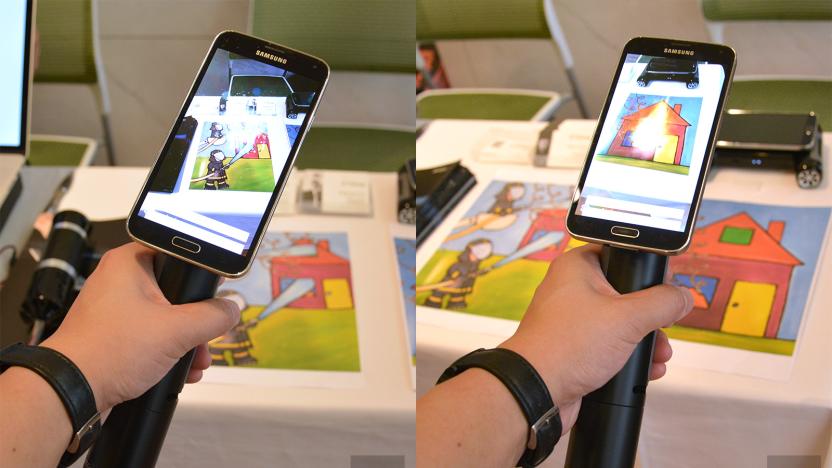
ThermoReal lets you feel heat, cold and even pain in VR and AR
While some companies are trying to make AR and VR more immersive via haptic feedback, one startup decided to focus on the thermal aspects of the experience. TEGway, a spin-off of the Korea Advanced Institute of Science and Technology, has created a slim, flexible thermo-electric device (or "TED" in short) that can rapidly heat up or cool down, covering a temperature range of 4 to 40 degrees Celsius (39.2 to 104 degrees Fahrenheit). Better yet, it can simultaneously produce both heat and cold in different zones on the same surface, which enables the simulation of a pinch on one's skin to produce pain. Now packaged as ThermoReal, the company is hoping hardware makers will integrate this solution into the likes of joysticks, gloves, haptic suits, chairs and more for a new level of immersiveness.

Microsoft Research wants to pit you against virtual swimmers
You don't need other people to swim, but a Microsoft Research project can spice up your swimming routine by putting you in or pitting you against virtual teams. Redmond's research division is working with a team of researchers from Korea Advanced Institute of Science and Technology (KAIST) to develop SwimTrain. It's a system consisting of an app, a waterproof case for your smartphone and a pair of underwater headphones that provides sensory/auditory feedback. SwimTrain puts you in a team of three swimmers -- if you're competing, it tells you how you're doing against your two virtual opponents. If you're in the same team, it helps you maintain your strokes so you can keep up with your virtual teammates.

Watch a tiny robot fly an aircraft nearly as well as a real pilot
Autonomous aircraft are likely to be the future of air travel, but we're not quite there yet; even with autopilot systems in place, most airplanes are designed with human pilots in mind. South Korean researchers may have a clever robotic stopgap, however. Their tiny PIBOT automaton uses a mixture of flight data and visuals to fly using real controls. It still needs intervention shortly before touchdown, but it can otherwise take to the skies as well as many organic air crews -- it may even be a bit better in a few areas, since it uses its camera to align neatly with the runway on takeoff and landing.

Velociraptor-inspired robot can run almost as fast as DARPA's Cheetah
There's a new robot that's almost matched Cheetah's speed record, but it wasn't designed after another speedy cat. Instead, it takes cues from something more terrifying: a velociraptor. The two-legged machine named Raptor was created by scientists from the Korea Advanced Institute of Science and Technology, who've even outfitted it with a tail like the extinct reptile's for balance. In its current form, it can go as fast as 28.58 mph (46 km/h), just a bit slower than the famous mechanical cat's max speed of 29.2 mph (47 km/h). Compared to DARPA's robotic cat, though, Raptor's technology is a lot simpler, even using ordinary springs as tendons to be able to run fast more effectively. Right now, Raptor's confined to running on a treadmill like Cheetah's older iterations, but its creators hope to make it more stable so it can run on any surface without a tether. Once that happens, all it'll need is a velociraptor suit for the KAIST researchers to start their own (hopefully safer) Jurassic Park.

Armadillo-T micro electric car folds to fit into compact parking spaces (video)
The Armadillo-T is pretty petite as it is, but when it comes time to fit into tight parking spaces, the all-electric car can do even better. The four-wheel-drive compact, which integrates a design similar to an armadillo's shell, includes seating for two, a 13.6 kWh battery pack and four in-wheel motors, allowing the rear half of the vehicle to fold upwards at the press of a button. Designed by a group of researchers from the Korea Advanced Institute of Science and Technology (KAIST), the prototype packs plenty of other high-tech features, too, including cameras that sub in for side-view mirrors, smartphone control and a ten-minute fast charge mode that nets 100 kilometers of range. The transporter is still a long way from reaching a production line, but it could one day serve to help ease congestion in overcrowded cities, letting you park in slots far too small to accommodate four wheels today.

Wirelessly-charged electric buses start public route in South Korea
Wireless charging might seem perfectly suited for smartphones and tablets, but the city of Gumi, South Korea is putting the tech to use with something a little larger: buses. A pair of Online Electric Vehicle (OLEV) motorcoaches, which recharge by driving over specially-equipped asphalt, are now running a public transportation route in the city, and it's said to be the first network of its kind open for regular use. Rather than stopping periodically to jack in, coils on the coaches' underside pick up power through an electromagnetic field created by road-embedded wires. Currently, the vehicles have a roundtrip journey of 24km (roughly 15 miles) when completing their stops. Since the system operates so long as 5 to 15 percent of the path is electrified, there's no need to rely on a completely rigged-up highway. What's more, the solution is only triggered by passing OLEVs, which means that normal cars can share the same street. If this all sounds familiar, that's because the Korea Advanced Institute of Science and Technology has been hammering away at the technology for several years. Now that it's made it this far, the city has plans to add ten more buses to its fleet by 2015.

Korean scientists solve flexible battery riddle (video)
We've got flexible displays, printed circuits, memory and even chargers -- why not batteries? So far, this has eluded manufacturers, but now researchers from the Korean Advanced Institute of Science and Technology have got the ball rolling with a high performance bendable lithium-ion version. As the video after the break (no sound) shows, the peel-and-stick type manufacturing process they devised allows the cell to provide constant juice, no matter how much it's deformed. Now the scientists are looking at ways of upping the capacity, so they can power more than just Christmas tree lights and ultimately bring "the next-generation of fully flexible" devices to market. That's no small thing, considering what some products are willing to do to fit into those tight aluminum jeans.

HUBO 2 has articulated hands, can walk 2 km on a charge: yours for $400k
HUBO has come so far from mastering the basics of mobility. The latest from KAIST is HUBO 2, a robot with flexible limbs that allow it to bend down and even do push-ups. The HUBO 2's hands are another big improvement, now allowing the humanoid to open car doors, operate a gear shift and hold up to 7 kg. KAIST used "individually actuated" fingers that adapt to the shape of whatever HUBO 2 is holding, a la Honda's new ASIMO. The robot can walk 2 km on a charge, and it looks like it's a little less of a slow poke now, too: KAIST increased its running speed to 4 kph from 3 kph. Check out the source link and video below to see the HUBO 2 in action -- if you're impressed, it can be yours for a cool $400,000.

Four HUBOs 'Come Together' for a Drexel Engineering MET-lab demo
Robot Beatles cover band? Check. Students at Drexel University's Music and Entertainment Technology Lab (MET-lab) have developed software that allows HUBO robots to create tunes following a musical score. The Roboband plays the song without human control during the performance -- a demo that combines humanoid tech and creative expression research. Four HUBOs jam the arrangement of the Beatles' "Come Together" by MET-lab student Matthew Prockup on Ringo's mini-kit and three "Hubophones." Drexel and seven other universities in the States are part of a humanoid research collaboration with KAIST, the designer of the HUBO robot.

Korean bendy memory could make plenty of trendy tech
Flexible displays aren't much good unless there's flexible memory alongside. It's been attempted before, but bending memory pushes the individual transistors so close that they begin to interfere with one another -- causing degradation and shortening the device lifespan to just a single day. The Korea Advanced Institute of Science and Technology (KAIST) has solved the problem by pairing transistors with memristors, which are immune to such annoyances. By fixing both inside a flexible substrate, you can push them as near as you like without any electo-radiation spanners jamming up the works. This also means that the flexible RRAM behaves just like flash memory; maybe in the future it won't just be antennas sewn into our clothes.

MoleBot interactive gaming table hooks up with Kinect, puts Milton Bradley on watch (video)
Looking to spruce up that nondescript living room table? So are a smattering of folks from the Korea Advanced Institute of Science and Technology. At this week's SIGGRAPH E-tech event, a team from the entity dropped by to showcase the deadly cute MoleBot table. At its simplest, it's a clever tabletop game designed to entertain folks aged 3 to 103; at the other extreme, it's a radically new way of using Microsoft's Kinect to interact with something that could double as a place to set your supper. Improving on similar projects in the past, this shape-display method uses a two-dimensional translating cam (mole cam), 15,000 closely packed hexagonal pins equivalent to cam followers, and a layer of spandex between the mole cam and the pins to reduce friction. When we dropped by, the Kinect mode was disabled in favor of using an actual joystick to move the ground below. In theory, one could hover above the table and use hand gestures to move the "mole," shifting to and fro in order to pick up magnetic balls and eventually affix the "tail" onto the kitty. The folks we spoke with seemed to think that there's consumer promise here, as well as potential for daycares, arcades and other locales where entertaining young ones is a priority. Have a peek at a brief demonstration vid just after the break, and yes, you can bet we'll keep you abreast of the whole "on sale" situation.%Gallery-130405%

KAIST's HUBO shows off some newfound dexterity, hides emotions behind ill-fitting motorcycle helmet
Sometimes when we see the seemingly slow advance of Honda's ASIMO, the inherent limitations of WowWee toys, or the purposefully limited one-off research projects of universities, we start to give up hope of being super best pals with a humanoid robot this century; hope of partaking in whimsical 80s movie hijinks, hand-in-metal-hand. This little video of the Korean Institute of Advanced Science and Technology's recent advances on its HUBO project therefore serves as a bit of a "hope refresher," allowing us to once again re-imagine those aforementioned scenes of whimsy with a metallic bot that can handle a sword and walk at an almost-useful pace, while inexplicably wearing a smallish, visored helmet. Sure, there's a long way to go, but we'd just like to say that when the robot apocalypse doesn't happen and we realize how much we really have in common with these machines we've built to look like us, that somewhere in late 2009 this video helped us keep on believing.

Flux capacitors sidelined as surface plasmons called upon to increase OLED efficiency
The surface science geeks out there already know that surface plasmons have enjoyed use in spectroscopic fluorescence measurements, but that's about as exciting as chamomile tea at a narcolepsy convention. However, those same surface plasmons have been used by Korean researchers to increase OLED efficiency by 75-percent while also increasing intensity twofold -- and that gets our attention. Note we said "researchers," though; the results were obtained with silver nanoparticles under high vacuum conditions -- in other words, a surface science lab. Although the word is that this technique can be used for flexible OLEDs, we won't be holding our breaths. Heck, at this point, we'd settle for relatively inefficient, inflexible, affordable OLEDs somewhere north of 20-inches.

Korean scientists create transparent memory chip... or so they tell us
Researchers at the Korea Advanced Institute of Science and Technology claim to have created a see-through non-volatile memory chip based on resistive random-access memory (RRAM) technology. Made with transparent oxide film and electrodes on clear glass or plastic circuit boards, the group believes commercial production could begin in 3 to 4 years and could be cheaply manufactured (current backers of RRAM include Fujitsu, Sharp, Samsung and others). They're hopeful the new technology will pave the way for transparent devices such as monitors and televisions. No images of the transparent chip have been published -- but they're not much to look at, anyway.[Via cellular-news]

Korean researchers build a fuel cell UAV that runs for 10 hours
Researchers at the Korea Advanced Institute of Science and Technology recently demonstrated a fuel cell system that can power an RC plane for up to 5 hours on just 500 grams (17 ounces) of liquid hydrogen, and is expected to power a UAV variant of the plane for up to 10 hours when the autonomous pilot system in completed. KAIST hopes to use the tech in a future Korean military UAV, and, pending funding, expects to have a complete production-ready drone within two years. Sadly, there's no word on when Korean kids will be able to hold all-night drone-flying stamina contests, but we're waiting for that YouTube video pretty eagerly.[Via AutoBlog Green]

KAIST shows off "Hubo-Way" Segway derivative
Having already accomplished the considerable feat of getting a robot to balance on its own two feet, engineers at Korea's Advanced Institute of Science and Technology (otherwise known as KAIST) now appears to have turned their attention to us humans, although they haven't exactly taken the most original approach. As you can see above, the Institute's so-called "Hubo-Way" takes a fair bit of inspiration from the Segway, although the technology has supposedly been "modified" to some extent. From the looks of it, the most significant of those modifications is the actual cost of the device, which the engineers say is half that of the Segway. Of course, there's no indication as to when or if the device might actually be commercialized, so it looks like you'll have to be content with the current crop of Segway-esque if you're not willing to throw down for the real thing.

Korean researchers build first eight-nanometer NAND chip
Reports of advances in memory storage densities aren't all that surprising anymore -- after all, storage devices have continually gotten both smaller and more capacious since IBM kicked out the first hard drive in 1956 -- but it's still nice to learn that the NAND flash used in our DAPs, cellphones, and soon laptops and desktops will break the terabyte barrier within the next decade. Researchers at the Korea Advanced Institute of Science and Technology (KAIST) and the National Nano Fab Center are claiming success in building the world's first NAND flash chip using an 8nm fabrication process, which could eventually lead to capacities as large as one terabyte in a package 1/25th the size of Samsung's 40nm 32GB unit. The breakthrough was realized by merging nanowires with silicon-oxide-nitride-oxide-silicon technology, and although it might seem like huge iPods are right around the corner, the research team still faces problems such as shrinking the area where data is saved. In other words, your gear isn't out of date quite yet, but you can rest assured that it will be soon. [Via China View]

Korean scientists create "software robot," still gets stage fright
Oh, South Korea -- land of robots galore, ranging from the militaristic to the domestic servant-like -- can you just stop making any robot that we won't be envious of? We're not really sure how this one works though, but apparently scientists at the Korean Institute of Advanced Science and Technology have just created a "sobot," or a software robot that can be transfered like a ghost in the machine from computer to computer and from robot to robot (such as the MyBot, pictured here). The theory goes that in one application, a sobot could be serve as a nurse, being able to perform triage on incoming patients. However, when Wired News went to go check one out, "Rity" the sobot, got stage fright (not the first time we've heard of that from a Korean robot), and eventually arrived on screen in the form of a dog character with a less than pleasant attitude. Still, Korea's got 14 more years to get the bugs out of this one, right?


