bionic
Latest

Open Bionics’ 3D-printed prosthetic arm is now available in the US
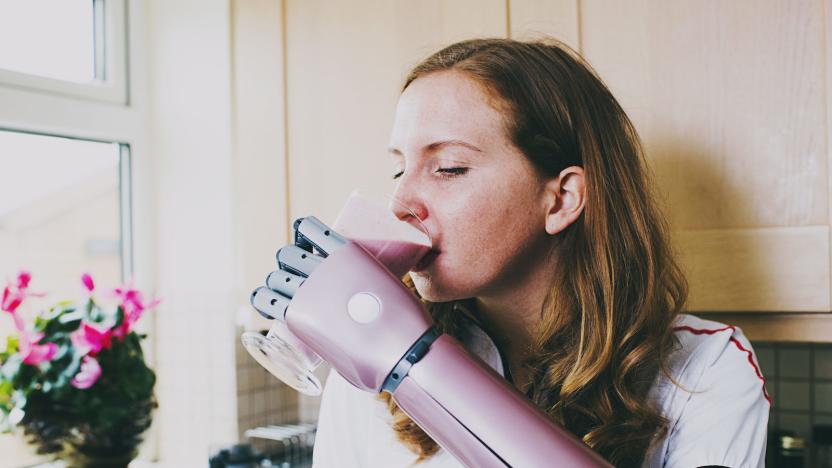
One year after Open Bionics began selling its 3D-printed Hero Arm prosthetic in the UK, the bionic arm is available in the US. Open Bionics has made a name for itself as a start-up specializing in low-cost prosthetics, and you might remember it as the company behind arms inspired by Iron Man, Star Wars, Frozen and Deus Ex. But until now, the Hero Arm has only been available in the UK and France.
Open Bionics’ latest 3D-printed arm goes on sale next month
Open Bionics announced today that its 3D-printed Hero Arm prosthetic will be available for purchase in the UK next month. The company's founders started Open Bionics because they were interested in developing prosthetic limbs that were less expensive than traditional options, which typically cost tens of thousands of dollars. Using 3D-scanning and 3D-printing, they aim to produce more affordable options that can be constructed much more quickly than other prosthetic devices. In the past, they've developed Star Wars-, Iron Man- and Frozen-themed prosthetic hands for children as well as a Deus Ex-inspired arm.

Exoskeleton for skiers gives your knees robotic boost
Skiing and snowboarding aren't gentle on your body, especially if you're taking on a challenging run or plan on a long day. Now, however, technology might ease your burden. Roam Robotics has unveiled an exoskeleton built expressly to reduce the burden on your knees. Sensors in the exoskeleton gauge your intent and use a mix of air bladders and fabric actuators to automatically tweak the torque in your knees. There's a manual option, too, if you know what motion to expect.
Brain interface adds sense of presence to bionic limbs
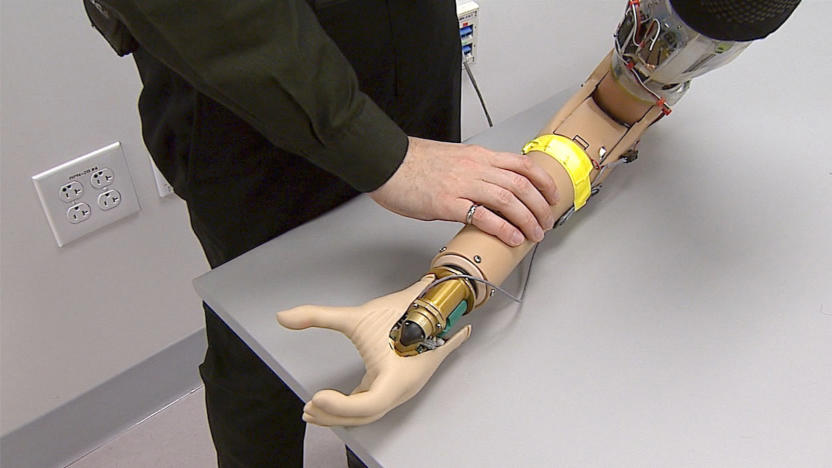
It's been possible for a while to control bionic limbs with your brain, but there's been something missing: kinesthetic feedback, or the nervous system signals that give your limbs a sense of presence. You frequently have to stare at your artificial arm to ensure that you're grabbing a cup instead of operating on instinct. That elusive quality may soon be a regular staple of prosthetics, however. Researchers have developed a neural interface that generate this feedback and make bionic feel like they're part of your body.

The first Cybathlon pushed the limits of bionic technology
Andre van Rüschen slowly climbed a five-step ramp at the end of his race. With a black processor strapped to his back and leg supports on either side of his lower limbs, he stayed focused on the body-machine coordination that was keeping him upright. He had walked over a wooden slope, criss-crossed bright yellow bars and tried to step on gray discs that were placed irregularly on the floor. Now, standing atop the last obstacle in the exoskeleton race, he took a moment to pause and look up at his opponent on the adjacent track. They were both on the ramp, going head-to-head at the world's first Cybathlon, a sporting competition designed for people with severe disabilities. The crowd inside the Swiss Arena in Zürich cheered them on. Van Rüschen, the German pilot who was using a ReWalk exoskeleton, quickly regained his focus and prepared to walk down the next five steps to complete the race. He hit a button on the remote around his wrist to change the settings from "walk" to "climb" and quickly adjusted his upper body to balance his weight on the crutches in his hands. With his competitor, Mark Daniel, right on his heels, he leaned forward to pick up the pace.
Segway creator's advanced prosthetic arm arrives in late 2016
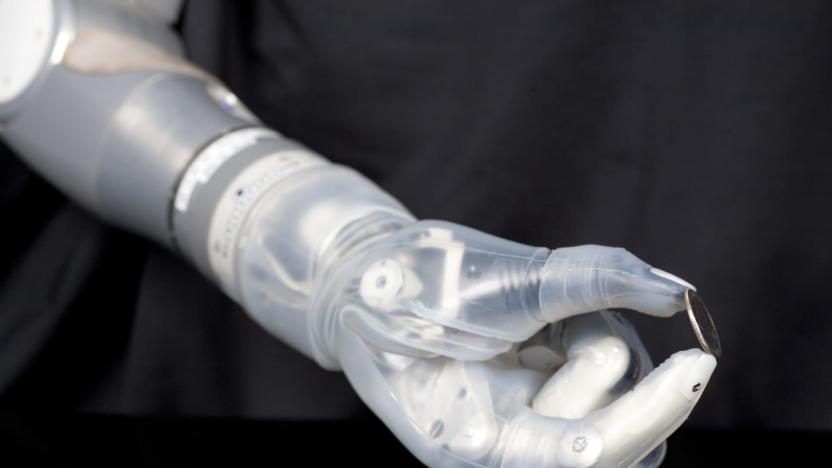
Segway creator Dean Kamen's Luke prosthetic arm has been a long time in coming -- the FDA approved it two years ago. At last, however, it's nearly here. Mobius Bionics has revealed that it will offer the Luke arm sometime in late 2016. It's not clear what it will take to get one (you can register your interest today), but the features remain the same. The bionic wearable is all about offering the life-like dexterity that hasn't really been an option until now: you can hold a glass over your head without spilling it, for example, and the hand's mix of four motors and grip sensors can help you grab both very delicate and very heavy items. The odds are that getting one won't be trivial, but it might well be justified if it grants some extra freedom.
Tattoo artist's prosthetic inking arm is better than a real hand
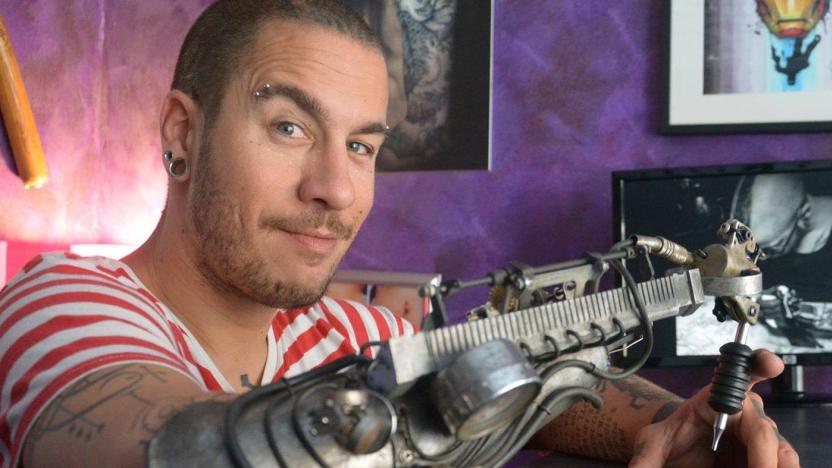
If you wanted to be a tattoo artist but lost your drawing arm, what would you do? JC Sheitan Tenet has an answer: get a prosthetic arm that's better than flesh and bone. He teamed up with artist Gonzal on a steampunk-inspired limb that integrates an inking needle, a pressure gauge and piping. It's a makeshift combo of a regular prosthetic, a sewing machine and a turntable, but it's reasonably light and easy to use -- so much so that you might prefer JC's mechanically-assisted output over that of a good conventional artist.

Panasonic shows how its robotic suits ease your burden
If you ask Panasonic, the future is full of wearable robotic assistants... lots of them. The Japanese tech giant has posted a video highlighting all the exoskeletons and service robots it's working on, and it's clear that the company wants to bring bionics to just about every facet of life. The Assist Suit (shown above) and Ninja respectively boost your lower back and legs, helping you lift heavy warehouse boxes or climb steep mountains. The Power Loader (directly inspired by Aliens), meanwhile, should help during construction work and disasters.
Brain-machine link helps you steer exoskeletons with your mind
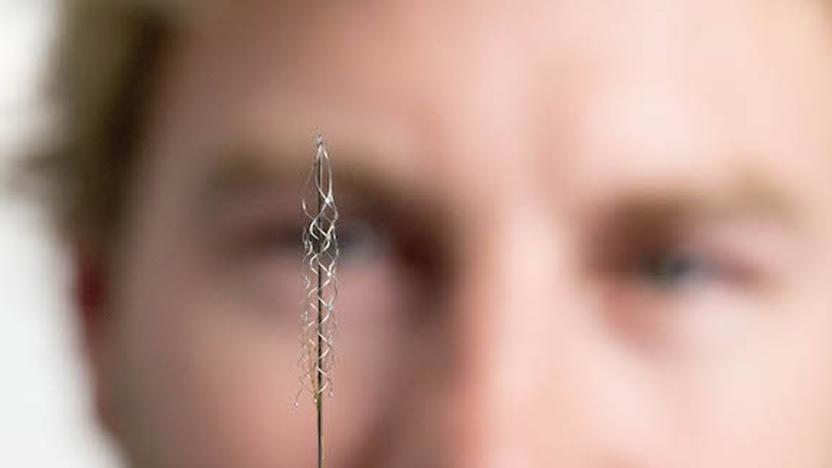
Right now, mind-controlling a machine isn't pretty: you typically wear a silly cap or headset, or else subject yourself to open brain surgery to get a deeper link. Australian scientists might have a better way, though. They've developed a brain-machine interface that taps into your motor cortex through a relatively simple operation -- you won't need to gamble with your health to have a permanent connection to robotics. The device (known as a stentrode) would let you directly steer an exoskeleton or artificial limb through thoughts alone, even if you need the implant for "many months" at a time.

Bionic leg climbs stairs with ease
As advanced as prosthetic feet and legs have become, they're frequently lousy with stairs. You usually have to reconfigure your limb to make the climb, even if it's just for a few seconds. That won't be an issue again if the Rehabilitation Institute of Chicago's efforts pay off, however. Its researchers have built a new bionic leg that lets you climb stairs, kneel and otherwise move freely without straining yourself. It revolves around a control system that tells what you're trying to do and adjusts automatically, letting you focus on walking instead of terrain changes. The leg is only in a very limited test run backed by the US Army, but it's expected to become a commercial product that helps amputees of all stripes. [Image credit: Ann Simon/Rehabilitation Institute of Chicago]
Super-precise artificial hand uses smart wires as muscles
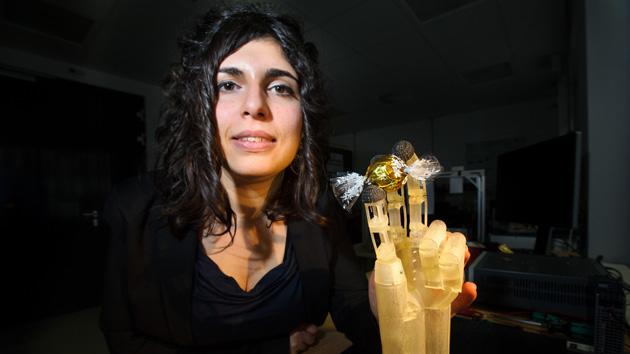
As a rule, bionic hands are clunky contraptions made of motors, pneumatics and other machinery that just can't be as elegant as the real thing. Germany's Saarland University might just change that, however. Its researchers have developed an artificial hand that uses smart nitinol (nickel titanium) wires as its muscles. All you do to make them flex is heat them up or cool them down -- the metal 'remembers' its original shape before you bend it, so you don't need bulky equipment to move it back and forth. The wire bundles are as thin as cotton, but they're very strong and can move with much more precision and speed than usual. They don't even need sensors, since electrical resistance in the wires themselves is enough.

DARPA-funded mind-controlled robotic arm now works a lot better
At Expand NY in November, DARPA Director Arati Prabhakar talked about the erm, friendlier projects the agency is funding, including a mind-controlled robotic arm tested by Pittsburgh native Jan Scheuermann. Her test run has recently ended, but the University of Pittsburgh researchers in charge of project have published a paper detailing how much the limb has improved over the past two years. Before they took off Jan's implants, she could already move not just arm itself, but also its wrist and fingers -- she reportedly even beat her brother at a rock-paper-and-scissors game. "Overall, our results indicate that highly coordinated, natural movement can be restored to people whose arms and hands are paralyzed," said Pitt School of Medicine professor Andrew Schwartz, Ph.D.

FDA approves a life-like prosthetic arm from the man who invented the Segway
After years of testing, the FDA today approved a new type of prosthetic arm that its makers claim will bring a whole new level of control to amputees. Known as the "Luke" arm or DEKA Arm System, Segway inventor Dean Kamen has been involved in its development and unlike existing prosthetics, it can understand multiple commands at once, giving its wearers "near-natural" control of the limb. As demonstrated in the videos embedded after the break, tests show wearers can get back to easily performing tasks like using keys and locks, brushing their hair, removing papers from an envelope, or picking up an egg without breaking it. While we've seen demos using other mind control techniques, the one approved for sale does its magic with electromyogram (EMG) sensors activated by the wearer contracting muscles close to where the prosthesis is attached or on their feet, which an embedded computer translates into movement.

Princeton crafts a 3D printed bionic ear with super hearing, creepy looks
Scientists have toyed with printing ear implants for ages, but they've usually been more cosmetic than functional. Princeton has just developed a bionic ear that could transcend those mere replacements to offer a full-on upgrade. Rather than seed hydrogel with cells and call it a day, the researchers 3D printed a blend of calf cells, hydrogel and an integrated, coiled antenna made from silver nanoparticles. The frankly spooky project doesn't resemble a natural ear all that closely, but it merges organic and synthetic more gracefully than inserting a chip into an existing implant. It can also expand hearing beyond normal human levels: the experimental version picks up radio waves, for example. Although the ear is just the first step on a long path toward natural-feeling bionics, it already has us wondering if we'll be actively seeking out replacement body parts in the future... not that we're about to go all Van Gogh to get them.

Touch Bionics' latest 'i-limb' offers a powered rotating thumb, smartphone controls
Touch Bionics' i-limb prosthetic hand has advanced quite a bit in recent years, adding features like Bluetooth connectivity and upgraded fingers. Now the company has made available its latest revision, the i-limb ultra revolution, which offers powered thumb rotation for some added dexterity, as well as a new "biosim" app (iOS-only for now) that gives the wearer quick access to 24 different grip patterns in addition to diagnostic and training modes. Of course, the hand isn't only controlled using a phone; as with previous models, it relies on muscle signals to shift into different pre-set patterns, which let the wearer perform a wide variety of actions. You can get a glimpse of some of those capabilities in the video after the break.

Swiss bionic hand offers true sensations through the nervous system
Those wearing bionic hands and similar prostheses often suffer a frustrating disconnect when they can touch an object but can't feel it, even if they're using direct neural control. The École Polytechnique Fédérale de Lausanne and allies in Project TIME have developed a hand that could clear that psychological hurdle. The design implants electrodes directly in key nerves that not only allow motor input, but deliver real sensory feedback from the artificial appendage -- including needle pokes, much to the test subject's chagrin. An early trial (seen above) kept the enhanced hand separate from the wearer and was limited to two sensations at once, but an upcoming trial will graft the hand on to a tester's arm for a month, with sensations coming from across much of the simulated hand. EPFL hopes to have a fully workable unit ready to test in two years' time, which likely can't come soon enough for amputees wanting more authentic physical contact.

Inhabitat's Week in Green: Dyson Spheres, bladeless wind turbines and airless bike tires
Each week our friends at Inhabitat recap the week's most interesting green developments and clean tech news for us -- it's the Week in Green. Over at Inhabitat, the election hangover is finally starting to wear off, and we've been looking forward to see what President Obama's re-election could mean for clean tech and renewable energy. The first bit of good news came on election night, when Obama called for action on climate change. That's all well and good, but what does it actually mean? For starters, it could mean the EPA enforcing stricter regulations. But the thing that most people in the renewable energy sector will be watching is whether the wind energy tax credit is renewed before it expires at the end of the year.

Nano-machines built to mimic human muscle could help power cyborgs, keep the OSI budget down
At today's prices, building a Six Million Dollar Man would cost around $31 million. Of course, being a TV show means the Office of Scientific Intelligence doesn't have too many bionic employees, but that might not the case in the future. Nicolas Giuseppone and a team at the Université de Strasbourg and CNRS have created thousands of nano-machines to replicate the movement of human muscle fibers. Weaving them all together, the machines are able to make a coordinated contraction movement that stretches and contracts. For the moment, the supramolecular polymers can only stretch a matter of micrometers, but in the future they could be used to create artificial muscles, small robots or even materials that can move. Hopefully it'll also give us the power to leap tall buildings, so we'll be outside practicing our sound effects.

Droid Bionic finally gets an ICS update as everyone else moves on to Jelly Bean
After nearly a year of suffering with Gingerbread, Droid Bionic owners who haven't given up on their phone will finally be rewarded with that long-awaited ICS update; the rollout starts October 19th, according to Verizon. Those who get it will receive a new customizable launch bar, a direct access lock screen, enhanced notifications, Motorola's SmartActions app, Face Unlock, easier multitasking, and many other goodies most Android owners have enjoyed for awhile now. It looks like Motorola Mobility actually made good on some of its promises to fix the handset that has suffered a number of different problems since its launch (which itself took almost nine months from the initial announce date). However, now that Jelly Bean has taken over as the firmware of choice with no word yet if that'll come to the Droid Bionic, we wonder if it's too little, too late. Update: We've learned from the comments, Motorola's owner support forum and its own Facebook page that the company is planning on rolling out Jelly Bean to the Droid Bionic "in the coming months" so don't lose hope just yet, Bionic faithful. [Thanks to everyone who sent this in]

Touch Bionics releases new prosthetic fingers, flips the old ones the bird
The only upgrades available for our puny human hands are gaming controller calluses, but if you're sporting an i-LIMB digits hand prosthesis, you can now grab a set of improved fingers. Touch Bionics' "smaller, lighter and more anatomically accurate" appendages are now available worldwide, as well as a new wrist-band unit which houses all the necessary computing power and juice for their function. Best of all, these developments allow more people to adopt the tech than the previous generation, including those with more petite hands or finger amputations closer to the knuckle. We don't know how much it'll cost for a fresh set, but we'll let health agencies and insurance companies deal with that part. With these upgrades and RSL Steeper's latest offering, it won't be long before our flesh-based variants are meager in comparison.


