DukeUniversity
Latest

Quantum encryption is now fast enough for voice calls
Quantum encryption is theoretically a dream for security, as you can't even inspect the data without altering it. However, it's currently several times slower than the conventional kind, which makes it impractical for voice calls or streaming video. Science may have come to the rescue, though: researchers have developed a quantum encryption key distribution system that promises to be five to 10 times faster than existing methods, or roughly on par with conventional encryption when run in parallel. The trick was to cram more data into each photon.
Computer models help form new magnetic materials
Magnetic materials are extremely difficult to find. They're rare in nature, and creating one in the lab usually involves both a lot of experimentation and a little luck. Duke University, however, has found a way to take the mystery out of the process: its researchers have used computer modelling to help generate two new kinds of magnetic materials. The models whittled down the potential atomic structures from a whopping 236,115 combinations to just 14 candidates by subjecting the structures to increasingly tougher tests. How stable are they? Do they have a "magnetic moment" that determines the strength of their reaction to an outside magnetic field? After that, it was just a matter of synthesizing the few remaining materials to see how well they worked in real life.

Researchers genetically engineer Salmonella to eat brain tumors
Salmonella has earned its bad reputation. It is responsible for more than a million cases of food poisoning every year, of which nearly 400 people die. But a team of researchers from Duke University have recently engineered the bacteria to not attack the human gastrointestinal tract, but rather the most aggressive form of brain cancer known to man.

ICYMI: Robots want us to rely on them for daily tasks
try{document.getElementById("aol-cms-player-2").style.display="none";}catch(e){}Today on In Case You Missed It: The latest servant robot to join the Pepper and Buddy crew is Big-I, a Kickstarter bot that uses 3D vision, motion tracking and facial recognition to help out the humans in their household. We say it looks like a rolling trashcan with a disturbingly large eye, but for those looking for an IoT hub that's more mobile than Alexa, it could certainly work.

ICYMI: Fast brain upload, mind-control monkeys & more
#fivemin-widget-blogsmith-image-222051{display:none;} .cke_show_borders #fivemin-widget-blogsmith-image-222051, #postcontentcontainer #fivemin-widget-blogsmith-image-222051{width:570px;display:block;} try{document.getElementById("fivemin-widget-blogsmith-image-222051").style.display="none";}catch(e){}Today on In Case You Missed It: Researchers at HRL Labs have developed a system to upload information to your brain using electrical signals already mapped from an expert's mind. Duke University is testing a wireless brain-machine interface that allows monkeys to steer a wheelchair with their mind, which they were able to do while also improving their skills over time. Cardiologists have a new tool to roto-rooter blood vessels filled with plague in the first FDA approved device that helps surgeons see inside vessels with a built-in camera.

Instant man-made blood vessels could speed up drug discovery
Man-made tissues and organs are useful tools for scientists seeking to understand and potentially fix the human body. One area in which they could have a significant impact is drug discovery, allowing researchers to test therapies in living models prior to animal and human trials. A group of biomedical engineers at Duke University are particularly interested in this use case, leading them to develop a new technique for creating working blood vessels in the lab. And what previous methods took six to eight weeks to achieve, the researchers have managed to condense into a matter of hours.

Humans are smart because we sleep weird
A new study claims to have learned one of the reasons that humans were able to rapidly evolve beyond rival primates, and it's all down to our weird sleeping patterns. Researchers at Duke University, as reported by the New York Times, believe that our seven-hours-of-straight-shut-eye sleep cycle is something of an aberration. By comparison, chimpanzees enjoy 11.5 hours of rest, but our shorter run enabled us to get a much deeper, more dream-filled snooze. Humans, it seems, have above-average quantities of REM sleep, enabling us to slice valuable hours off the amount of time we're laid up.

Apple introduces ResearchKit apps for autism, melanoma and epilepsy
Apple wanted to make data gathering easier for medical researchers with ResearchKit. According to the company, since the launch of the open-source platform earlier this year, over 100,000 participants have already shared their health data with a host of apps that study asthma, diabetes, breast cancer and more. The Kit's ever-increasing list of studies will now include autism, epilepsy and melanoma.
Researchers draft the first comprehensive tree of life
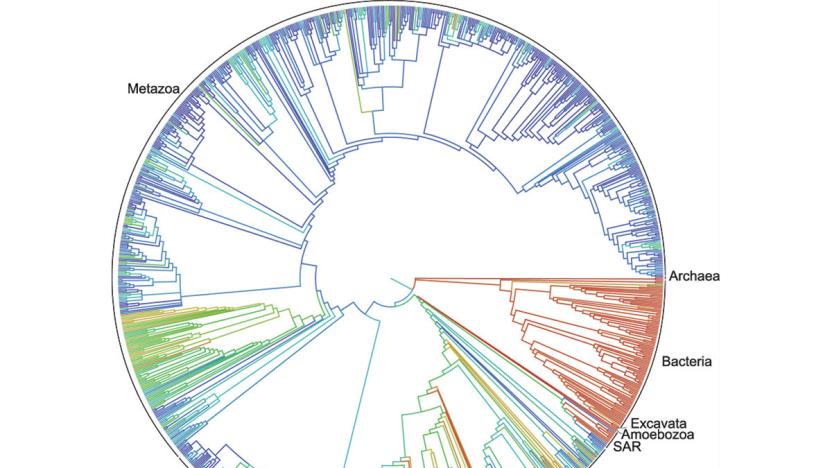
It's very poetic to talk about a tree of life, where every species can trace its roots, but actually illustrating this tree is no mean feat when Earth has been home to at least 2.3 million known species. However, scientists have finally given it a shot. They've published the first draft of a comprehensive tree of life that shows every major evolutionary branch, ranging from the very first organisms to complex beings like humans. This isn't a complete tree, of course (it's doubtful that we'll ever know all the species that ever existed), but it beats the patchwork from before.

Lab-grown muscles could lead to personalized medicine
A team of researchers from Duke University have grown human skeletal muscles in the laboratory -- muscles that actually function and react to stimuli like their real counterparts. In order to do so, the scientists took cells that have already progressed beyond stem cells, placed them on a scaffolding with nourishment and waited for them to align into muscle fibers. That sounds easy written down, but the truth is they still had a tough time making it happen. According to one of the researchers, Lauren Madden, it took them "a year of adjusting variables like cell and gel density and optimizing the culture matrix and media" despite their experience growing animal muscles.

Here's how doctors will test Apple's new patient tracking features
Apple briefly hinted last week that hospitals would soon try out HealthKit's patient tracking technology, and we now know how those experiments are going to work. According to Reuters, both Duke University and Stanford University are weeks away from launching trial programs that will let doctors monitor vital stats with patients' permission. In the Stanford test, young Type 1 diabetes sufferers will carry both an iPod touch and a smart glucose meter to keep tabs on their blood sugar levels. There are fewer details surrounding Duke's pilot, but it will track the blood pressure and weight of those with cancer or heart disease.

'Acoustic cloak' could shield submarines with a cone of silence
We've seen some overly elaborate invisibility cloaks in our day, but Duke engineers have shown that lo-fi may be best for audio. After much refinement, they've developed a shield that can hide objects from sound waves thanks to a highly engineered pyramid shape and carefully placed holes. The stacked layers retard sound coming from any angle, so that it appears to have bounced off a flat wall when picked up by a detector (see the video after the break). Though it's still early days, such materials could one day protect ships from sonar or improve concert hall acoustics, for instance. It's also got the pyramid power thing going on -- so maybe it could also keep your razor sharp.

Duke melds two rats' minds through the internet, Spock may not approve
Some would say the internet already lets us share every minute detail of our thoughts, much to our followers' dismay. Duke University isn't deterred by our behavior -- if anything, it just took oversharing literally by connecting two rats' minds in an experiment, first in a lab and ultimately online. Electrodes attached to the brain of a host "encoder" rat in Brazil processed the motor-oriented mental activity for a desired behavior, such as pressing a lever on cue, and converted it into a signal that was then received by a "decoder" rat as far away as Duke's US campus. The majority of the time, the decoder rat performed the same action as the encoder. Researchers also found that rewarding the encoder alongside the decoder created a virtuous loop, as treating the first rat for a job well done focused its attention and improved the signal strength. We're not sure that Vulcans would endorse this kind of mind meld, though: apart from immediately depriving the decoder rat of self-control, prolonged testing led to the same rodent developing additional sympathetic reactions to the encoder. There's also concerns that the test was too binary and didn't reflect the complexity of the whole brain. All the same, Duke's study is proof enough that we can export brainwaves in a meaningful way.

Metamaterial camera needs no lens, could herald cheaper imaging tech
Metamaterials are proving to be quite useful for toying with the electromagnetic spectrum, whether for technology previously thought to be the stuff of science fiction, or for boring real-world applications. Engineers at Duke University have come up something that falls more into the latter category: a metamaterial imaging sensor that doesn't require a lens to generate a picture. The sensor is a flexible copper-plated sheet patterned with small squares that capture various light frequencies all at once, functioning like one big aperture. Add a few circuits with a pinch of software and the sensor-only camera can produce up to ten images per second, but the catch is Duke's only works at microwave frequencies. Microwave imaging is used plenty, however, and due to its flexibility and lack of moving parts, the sensor could be used to build better integrated, cheaper airport scanners and vehicle collision avoidance technology -- making you safer however you choose to travel. Unless you take the train. Then you're on your own.

Duke University creates 'perfect' one-directional microwave cloak, might lead to stealthier vehicles
Most attempts at cloaking, no matter the slice of spectrum, usually leave clues as to what's there -- even microwave cloaks can spoil the surprise through reflections. At Duke University, researchers have licked some of those past problems with the first instance of a flawless microwave cloaking scheme. By crafting a special diamond-shaped cloak where the light properties stay consistent at the corners, the school's Nathan Landy and David Smith have successfully shielded a 3-inch wide cylinder from microwave detection without a hint that something was amiss. The gotcha, as hinted by the shape, is a two-dimensional nature that gives away the secret at less than ideal angles. Duke suggests that it still has the groundwork for something that could be vital for communications or radar -- we can imagine a stealth aircraft or ship in the far-flung future that could actively mask itself from radar signals. It's not quite the optical illusion we're looking for, but a refined version of the Duke project might be enough for a rare practical use of cloaking when fantasies are much more common.

Alt-week 10.13.12: is the Universe a simulation, cloning dinosaurs and singing mice
Alt-week peels back the covers on some of the more curious sci-tech stories from the last seven days. Are you reading this? Seriously, are you? Sure, we know you think you are, but what if you're just a sub-feature of a complex computer program. A sprite, nothing more than the creation of software. The problem with this question is, how would you ever know? You wouldn't, right? Well, not so fast there. Turns out, maybe there is a way to unravel the matrix (if there is one). It'll come as no surprise, that this is one of the topics in this week's collection of alternative stories. Think that's all we got? Not even close. We'll explore the truth behind cloning dinosaurs, as well a rare performance by singing mice -- all before dinner. Or is it really dinner? This is alt-week.

Strobe lighting goggles shown to improve short-term memory, all-night ravers feel validated
Those goggles you see above aren't for stylish looks while playing dodgeball -- they're the keys to a potentially important discovery about short-term memory. Duke University's Institute for Brain Sciences found that subjects playing catch with goggles simulating strobe lights were noticeably better at memorizing information during tests, even a full day after playtime was over. It's not hard to see why: with a limited amount of time to see that incoming ball, participants had to more vividly remember brief scenes to stay on top of the game. We don't yet know if there's any kind of long-term boost, so don't get your hopes up that strobe lights are the shortcuts to permanent photographic memory. Still, the findings suggest that frequent nightclubbers might be on to something... or, at least, have a better idea of where they left their keys the morning after. [Image credit: Les Todd, Duke Institute for Brain Sciences]

Copper-nickel nanowires from Duke University could make ubiquitous printable circuits
Nanowires, although they're building steam, still have to overcome the not-so-small problem of cost -- they often have to use indium tin oxide that's not just expensive, but fragile. Duke University has developed copper-nanowire films that could remedy this in style. The choice of material is both a hundred times less expensive to make than indium and is much more durable. It's flexible, too: if layered on as a coating, the nanowires would make for considerably more viable wearable electronics that won't snap under heavy stress. The catch, as you might suspect, stems from the copper itself, which doesn't conduct as much electricity as indium. The nickel will keep your copper electronics from oxidizing faster than the Statue of Liberty, however. Any practical use could be years away, but further successes from Duke could quickly see printable electronics hit the mainstream power and power our dreams of flexible displays.

Ditching DRM could reduce piracy, prices, inconvenience
This may run counter to what your common sense tells you but, a new paper out of Duke and Rice University says that ditching DRM could actually reduce piracy. The study, which relied on analytical modeling, showed that while copy protection made illegally sharing content more difficult it had a significantly negative impact on legal users. In fact, the researchers say, "only the legal users pay the price and suffer from the restrictions [of DRM]." Many consumers simply choose to pirate music and movies because doing simple things, like backing up a media collection, is difficult with DRMed content. Even the most effective DRM is eventually broken, and fails to deter those already determined to steal. Meanwhile, abandoning these restrictions could increase competition and drive down prices (as well as remove a serious inconvenience), encouraging more people to legitimately purchase content. You can check out the November-December issue of Marketing Science for more details.

Monkeys control virtual arm with their brains, may herald breakthrough for paraplegics
Monkey mind-controlled arm: It sounds like the name of an awesomely terrible sci-fi film or a fledgling grindcore group, but it's a very real phenomenon, and one that could pay significant dividends for paraplegics everywhere. Neurobiology professor Miguel Nicolelis and his team of researchers at Duke University recently devised a method by which monkeys (and, perhaps one day, humans) can control a virtual arm using only their brains. It's a concept similar to what DARPA has been pursuing with its mind-controlled "Luke" arm, with one important difference: Nicolelis' system not only allows users to remotely execute motor functions, but provides them with near-instantaneous sensory feedback, as well. Most similar techniques use electrode implants to stimulate brain activity, but this can create confusion when a patient's brain sends and receives signals to and from a prosthetic arm. Nicolelis circumvented this problem with a new interface that can read and transmit brain signals to an artificial limb, before switching to a receptive mode in just milliseconds. After designing the technology, Nicolelis and his colleagues tested it on two, electrode-equipped rhesus monkeys. One set of electrodes was placed in the motor cortex of each animal, with the other implanted within their brains' sensory regions. They then trained the monkeys to look at a three identical objects on a computer screen and to "touch" each object with a virtual arm, controlled by signals sent from the brain electrodes. Only one of the three objects had a so-called "virtual texture," which, if selected with the on-screen arm, would send a sensory signal back to the monkey's brain (while triggering a tasty squirt of fruit juice for the lucky contestant). The two rhesus species ended up passing the test with flying colors, resulting in a "proof of principle" that Nicolelis' system can send tactile signals to the brain in almost real-time. The scientists have already developed a way for monkeys to control the arm wirelessly, and are now embedding their technology within a full-body, mind-controlled exoskeleton for paralyzed patients, as well. Of course, the technology still needs to be tested on actual humans, though Nicolelis seems confident that he and his team have already cleared the most difficult hurdle: "Since we cannot talk to the monkeys, I assume with human patients, it's going to be much easier."


