Posts with tag earth
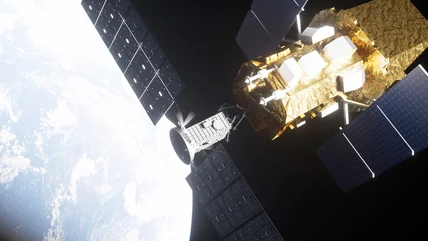
Good news, everyone! According to reports, a US spy satellite which has lost power and propulsion is weeks or even months away from striking Earth. Officials say that the space junk -- which can now no longer be controlled and could contain hazardous materials -- is due to come smashing into some location on our planet's surface, but they can't really say where. "Numerous satellites over the years have come out of orbit and fallen harmlessly. We are looking at potential options to mitigate any possible damage this satellite may cause," said Gordon Johndroe, a spokesman for the Nation Security Council. Government agencies are still considering options such as shooting down the stray equipment, though they say they'd be just as happy to let the potentially radioactive / alien-filled hunk of metal crash into a small village in a developing country.
Neonode planning revamped OS, totally new handsets

Nokia N95 + RC plane = unlimited DIY aerial photography
If you've found yourself tempted by other interesting DIY aerial photography rigs, but spent all your dough on the Nokia N95 instead, you may still be able to make a lifelong (or momentary) dream come true. A pioneering lad over at the N95 Blog has suggested that nearly unlimited high-resolution aerial photography can be yours if you're willing to strap your precious handset to an RC plane and get savvy with Pict'Earth software. The application allows users to create a theoretical Google Earth of their own if the existing imagery isn't up to snuff with their personal standards. Still, we'd have to mull this one over mighty hard before attaching such a valuable communicator to a potential death bed, but feel free to let us know how things go if you can muster the courage.
[Via AllAboutSymbian]
[Via AllAboutSymbian]
San Diegans convert carbon dioxide to fuel via solar energy
Being Earth Week and all, it's not too surprising to hear of San Diegans stretching their mental might and figuring out an effective way to convert carbon dioxide to fuel, but according to the University of California, San Diego, that's precisely what they've done. Clifford Kubiak and Aaron Sathrum have reportedly developed a prototype device "that can capture energy from the sun, convert it to electrical energy, and split carbon dioxide into carbon monoxide and oxygen." Interestingly, this concept produces more than just an alternate source of fuel, as CO2 splitting also creates a "useful industrial chemical" in CO, and furthermore, helps reduce a greenhouse gas. Currently, they are building the device using a gallium-phosphide semiconductor, and while the existing rendition still requires "additional energy" outside of sheer sunlight for the process to work, they're hoping that the American Chemical Society will warm up to the idea and give 'em a helping hand.
[Via Physorg, thanks Richard N.]
[Via Physorg, thanks Richard N.]
Portable generator converts waste into energy
Although developing alternate fuel sources is most certainly a worthwhile effort, a group of Purdue scientists are looking to demolish two birds with a single, um, bag of refuse, as its portable generator not only creates useful electricity, but it disposes of worthless garbage while it's at it. The aptly-named "tactical biorefinery" processes several kinds of wastes at once, which it then converts into fuel via two parallel processes before burning the results in a diesel engine to power a generator. The device, which comes in just a hair smaller than a "small moving man," can crunch through multiple kinds of garbage at once, creating energy completely without discrimination towards certain kinds of gunk, and is already being eyed by the US Army for future battlefield usage. Interestingly, initial prototypes are showing that it can produce "approximately 90 percent more energy than it consumes," and considering that it pulverizes everything inserted into it, soldiers won't have to worry about leaving behind remnants of their stay. Ideally, the backers would love to see the unit available in commercial settings as well as in the military, but we think this thing will be a real winner when it can compress gobs of garbage into vicious (smelling) pellets and launch grotesque projectiles while keeping our planet green.[Via CNET]
AIST turns transparent glass into mirrors to conserve energy
We've seen two-way displays and undercover mirrors before, but the latest two-faced invention to come from the depths of the National Institute of Advanced Industrial Science and Technology (AIST) can pull double duty in regard to purpose and save a little energy in the process. The "switchable glass" has certain reflexive properties created by the twin coatings of "40-nanometer-thick magnesium-titanium alloy, plus a 4-nanometer-thick layer of palladium," which allows for the mirror to become transparent when a small amount of hydrogen is introduced between the two panes. Alternatively, tossing in a bit of oxygen forms a reflecting mirror, allowing users to "switch" the glass by injecting gases. Contrary to other commercialized approaches, this rendition can purportedly result in up to a "30-percent savings in energy costs" by having to run your air conditioner less, but there's still work to be done. Scientists at the AIST are still toiling away as they try to fight the relatively rapid deterioration that occurs from "frequent switching," but if they can add a dash of durability and get the price down to a respectable level, we could all be living in a house of mirrors before too long.[Via PlasticBamboo]
Girasole electric car packs horse hoof warnings
Apparently, we've used that simple "beep" to alert pedestrians when a vehicle is reversing or otherwise coming up on someone long enough, as Yoshio Takaoka, in collaboration with Italy's Start Lab SAP, has crafted a fully functional electric car that packs built-in "horse hoof" sound effects. The Girasole can be fully charged from a home AC outlet for around $1 per "tank," and can then travel nearly 75 miles at a top speed of around 45-miles per hour, but the standout feature on this otherwise uninspiring (albeit very green) automobile is the entirely bizarre "clip-clop" horn that "alerts pedestrians and other drivers" that the car is near. While we're not entirely sure why a next-generation vehicle is throwing back to the days of (way) old when literal horsepower was the main means of transportation, we'll give due props for the ingenuity, but equipping our vehicle with equestrian noises is likely the least of the worries here in the US.[Via AutoblogGreen]
Researchers develop closed hydrogen fuel cell system
If EEStor's elaborate claims are to be believed, we suppose all these other fuel alternatives should just hang up the gloves while they're at it, but just in case things don't pan out so well, we suppose the continued research in hydrogen fuel cell power isn't such a bad idea. Although we've seen glimpses of hydrogen-powered vehicles (and um, crafts) in the past, most of these modes of transportation have been large-scale, and now it seems that a closed system has been crafted which would make these techniques suitable for more diminutive applications such as chainsaws and lawnmowers. The research team has reportedly found a way to better control the way the fuel is used, thus eliminating the need for costly recycling stations, and they insinuate that their findings are "ideal" for devices currently using small internal combustion engines that lack emissions controls. Of course, the system has yet to be broadly trialed, but if things go as planned, there's even hopes to link several of the new cells together to rival the power of cells currently being tested in the automotive industry.EEStor unveils ultracapacitor-based battery system, Li-ion shudders in fear
If relying on sunlight and downhill routes in Venturi's uber-green Eclectic doesn't exactly sound feasible for your everyday (and night) errands, and your ultraportable's five hours of battery life just isn't where you think it should be, EEStor is hoping to remedy those issues -- along with basically every other battery-related quandary -- in one fell swoop. In another case of "this just can't be for realz," an elusive Texas company is coming clean about what's been happening in its labs of late, and the proclamations are nothing short of sensational. The firm boldly states that its one of a kind system, a "battery-ultracapacitor hybrid based on barium-titanate powders, will dramatically outperform the best lithium-ion batteries on the market in terms of energy density, price, charge time, and safety." Moreover, this miracle-working solution is said to produce "ten times" the power of lead-acid batteries at half the cost, sans the need for "toxic materials or chemicals." Additionally, EEStor is hoping to have its Electrical Energy Storage Unit (EESU) powering the wheels of Toronto-based ZENN Motor vehicles, and if "estimates" are to be believed, it will only take about $9 worth of electricity for an EESU-propelled car to travel 500 miles, compared to nearly $60 in gasoline. Of course, such a "breakthrough" product is bound to have its fair share of naysayers, and Jim Miller, vice president of advanced transportation technologies at Maxwell Technologies, is indeed skeptical that EEStor's technology will be able to withstand the unique pressures that a vehicle would place on the "brittle" structure. But we've got to give credit to the company's vow to veer clear of hype, as it notes that this is just the first time it has come forward to intro the technology, and maintains that it will "meet all of its claims" -- guess we'll see about that, eh?[Via The Raw Feed]
Explosive data mining robots could be sent to hazardous asteroids
Sending robotic creatures into space has become somewhat of a worldwide pastime, but sending explosive robots to take care of multiple acts of business is what Dennis Ebbets of Ball Aerospace in Boulder, Colorado has on his mind. In a recent presentation given to the American Astronomical Society, Mr. Ebbets described a fleet of robotic probes small and cheap enough to "investigate a near-Earth asteroid's composition and structure." The devices would be battery-powered and would only be useful for a matter of days, but during the time it was on the asteroid, it would collect data of the surface, explode, and allow other still-in-tact siblings to "listen for vibrations that could reveal the object's inner structure." Considering that NASA has compiled a list of over 800 asteroids that could be potentially dangerous to our planet due to their orbit, these exploding bots would serve a dual purpose as they erupted on the surface to break up the asteroid or veer it off course, all while collecting precious data about the "inner structures" of these mysterious rocks. Although funding still isn't guaranteed for the volatile critters to take off just yet, as many as six of the 12-kilograms probes could loaded onto a single spacecraft and launched to its destination "relatively cheaply," and if things go as planned, we could see the first of these gizmos gettin' dirty by 2011.Venturi readies the launch of its solar / wind-powered Eclectic vehicle
Leave it to the makers of the first "solar shuttle" to actually hit its production schedule, as Venturi Automobiles is officially readying its Eclectic vehicle for a June 2007 launch. The "world's first" commercially available autonomous vehicle sports a "stylish, urban design," room for three, and never needs to get friendly with an AC outlet (although it can, if necessary) or fuel pump. This puppy is powered and recharged completely by renewable energy, be it sunlight or wind, as it houses a bevy of NiMH (NIV-7) liquid-cooled batteries that can be juiced up from the 2.5 square meters of photovoltaic cells atop its roof or a set of wind turbines that can be fixed to the vehicle while parked. Right on target, the company plans to launch a "limited run" of 200 in June, which will be white in color and demand around €24,000 ($31,421). As the learning curve kicks in and production costs sink, the vehicle price should ring up closer to €15,000 ($19,638) when it goes full scale in 2009, while a "single-seat utilitarian version" will compliment the flagship unit sometime in the future. So if you're thinking about ditching the whole "fill your car up" thing, you may still have time to get in on the pre-orders now being accepted for the first 20, but if history proves anything, it's doubtful. [Warning: PDF link][Via AutoblogGreen]