europeanunion
Latest

The EU wants an investigation of the Switch's Joy-Con 'drift' issues
The European Consumer Organisation received more than 25,000 complaints over the problem.
Tech giants call for more content liability protection in the EU
Safeguards would give them more leeway to tackle hate speech, a lobby argued.

The EU is testing cross-border COVID-19 contact tracing
Six countries are trialing the system, which should go live next month.

EU antitrust regulators are investigating Google's Fitbit purchase
They said Google's plan to 'silo' the wearable company's fitness data was 'insufficient.'
Facebook is facing an EU investigation over data collection
Google isn't the only tech giant facing an investigation from European Union antitrust regulators over data collection and monetization. The European Commission has Facebook in its sights too.

EU says sites using Facebook's Like button are responsible for your data
The highest court in the EU has issued a ruling that affects websites using Facebook's Like button plugin. It determined sites should obtain the consent of visitors before the plugin captures and sends their data to Facebook, whether or not you click the Like button. Alternatively, sites will have to prove there's a legitimate reason for collecting data and transmitting it to Facebook.
Google appeals $1.7 billion EU fine over restrictive ad contracts
As was expected, Google is appealing a €1.49 billion ($1.7 billion) fine laid against it by the European Commission related to its AdSense advertising business. Antitrust officials found that, in contracts with major sites between 2006 and 2016, Google included restrictive contracts that could be seen as it trying to muscle rivals out of the market.

Google's Jigsaw is giving European politicians free DDoS protection
Political organizations in Europe can now get free protection from web flooding attacks from Google's cybersecurity incubator Jigsaw. For the first time, European operators will be able to use Project Shield, a tool that helps protect political operations and websites from being taken offline by a distributed denial-of-service (DDoS) attack. The technology was previously only offered to campaigns in the US.
Facebook expands election integrity efforts ahead of EU vote
European Parliament elections are set to take place in May, which of course means there are bad actors who will try to use nefarious means to disrupt the process. Facebook is trying to clamp down on interference on its platforms, with measures including new rules for electoral ads and those related to key election issues. Advertisers need to confirm their identities before they can post ads, while Facebook plans to increase transparency around such ads (an effort with which it has faced some difficulties).

France fines Google $57 million over data transparency
The European Union's GDPR is relatively young, but Google is already in hot water over claimed violations. France's CNIL regulator has fined Google €50 million (about $57 million) for allegedly failing to provide transparent, "easily accessible" data consent policies. Google reportedly made it hard to learn about and control how it used personal data, including for targeted ads. It can sometimes take "5 or 6 actions" before you know what Google is doing, CNIL said, and the company spread ad targeting information across "several documents."

German climate proposals could put an end to no-limit Autobahns
Germany's Autobahns are legendary for segments with no speed limits, but you might have to wave goodbye to those unfettered driving experiences. Reuters has obtained draft proposals from a transport committee that would cap speeds at 130km/h (about 80MPH) in a bid to curb emissions and mitigate climate change. That's still quite fast, but it might dampen the enthusiasm of someone trying to push their Porsche to the max.
EU copyright laws face uncertain fate after 11 countries reject proposal
Internet giants like Google might breathe a little easier in Europe... at least, for now. The EU has called off January 21st negotiations for a final vote on the controversial Copyright Directive after 11 countries, including Germany, Italy and the Netherlands, said they wouldn't support the latest version of the proposal. European Parliament Member Julia Reda noted that most of these countries (Croatia and Portugal are exceptions) have previously argued that the disputed Articles 11 and 13 of the directive didn't do enough to protect users' rights, and this may have played at least some part in their opposition.
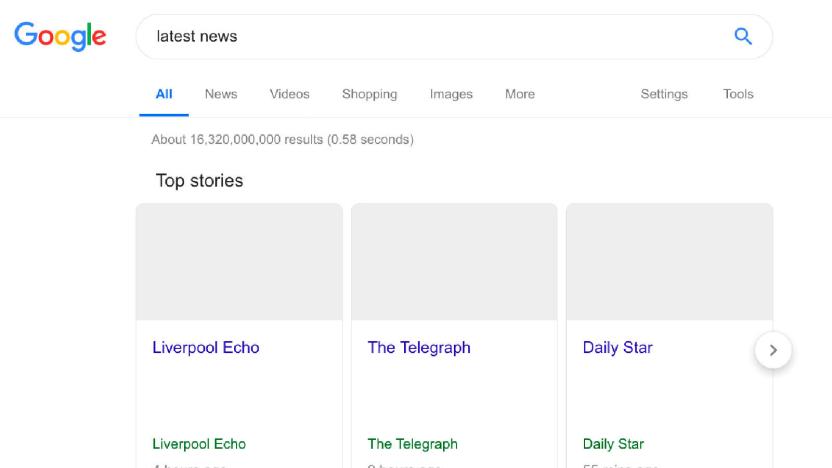
Google shows its bleak vision of search under new EU copyright laws
Google hasn't been shy about decrying the consequences of the EU's proposed Copyright Directive. Now, however, it's using stark visuals to illustrate its point. The company recently told Search Engine Land that it was experimenting with a version of its search engine to gauge the "impact" the Directive would have on both users and publishers, and provided screenshots to illustrate this test. The result, according to Google would be rather... empty. As publishers would have the right to demand payment for use of tiny snippets of content under the Directive's Article 11, Google believes it would have to avoid using the content altogether -- that means blank thumbnails and missing preview text.

Facebook will expand its political ad rules to Nigeria, Ukraine and EU
Facebook will be introducing some of its political advertising policies in additional regions in the coming months, Reuters reports. In Nigeria, where a presidential election is set to take place in February, Facebook will now require those purchasing electoral ads to be located within the country. That same rule will roll out to Ukraine next month ahead of its March election.

EU offers bounties to help find security flaws in open source tools
The European Union believes it has a simple way to bolster its digital security: offer lots of cold, hard cash. The European Commission is launching bug bounties in January that will offer prizes in return for spotting security flaws in 14 free, open source software tools EU institutions use. These include well-known tools like VLC Media Player, KeePass, 7-zip and Drupal as well as something as vital as the GNU C Library.

EU aims to be 'climate neutral' by 2050
European countries have already vowed to take significant steps to curb their effect on the climate, but they're now setting a more ambitious target. The European Union now hopes to achieve a "climate neutral" economy by 2050 -- that is, zero net greenhouse gas emissions. The strategy would involve wider use of renewable energy (80 percent by 2050), a shift to electric transportation and 'decarbonizing' industry.
EU approves Disney's purchase of Fox assets, with conditions
Disney's acquisition of Fox studios and TV channels is one step closer to becoming a practical reality. The European Commission has approved the mega-deal under the condition that Disney has to divest its stake in "factual channels" it controls in the European Economic Area, including History, Crime & Investigation and Lifetime. The buyout would have eliminated competition between two rivals in several countries, the Commission said.

Experimental AI lie detector will help screen EU travelers
In the future, you might talk to an AI to cross borders in the European Union. The EU and Hungary's National Police will run a six-month pilot project, iBorderCtrl, that will help screen travelers in Hungary, Greece and Latvia. The system will have you upload photos of your passport, visa and proof of funds, and then use a webcam to answer basic questions from a personalized AI border agent. The virtual officer will use AI to detect the facial microexpressions that can reveal when someone is lying. At the border, human agents will use that info to determine what to do next -- if there are signs of lying or a photo mismatch, they'll perform a more stringent check.

Germany calls for global minimum tax on large tech companies
German Finance Minister Olaf Scholz has called for a global minimum tax on large technology companies, The Telegraph reports, and it's a move aimed at ensuring tech firms pay taxes in the countries in which they generate revenue rather than only in the countries where they're headquartered. "We need a worldwide minimum tax level that no state may go below," Scholz told Welt am Sonntag. "We require coordinated mechanisms which prevent the displacement of revenues to tax havens."
EU approves Microsoft's $7.5 billion GitHub takeover
The EU has unconditionally approved Microsoft's $7.5 billion deal for GitHub, moving the acquisition another step closer towards closing. After a five-week probe, European Commission antitrust officials concluded that the takeover raises "no competition concerns because the merged entity would continue to face significant competition from other players."


