LargeHadronCollider
Latest

A major upgrade to the Large Hadron Collider is underway
The Large Hadron Collider (LHC) is getting an upgrade that will let researchers collect approximately 10 times more data than they can now. Currently, the particle accelerator can produce up to one billion proton-proton collisions, but that number will be increased significantly once the upgrades are in place. Today, a ground-breaking ceremony kicked off the work that's scheduled to be wrapped up by 2026.

Quark fusion makes ten times as much energy as nuclear fusion
Scientists have overcome huge barriers in the past year to get us even closer to nuclear fusion, and with it a near-limitless supply of clean energy. But, what if there's something far more powerful out there? According to researchers at Tel Aviv University and the University of Chicago, there is, and it involves the fusion of elementary particles known as quarks -- the resulting energy from which would be ten times that of nuclear fusion.
Open data from the Large Hadron Collider sparks new discovery
Back in 2014, CERN released the data from its Large Hadron Collider (LHC) experiments onto an online portal called the Open Data portal. It was an unprecedented move, making data from the LHC's experiments available to those who don't have access to a particle accelerator. It's not completely up-to-date; there's a three-year embargo on results, so, generally speaking, the most recent data being uploaded is from the year 2014. This was the first time results of any particle collider experiment have been released to the public, and now it's produced results.
CERN introduces Large Hadron Collider's robotic inspectors
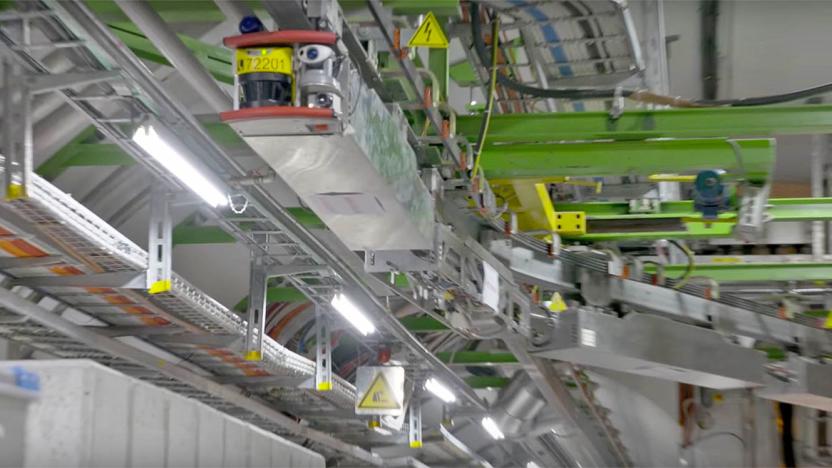
Since the Large Hadron Collider (LHC) needs to be in tip-top shape to discover new particles, it has two inspectors making sure everything's in working order. The two of them are called TIM, short not for Timothy, but for Train Inspection Monorail. These mini autonomous monorails that keep an eye on the world's largest particle collider follow a pre-defined route and get around using tracks suspended from the ceiling. According to CERN's post introducing the machines, the tracks are remnants from the time the tunnel housed the Large Electron Positron instead of the LHC. The LEP's monorail was bigger, but not quite as high-tech: it was mainly used to transport materials and workers.

Large Hadron Collider's new 'particle' was just a fluke
Sorry, folks: CERN didn't mean to get your hopes up. Researchers have determined that Large Hadron Collider data suggesting a possible new particle was really just a "statistical fluctuation." Additional data collected over the course of the past several months reduced the unusual diphoton "bump" to a significance of 2 sigma, or well below the 5 sigma needed for a discovery to be considered authentic. It's just unusual that scientists saw a blip like this at both the ATLAS and CMS experiments, ATLAS' Dave Charlton explains to Scientific American.

Make music with the Large Hadron Collider through a web app
Now that music has come to the Large Hadron Collider, it's time for the giant science ring to make some music of its own. Meet Quantizer, a project from students Juliana Cherston and Ewan Hill that turns the ATLAS experiment's many, many particle collisions into music. The web app grabs data (in real-time when possible), cleans it up and maps it to musical notes. After that, it's just a question of the style you want to hear. There are cosmic sounds if you prefer an ambient vibe, or house music if you'd like something a little more dance-worthy.

Tech doesn't work with children and animals
It's a tale as old as time: Kids and animals don't mix with tech. Whether it's little Billy turning your new flatscreen on and off until it burns out or Rover chewing through another pair of fancy headphones, you'd think we'd know better by now that letting pretty much anything that isn't capable of voting near technology is a bad idea. But as you're about to find out, sometimes it just can't be helped.
CERN opens access to 300TB of Large Hadron Collider data
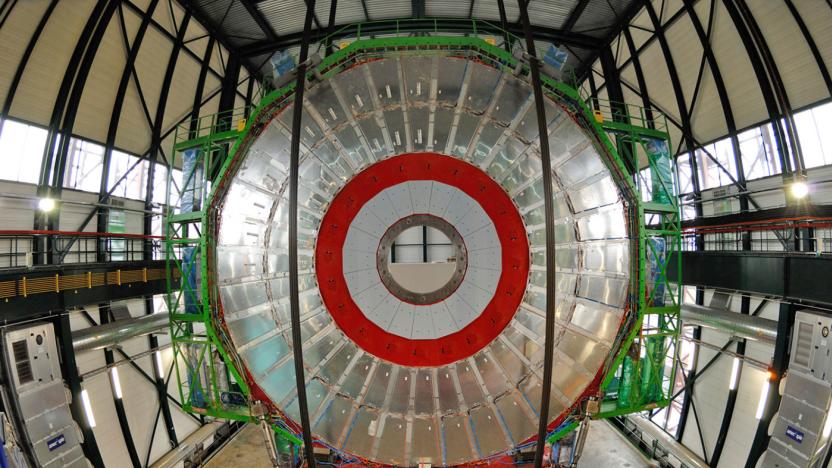
CERN will keep you researchers, students and dataphiles busy this weekend. The institute has released 300 terabytes of Large Hadron Collider data collected by the Compact Muon Solenoid (CMS) detector back in 2011. You know how scientists use the collider to smash particles? Well, the CMS is one of the two components of the LHC with the capability to see the particles (like the Higgs boson) or phenomena produced by those high-energy collisions.

ICYMI: Sad unicorn truth, disease-fighting drones and more
#fivemin-widget-blogsmith-image-781614{display:none;} .cke_show_borders #fivemin-widget-blogsmith-image-781614, #postcontentcontainer #fivemin-widget-blogsmith-image-781614{width:570px;display:block;} try{document.getElementById("fivemin-widget-blogsmith-image-781614").style.display="none";}catch(e){}Today on In Case You Missed It: The news that a type of unicorn walked the earth at the same time as prehistoric humans makes modern-day fantasy novels make a lot more sense. CERN is getting its Large Hadron Collider back online after a hiatus to improve its electrical system. And Ethiopia is using drones to drop sterile tsetse flies over the country, intending for them to breed with the wild natives and cut back on the population of disease-carrying insects, thus lowering risk of illness to humans and animals. We also share that paleontologists mapped the evolution of the largest type of dinosaurs, learning new things about them; and also touched on how vertical farming operations are moving into grocery stores. As always, please share any great tech or science videos you find by using the #ICYMI hashtag on Twitter for @mskerryd.

Take a 360-degree video tour of CERN's Large Hadron Collider
CERN's Large Hadron Collider keeps delivering important scientific discoveries, but apart from some Google Street View images, it's pretty hard to grasp the scale of it. However, a new 360-degree video from the BBC (below) takes you on a visual tour of the world's largest machine. At up to 4K resolution, you can see parts of the 27 km (16 mile) tunnel where particles fly by at the speed of light in both directions. It also shows the Compact Muon Solenoid detector that looks for dark matter, extra dimensions and the Higgs Boson. The science is mind-bending, but as the video shows, the machine needed to test it is equally so.

Large Hadron Collider may have detected a new particle
The rejuvenated Large Hadron Collider might have achieved another breakthrough... provided everything lines up, that is. Two teams of CERN scientists have detected an excess of gamma ray pairs that they suspect might represent the radioactive decay of a previously unknown particle. The data is far from conclusive (there's a 1 in 93 chance that it's nothing), and the researchers don't expect to have enough data until they present at a convention next summer. However, it's rare that two groups notice the same anomaly -- that's frequently a sign that something's up.

The Large Hadron Collider's next upgrade is moving forward
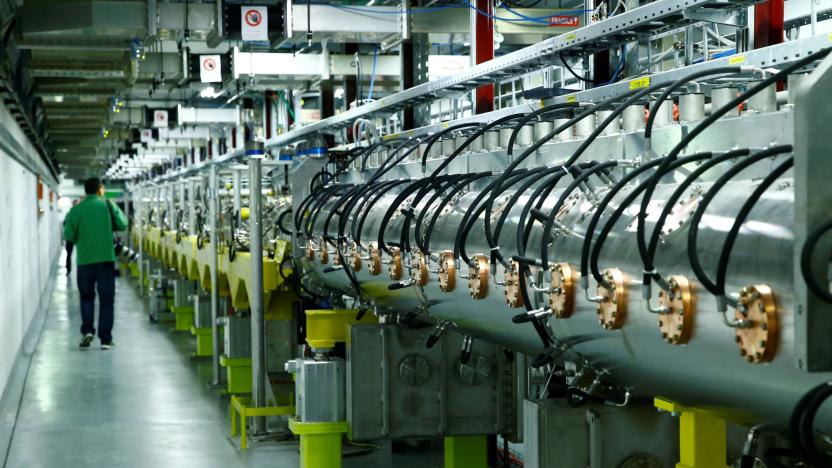
The Large Hadron Collider recently got back to work after a two-year layoff for maintenance and upgrades, but soon it will go under the knife again. Last week 230 scientists met at CERN in Switzerland to discuss the High-Luminosity LHC (HL-LHC) project, and move it from the development phase to the construction stage. After two more Long Shutdown periods in 2019 and 2024, the HL-LHC will deliver 10 times the amount of particle collisions it does now. New technology coming its way includes 12 superconducting quadropole magnets (one is pictured above), "crab" cavities that tilt the particle beams before collisions and more. When we took a look at the science behind particle accelerators a few years ago, the HL-LHC was already in development and after a four year design study it's one (big) step closer to reality.

Watch the rock band Deerhoof experiment with sound at CERN
You knew that CERN was big on experimentation when it built the Large Hadron Collider, but it just took that curiosity in a strange, fascinating new direction. ATLAS physicist James Beacham has kicked off Ex/Noise/CERN, an initiative that has musicians experiment with sound at CERN in tribute to the institute's physics breakthroughs. The first band in the mix is the out-there indie group Deerhoof, and the results are about as odd as you'd expect -- the rockers' fuzz and bass sounds very, very different in an LHC magnet test facility versus a stage. Most of what they play in the clip below wouldn't be considered melodic, to put it mildly, but that's part of the point. This is the sort of listening that usually involves a dark room, some big headphones and an open mind. Here's hoping that the series carries on for a long while, and pushes more than a few creative boundaries. [Image credit: Marine Bass/CERN]

The Big Picture: U2's tour art takes a page from particle physics
Who said that science can't be pretty? Certainly not artist Jeff Frost. When U2 asked Frost for tour art that reflected a "neural net of humanity," he went to CERN's Large Hadron Collider to capture timelapse footage and otherwise treat the particle smasher as a creative tool. As you can see above, the result is dazzling -- it looks like the internet made manifest in a painting. And while you'd think that physicists would be annoyed by this kind of interruption, they actually went out of their way to give Frost access to areas that even they couldn't always see. This doesn't quite make up for U2 foisting an album on millions of people, but it does give Bono and crew some extra geek cred.
Large Hadron Collider finds a new 'pentaquark' particle (updated)
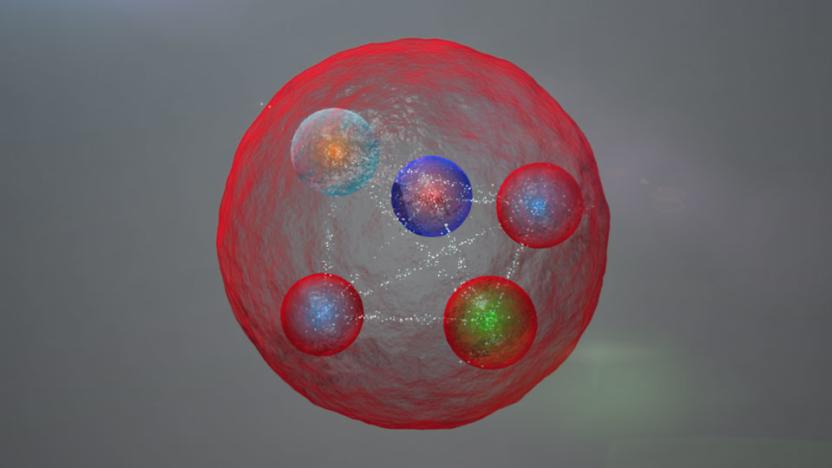
It didn't take long for the Large Hadron Collider to push the boundaries of science once more. The LHCb experiment team has discovered the existence of "pentaquarks," or subatomic particles where there are four quarks and one antiquark in specific states. Scientists have known for decades that these kinds of particles should exist under our current model for quarks, but they've never had solid evidence until now. As they explain, earlier tests were like "looking for silhouettes in the dark" -- the LHC test (which studied the decay of a baryon particle) had so much high-precision data that a pentaquark was the only possible explanation for the results. More tests will be necessary to see how this pentaquark behaves and what it can teach us about physics, but those will begin as soon as the collider starts its next run. [Image credit: CERN/LHCb experiment] Update: To be clear, the data used in this discovery is from the LHC's initial run, before the shutdown. It's during the second, ongoing stint that researchers will conduct follow-up tests.

Large Hadron Collider gets back to running science experiments
What's that strange circular shape, you ask? That, friends, is what particle physics looks like when it's getting back on track. After weeks of test runs following its return to service, the Large Hadron Collider has resumed smashing particles together for the sake of real, honest-to-goodness science experiments -- those criss-crossing lines in the image above are a few of the early collisions. And this time, there's much more energy involved. The LHC is now colliding particles at a level of 13 trillion electron volts, or nearly twice as much energy as it used before its two-year downtime. The boost will hopefully lead to physics discoveries that weren't possible in the previous go-round, which is saying something when some past results were enough to earn a Nobel prize. [Image credit: CERN]

The Large Hadron Collider is back and stronger than ever
Yes, it's back -- after a two-year upgrade program, CERN's Large Hadron Collider is once again operational. Scientists are only firing collision-free proton beams right now to test the new system, but they'll ramp up over the next few months to the point where they're smashing protons together at 13 teraelectronvolts -- about twice the energy the LHC managed in its first season. The machine will have a relatively short three years to operate before its next shutdown, but the higher output should help researchers explore antimatter, dark matter and other aspects of physics that are relatively untested. Given that the collider appears to have discovered the mysterious Higgs boson during its first run, we're hopeful that its second season has more breakthroughs in store. [Image credit: CERN]

These videos prove that music and science can (usually) mix
Wondering how NASA could make a clever yet groan-inducing music video like "All About That Space?" Really, it's just carrying on a tradition of producing science-themed tunes. A lot of them are cheesy covers -- we've seen scientific riffs on Adele and Psy, among others -- while others remind you why biology, chemistry and physics are such wonderful things. We've rounded up ten noteworthy science music videos to show you how good (or at least, dorky) they can get. And if you've discovered any other cool or kitschy clips, be sure to share them in the comments.

Watch the trippiest virtual trip through the Large Hadron Collider
We'll bet you didn't wake up this morning wanting to experience what a particle goes through as it zooms along the massive tunnels of the Large Hadron Collider. Oh, wait -- you did? Well, game development studio Funktronic Labs is waaay ahead of everyone. The firm has already created a trippy first-person virtual reality journey through the LHC, as an homage to the Higgs boson-like particle it found back in 2012. You can interact with the kaleidoscopic world and control your virtual trek by waving your hands (and using pinch-and-pull motions) over a Leap Motion detector, which triggers visual changes on screen. But, if you're lucky enough to have an Oculus Rift at this point in time, you can use one for a more immersive (and very, very trippy -- because this needs to be said more than once) experience. Don't have either? Don't worry: head after the break and watch a preview video to at least get a glimpse of the psychedelic experience.

Google Street View lets you stroll around CERN, no doctorate required
Previously, free rein to explore the labyrinthine laboratory that is CERN has been granted only to the lucky, or those with four degrees and an aptitude for finding theoretical particles. That changes today, however, as anyone can now explore the home of the Large Hadron Collider in Geneva, Switzerland through Google Street View. All the imagery was captured back in 2011, but it's finally been stitched together, allowing you to wander freely around the site of the famous particle accelerator and learn a little about its experiments. Hit up Google Views to begin your personal guided tour, and let us know if you spot this Higgs fellow everyone's so keen on finding.


