recycle
Latest

The North Face’s high-tech Futurelight jackets are finally here
It uses a proprietary nanospinning technology that lets air move through fabric easily and according to the company offers more venting than ever before.

The North Face teases its most breathable waterproof gear yet
As great as waterproof apparel is to keep you protected from bad weather, most jackets, pants and other gear tend to be too bulky or uncomfortable. That's a problem The North Face is well aware of, and it has come up with a new material that it believes will fix this: Futurelight, which the company is calling "the most advanced breathable waterproof outerwear technology." According to The North Face, Futurelight is its most comfortable waterproof gear yet, thanks to a design that lets air move through fabric more easily and provide "more venting than ever before.'
Washington state bill would make hard-to-repair electronics illegal
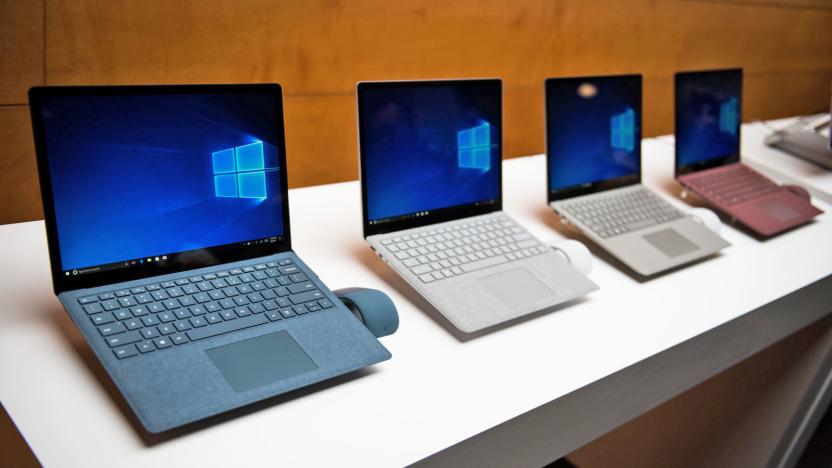
A number of states are considering right to repair bills, legislation which if passed would make it easier for individuals and repair shops to replace or repair electronics parts. Repair.org reports that 17 states have already introduced bills this year and while most aim to make repair parts and manuals accessible, Washington's proposed legislation would straight up ban electronics that prevent easy repair. "Original manufacturers of digital electronic products sold on or after January 1, 2019, in Washington state are prohibited from designing or manufacturing digital electronic products in such a way as to prevent reasonable diagnostic or repair functions by an independent repair provider," says the bill. "Preventing reasonable diagnostic or repair functions includes permanently affixing a battery in a manner that makes it difficult or impossible to remove."

Dell and Nikki Reed harvest gold from old laptops for jewelry
Dell's no longer just an electronics company -- it now makes jewelry too (sort of). It has teamed up with actor and activist Nikki Reed on the Circular Collection, which comprises pieces made from gold recovered from Dell computer motherboards. These are 14- and 18-carat gold rings, earrings and cufflinks, mind you, and don't look like they've been remade from waste material at all.
AI recycle bins could know what you’re throwing away
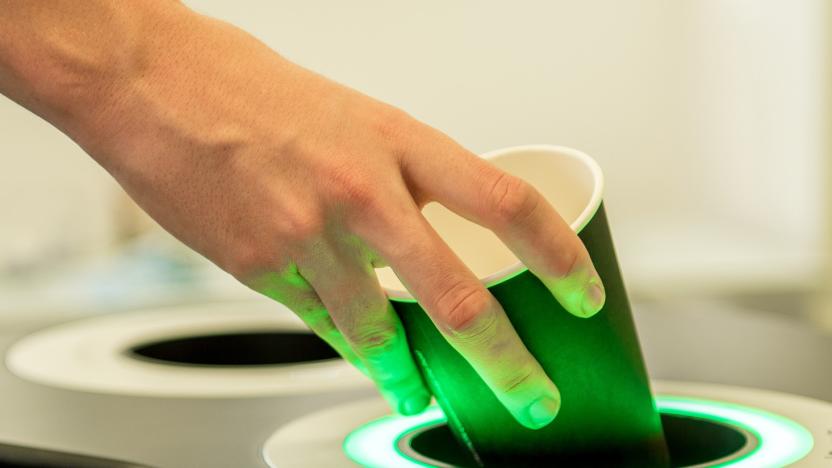
Is that coffee cup recyclable or compostable? It can be tough to tell, for sure, but a new recycling system from Cambridge Consultants aims to help using image recognition and machine learning. With low recycle rates in the US and UK, possibly due to consumer confusion over what's possible to recycle, this new retail-focused recycle point could help us all know what to recycle and what to trash. The company envisions a future where you'll even be rewarded via a phone app with points or a donation to charity when you recycle this way.
Samsung will mine scrapped Note 7s for parts and rare metals
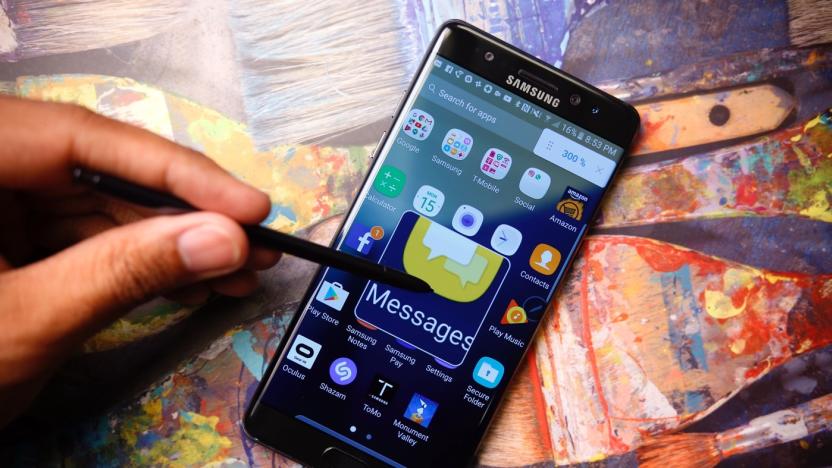
Samsung will kick off its Galaxy Note 7 recycling efforts this month and expects to recover 157 tons of rare metals from the controversial device. The phone's fiery history is pretty hard to forget, but to refresh your memory, Samsung had to pull it from shelves and discontinue its production after numerous reports of the model catching fire came out. Samsung has recently released refurbished Note 7s in Korea, but it still has to deal with a mountain of phones it won't be able to sell anymore.
HP is turning trash into printer cartridges
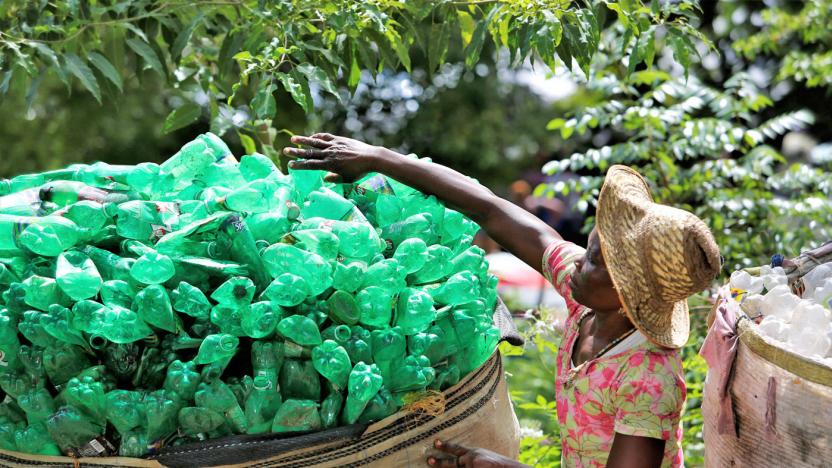
All those printer cartridges from HP that usually cost an arm and leg will start helping to do some good in the world beyond your prints of kitten photos. During an event at its headquarters, HP announced that it is using recycled plastic from Haiti to manufacture select cartridges.

Reebok will introduce plant-based sustainable shoes this year
While others try shoes that lace themselves or have 3D printed soles, Reebok will have "plant-based" footwear on shelves this year. Adidas already sold a sneaker produced from ocean-plastic, but Reebok's "Cotton + Corn" push is focused on shoes that are made from sustainable, growing materials, that can even be used as compost after they're worn out.

Edible milk-based film preserves food better than plastic
Figuring out how to keep food fresh was a challenge seemingly met by plastics. But as it became clear that spooling out all that synthetic packaging was adversely affecting the environment, interest in greener methods of preservation has spiked. While most containers in your grocery store can be recycled, the thin film stretched over fresh-cut meat can't be — and it's not even that good at keeping food unspoiled. Now, US Department of Agriculture researchers have pioneered a drastically more efficient covering...and it's made out of milk.

ICYMI: Baggage bot, sea plastics become fashion and more
try{document.getElementById("aol-cms-player-1").style.display="none";}catch(e){}Today on In Case You Missed It: A baggage handling robot is being tested at the Geneva Airport to both carry your luggage and print out tags. Adidas made athletic shoes that are almost entirely recycled; with gill nets making up the stitching on the outside. It joins clothing designer and entertainer Pharrell Williams in upcycling sea garbage (much of which kills sea creatures) to make their garments. If you're interested in the Zero Electricity Air Cooler, the video is here. You can learn more about PARLEY, the group that helps collect plastic and other waste from the oceans, here. As always, please share any great tech or science videos you find by using the #ICYMI hashtag on Twitter for @mskerryd.

Epson wants to put a paper recycling machine in your office
If Seiko Epson has its way, your office paper recycling bin could soon become obsolete. The company's PaperLab, an 8.5-foot-wide device that turns used paper into clean white sheets, is set to go on sale next year. The machine strips paper into fibers before using additives to bind fibers back together, remove colors and calibrate the white appearance for the final result. PaperLab works at a rate of 14 sheets per minute or around 6,720 sheets in an 8-hour workday. In addition to convenience, the PaperLab should also reduce the environmental impact from transporting paper waste and new recycled sheets back and forth. Epson isn't discussing pricing specifics just yet, but expect the requisite investment to be quite substantial.

Dell will use recycled carbon fiber in Alienware and Latitude products
Later this year, Dell will increase the amount of recycled materials that it uses to make its products. Before the end of 2015, the company will begin using excess carbon fiber and other scrap materials in a few Alienware and Latitude devices. The effort with expand across those two lines in 2016 as the Dell says its plan to use the recycled carbon fiber is "an industry first." The company is teaming up with the supplier SABIC on the initiative, and it says estimates show the duo can keep 820,000 pounds of carbon fiber from hitting landfills. The computer maker began using recycled plastics for enclosures back in 2014, re-using 4.2 million pounds since that time in a number of displays and its OptiPlex desktops.

'Nano-paper' chips end up in compost heaps, not landfills
Today's cast-off gadgets are far more likely to end up in a landfill than they are being responsibly disposed of. In fact, 41.8 million tons of e-waste were scrapped last year alone. To combat this, a team from the University of Wisconsin-Madison has invented a radically new kind of ecologically-friendly semiconductor chip made from wood. No, seriously.

Apple's iPhone trade-in program hits UK retail stores from today
Apple has offered online trade-ins for the last few years, and now it's bringing its in-store version across the pond to the UK. The fruity phone flinger is letting customers wander into one of the company's retail outlets, drop off their elderly hardware and walk out with credit for a replacement. Apple released the following statement, which should sound familiar to anyone who had already read the US version -- after all, all someone did was add the phrase "in the UK" to the text. "iPhones hold great value. So, Apple Retail Stores in the UK are launching a new program to assist customers who wish to bring in their previous-generation iPhone for reuse or recycling. In addition to helping support the environment, customers will be able to receive a credit for their returned phone that they can use toward the purchase of a new iPhone." Update: We're also hearing news that the trade-in program has gone live in a few other European countries this morning. We've contacted Apple and will let you know what the official line is when we hear back.

Finland sets new mobile phone record... by throwing one
Admittedly, Finland's seen better days in the mobile industry, but that hasn't stopped the townspeople in Savonlinna from hosting the 13th annual Mobile Phone Throwing World Championships to brighten things up. In fact, the recycling awareness event went so well that 18-year-old Ere Karjalainen set a new championship record of 101.46 meters. The secret? Just an old Nokia device (obviously) plus a bit of preparation the day before -- "mainly by drinking." While Finnish organizer Christine Lund claims this is a new world record, a little digging revealed that Britain's Chris Hughff threw -- as a guest participant -- a 102.68 meter distance at JIM Mobile's Belgium Championships earlier this year. Despite the utilization of a laser rangefinder plus video proof after the break, Lund dismissed the "unofficial" event's record, according to the AAP. Regardless, Karjalainen is no doubt the latest sweetheart amongst Finnish geeks.

Fujitsu making laptops from unwanted CDs and DVDs
Back in our day, we used to listen to music on shiny plastic discs with lasers, not any of your new-fangled Zunes and what not. That was back when bands had sensible names, like the Dave Clark Five. These days, however, CDs and DVDs are remnants of a simpler time, a time before these kids were playing their Lady Gagas on their Rio Carbons. Fujitsu will be putting those outdated media formats to work again, with a recycling program that uses the material to build shiny new notebooks, starting with the Lifebook P772/E enterprise laptop, with more models to follow. According to the company, the new program is set to reduce the use of new plastic by 10 tons a year and slice C02 emissions by around 15 percent. More information on the program can be found after the break. Now please get off our lawn.

Researchers create super-efficient microbial fuel cell, dream of selling excess electricity
Recycling wastewater to generate energy has turned up noses before, but researchers at Oregon State University have developed a microbial fuel cell that can create 10 to 50, or even 100 times more electricity per volume than similar technologies. After refining the tech for several years using new materials, techniques and selecting better microbes, the team can now extract two kilowatts per cubic meter of refuse. As bacteria oxidizes organic matter, electrons -- rather than the hydrogen or methane that other methods rely upon -- are produced and run from an anode to a cathode within the device to create an electric current. Once implementation costs are cut down, the technology could power waste treatment plants and enable them to sell excess electricity. The contraption isn't just for processing what comes out of the porcelain throne -- it can also utilize materials ranging from grass straw to beer brewing byproducts. For now, however, the cell will tackle a pilot study before it inches closer to your local brewery or water treatment facility.

Scientists develop flush-efficient toilet system that can turn waste into energy, sort before it recycles
Scientists from Singapore's Nanyang Technological University aren't keen on being wasteful -- that's why they've developed a toilet that uses 90% less water than other commodes and is capable of generating energy. Aptly named the No-Mix Vacuum Toilet, the porcelain pedestal's pot divides waste between two partitions -- one side for liquids, the other for solids -- and uses vacuum tech reminiscent of airline lavatories. Flushing solid and fluid wastes with 1 and 0.2 liters of H2O, respectively, the can will be able to route refuse to external processing facilities. Fertilizer ingredients such as nitrogen, potassium and phosphorous would then be harvested from liquids. Similarly, methane can be coaxed from solids for conversion to electricity or as a replacement for other natural gasses. Two of the university's restrooms are slated to have the toilets installed in the near future, and the team expects the thrones to roll out worldwide within three years. [Thanks, Yuka]

Insert Coin: Berlin Boombox recyclable cardboard stereo (video)
In Insert Coin, we look at an exciting new tech project that requires funding before it can hit production. If you'd like to pitch a project, please send us a tip with "Insert Coin" as the subject line. It's been years since we've spotted a proper handle-sporting boombox on this side of the equator (in public, at least), but we're decidedly impressed with this unique Kickstarter creation, dubbed the Berlin Boombox. Constructed nearly entirely of cardboard, save for some metal- and plastic-based essentials, the speaker rig ships disassembled in a flat cardboard box. Getting the Boombox up and running shouldn't require much effort, however -- the designer states that you won't need any tools during the quick assembly process. After you're done, you can connect the setup to any source with a 3.5mm headphone jack, then control volume with the large aluminum power/volume knob. The Berlin Boombox also ships with four AA batteries, though it's not clear how many hours of music you'll be able to pipe through the speakers with that initial set of cells. We also can't speak to sound quality, though there is a free custom sound profile available for iOS devices -- audio "will be remastered in real-time to use the full potential of the Berlin Boombox." You can pre-order your own with a $50 pledge, saving you 9 bucks off the estimated retail price. There's also a "limited edition" two-tone box, available with a $100 pledge, while $250 will net you a custom-designed model, which can also be paired with a dinner and tour of Berlin with the inventor if you're willing to fork over $500 or more. There's just shy of two weeks left during the funding period -- you'll need to provide that financial support before noon on April 25th. The project is on track to meet its $14,000 funding goal, however, so it's fairly safe to say that you'll be able to snag one of these cardboard contraptions even if you aren't ready to take the plunge just yet. Jump past the break to see the Berlin Boombox in action, and to catch up with our last Insert Coin project: The PowerPot.

ReCellular's headquarters toured by iFixit, recycling and redistribution gets a closer look
ReCellular's hardly a new name in the recycling universe, but as more and more individuals toss their dumbphone for a smarter alternative, the Ann Arbor-based outfit is seeing a new wave of interest. iFixit, a company that thrives on tearing down gadgetry both new and old in order to inform people of their repair and upgrade options, recently had the opportunity to tour ReCellular's monolithic warehouse, where some 10,000 used phones are processed every 24 hours. The tour also included a bit of back-and-forth with the founder, who isn't against the seemingly endless churn of devices. In fact, he quips that "we have the right to get a phone that's smaller and a prettier color if we want," insinuating that ReCellular simply exists to provide a better home to older gizmos than in some landfill. Perhaps surprisingly, Chuck Newman even confesses that the whole "environmental message" isn't very effective, which is why it distributes prepaid envelopes to encourage recycling that would probably not happen otherwise. Eager to read more? Give those links below a tap.


