RiceUniversity
Latest
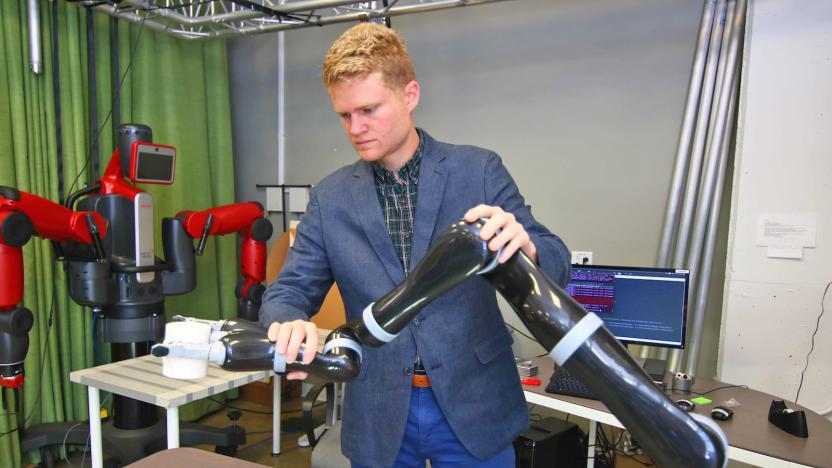
Researchers develop a way to train robots with just a gentle nudge
Researchers at Rice University have developed a way to train robots with just a little push. Their method uses algorithms that allow robots to not only respond to a human's touch in the moment, but alter their trajectory based on that physical input. "Here the robot has a plan, or desired trajectory, which describes how the robot thinks it should perform the task," said graduate student Dylan Losey about the project. "We introduced a real-time algorithm that modified, or deformed, the robot's future desired trajectory."

Flat microscope for the brain could help restore lost eyesight
You'd probably prefer that doctors restore lost sight or hearing by directly repairing your eyes and ears, but Rice University is one step closer to the next best thing: transmitting info directly to your brain. It's developing a flat microscope (the creatively titled FlatScope) that sits on your brain to both monitor and trigger neurons modified to be fluorescent when active. It should not only capture much more detail than existing brain probes (the team is hoping to see "a million" neurons), but reach levels deep enough that it should shed light on how the mind processes sensory input. And that, in turn, opens the door to controlling sensory input.

Researchers are closer to working capillaries in 3D-printed organs
Researchers have brought 3D-printed organ and tissue capabilities a long way, but the technology still faces a few challenges. A major one is how to incorporate blood vessels into bioprinted tissue. Living tissue needs a blood supply nearby because without blood to bring in nutrients and take away waste, biological cells will die. Researchers have been able to print larger blood vessels, but functional small vessels like capillaries have been much harder to create and sustain. However, researchers at Rice University and Baylor College of Medicine have developed a new technique, published in Biomaterials Science, that might make it possible.

Researchers can now desalinate seawater with the power of the Sun
One of the oldest means of extracting potable liquid from seawater involves distillation, basically boiling the water into steam and then cooling the purified vapor in condensation tubes. Problem is, this method is incredibly power intensive with nearly half of the input energy going towards just boiling the water. But, a team of researchers from Rice University have developed a new technique that not only drastically reduces the amount of energy needed but can decouple the process from the power grid altogether.
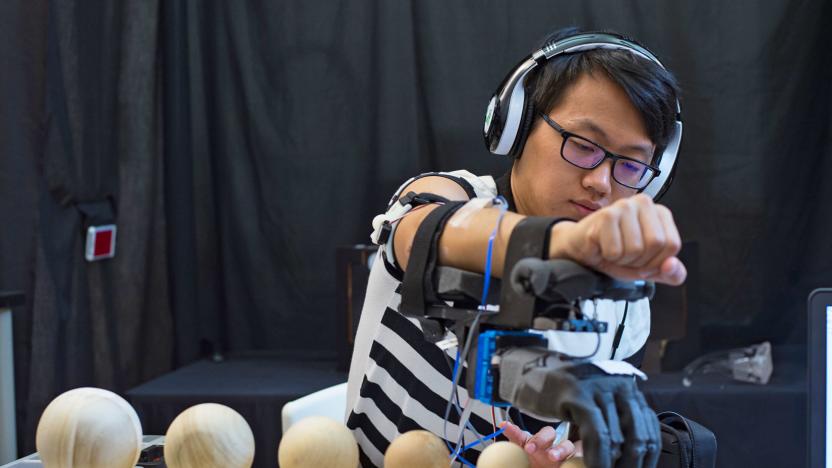
Haptic feedback gives prosthetics 'muscle sense'
For all the actuators, artificial tendons and glitter cannons that researchers are packing into modern prosthetics, these devices still lack an noninvasive means of transmitting haptic feedback to its user. However a device developed by Rice University in partnership with the University of Pisa and the Italian Institute of Technology aims to do just that.

Graphene key to promising treatment for spinal cord injuries
Graphene seems to have almost limitless potential, from making better batteries to night-vision windshields and microscopic sensors. And now, a team at Rice University has shown the material could be key to a promising new treatment for severe spinal cord injuries.

Researchers take nanocars out for an open-air test drive
Nanocars, those molecular-scale vehicles that might one day carry around tiny payloads, have been zipping around in vacuum environments for awhile now. But one breakthrough the nanocar researchers at Rice University have been searching for is the ability to operate these nanomachines in ambient, open environments.

ICYMI: VR Mars bus tour, self-assembling nanowire and more
#fivemin-widget-blogsmith-image-456992{display:none;} .cke_show_borders #fivemin-widget-blogsmith-image-456992, #postcontentcontainer #fivemin-widget-blogsmith-image-456992{width:570px;display:block;} try{document.getElementById("fivemin-widget-blogsmith-image-456992").style.display="none";}catch(e){}Today on In Case You Missed It: Lockheed Martin is encouraging kids to get into STEM with a Mars Experience Bus, with giant displays that look as though they're actually driving on the surface of Mars. Rice University created nanotubes that quickly self-assemble into nanowire. And Yamaha created an acoustic guitar that can store and loop back reverb and chorus sounds. We are also collectively irritated by the latest smart mattress with sensors inside, designed to catch your partner cheating, on your own mattress, when you're not at home. Ugh. As always, please share any great tech or science videos you find by using the #ICYMI hashtag on Twitter for @mskerryd.

Tesla coil zaps nanotubes into a self-assembling circuit
Carbon nanotubes have gotten fanfare for rebooting Moore's Law and possibly powering the next generation of space probes, but that's not all the versatile material can do. How about shocking nanotubes with an electricity gun until they line up into neat little rows? Scientists at Rice University are firing a force field from a tesla coil at piles of carbon nanotubes until they self-assemble in a process called "Teslaphoresis". The force field oscillates positive and negative charges in each nanotube until they line up. These chains of nanotubes can form a structure and even carry a current. They light up LEDs, which are wirelessly powered by energy absorbed from the tesla coil's force field. "Normally when you talk about building circuits, you have to have physical contact. Now they're talking about building circuits without actually touching them," says Rice University scientist Carter Kattrell in a video. Pointing your lightning beam at carbon nanotubes to do your bidding is cool, but rearranging them has possibilities beyond just lighting up your Christmas tree. Depending on how they're configured, they can make a material that is stronger and lighter than kevlar or make the blackest fabric known to man. Self-assembly via electric fields isn't new, but it's only been done at extremely short ranges. The Rice scientists saw Teslaphoresis line up nanotubes from several feet away, and believe the process could chain them from the bottom-up into macro structures.
ICYMI: Water-repellent coating, elite air travel and more
#fivemin-widget-blogsmith-image-590267{display:none;} .cke_show_borders #fivemin-widget-blogsmith-image-590267, #postcontentcontainer #fivemin-widget-blogsmith-image-590267{width:570px;display:block;}try{document.getElementById("fivemin-widget-blogsmith-image-590267").style.display="none";}catch(e){}Today on In Case You Missed It: Rice University scientists came up with a new kind of water-repellent coating that is modeled on the lotus leaf. Australians have their first ever remotely controlled firefighting robot that is capable of firing a water cannon up to 90 feet. And Windspeed Technologies, an aerospace engineering firm, just upped the luxe travel game by putting a dome at the top of an aircraft with top 'o the plane seating for those you can pay for it.

Nanoparticle-based windows could switch colors on demand
One day, you might not need special bulbs to give your room's lighting a different hue -- you'd just tell the windows themselves to change. Rice University researchers have discovered that you can change the colors transmitted through glass by sending a voltage through pairs of gold and silver nanoparticles, which you frequently find in stained glass windows. Jolt a window one way and you'd get a bright red; reverse the voltage and you'd get blue. All you're really doing is forming or removing chemical bridges between the particles.

Nanofiber gel and snake venom work together to stop the bleeding
Researchers at Rice University announced a novel use for batroxobin, a hemotoxic component in the venom of two South American pit viper species. They've figured out how to leverage it as a potent coagulant -- when combined with a nanofiber hydrogel called SB50 -- that could save countless lives in surgery. Medical science has actually been employing batroxobin as a topical clotting agent and thrombosis treatment since the mid 1930s. Used along with the gel, now it's shown a capability to stop the flow of blood even if the patient is on heparin, a powerful anticoagulant administered before some surgeries.

Researchers make a living circuit out of bacteria
Under the right circumstances, bacteria can be quite cooperative -- both with each other and the organism they're living in. A research team at Rice University has managed to exploit that natural congeniality to, for the first time, create a biological circuit that works much like a conventional computer chip. But the goal of the researchers' work isn't to build better biocomputers, it's to help them more fully understand how these organisms interact within our guts.

'3D' white graphene could revolutionize gadget cooling
Graphene seems to be the new millennium's wonder material: it can be used to build more powerful processors, more efficient solar cells, better sounding headphones and, apparently, can even be deep-fried to create long-lasting batteries. Now, researchers at Rice University think that a "3D" variant of the material could change the way we cool our gadgets.

Taking walks with this leg brace can power an artificial heart
Someday, folks with artificial hearts might have to take long, daily walks to stay alive -- not because exercise is good for their health, but because those walks literally power their synthetic organ. A team of students from Rice University called "Farmers" are developing a device that can generate energy and feed it back into the body to be used by an artificial heart. Their creation? A modified medical leg brace with a motor attached right on the joint, so it can produce energy every time the user bends his knee. An earlier prototype for the same project -- it's a multi-year endeavor, and the current model is the brainchild of the third batch of students -- could also generate power by walking. However, that wasn't a brace, but a shoe with a pedal attached to the sole.

Technology designed for aerospace could improve Parkinson's therapy
When Rice University chemist Matteo Pasquali set out to to create strong and conductive carbon nanotube fibers, he had aerospace applications in mind. But it turned out his microscopic fibers are also great at communicating with the brain, making them an ideal candidate for therapies that deal with neurological disorders such as Parkinson's disease. Pasquali said: "...once we [he and his team] had them in our hand, we realized that they had an unexpected property: They are really soft, much like a thread of silk. Their unique combination of strength, conductivity and softness makes them ideal for interfacing with the electrical function of the human body."

DARPA funds $11 million tool that will make coding a lot easier
DARPA is funding a new project by Rice University called PLINY, and it's neither a killer robot nor a high-tech weapon. PLINY, named after Pliny the Elder who wrote one of the earliest encyclopedias ever, will actually be a tool that can automatically complete a programmer's draft -- and yes, it will work somewhat like the autocomplete on your smartphones. Its developers describe it as a repository of terabytes upon terabytes of all the open-source code they'll find, which people will be able to query in order to easily create complex software or quickly finish a simple one. Rice University assistant professor Swarat Chaudhuri says he and his co-developers "envision a system where the programmer writes a few of lines of code, hits a button and the rest of the code appears." Also, the parts PLINY conjures up "should work seamlessly with the code that's already been written."

Invisibility suits are coming thanks to squid-like displays
It's not as hard to make an invisibility cloak as you might think, but making one that's truly sophisticated is another matter; metamaterials (substances that change the behavior of light) are hard to build. Rice University appears to have solved part of the problem, however. It just developed a squid-like color display (shown below) that should eventually lead to smart camouflage. The new technology uses grids of nanoscopic aluminum rods to both create vivid, finely-tuned colors as well as polarize light. By its lonesome, the invention could lead to very sharp, long-lasting screens. The pixels are about 40 times smaller than those in LCDs, and they won't fade after sustained light exposure.

Future phones could house a terabyte of memory
You may think that the 3GB of memory in your new smartphone is hot stuff, but that pales in comparison with what Rice University has in store. Its scientists have detailed a form of resistive RAM (RRAM) that can be made using regular equipment at room temperatures, making it practical for everyday gadgets. The trick is the use of porous silicon oxide where metals (such as gold or platinum) fill the gaps. Using the silicon material doesn't just give manufacturers something familiar to work with; it requires much less power than previous techniques, can last through 100 times as many uses and isn't fazed by heat. It's also far denser than earlier RRAM, storing nine bits per cell where even conventional flash storage stops at three. The result should be an easy-to-make RAM chip with the kind of capacity that you'd normally expect from much larger permanent storage, like an SSD -- as the company Crossbar hinted when it first discussed this approach, you could stuff 1TB into a component the size of a postage stamp.

New medical gel grows bone tissue exactly where you need it
Repairing seriously damaged bones is normally a delicate art; while you want to regrow bones quickly, you also have to carefully manage that growth to produce the right shape. Thankfully, Rice University has created a gel that makes it easier to produce only the bone tissue a patient needs. The material kickstarts bone regeneration using a patient's stem cells, but it also dictates where that growth occurs by forming a scaffold that degrades only when tissue takes its place. Effectively, doctors just have to fill an area with the gel and wait for nature to do the rest. The technique should initially be useful for repairing skull damage, but it's likely to be handy for both less vital operations and cosmetic surgery -- don't be surprised if doctors can eventually give you a facelift by reshaping your cheekbones. [Image credit: Jeff Fitlow/Rice University]


