tactile
Latest

This OLED screen can fill with liquid to form tactile buttons
Swiping and tapping on flat screens is something we’ve learned to deal with in smartphones, tablets and other touchscreen gizmos, but it doesn’t come close to the ease of typing on a hardware keyboard or playing a game with a physical controller. To that end, researchers Craig Shultz and Chris Harrison with the Future Interfaces Group (FIG) at Carnegie Mellon University have created a display that can protrude screen areas in different configurations. It’s a concept we’ve seen before, but this version is thinner, lighter and more versatile.
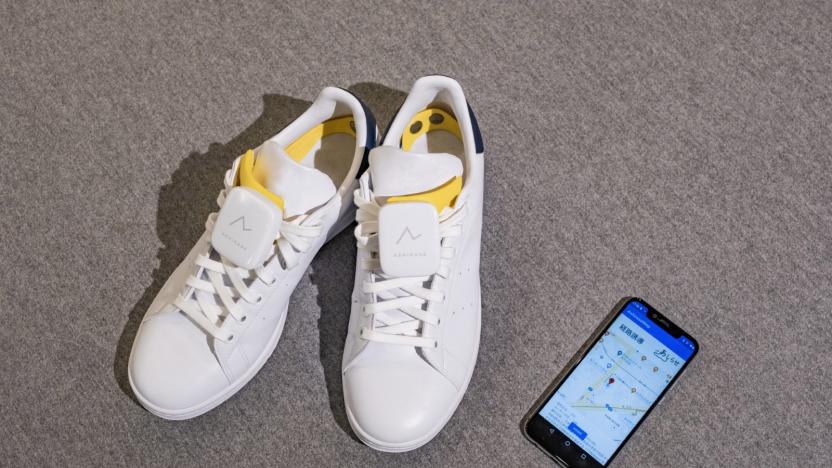
This toe tickling navigation system will help the visually impaired walk tall
The Ashirase system allows low-sighted people to navigate through cities using their feet, rather than cell phones or visual aids.
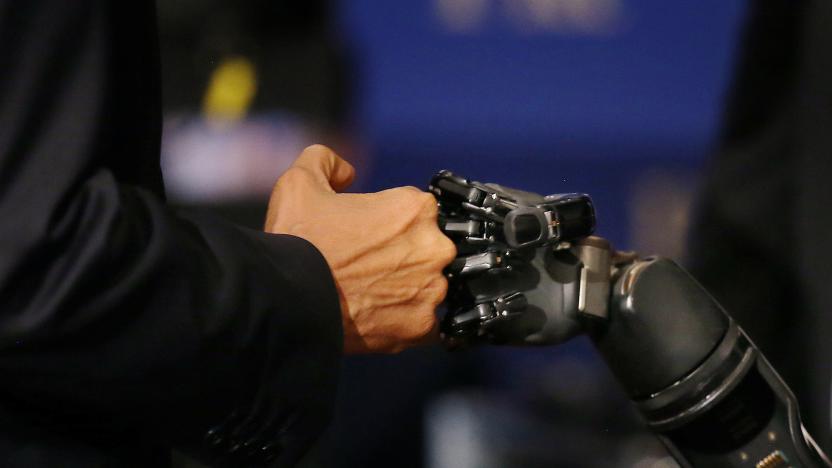
Researchers boost robotic arm movement by adding a sense of touch
Researchers helped a paralyzed man to move his robotic arm even faster by adding tactile feedback to the process.

Researchers built robotic skin with a sense of touch
Using Intel's neuromorphic Loihi chip, researchers created a robotic skin that detects touch more than 1,000 times faster than the human sensory nervous system.
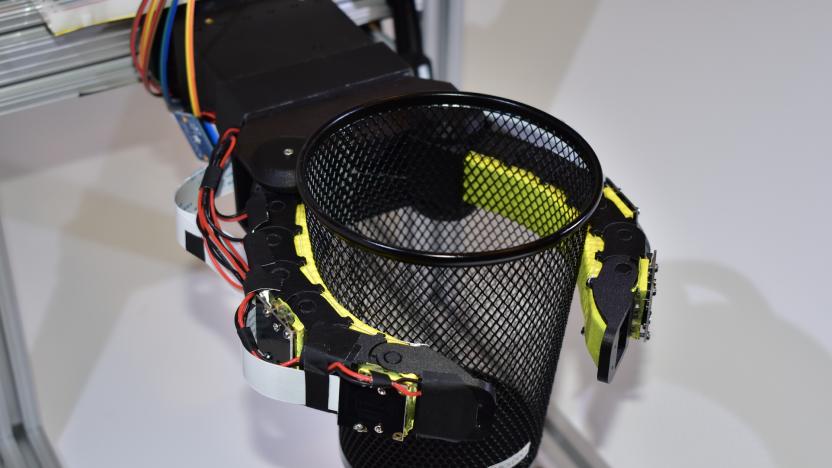
MIT gives soft robots a better sense of touch and spatial awareness
Researchers from MIT give robotic grippers a better sense what they’re gripping and how much force to use.

Facebook Research is developing touchy-feely curious robots
As a social media platform with global reach, Facebook leans extensively on its artificial intelligence and machine-learning systems to keep the site online and harmful content off it (at least, some of the time). Following its announcement at the start of the month regarding self-supervised learning, computer vision, and natural language processing, Facebook on Monday shared details about three additional areas of research that could eventually lead to more capable and curious AI.

3D-printed images help the blind 'see' Hubble's photos of space (video)
The Hubble Space Telescope has produced some of the most spectacular images known to man, but there's a large segment of the population who've been unable to enjoy them: the blind. A pair of astronomers from the Space Telescope Science Institute aim to change that, though, by producing tactile "images" of the universe using a MakerBot Replicator 2 3D printer. While such prints can be made from almost any object, the duo's biggest challenge was figuring out the 3D structure of objects like galaxies -- and then making it possible, through feel, for the visually impaired to picture them in their mind's eye. So far, they've developed 3D prototypes showing stars, gas clouds, filaments and more using lines, raised circles and dots formed formed in plastic. The group hopes to one day produce tactile pictures for schools, libraries and the public -- meanwhile, check the video after the break to see what the first users thought about it. [Image credit: NASA, ESA and M. Estacion]

Daily iPad App: Finger Tied will tie your fingers in knots
Developer Owen Goss has made some really interesting puzzle games for iPhone and iPad, including the excellent LandFormer. He also built an app called Baby's Musical Hands that emphasizes simple interaction with the iPad. Clearly, he's very interested in the iPad's tactile possibilities. His latest game, Finger Tied, explores the idea even further by asking players to directly interact with the glass screen in several ways. The core idea is simple. There are a few different shapes on the screens with tracks attached to them. Your goal is to drag your fingers across the screen and follow those different tracks. As you can see above (and in our video below), this can get difficult as the levels go up, sometimes requiring you to independently operate up to four different fingers at once. The game also has a very nice and intuitive level creation editor, where you can make your own levels in a snap. Unfortunately, I can't find an easy way to share custom levels, so maybe that's a feature that will be in the pipeline for a later date. At any rate, Finger Tied is an excellently designed title, and demonstrates how much thought Goss has put into the touchscreen's potential. The game's currently available at a launch sale price of just US$0.99, making it a must-buy for anyone with 10 fingers and an iPad.

Google patents smart watch with flip-up display that could reveal everyday objects' secrets
It looks like Google has considered transferring ideas from Project Glass over to your wrist by patenting a smart watch with a transparent, flip-up touchscreen. If such a device ever came off the USPTO papers, it would present notifications and other info transmitted from your smartphone at a glance, like many, many others now on the market. However, Mountain View's added a new twist when you'd flip up its bezel -- at that point, it's claimed that the watch could channel a plethora of other Google apps, like Gmail, Goggles, and Maps. Of course, you'd be able to privately view messages inside the bezel, but since the display would also be transparent, you could see through it to landmarks or object around you. According to the patent, you could then be given directions based on GPS coordinates and the buildings "seen" by the watch, while a Goggles-like implementation would be able to identify smaller items in the display. That would let the search giant throw ads or other data about the product your way, giving you the info you need to snap it up -- and likely not hurting Google's bottom line.

Matias Quiet Pro claims to be the 'world's quietest mechanical keyboard'
Canada's Matias Corporation has made something of a name for itself with its tactile keyboards, but those have primarily appealed to those who also enjoy (or at least accept) the sound of a mechanical keyboard in addition to its feel. The company's hoping to bring a few more into the tactile fold with its new Quiet Pro, though, which it claims is the "world's quietest mechanical keyboard." That, Matias says, comes without any sacrifices to tactile feedback, and is said to be the result of more than two years of work. As usual, the keyboard comes in both PC and Mac specific models (all-black and silver & black, respectively), each of which boasts three USB 2.0 ports and laser-etched keys with beveled keytops as opposed to the increasingly common flat variety. Not surprisingly, you can also expect to pay a bit of a premium over your average keyboard -- each model will set you back $150, with US models available today (UK, German and Nordic versions are promised for January). Interestingly, the company says it is also planning to sell the new switches it's developed to other companies for use in their own keyboards, and even to hobbyists interested in going the DIY route. Additional details on that are promised soon.

Robot with tactile sensor is better at identifying materials than you are (but only wants to help)
Researchers at USC's Viterbi School of Engineering have developed a robot capable of identifying materials, thanks to a tactile sensor. The so-called BioTac sensor mimics the human finger, with flexible robot skin layered over a liquid filling -- and the skin even has fingerprints to increase the robot's sensitivity to vibration. Researchers trained the robot to recognize 117 common materials, and by making "exploratory movements" to feel out textures it was able to correctly identify materials 95 percent of the time -- a higher accuracy rate than humans achieve. Still, though the robot is an ace at understanding textures, it doesn't possess the ability to decide which materials are preferable to humans. For this reason, the USC team says it will focus more on applications such as human prostheses and consumer product testing. Relax: your fingers are still worth something -- for now.

Researchers suggest haptics and audio for discreet password input
You can use as complex as a password as you like, but that won't do you much good if someone's able to watch or record you entering it. Researchers Andrea Bianchi, Ian Oakley and Dong-Soo Kwon have some ideas for overcoming that little problem though, and recently put together a video demonstrating a few of the possibilities they've come up with. All of those rely on haptic input systems -- either on their own or in conjunction with some audio output (through headphones for privacy). That includes things like a dedicated haptic keypad or haptic wheel, and different methods that could take advantage of a haptic display on a smartphone. As you can see in the video after the break, some of those options could be a bit more time consuming than an easy-to-remember password, but there's certainly plenty of potential applications where security would trump convenience.[Thanks, An]

Rumor mill: Will the new iPad have a tactile display?
Remember Senseg's tactile touchscreen displays? Well, last December the company showed off a screen that used an electrostatic field to simulate friction and textures on the glass. Such technology was a couple of years away from being commercially viable, but there's a tiny glimmer of a chance it might be the new killer iPad feature. Pocket-lint spoke to a company rep who cryptically said that the company wasn't making any statements until "after Apple's announcement." Why would they issue any statement tied to today's Apple news? Could it connect with a remark made back in June 2011 to Trusted Reviews, that Senseg had partnered with a "certain tablet maker based in Cupertino?" Maybe that line in Apple's invitation to today's event is another clue: "We have something you really have to see. And Touch." After all, Siri was announced at the "Let's talk iPhone" event, so it wouldn't be the first time the company places vague hints under our noses. Still, we have but a few hours left to wait until we really know what's coming, so join us for the live announcement later today.

Experimental controller has 'thumbstick within thumbstick' for blistering sensations (video)
Just when you thought slingshots were the future, here comes a whole new way to enjoy baddie deletion in Uncharted 7. Each thumbstick on the prototype controller above has a secondary force feedback-enabled nub at its center, which moves independently and creates different sensations by stretching the skin on the pad of your opposable digit. In the video after the break, the designers at the University of Utah show how they've created effects for crawling, collisions, explosions and even fishing. They're apparently hoping to push their technology into next-gen games consoles, but they'll have to join the queue.

Hands-on with Immersion HD Integrator hi-fi haptics
It was just over a year ago when we met with the folks from Immersion, and they showed us a prototype handset packing its HD haptics technology. Since that time, the piezoelectric actuator that makes the tactile magic possible has gone into mass production, and the first commercial device packing such hi-fi haptics, the Pantech Element, hit store shelves. Immersion's got greater aspirations for its tactile tech, however, and its new HD Integrator platform aims to put high fidelity haptics in every handset. We got to sample the HD haptics goods once again and chat with Immersion about the new platform and its technology, so head on past the break to see what the company has in store.

Das Keyboard Model S mechanical keyboard heads to the Mac this April
We just got a look at one new mechanical keyboard designed for Macs at CES last week (Matias' Tactile One), and now we have word of another option for those who take their typing seriously. Das Keyboard confirmed today that a Mac version of its Model S Professional keyboard will be available on April 15th, and that you can pre-order it now for $113 (a 15% discount off its list price). It brings with it the same gold-plated mechanical key switches found on the existing Model S, but with the additional of all the keys you'd expect on a Mac-specific keyboard -- plus some other bonuses like a two-port USB hub and an instant sleep function. Unfortunately, Mac users looking to go truly minimalist with an Ultimate edition will either have to wait and hope that one's coming or break out some black paint.

German researchers create smudge repellent coating from candle soot
While they're working on the lack of feedback, and need for exposed skin problems for touch screens, that other gripe -- dirty smudges -- could soon be wiped-out permanently. Researchers from the Max Planck Institute for Polymer Research in Mainz obviously had enough of sleeve-cleaning their devices and created a coating that could usher in a smudge-free world. The discovery comes after the team applied candle soot to glass and then coated it in silica to keep it in place. The glass is then heated to a bratwurst-baking 600 ºC for calcination, which makes the soot transparent -- somewhat handy for screens. To test, different oils and solvents were applied, but the glass' superamphiphobic properties soon fended them off. A resilient coating sounds a little more straight-forward than what Apple recently applied to patent, but until either of these see the light of day, you'd better keep that Brasso close by.

Senseg's tactile display gets demoed on a tablet, products anticipated within 24 months
We've seen Senseg's tactile display technology demoed on a few different devices in the past, but CNET has now gotten a quick look of the company's latest tech on a tablet, along with some additional word on its future. As with previous prototypes, the screen doesn't rely on any moving parts as some other tactile displays do, but instead employs an electrostatic field-based system that allows different parts of the screen to produce varying degrees of friction. As Senseg notes, that opens up a number of interesting possibilities for gaming, as well as other applications where you may not always want to look at the screen. Of course, that tablet is still very much a prototype, but Senseg's Dave Rice says that he's "optimistic" we'll see actual products using it "within the next year," although he notes that could extend to 24 months. See the video after the break or at the source link below.

FingerFlux system uses magnets to add tactile feedback to touchscreens
We've seen a number of efforts that promise to make touchscreens more tactile, but none quite like this so-called FingerFlux system developed by a team of researchers from Germany's Aachen University. Its hook is a layer of magnets that lie beneath the touchscreen and react to a simple thimble that the user must wear. While that particular accoutrement could be considered a slight drawback, it does open up a number of interesting possibilities -- including the ability to draw your finger towards an item on the screen, and "lock" it in a certain area. What's particularly key, however, is that you're also able to feel a bit of feedback before you even touch the screen -- as opposed to other entirely screen-based options -- which could could let you operate something like media player controls without actually looking at your phone. Of course, it's all still a long ways from being shrunk down to phone-size, but the researchers do have a working prototype in a table-top device. Check it out in the video after the break.

HAPMAP navigational system keeps your eyes on the prize, your hands on the route (video)
Alternative navigational systems aren't exactly new, but the concept shown here just might have wings. HAPMAP was one of a handful of projects selected for demonstration at SIGGRAPH's E-tech event, aiming to keep a human's eye away from the map (and in turn, on whatever's in front of them) by developing a system that guides via haptics. With a handheld device capable of both navigating and vibrating, the interface indicates complex navigation cues that follow the curvature of a road or path -- it's far more detailed than the typical "go straight," and there's also opportunity here to provide handicapped individuals with a method for getting to previously inaccessible locales. By mimicking the operation and interface of sliding handrails (as well as using motion capture cameras), it's particularly useful for the visually impaired, who need these subtle cues to successfully navigate a winding path. Hop on past the break for a couple of demonstration vids. %Gallery-130395%


