TI
Latest

Texas Instruments makes it harder to run programs on its calculators
Texas Instruments has pulled the support for assembly-based programs on its graphing calculators -- it's meant to fight cheating, but also hurts hobbyists.
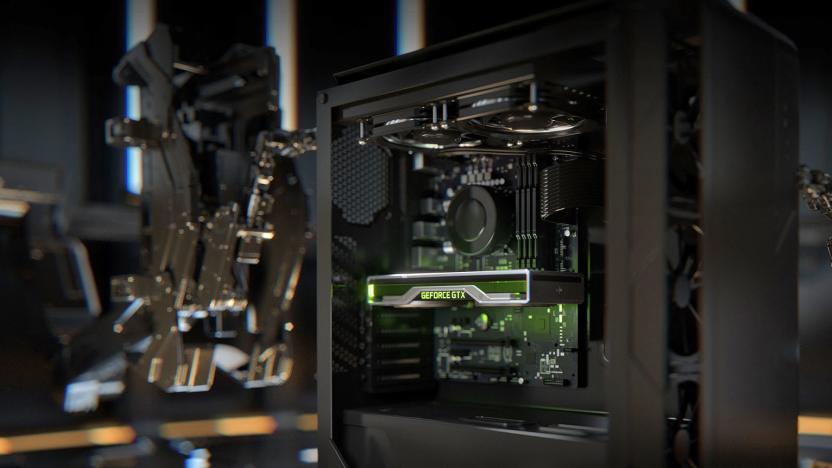
NVIDIA's GTX 1650 and 1660 Super are two very different GPU upgrades
Following the release of its "Super" RTX 2060, 2070 and 2080 GPUs, NVIDIA is back with a pair of updated graphics cards: the GeForce GTX 1660 Super and GTX 1650 Super. As with the RTX Supers, though, what "Super" means for these new cards is not set in stone. In fact, the two upgrades could barely be more different.

Netflix's music talent show 'Rhythm + Flow' premieres October 9th
It took a couple of years, but Netflix's talent series Rhythm + Flow is nearly ready. The service's first music competition will premiere October 9th with Cardi B, Chance the Rapper and T.I. judging undiscovered hip-hop artists as they strive for glory. You'll have to be patient if you want to see the whole saga play out. Unlike most Netflix productions, you'll have to watch over multiple weeks to see everything.

Texas Instruments has a gold-hued graphing calculator
Want to prove that you're a cosine champion at your next math exam? Texas Instruments thinks it has the answer. It's trotting out a limited edition version of the TI-84 Plus CE graphing calculator that comes in a gold-hued (as TI puts it, "Golden Ratio") metallic shell -- yes, you can show some swagger while you're visualizing functions. There's also a special "Bright White" model (below) if you're not quite so ostentatious. Both calculators should arrive this summer without a price premium (existing models sell for $108 on Amazon), so you won't have to pay extra to bring some flash to your calculus class.

TI's super-slim graphing calculator shows that math can be stylish
Who said that graphing calculators were dead in the smartphone era? Certainly not Texas Instruments -- if anything, it's showing that there's still plenty of life left in dedicated math machines. Its new TI-84 Plus CE is 30 percent thinner and 30 percent lighter than the regular Plus, making for a surprisingly sleek-looking way to crunch numbers. It has six times the memory, too, so you can store more color graphs and images (and, let's be honest, a fresh copy of Drugwars for goofing off mid-class). TI hasn't divulged pricing for the Plus CE, although its new design and advanced feature set hint that it'll be relatively costly when it arrives in the spring. Look at it this way, though: you might just be the envy of your fellow students when you take this svelte plotter out of your backpack.

Moto 360 teardown reveals ancient chips, clever tech and a small battery
Motorola has been willing to offer a quick peek at the Moto 360's inner workings, but let's face it: that doesn't really go deep enough to sate your curiosity, does it? You don't have to worry, though, as iFixit has torn apart the circular smartwatch to examine every last detail. In the end, the hardware is an odd mix of the latest technology with surprisingly old components. While that round LCD and inductive charger are pretty forward-thinking, the teardown also confirms the presence of TI's OMAP3630 processor -- a chip that hasn't been cutting edge since that Droid 2 you rocked back in 2010.

Texas Instruments shrinks its HD DLP Pico projector chip down to 0.3-inches
We wouldn't say that smartphone projectors have exactly caught fire, Samsung's Galaxy Beam notwithstanding. Part of the problem is the extra bulk required by pico projector components, which is where Texas Instruments comes in with its new HD "Tilt and Roll" DLP Pico chipset. They've now got the size down to about 0.3-inches, or about the size of a pencil-tip as shown above. That should let makers of tablets, smartphones and wearables add 120 Hz projector powers to their devices. It's also the chip used in Avegant's Glyph VR headset -- so it might be beaming a movie directly to your retinas at some point in the future.

Visualized: Inside the Vertu workshop, where phones are made by hand (video)
While not everyone's comfortable with splashing out on a fancy Vertu phone, there's no stopping us from appreciating the company's craftsmanship and engineering expertise since its Nokia days. We're talking about dealing with various luxurious materials -- pearl, ruby, sapphire, titanium, gold, alutex, alligator skin and more -- while making sure that each device is mechanically built to last. As such, it's perhaps a slight surprise that Vertu phones are actually "handmade in England." Courtesy of our buddy and CEO Max Pogliani, we got to see the process up close and personal at his 60-strong workshop in Church Crookham. (And in case your butler isn't around to read this article to you, we've also got a video tour after the break.)

TI intros DLP pico projector chipset based on its Tilt & Roll Pixel technology
TI's DLP unit promised us brighter, sharper pico projectors when it unveiled its Tilt & Roll Pixel architecture at CES, and it now has the TRP-based silicon to make those projectors possible. The company's new DLP Pico 0.2" TRP chipset produces images with up to twice the brightness and resolution of its ancestor, even while it uses as little as half the power. The company hasn't named hardware partners, but it notes that companies are already building products with the chip; it may not be long before we see the next generation of projector-equipped smartphones and tablets.

TI intros single-chip DockPort technology destined for laptops and tablets
The DockPort standard is only just getting off the ground with support in AMD's Elite Performance processors. TI could soon make the technology fly, however: its new (if awkwardly named) HD3SS2521 controller handles all the tasks of DockPort on a single chip. The hardware is both simpler and cheaper than past multi-chip designs, and makes it easier for laptops and tablets to deliver DisplayPort video, USB 3.0 and power through a single cable. Whether or not we see more DockPort-equipped mobile gadgets is another matter. While the TI chip is available today, device builders still have to choose DockPort over a more established standard like Intel's Thunderbolt.
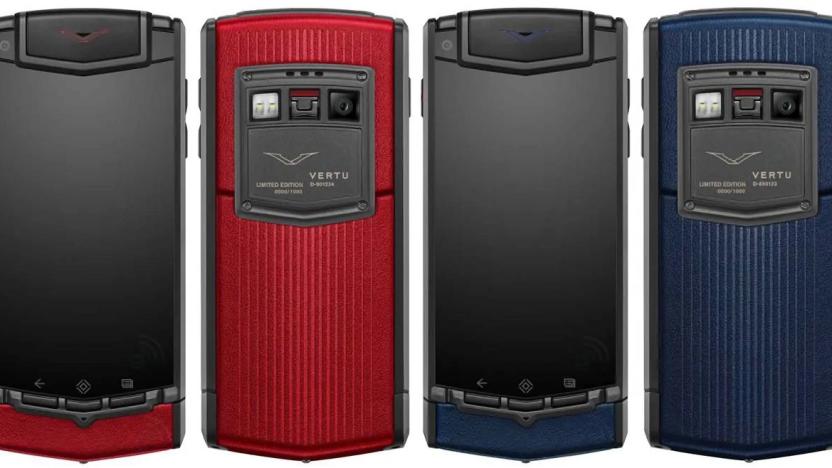
Vertu Ti now available in red or blue limited editions, only 1,000 of each made
The Vertu Ti Colours collection is wrapped in either "Sunset Red" or "Midnight Blue" calf leather, and only 1,000 units are made for each color.

Texas Instruments brings fast charging, extended life to Li-ion batteries
Yesterday Texas Instruments introduced a couple of new chipsets (fuel gauge an charger ICs) designed to improve the charging speed and life expectancy of single-cell Li-ion batteries. The technology, called MaxLife, is expected to provide an improvement of up to 30 percent in battery service life and faster charging times. Cell impedance is carefully monitored by the fuel gauge chip while the charger IC uses a model of battery degradation to charge the cell in the most effective way. Both chips are connected via an I2C bus to form an autonomous battery management system which, according to the company, is safer and more thermally efficient than existing solutions. The two chipsets (2.5A and 4.5A) are now available along with a development kit, so it's only a matter of time until this technology lands into handsets and other devices that use single-cell Li-ion batteries. Check out the details after the break.

Spark Core board adds WiFi to almost everything, takes input from anywhere (video)
Spark Devices wants the inclusion of WiFi in devices to be a matter of when, not if -- and if its new Spark Core gets to market as planned, tinkerers might never have a moment of doubt. The tiny board combines an Arduino-compatible ARM Cortex-M3 platform with a TI CC3000 WiFi chip that not only simplifies getting online, but could save the DIY crowd from having to touch projects afterward. Owners can flash the firmware with new code over WiFi, for a start. A free Spark Cloud service also allows for custom apps that interface with the Core through seemingly anything with an internet connection: if you want to reconfigure a homebrew security camera from your phone, you can. While Spark Devices is relying on crowdfunding to fuel its connected strategy, the company is comfortably past its $10,000 goal and should deliver both the Spark Core ($39) and optional shields to new contributors around September. [Thanks, Greg]

The Engadget Interview: Vertu CEO Perry Oosting talks specs and rationale
Vertu CEO Perry Oosting talks about the rationale for buying luxury goods.

TI shows off LaunchPad-based prototype mouse, hints at a big follow-up
If you've been needing a little inspiration for your next TI LaunchPad project, look no further than the company itself. Texas Instruments set up shop in the maker tent across from the Austin Convention Center this week, showing off creations built atop its line of microcontrollers. The rep we spoke with was particularly excited about this mouse hack that the company put together in a few hours, while getting ready for SXSW. The creation utilizes the Stellaris board's accelerometers to control the cursor of a Windows machine on X, Y and Z axes, via USB. The project is more than just a hack, according to the company -- it's actually a prototype of something it's set to unveil later this year. No specifics on that front, but TI promised a "big surprise." In the meantime, you can check out video of the project after the break.%Gallery-181193%

DLP's IntelliBright tech promises brighter pico projection at no extra power
Most portable projectors are tasked with striking a delicate balance between power consumption and picture quality. With this in mind, Texas Instruments' DLP arm has unveiled a new system at MWC known as IntelliBright, which is intended to improve the brightness of pico projectors without making hardware hungrier. It's no fancy set of circuits, though, but a pair of algorithms which tinker with image brightness and contrast to produce a more radiant picture. What's more, the algorithms can be tweaked separately by hardware manufacturers for any desired result, and can incorporate data from ambient light sensors to increase projector efficiency. DLP recently introduced its new Tilt & Roll Pixel chip architecture at CES, which is also designed to make pictures brighter and batteries happier in the next generation of pico products. All we hope is the developments inspire Samsung to create a Galaxy Beam II, just with more focus on the phone part this time

Vertu's first Android smartphone costs $9,600, admits to falling short of 'bleeding edge' (updated)
That fancy Vertu Ti handset we saw pop up last month? It's finally been priced, predictably out of the average buyer's price range. Sticker shock for Vertu's first device since the EQT acquisition starts at €7,900, or about $10,587 $9,600 in the US, and buys eccentrics with money to burn a sapphire-covered 800 x 480 display, 1.5GHz 1.7GHz of processing power and a 1,250mAh battery -- all wrapped in a durable titanium shell. What's it missing? 4G connectivity, unfortunately. "Vertu will never be at the bleeding edge of technology," Vertu head of design Hutch Hutchison told the BBC. "It has to be about relevant technology and craftsmanship -- it's not a disposable product." At those prices, we'd certainly hope not. Vertu phones might not be packed with the mobile world's latest tech, but Hutchison says that the top dollar pricetag buys better durability. "People think sapphire is just posh glass," he explained to the BBC. "The only thing that scratches it is a diamond." At the very least, Vertu customers won't have to worry about which pocket they keep their keys in. Update: Now with official product shots below and press release (including details on the various stress tests) plus promo video after the break. Also, here's a detailed list of specs: Android 4.0, dual-core 1.7GHz Qualcomm Snapdragon S4 SoC, 64GB storage, 3.7-inch sapphire crystal screen, titanium casing, 8-megapixel rear camera, 1.3-megapixel front camera, NFC and "Full/Micro/Nano SIM capability" (see new update below). The prices are as follows: • Titanium Black Leather - $9,600 • Titanium Pure Black - $11,500 • Titanium Black Alligator - $12,800 • Black PVD Titanium Red Gold Mixed Metals - $19,900 Update 2: We heard back from Vertu regarding the multi-SIM compatibility, and the feature's indeed just as bland as we had feared: "Vertu Ti can hold a regular sized SIMs, nano and micro. It is purpose built to hold a regular sized version. If a customer has a smaller SIM, the phone has a special SIM adaptor that ensures that it fits in properly." Richard Lai contributed to this report.

Texas Instruments brings sci-fi tech to life with DLP (hands-on video)
We've come across a number of DLP-based pico projectors over the years and while these products are getting smaller, brighter and higher resolution, it's the integration with other devices that's really captured our imagination. Samsung's Galaxy Beam, which we reviewed last year, merges a 15-lumen nHD (640x360) DLP-based pico projector with a Galaxy S Advance. More recently at CES 2013, Texas Instruments announced its new Tilt & Roll Pixel chip architecture and demoed a handful of other DLP-equipped products live on our stage, including 3M's Streaming Projector and Smart Devices' U7 tablet. The company recently invited us to play with some of these devices and to show us other applications in areas such as 3D printing, 3D scanning, optical research, medical imaging and even automotive. Some of this DLP-equipped tech, like the Interactive Center Console, shows where we're headed in the near future -- other products, like Christie's VeinViewer Flex, exist today but remind us of something right out of science-fiction. Take a look at our galleries below, then join us after the break for our hands-on video and more info on these devices.

TI-Nspire rethinks the graphing calculator for the iPad (video)
With tablets slowly working their way into the classroom, it wasn't a huge stretch to realize that Texas Instruments would bring a graphing calculator app to the table, but would you believe its solution is just hours away? The company has revealed TI-Nspire for the iPad, which is currently available within the App Store for those in Australia. Beyond problem solving, the product is said to provide an interactive experience that should be helpful for reinforcing mathematical concepts. Depending on your needs and curriculum, you'll find numerical and symbolic (CAS) versions of the TI-Nspire app, both of which cost $29.99. Yes, the app's a bit pricey, but it's not surprising given the insane profit margins of TI's graphing calculator biz. Hop the break for a better peek of the app that might just become required within classrooms.

Android-powered Vertu Ti leaked all over, just needs a diamond-studded price tag (updated)
Shortly after the latest rumor that Vertu's prepping its first-ever Android-based device, eagle-eyed Blog of Mobile delivered further evidence to support the claim, and it even managed to dig out what it claims to be product shots of said phone. First of all, the name "Ti" and model number "RM-828V" are spotted across Bluetooth SIG, GLBenchmark and telecom regulator databases in Singapore and Macau. Having scanned through these pages we now know that the Ti will come with Android 4.0.4, an 800 x 480 display, a 1.5GHz processor, Bluetooth 4.0 and NFC. Blog of Mobile added that it's a Snapdragon MSM8260A SoC with WCDMA 850/900/1700/1900/2100 radio, accompanied by a rather lame 1,250mAh battery. Bluetooth SIG's page provided the following design description of the device: "VERTU Ti possesses the classic Vertu design DNA and characteristics – strong, unique & distinctive. The design and craftsmanship positions VERTU Ti alongside other iconic products in the luxury market." If the above images are authentic then the Ti does indeed maintain the classic Vertu look. The only real changes we can see so far are the three new physical keys -- presumably "Back," "Home" and "Recent apps" for Android. If all goes well, we should see this wallet-busting gadget at MWC next month, so start saving up now. Update: Russian retailer spblux.ru lists four variants of the Ti or, as the site calls it, the Constellation Ti: "Titanium Black PVD black leather," "Titanium Black Alligator," "Red Gold Mixed Metal" and "Titanium Black Leather." Interestingly, the red gold version has a search button instead of "Recent apps," but we guess that was an earlier design. Regardless, we have all four designs after the break for your viewing pleasure. [Thanks, Roman K.] Update #2: We've had unofficial but reliable word that the new Vertu will cost in the region of $10,000 -- more than double what was first rumored.


