Skip to Content

AOL Tech

wireless posts

Xbox 360 802.11n adapter rebirths on Costco site, ships November 10th for $88

You can't keep a phoenix down and this Xbox 360 wireless n adapter seems to be a bird of similar feather. After discretely showing up on US retail sites and subsequently managing to drop off into internet obscurity, the 802.11n-compliant peripheral has returned to the scene via Costco's site, this time with a November 10th shipping date and a more attractive than before $88 price tag. With only five days until the 10th, will this finally be the price and date that stick? Who knows -- but at least this time we won't have to wait long to find out.

[Thanks, WeakSasco]

EOps i24R3Portable speaker is mad, bad, and waterproof

Think of a soundbar rolled into a circular, battery-powered body and you'll have a pretty good idea of what we're looking at here. The product's name -- EOps i24R3Portable Wireless Waterproof Digital Speaker Platform -- should tidy up any further queries you may have. Michael Young's latest design for EOps, whose appearance only hints at its i24R3 heritage, is a fully sealed noisemaker that can communicate via wireless USB or Bluetooth, depending on the model. You should pick your poison with care as there are no options for wired hook-ups. With a Li-Pol battery pack and an array of flat panel speakers and passive radiators inside, this could well be the ultimate in portable weatherproof speaker design, but even if it isn't, we'd still consider mounting it on a wall and worshipping it as our Sun God.

[Via Design Spotter]

Bang & Olufsen's multifunctional BeoTime gets carefully handled

It's rare that we get to see magic wand-shaped remote controls, and rarer still for them to have integrated alarm clocks. The Bang & Olufsen BeoTime is just that sort of exotic specimen, and its $375 touch-sensitive aluminum body has now been tested for our amusement. Being able to turn on your other B&O products by simply grabbing the remote or setting an alarm for the desired time struck positive notes, and those bite-sized displays earned praise too. With automatic backlighting, built-in accelerometer, and full channel readouts, they ensured the minimum of strain for the user (which is probably still pretty high considering they're tiny!). There wasn't much to complain about, but at that price point you wouldn't expect it either. Full hands-on gallery can be found at the read link.

Sprint lights up WiMAX in NC, Chicago and Dallas, launches subsidized Mini 10

Don't you just love it when a plan comes together? Or better yet, when a leaked roadmap doesn't get delayed in the slightest? After months upon months of waiting, broadband-lovin' citizens in the North Carolina Triangle and Triad will be celebrating alongside DFW residents and Chicago natives as Sprint's 4G WiMAX service rolls into town. As of right now (that's today, junior), consumers in Raleigh, Durham, Chapel Hill, Cary, Greensboro, Winston-Salem, High Point and Charlotte, NC; Dallas-Ft. Worth, Texas and Chicago, Illinois can roll into a Sprint store and snag a U300 3G / 4G WWAN modem on a $69.99 monthly data plan. We're told that San Antonio and Austin will get lit up later this month, while Honolulu and Maui, Hawaii; Salem, Oregon and Seattle, Washington will join the fray before 2010. Oh, and did we mention that Palm's favorite carrier finally snagged itself a WWAN-equipped netbook? 'Cause the Dell Mini 10 is available starting today for $199.99 at select Sprint stores in the metropolitan Baltimore area.

Update: Looks like Sprint changed "Baltimore" to "Bay Area." Odd.

Read - Sprint WiMAX in the Triangle
Read - Sprint WiMAX in the Triad
Read - Sprint WiMAX in Charlotte, NC
Read - Sprint WiMAX in Dallas-Ft. Worth, TX
Read - Sprint WiMAX in Chicago, IL
Read - Sprint's first netbook is Dell Mini 10

FCC keen on commandeering TV spectrum for wireless broadband

We'll come right out and say it, we like Julius Genachowski. Whether you agree with the dude's policies or not, you can't deny he's pursuing them with gusto. Having already noted the insufficient carrying capacity of current mobile broadband airways to deal with incoming 4G connections, the FCC chairman is now reported to be moving ahead with plans to provide greater spectrum allocation for those purposes. Currently in the draft stage, the latest Commission proposals include a plan to reclaim airwaves from digital broadcasters (and pay them appropriately for it), which are to then be sold off to the highest bidder from among the wireless service providers. Executing the most extreme version of this plan could generate around $62 billion in auction revenues, though it would require transitioning digital TV viewers over to cable or subscription services and is therefore unlikely. Jules and his crew are still "looking at everything" and ruling out nothing, but we can probably expect to see a moderate shift of TV spectrum rights over to wireless carriers in the final plans when they're revealed in February.

[Via Phone Scoop]

Samsung and TeliaSonera bringing LTE to vikings in 2010

Scandinavian folks tend to be a pretty cheerful bunch during the summer, and now Swedes and Norwegians will have reason to smile through the cold dark winters as well, with Samsung announcing an agreement to provide TeliaSonera with "mobile broadband devices for commercial service next year." This agreement relates to Sammy's Kalmia 4G USB modem and adds to the Swedish operator's LTE push, which already counts Ericsson and Huawei among the contracted hardware providers. So that's 100Mbps mobile broadband, coming to a snow-covered nation near you within the next dozen months or so. All we would ask of our viking friends now is that they remember their world-conquering ways of the past and start spreading that goodness globally. Come on, it's our right! Full press release after the break.

Yamaha's PDX-60 wireless iPod / iPhone dock adds yAired to the lexicon

Sony's got its S-AIR, Yamaha has its yAired -- so, what of it? The outfit famous for making just about everything from ATVs to wicked soundbars has today introduced a classy addition to the oversaturated iPod / iPhone sound system market: the PDX-60. Apple loyalists simply dock their media player in the wireless base and watch as the tunes are streamed effortlessly into the magical box on the other side. There's also remote control capability for keeping tabs on that playlist whilst planted on the sofa, and the dock can even power on and off automatically with "yAired-enabled iPhones / iPods." The music maker itself boasts a pair of 3.25-inch speakers and a digital amplifier of undisclosed wattage, and it's available in black, gray, blue or pink for $299.95. So, any takers, or are you stickin' with Bose?

SplitFish Dual SFX Frag Pro pairs button-enriched mouse with 'fragchuck,' ships November 10

For those of you not paying attention in class, SplitFish is a peripherals maker that, true to its name (or half its name, anyway), offers PS3 controllers that split the left and right hand controls into separate parts. The Dual SFX Frag Pro, its latest, comes with a 2,000dpi laser mouse to tempt those last few PC gamer holdouts to the dark side of consoles, and a three shoulder button-equipped directional pad for navigation. What can we say, it looks weird as hell, but the more we thought about it, the more we wanted to get our hands on a set to see just how games played with this unorthodox control scheme. Should you share our interest, you'll also want to know that pre-orders are being taken now for a cent under $90 in the US or a penny short of £80 in the UK, and shipping starts November 10.

[Via SlashGear]

Texas Instruments CC2540 promises ultra-low energy Bluetooth

Texas Instruments is pretty chuffed with itself right about now, as it's prepping to demonstrate a swell-sounding new system-on-chip that takes Bluetooth connectivity to the extreme reaches of low energy consumption. About to be shown off in Munich tomorrow, the new CC2540 takes up a measly 6mm-squared of real estate, and is said to be able to operate for more than a year on a single button cell battery. With the reduced physical size and embedded Flash memory, this should be easier to install and update as necessary too. Considering the battery-draining ways of current Bluetooth tech, such claims sound preposterously awesome, but we'll keep our giddy enthusiasm in check until early next year when samples will begin rolling out. For now, you can check out the older video below 'splaining the prospective benefits in more detail.

Read - Texas Instruments press release
Read - Bluetooth low energy webpage
Read - Video explanation of Bluetooth low energy

Logitech Notebook Kit MK605 asks 'what multitouch revolution?'

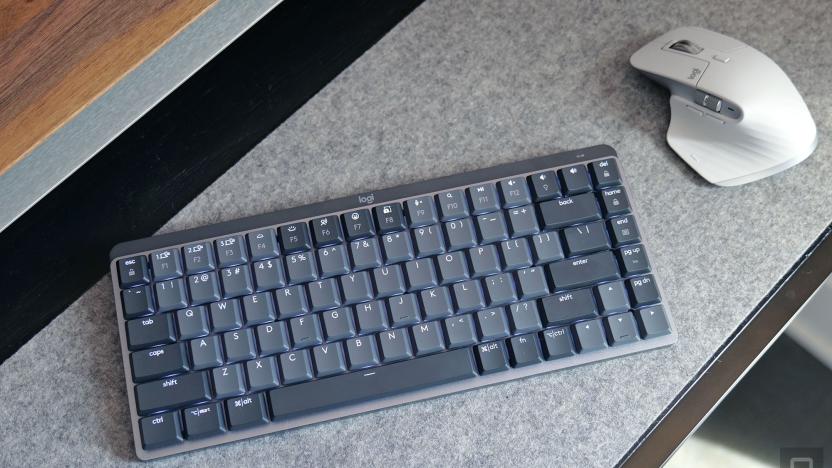
Logitech, the company that's dropped more than a billion mice in our laps, is back with a glossy, gold-accented new laptop accessory kit. There's not an overwhelming amount we can tell you that you can't already see above, so we'll go ahead and point out that the laser mouse (M505) and keyboard duo are controlled wirelessly via Logitech's teeny tiny Unifying Receiver (which comes as part of the package), and the laptop stand is capable of accommodating machines with screens up to 15.6 inches diagonally. The riser also has three elevation levels, while the keyboard packs a full numeric pad -- something at least Excel-loving accountants should appreciate. Expect the set to show up in Europe and the US this November with a price around $100.

[Via Electronista]

Wi-Fi Direct enabling P2P communications amongst WiFi wares, scaring Bluetooth half to death

Hear that Bluetooth? That's the sound of competition... finally. After years of waiting for some sort of serious rival in the short-range communication realm, the Wi-Fi Alliance is doing what it should've done eons ago. Starting sometime in mid-2010 (if all goes to plan, of course), a Wi-Fi Direct specification will be published, enabling WiFi'd devices to connect to one another without some sort of WLAN hotspot nearby. Previously, the standard was codenamed Wi-Fi peer-to-peer, as it gives printers, mobile handsets, human interface devices, cameras, laptops and a host of other wireless wares the ability to talk to one another without first consulting an access point. We're told that devices will be able to make "one-to-one" connections or talk amongst a group, and WPA2 security will be bundled in to keep the ill-willed sniffers at bay. Call us crazy, but we get this feeling we're going to dig this protocol -- now, if only we could actually count on seeing shipping products before we're too old to enjoy it, we'd be set.

Sonos ZonePlayer S5 all-in-one wireless speaker lowers cost of entry (video!)


For many, the perceived high cost of getting into a Sonos wireless home audio system has been a significant barrier. While you crave whole-home, distributed audio that just works without pops, hisses, or clicks, you simply can't justify dropping $350 on a ZonePlayer ZP90 and another $200 or so for a pair of decent amplified speakers. Even then, you're still only talking about a single room -- adding more rooms (or zones) and dedicated Sonos controllers jacks the price up even higher. Today, Sonos fills a significant gap in its product portfolio with the introduction of its $399 / €399 all-in-one ZonePlayer S5 speaker. The 217 x 365 x 123-mm S5 brings a decidedly Bose-like external design while packing a 5-driver speaker system (two tweeters, two 3-inch mids, and a built-in 3.5-inch sub) that's meant to fill a room with Sonos' wireless audio. And because the ZonePlayer is integrated right into the all-in-one chassis, it easily drops into your existing Sonos device network to extend audio into any room that needs it -- no wiring required. There's even a headphone jack for stealth listening in the bedroom. Of course, the beauty of Sonos is in the wide variety of audio sources available: freebies like thousands of internet radio stations, your iTunes library, CIFS NAS storage, or line-in devices like your home stereo or MP3 player; or subscriptions music services like Last.fm, Pandora, Rhapsody, Sirius, or Deezer depending upon your geographic location.

If you already have an iPhone or iPod touch and the ability to easily network the S5 back into your router (via fixed Ethernet or close proximity), then $399 / €399 is what it now takes to get started with Sonos. Otherwise, you'll need to add a $99 / €99 ZoneBridge to link the S5 to your router over Sonos' proprietary SonosNet 2.0 (think 802.11n but optimized for distributed mesh audio) and another $349 / €349 for the dedicated CR200 controller if the free PC / Mac software controllers don't serve your need. We'll be getting our hands-on with a unit soon and will update you with our subjective listening experience. Until then, you can ponder the "end of October" and November 10th ship dates for the US and Europe, respectively. Video demonstration after the break.

Show full PR text
SONOS INTRODUCES THE SONOS ZONEPLAYER S5: THE ALL-IN-ONE WIRELESS MUSIC SYSTEM CONTROLLED WITH AN IPHONE

  • Wirelessly play music in any or every room of the house for $399 per room
  • Enjoy room-filling, high-performance sound with all digital architecture
  • Access your iTunes® library, plus thousands of radio stations and millions of songs from the Internet
  • Control your music experience with free Sonos Controller for iPhone™ app or any other Sonos Controller

SANTA BARBARA, Calif. – October 13, 2009 – Sonos®, Inc., the leading developer of wireless multi-room music systems for the home, today introduced the Sonos ZonePlayer S5, an all-in-one wireless music system that can be controlled with an iPhone, iPod® touch or any Sonos Controller. The S5 delivers crystal-clear, room-filling sound that rivals much larger, more complicated audio equipment. Plus, the S5 provides instant access to unlimited music with control from the palm of your hand. Now music lovers can find and play any song from an iTunes library, plus, a world of music and radio on the Internet, in any room of the house. The S5 will be available for $399 in late October. To see the S5 in action, please visit: www.sonos.com/S5demo. "Our customers tell us they listen to twice as much music after bringing Sonos into their homes," said John MacFarlane, CEO of Sonos. "The new S5 is our latest effort to simplify the Sonos experience so more people can enjoy more music than ever before."

The S5 features a 5-driver speaker system that packs a big sound – filling an entire room with music. Sonos uniquely designed the S5 with an all-digital sound architecture for precise sound reproduction. The S5 includes two tweeters, two mid-range drivers and a built-in single subwoofer – each individually powered by a dedicated digital amplifier and optimized to deliver room-filling sound with smooth tonal balance and deep bass. All filter settings, bass and treble controls, active equalization, and time-alignment are done in the digital domain through state-of-the-art DSP circuitry, so there's absolutely no loss of audio quality or energy. With the Internet-connected S5, you can listen to way more music than you can with a dock that only plays the songs that fit on your iPod. The S5 gives you instant access to a world of music, including 25,000 Internet radio stations, shows and podcasts -all free of charge and pre-loaded on Sonos. Sonos works seamlessly with the most popular music services to provide computer-free access to millions of songs and stations from the likes of Last.fm, Napster, Rhapsody, Pandora, SIRIUS Internet Radio, and Deezer. The S5 also gives you instant access to any iTunes library stored on any computer or Network Attached storage, such as an Apple Time Capsule. The S5's analog audio input lets you connect to an external audio source (such as an iPod, CD player, TV, DVD, VCR, or radio) and play music or audio on all ZonePlayers in the system.

When it comes to controlling your S5, you simply reach into your pocket for your iPhone or iPod touch. With the free Sonos Controller for iPhone app (available on the iTunes App Store), you can search for songs and stations, choose the music and control the volume in as many rooms as you like. And because the iPhone is controlling the music, and not the source of it, when a text comes in or you need to make a phone call, the music doesn't stop. That also means you can keep your iPhone in your pocket, not stuck in a dock. The S5 also includes free Sonos Controller software for your Mac or PC. Or you can let everyone in the house share the control with the dedicated Sonos Controller 200 (sold separately). As with all Sonos ZonePlayers, the S5 is simple to set up, easy to expand and 100% compatible with all other Sonos products. Just plug in the S5 wherever you want music. One ZonePlayer or Sonos ZoneBridge™ (sold separately) must be connected to your router and all the rest will work wirelessly. When you're ready to play more music in more rooms, simply add S5s or other ZonePlayers without adding wires. Now you can play the same song in every room with perfect synchronicity or mix it up by playing different songs in different rooms. The S5 will be available for purchase in the United States beginning in late October. To learn more or to locate an authorized Sonos dealer, please visit www.sonos.com or call 877.80.SONOS.

Cables To Go Wireless USB Superbooster Extender might be as awesome as it sounds

We're not claiming to be experts on marketing or anything, but Cables To Go should really consider a name change. The outfit who's job it is to make your life one that's completely devoid of cables has pumped out yet another cord-free solution in the Wireless USB Superbooster Extender. Said device, which has an admittedly sensational name, is comprised of two pieces: a receiver that connects to your USB-equipped PC via a standard USB cable and a wireless dongle that connects to whatever USB device you'd like to make wireless (a printer, a scanner, a heated blanket, whatever). The kit provides cordless connectivity up to 150 feet (even through walls), though you'll be paying dearly to take advantage. How dearly? $189.99 -- yeah, that dearly.

[Via PC Launches]

'Spider pill' bowel scanner will be ready within a year

Endoscopy, or the examination of a person's bowels via a tube-mounted camera, is not exactly the most pleasant medical procedure one could undergo. In 2004, we noted the early stages of a project to alleviate the (literal) pain of the procedure with a spider pill, which -- once swallowed by the hopefully willing patient -- can be remotely controlled and positioned inside the human body. Yes, it's a tiny, wirelessly communicating robot with a camera for a head crawling inside you. Hit the read link for the full BBC report, it really is worth seeing, and start your Innerspace jokes ... now!

Sony and Toshiba demo TransferJet short-range sharing at CEATEC (video)

TransferJet is still solidly in the "fledgling" stage, but it looks as if a few big time industry players have faith that consumers have a desire -- nay, a need -- for short-range, high-speed sharing. Here at CEATEC in Japan, both Sony and Toshiba were on hand with independent TransferJet demonstrations, and while the actual protocol has been in place for awhile now, it's the supporting cast (read: hardware) that has remained elusive. Toshiba was utilizing a snazzy TG01 and Qosmio laptop in order to showcase just how quickly the two could share information over the air, while Sony had us believing that pretty much everything it'll make for the rest of eternity could support device-to-device sharing. Head on past the break for a peek at the demos, but try not to get your hopes up for seeing this stuff in shipping products anytime in the immediate future, okay?
Zune HD ExposedHTC Hero: Android Evolved
Follow us on TwitterEngadget Video


AOL News

Joystiq

Download Squad

TUAW

Daily Finance

Asylum

Autoblog

Switched.com

FanHouse

Autoblog Green