Yo is a notifications app where all it does is send the word "Yo" to your friends. That's it. Just "Yo." Of course, silly single-purpose apps like these are a dime a dozen -- remember those fart apps of old? -- but the thing that sets Yo apart is that it's actually attracted a whole lot of attention. More than a million dollars' worth, in fact. Yep, this seemingly frivolous app has recently raised around $1.5 million in funding, giving it a valuation close to $10 million. It's also apparently been downloaded more than 2 million times since its tongue-in-cheek April Fools' Day debut.
Crazy? Well, yes, perhaps. But it's not entirely unusual. In case you need a refresher (and probably a laugh or two), here's a look at some of the more overhyped apps in the past few years. Have any other ideas? Leave a comment and let us know of any apps we've missed.
When an app gets a whopping $41 million in funding before it even launches, you can pretty much guarantee high expectations. That's what happened to photo-sharing app Color back in 2011, partly due to the caliber of one of its founders, Bill Nguyen, who had recently sold off music site Lala to Apple. With Color, you could create ad-hoc "social networks" based on the people around you. Anyone who shares a photo on Color at the same place and time would be able to see a shared photo stream.
Unfortunately, this opened the door to potential privacy concerns, as everything on Color was public by default. Additionally, Color was pretty useless if you weren't the sort to take photos around a lot of other people or didn't care much about interacting with nearby strangers. People just weren't into it. Six months later, Color re-launched with Facebook integration and video sharing. Then it tried a Verizon partnership where it'd come pre-installed in the carrier's phones. In the end, even $41 million couldn't salvage what was ultimately a poorly executed idea.
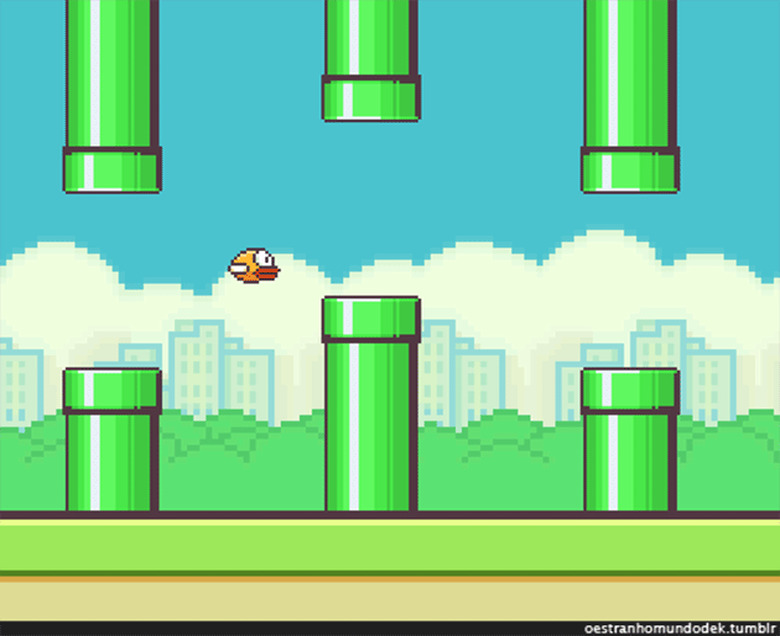
Flappy Bird is probably the most overhyped mobile game to come our way in the past few years. Even though it was released on May 24, 2013, it gained sudden notoriety in 2014 when it rose to the top of Apple's App Store and was then later released on Google Play for Android. The gameplay was famously addictive, but difficult to master -- you control a bird's flight path by tapping the screen at the right time, navigating it through a series of pipes without crashing into them. Flappy Bird turned out to be so popular that its developer, Dong Nguyen, claimed that he earned $50,000 a day from in-app ads.
Which made his decision to shut the game down and pull it from the App Store on February 10, 2014, all the more puzzling. According to Nguyen, he felt guilt over how addictive the game turned out to be and lost sleep over it. Its sudden removal prompted a slew of Flappy Bird copycats, and phones with pre-installed copies of the game were put on eBay for around $900 each. However, it seems like Nguyen mustn't have felt too guilty about it, as he recently announced he's coming out with a second version of Flappy Bird that adds multiplayer and promises to be less addictive.
If you've ever wanted to confess your deepest fears or engage in a bit of kiss-and-tell without the fear of outing yourself, then you might be interested in an app called Secret. Released in January of this year, Secret is the current poster child of the anonymous-sharing app movement that's part of a recent trend in Silicon Valley. Unlike other anonymous apps, however, posts on Secret are limited to a network of friends based on your phone's address book. More recently, they've extended that network to include your Facebook friends if you decide to offer the service your Facebook credentials.
Over the past few months, Secret has gained something of a cult following -- there's even a rogue spin-off service called anonyfish that lets people on Secret message each other using disposable usernames. The app has also received a lot of attention due to leaked industry secrets -- Vic Gundotra's departure from Google was supposedly leaked on Secret, and so were the recent round of Nike layoffs. As a result, the company has grown quite rapidly since its launch -- it's recently raised an additional $25 million that gives the six-month-old company a valuation of higher than $100 million.
1 / 3
Color
When an app gets a whopping $41 million in funding before it even launches, you can pretty much guarantee high expectations. That's what happened to photo-sharing app Color back in 2011, partly due to the caliber of one of its founders, Bill Nguyen, who had recently sold off music site Lala to Apple. With Color, you could create ad-hoc "social networks" based on the people around you. Anyone who shares a photo on Color at the same place and time would be able to see a shared photo stream.
Unfortunately, this opened the door to potential privacy concerns, as everything on Color was public by default. Additionally, Color was pretty useless if you weren't the sort to take photos around a lot of other people or didn't care much about interacting with nearby strangers. People just weren't into it. Six months later, Color re-launched with Facebook integration and video sharing. Then it tried a Verizon partnership where it'd come pre-installed in the carrier's phones. In the end, even $41 million couldn't salvage what was ultimately a poorly executed idea.