This is the future of food

Are you ready for lab-made hamburgers, bug-filled protein bars and 3D-printed cuisine? With the Earth's population rapidly approaching 8 billion and the race to keep up with food demand intensifying, industries have begun to drain essential resources and adversely affect the environment. Thanks to some scientific know-how, we're finding new ways to bypass those issues while still bringing natural and nutritious food to the table. In honor of that quest, we've gathered an assortment of forward-thinking products and projects that aim to alleviate the environmental impact of feeding the world and help kickstart a farming future for our space-faring progeny.


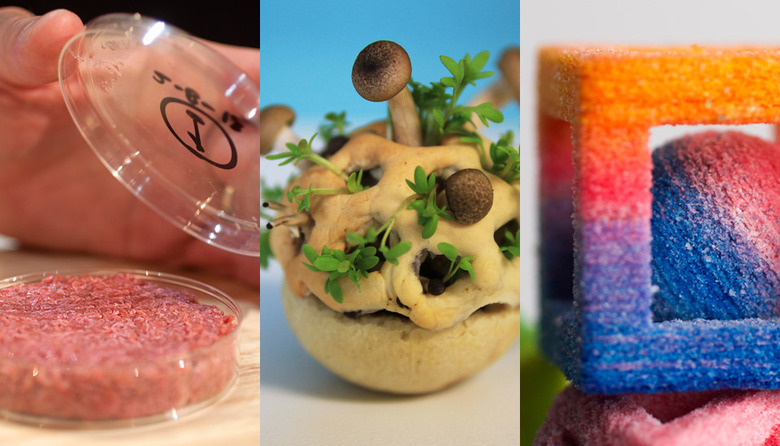
If you want some futuristic elegance beyond a sugar rush, Natural Machines' Foodini printer offers an alternative. Just prepare ingredients of your choosing and load them into capsules for pre-programmed distribution and layering of ready to cook dishes. Pre-loaded capsules with fresh ingredients are also under consideration.
Although still more of a decorative tool, it could transform leftovers into more attractive arrangements and help you create snacks with healthy, custom-curated ingredients.


Industrial techniques like high-pressure processing (HPP), which avoids heat and chemical preservatives to kill microorganisms, help safely extend the life of many off-the-shelf foods. On a smaller scale, though, commercial dehydrators provide convenient ways to convert fresh groceries into long-lasting snacks, dried herbs and jerky. Kitchen counter-sized units cost around $35 or more, providing a way to mitigate your reliance on refrigeration and pre-fab, store-bought snacks. DIY enthusiasts can even make their own solar-powered units to take the process off the grid entirely.


Algae (specifically seaweed) have long been a staple in some cuisines and an additive in many everyday foods. Still, changing the global public's perception of what's "good" to eat can be challenging. Oregon State University's Food Innovation Center has an ace in the hole, though. Chris Langdon, an aquaculture researcher has developed a patented strain of seaweed called dulse. It grows faster than the wild version and is packed with minerals, vitamins, antioxidants and protein. Plus, according to reports, it tastes like bacon when fried.

Bugs are good for you. Currently, about 80 percent of the world eats insects on the regular. Crickets, for instance, are chock-full of protein, iron and have far less impact on the environment than meat and poultry production.
Facilities like Ontario, Canada's Next Millennium Farms sell these hopping bugs as flour, livestock and pet feed, or simply frozen or dehydrated. Companies like Exo use its cricket flour to make protein bars, which may taste a bit grassy, but offer nutrients with less carbon footprint history than other products.

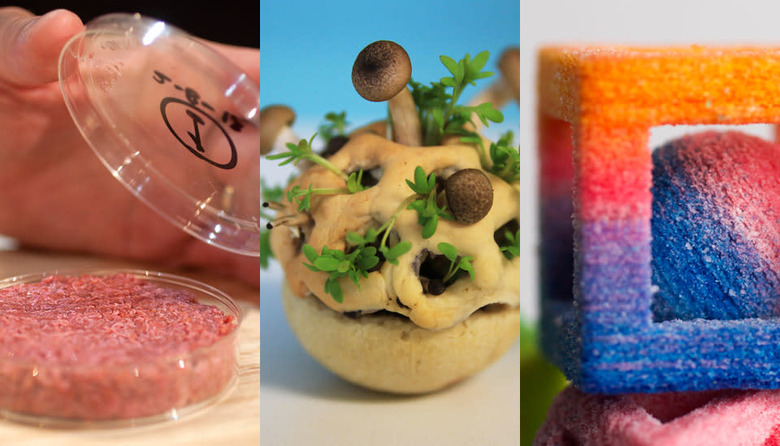
Insects aren't for everyone, but many people can appreciate a good burger. Raising livestock on a large scale, though, is a drain on resources. Humane treatment of animals is also something to consider. Professor Mark Post from Eindhoven University of Technology was already on the case in 2008 with his investigation into "in-vitro meat."
The project, which painlessly harvests muscle tissue from a cow and grows the cells, ended up costing about $325,000 for one burger when unveiled in 2013. Chalk that price up to innovative research though; prices should drop to an affordable scale in the future. According to a study by the University of Oxford, the production of "Cultured Beef" could take up 99 percent less space than traditional livestock farming. Maybe Bart was on to something.


As we expand our reach into space, crop cultivation will become a necessity. NASA launched its plant-growth system project called Veggie last year, starting with the Veg-01 experiment. "Outredgeous" romaine lettuce seeds were planted in individual "pillows" filled with a calcined clay (like the stuff on baseball fields) as the growth medium. The project's initial goal was to troubleshoot the hardware and monitor microbial levels on the plants to confirm they'd be safe for consumption.
Veg-03 commenced this March with "Tokyo Bekana" cabbage as the crop. Previous test data led the team to refine the pillow design, fertilizers, species of plants and other factors to help grow healthy plants, which will eventually supply astronauts with both sustenance and recreation.
Sweet 3D
[Images: David Parry / PA Wire (Cultured Beef); Chloe Rutzerveld (Edible Growth); 3D Systems (ChefJet)]