alzheimers
Latest

AI can detect Alzheimer's 10 years before symptoms show up
Various researchers around the globe are developing ways to detect Alzheimer's as early as possible. After all, early detection gives people the power seek treatment that can slow down the condition's effects, as well as enough time to get their legal and financial affairs in order. Some decided to focus on blood and cerebrospinal fluid tests, while others are developing gadgets that can look for early signs. A team of researchers from the University of Bari in Italy, however, believe the answer lies in artificial intelligence. They developed an algorithm that can spot tiny structural changes in the brain caused by the disease a decade before symptoms even appear.

‘Sea Hero Quest’ hides dementia research inside a VR game
On the face of it, Sea Hero Quest could be just another mobile game. Cheerful, colorful and with plenty of bite-sized levels intended to test memory and spatial awareness. But while you're captaining your little boat along snaking channels towards checkpoints, the game is watching you. It's scoring your spatial navigation skill, one of the first innate abilities dementia sufferers experience a deterioration in. The data gathered is contributing towards a better understanding of what 'normal' looks like -- the benchmark for navigation skill across different demographics of people. The organizations behind the game are now back with a VR sequel, and the goal of advancing dementia research even further with their gamified approach.

Mice brains store backup copies of memories
Turns out that even the human brain might use redundancy when it comes to storage. New research out of the Riken-MIT Center for Neural Circuit Genetics suggests that memories are stored in two places in the brain: the hippocampus for short-term and the cortex for longterm. Previously, the prevailing theory was that once a memory was formed in the hippocampus, it would then move to the cortex for storage. But that may not be the case, according to a paper published in Science.

Scientists reverse Alzheimer's-like symptoms in mice
Scientists have discovered a way of counteracting the proteins that cause Alzheimer's-like symptoms including memory loss. In mice, at least. Whereas other treatments have focused on beta-amyloid clumps (which the University of Michigan recently discovered how to "fingerprint"), researchers at Washington University in St. Louis, Missouri focus on tau protein tangles. Specifically, the genes that produce them.

Protein fingerprinting could shed light on Alzheimer's
Scientists know that the proteins in our bodies can sometimes fold and form clumps called amyloids, which lead to neurodegenerative diseases. However, they still don't fully understand the whole process -- there's just no efficient way to examine the clumps. Since understanding amyloid formation could be the key to preventing or developing treatments for conditions like Alzheimer's and Parkinson's, a team of researchers have developed a technique to measure individual protein molecules' properties.

Flickering LED lights could treat Alzheimer's disease
Twinkling lights aren't just pretty -- if they're flickering at a specific frequency, they could also treat Alzheimer's disease. A group of researchers have tested the effectiveness of LED lights flashing at 40 hertz as a treatment for Alzheimer's on mice genetically engineered to develop the condition. They found that exposing mice in the early stages of Alzheimer's to the lights for an hour lowered the beta amyloid protein levels in their brains. Beta amyloid accumulates to form plaques that interfere with normal brain function. Further, when they used the same technique on mice already in the advanced stages of the disease for seven days, they found that the method "markedly reduced" the plaques in their brains.

Brains can recover some 'lost' memories
For the longest while, researchers believed that you could only preserve a memory in your brain if the relevant neurons were active. However, it now looks like this isn't always the case -- and that could be a tremendous help to anyone suffering from short-term memory loss. Scientists have discovered that small jolts of electricity to the brain (specifically, a pulse of transcranial magnetic stimulation) can revive recent memories. Your mind can slow near-term memories down to a dormant state where they're in the background, but remain ready to come back when necessary.
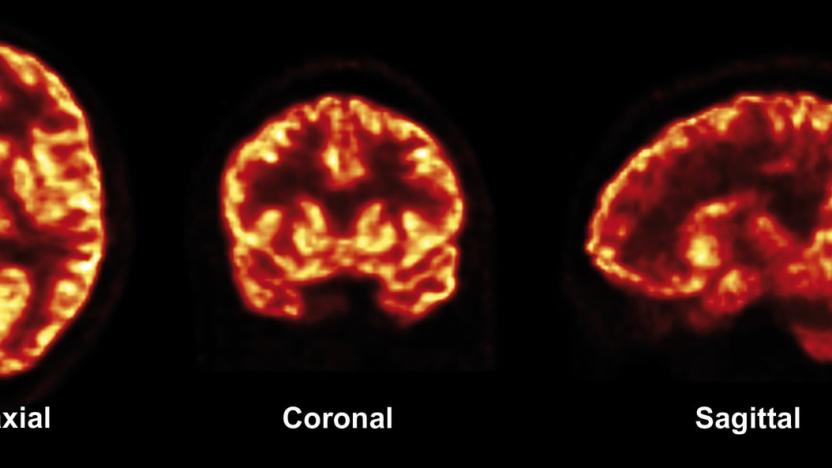
New imaging method reveals how Alzheimer's reshapes the brain
Researchers at Yale University have led development in to a new type of brain scan designed to detect changes in synapses associated with common brain disorders. Until now, researchers have only be able to detect these changes during autopsies, but by combining a Positron Emission Tomography (PET) scan with a new type of injectable tracer, Yale radiology and biomedical imagining professor Richard Carson was able to measure the synaptic density in a living brain. According to the findings published in Science Translational Medicine Wednesday, the technique could help doctors better understand and treat a wide range of neurological conditions from epilepsy to Alzheimer's disease.

Doctors breach the blood-brain barrier for the first time
Our blood-brain barrier is a highly selective membrane specially designed to only allow very specific molecules access to our grey matter while keeping everything else out -- regardless of whether they're invading foreign bodies or potentially life-saving medicines. That's no longer the case. Doctors from Toronto's Sunnybrook Hospital have recently managed to temporarily jiggle the barrier open using directed ultrasonic waves and keep it open long enough to deliver chemotherapy drugs.

ICYMI: Mousetrap for memory, balloon space launch and more
#fivemin-widget-blogsmith-image-30194{display:none;} .cke_show_borders #fivemin-widget-blogsmith-image-30194, #postcontentcontainer #fivemin-widget-blogsmith-image-30194{width:570px;display:block;} try{document.getElementById("fivemin-widget-blogsmith-image-30194").style.display="none";}catch(e){}Today on In Case You Missed It: A virtual reality simulator putting mice through a pretend maze is analyzing memory formation that should benefit humans. A newish space launch company plans to inflate stadium-sized balloons for a gentle flight to the stratosphere, with actual flights scheduled for 2017. Meanwhile researchers built a tractor beam using high-amplitude sound waves to move small objects, which is just as cool as it sounds.

VR simulator for mice helps researchers study Alzheimer's
A group of scientists from Janelia Research Campus have built their lab mice some sort of an Oculus Rift of their own. Okay, so it's not a tiny VR headset for rodents -- though that would have been amusing to see -- but a simulator with walls that touch the mouse's whiskers on either side. This makes the mouse think it's moving through a maze, when it's really just running on a small spherical treadmill. The researchers created the system not because the lab mice needed entertainment: they built it so they can observe how a mammal's brain reacts to injury, learns how to find routes and forms memories. They believe that by having a better grasp of memory formation, we can also understand diseases that cause memory loss (like Alzheimer's) a lot better.

Digital pens help spot early signs of brain conditions
Doctors frequently check for early signs of brain conditions like Alzheimer's and Parkinson's by looking at irregularities in your drawings, but it's an imperfect art based largely on the doctor's opinion. All too often, the only concrete signs show up by the time you've already been ravaged by the disease. MIT researchers might have a more effective way to catch these conditions early on, though. By using custom tracking software to monitor the output from a digital pen, they can more accurately predict the onset of brain conditions based not only on what you draw, but how you draw. Healthy people spend a bit more time thinking than scribbling; those with memory issues (such as Alzheimer's sufferers) spend a lot more time in thought, while Parkinson's patients tend to struggle with the drawing process.

Sony's Folding@Home Android app now fights cancer while you sleep
Want to help cure Alzheimer's or breast cancer? From now on, you don't have to do much more than charge your phone. Sony has released a big upgrade to its Folding@Home app for Android that can use your phone's processor for medical research on a continuous basis -- so long as you're on WiFi and charging, you can doze off knowing that you're contributing to a good cause. It also ties into your Google account to both accumulate time on multiple devices as well as earn game-like achievements. The refresh is available now, so give it a shot if you'd like your phone to do more in its idle time than fetch your email.

Obama's 2013 'BRAIN' initiative results in remote-controlled mice
The first results to stem from President Barack Obama's 2013 "Brain Research through Advancing Innovative Neurotechnologies" initiative are in, Reuters reports. As noted in the journal Neuron, scientists were able to manipulate the brain circuitry of lab mice, making them move, stay still, eat or leave their bowls of food behind. This was accomplished through the use of DREADDs, "designer receptors exclusively activated by designer drugs." The DREADDs system uses genetically engineered brain neurons to create custom receptors that lock into manmade molecules, activating whichever neuron scientists target. The DREADD method is a noninvasive form of behavior control, first introduced about a decade ago as a way to turn neurons on or off -- the newest DREADDs are the first to be able to do both.

Samsung app helps Alzheimer's patients remember their families
If you've seen Still Alice, you know how important a smartphone can be for an Alzheimer's patient -- it helps jog memories that might otherwise be lost. Samsung is clearly aware of this, as it just released a dedicated Backup Memory app to stimulate the memories of early-onset patients. The Android tool uses Bluetooth to detect when friends and family running the app are nearby. If they are, it'll both identify the person and show user-uploaded photos and videos that recall past events. The app is currently very simple (Samsung still wants to add GPS locations, for instance), but it's reportedly promising enough in early tests that it's slowing down the effects of Alzheimer's and making life just a little bit easier.

Ultrasound helps destroy Alzheimer's-causing plaque in mice
Alzheimer's is a degenerative disease often characterized by severe memory loss, and even though it affects more than 5 million people in the United States (with an uptick expected as the Baby Boomer generation ages), it remains notoriously difficult to treat. The University of Queensland reports an Australian research team recently took an encouraging step toward possible treatment by sending ultrasound waves at the brains of mice with Alzheimer's. In 75 percent of the mice, the waves broke up clusters of an amyloid beta plaque that contributes to the disease's progression, and these mice performed better on subsequent memory and spatial recognition tests.

Scientists show how you can restore lost memories
It's scary to lose memories, especially in the early phases of diseases like Alzheimer's -- you're really losing part of yourself. Thankfully, researchers at UCLA may have found a way to get those memories back. They've conducted experiments suggesting that memories aren't stored in synapses, as established theory dictates. Instead, you only need to make sure that neurons are intact and that the brain can synthesize the proteins needed to form new synaptic links. In a snail, memories came rushing back after scientists stopped using a protein synthesis inhibitor that curbed synaptic growth. Those memories would have been gone forever if the synapses themselves were really the key.

New blood test is an early warning system for Alzheimer's disease
Of all the tragic things that come with Alzheimer's disease, its tendency to sneak up on people is one of the toughest to deal with. That's because by the time the condition is even detectable, there's a good chance it's already too late to turn back the tide. Earlier diagnoses could mean the difference between years of mental decline and a life of relative normalcy -- that's why a test developed by researchers at King's College London and Oxford University could be such a game changer. According to The Telegraph, the scientists can predict whether or not Alzheimer's will strike someone with existing memory loss problems by looking for 10 telltale proteins in their blood.

Scientists can create and erase memories 'at will'
A person is the sum of their memories, so what happens when our personal histories can be deleted at will? That's the ethical dilemma facing researchers over at the University of California, San Diego, who have found that it's possible to delete and recover memories created in the minds of genetically engineered rats in the same way MIT scientists did with mice last year. In a slightly gruesome series of experiments, the rodents were given electric shocks while their neurons were bombarded by light pulses delivered by an optical fiber implanted into their brains. After a while, the shocks stopped, but whenever their brains were stimulated, the rats continued to feel fear, since they were drawing on memories.

Project Evo may determine players' risk of Alzheimer's
Diagnosing illnesses early is always ideal, but traditional screening methods such as x-rays or lab work can be extraordinarily expensive. In the case of Akili Interactive Labs' Project Evo, profiled by IEEE Spectrum, determining a patient's susceptibility to Alzheimer's might be aided by an iOS app. For as challenging as achieving its goal is, Project Evo seems simplistic from a player's perspective - in the game, gyroscope controls are used to guide an alien down a river. Birds and fish appear during the journey, and players must tap the screen according to the species Project Evo asks them to respond to. IEEE Spectrum explains that modern PET scans provide estimates of amyloid plaque levels in a patient's brain, which are used to help assess whether the patient is at risk of Alzheimer's. Akili Interactive began a trial with pharmaceutical company Pfizer in March, which involves comparing the success of Project Evo's players with high and low amyloid plaque levels. If a trend surfaces in relation to Project Evo aptitude and amyloid levels in the brain, Project Evo may work as a supplementary screening tool for Alzheimer's. Akili is also conducting trials with Project Evo that research ADHD, autism and depression. Akili Vice President Eddie Martucci explained that the common link between identifying each disorder lies in interference processing, a multitasking-oriented skill used while playing Project Evo. Proficiency with interference processing deteriorates with age, and Martucci explained that a low competency at that skill may allow other goal-oriented abilities to degrade, leaving patients susceptible to further problems. [Image: Akili Interactive Labs]


