kyocera
Latest

Kyocera releases tiny e-paper companion phone in Japan
If you've been curious as to what Instagram might look like on an e-paper screen and happen to live in Japan, the Kyocera Card Keitai KY-01L might be of interest. It's a companion device that's supposed to be a sidekick to a beefier mobile phone. The KY-01L is really small -- not too much larger than a credit card. It's about 9 centimeters tall, 5 centimeters wide, 5 millimeters thick and weights in at a miniscule 47 grams. It has a standby time of 100 hours and a continuous talk time of 110 minutes.
Kyocera's DuraForce Pro is a smartphone and action cam in one
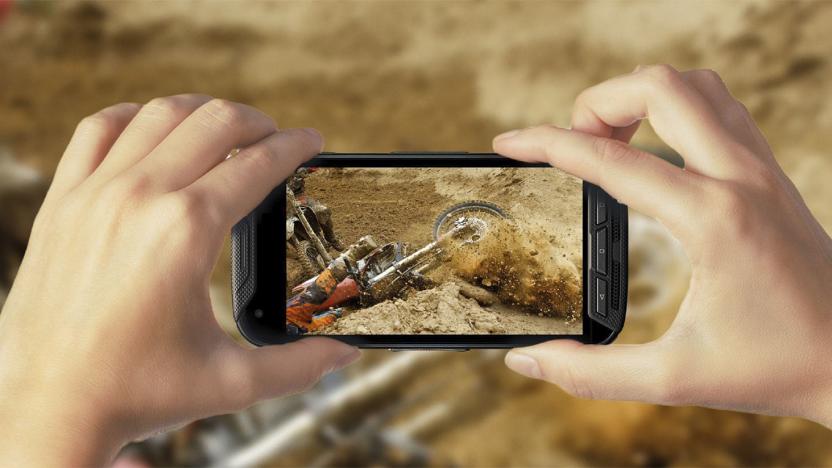
If you film motorcycle ice racing or open pit mines, a regular smartphone may be a bit dainty. Kyocera's newest model, the DuraForce Pro, is up for the job, though. It's a ruggedized, 5-inch phone packing a special action camera that shoots Full HD with a wide-angle field-of-view. The device lives up to its assertive name with an IP6X dustproof case, underwater mode (two meters for up to 30 minutes) and military specs for dust, shock, vibration, temperature extremes, solar radiation and ... well, you get the idea.

6 next-gen green cell phones
By Cat DiStasio In the grand scheme of things, mobile phones haven't been around that long. Less than 20 years ago, hardly anyone had one, and devices of that era certainly weren't capable of doing what today's smartphones can do. Cell phone technology progresses so quickly, in fact, that most users are prone to replacing their phones with new ones every few years -- even if the old one still works -- just to have something with longer battery life and a better camera. This behavior is inspiring designers to create more sustainable handsets: some with easily upgradable modules, some made with recycled materials and some that charge themselves with little or no interaction from the user. Although a few of these technologies are still in the conceptual phase, it's easy to imagine that they could be available within the next few years -- right about when you'll be thinking about replacing the phone you have now.

Kyocera shows off another solar-powered prototype smartphone
Last year, during Mobile World Congress, Kyocera teased a rugged smartphone with solar charging built in. What made that concept device interesting was how its sun-powered films were laid out: they sat between the LCD and touch panel, as opposed to being somewhere on the outside of the body. Now, Kyocera's building on this idea with a new prototype handset, which it has once again created in tandem with Sunpartner Technologies, a French company that focuses on solar tech.

Inhabitat's Week in Green: 'Deathproof' vehicles and more!
Many automakers are working on self-driving cars, but Volvo is the first to announce plans for completely "deathproof" vehicles by the year 2020. Meanwhile, General Motors invested $500 million in Lyft to create a network of autonomous vehicles. Snowstorms snarl traffic, but engineers have a solution: electric roads that de-ice themselves without the need for road salt. We also spotted a unique circular bridge in Uruguay that encourages drivers to slow down and enjoy the view. And Ford teamed up with fashion designers to debut a collection of couture made from recycled upholstery.

ICYMI: Scrubbable smartphone, bioreactive bandage and more
#fivemin-widget-blogsmith-image-628914{display:none;} .cke_show_borders #fivemin-widget-blogsmith-image-628914, #postcontentcontainer #fivemin-widget-blogsmith-image-628914{width:570px;display:block;}try{document.getElementById("fivemin-widget-blogsmith-image-628914").style.display="none";}catch(e){}Today on In Case You Missed It: Scientists created a bandage that react to the presence of infection with a green glow. Yet another flying drone camera is up on Kickstarter, but this one keeps its rotors under wraps for safety. And Japanese phone maker Kyocera just upped its cool cred with a smartphone that can be soaped up and rinsed without harming the phone.

Finally, a smartphone you can wash with soap and water
What's better than a waterproof smartphone? How about one you can clean with soap? Kyocera, which has done a line in toughphones for several year, revealed exactly that. Launching in (particularly soap-themed) pink, white and blue options in Japan, don't let the kawaii design fool you -- the phone is pretty designed to take some damage. And a shower.

Microsoft and Kyocera quietly squash patent beef
Microsoft can cross out another patent dispute in its list, now that it has settled its issue with Kyocera. Redmond filed a lawsuit against the Japanese electronics maker back in March, claiming that the latter's Android phones infringe upon seven patents it owns, including their messaging and location tracking features. Several Android device manufacturers, such as HTC, ZTE and LG, have been paying Microsoft royalties to use its patents for quite some time. It's unclear if money will change hands when it comes to this particular deal, though, since its announcement only talked about signing "an agreement expanding" an older one. The two have apparently signed a cross-patent license after making peace, allowing them to use each other's technologies in their own devices.

Microsoft sues Kyocera over Android phone patents
Microsoft may be taking some steps to make nice with the Android world, but the company is still willing to pick fights when its royalty payments are at stake. The Windows maker has sued Kyocera in the US over claims that Android phones like the Brigadier and Hydro series violate seven patents on features like location tracking and messaging. While Microsoft says it's hoping things can be "resolved amicably," it's prepared to go nuclear if necessary -- it wants a ban on those phones if Kyocera doesn't cooperate. We've reached out to Kyocera to see how it's responding to the lawsuit. If history is any indication, though, it may be tempted to settle. Microsoft already has most Android manufacturers coughing up royalties, and Kyocera isn't an industry giant with loads of cash to fight back.

Japan's leading designers combine to create the latest Infobar smartphone
Japanese carrier au by KDDI has been creating tech-as-art for well over a decade with its Infobar line of phones. After starting with a stylish-but-dumb cameraphone in 2003, the brand began offering fully-fledged smartphones with the A01 back in 2011. It's now back with the third iteration of the A series, the A03, and it's as pretty as ever. Industrial design for the latest Infobar comes from minimalist product designer Naoto Fukasawa, who has worked on the range since its inception, and also created Muji's wall-mounted CD player, part of the MoMA's permanent collection. After the uncharacteristically bland A02, the A03 returns to Infobar's more colorful roots. Encased in anodized aluminum, the A03 has a 4.5-inch 1080p display, 13-megapixel camera, 16GB of storage (expandable with microSD) and capacitive keys for navigation. It's available in a number of hues, but our favorite is undoubtably "nishikigoi," the koi-inspired coloring that Infobar is famous for.

Kyocera's sapphire screen is tougher than we expected
Few things in life are more satisfying than taking out pent-up aggression on a poor, helpless phone, and the Kyocera Brigadier gave me that opportunity this week. Armed with a 4.5-inch Sapphire Shield screen, the rugged Verizon-exclusive device claims to be scratchproof and drop-proof because the material is harder than glass. Since an increasing number of manufacturers (including Apple and Huawei) are reportedly planning on using sapphire on future products, I wanted to torture-test the Brigadier with a lot of sharp and abrasive objects to see if it really holds up to its claims.

Kyocera piezoelectric film speaker delivers 180-degree sound to thin TVs and tablets (update: live photos)
The thinner our devices become, the less room there is for speakers and other thicker components. Kyocera has a solution, however: it just modified its Smart Sonic Receiver conduction technology for use with conventional, over-the-air audio. The company's new Smart Sonic Sound device still relies on a piezoelectric actuator, but vibrates against a film to generate as much volume as a regular speaker in a far thinner (under 1.5mm thick) design. The new speaker might even sound better than its traditional counterparts. It delivers full volume and quality in a 180-degree listening arc, and it's responsive enough to recreate very subtle noises. Smart Sonic Sound is already shipping in LG's 55-inch curved OLED TV, and Kyocera expects it to reach laptops, tablets and other devices where interior space is valuable. Update: Our colleagues at Engadget Japanese have posted their first-hand look at Kyocera's speaker technology, complete with a gallery of live photos; we've posted two of them here.

Verizon to launch waterproof Kyocera Hydro Elite on August 29 for $100 (video)
Kyocera handsets in the US typically debut on Sprint or smaller carriers like Boost or Cricket, but that doesn't mean Verizon can't have a go at devices from the Japanese company. First spied a few months ago, the Kyocera Hydro Elite is one such handheld headed for Big Red, and looks to be a waterproof model much like its Hydro predecessor. Indeed, the Hydro Elite can supposedly be immersed in up to 3.28 feet (1 meter) of water for almost half an hour before calling it quits. Like the Torque, the Hydro Elite also boasts a Smart Sonic Receiver technology that promises outstanding audio quality even in the noisiest environments. The Hydro Elite is not exactly tiny, measuring 4.82 x 2.38 x 0.43 inches and weighing in at 4.51 ounces. Other notable features include -- let's take a deep breath here -- a 4.3-inch HD display, 4G LTE, an 8-megapixel HD cam, a front-facing 1.3-megapixel shooter, Qi wireless charging, NFC, MHL support, DLNA support, a microSD card slot and a 2,100 mAH battery. Phew. If that list of specs sounds scintillating enough to you, you may pick one up at your local Verizon store this Thursday for only $100 after a rebate and a two-year service agreement. For those who need a little more convincing, you can check out a Kyocera-commissioned video after the break starring none other than Man vs. Wild survivalist Bear Grylls.

Mobile Miscellany: week of August 5th, 2013
If you didn't get enough mobile news during the week, not to worry, because we've opened the firehose for the truly hardcore. This week brought a smartphone inspired by TopGear's 2012 supercar of the year, leaks of a water-resistant handset for T-Mobile and an Android smartphone from LG that sells for under $100 outright. So buy the ticket and take the ride as we explore all that's happening in the mobile world for this week of August 5th, 2013.

Kyocera's water-resistant Hydro Edge dives onto Sprint, Boost Mobile this month
An ice bar isn't how we'd choose to showcase a water-resistant smartphone, but that's just what Kyocera did at CTIA this year for the Hydro Edge. At the time, Sprint and Boost Mobile had set a loose summer launch for the modest device and now we have a hard date: July 19th and July 23rd, respectively. The IPX 5/7 certified device can be had on a two-year plan at the Now Network for $20 or for $150 outright at Boost, which gets you a 4-inch WVGA display, dual-core 1GHz Snapdragon processor running Android 4.1 Jelly Bean and a 5-megapixel rear shooter. It's not as sleek and stylish as Sony's own hydrophobic smartphone, but if you're on a budget and need to brave the watery element, the Edge'll have to do.

Refresh Roundup: week of July 1st, 2013
Your smartphone and / or tablet is just begging for an update. From time to time, these mobile devices are blessed with maintenance refreshes, bug fixes, custom ROMs and anything in between, and so many of them are floating around that it's easy for a sizable chunk to get lost in the mix. To make sure they don't escape without notice, we've gathered every possible update, hack, and other miscellaneous tomfoolery we could find during the last week and crammed them into one convenient roundup. If you find something available for your device, please give us a shout at tips at engadget dawt com and let us know. Enjoy!

Kyocera Hydro Xtrm and Hydro Edge hands-on
Kyocera kitted us out with toques, touch-sensitive gloves and giant black faux-fur coats -- well, Brad chose white -- and led us all into a bar made entirely of ice to launch its new handsets here at CTIA. Kyocera, playing off the tough-guy thing, had the Hydro Xtrm and Edge laid out on slabs of ice in a pretty frosty environment for us to handle with our gloved hands. Both handsets will be priced toward the lower end of the spectrum, with the Hydro Edge being the least expensive and most modestly specced of the two. Both devices are decent as far as material choices go, though the Edge was perhaps our favorite even if the Xtrm beats it out in the display department somehow. There weren't any water tanks to test out both sets IPX5 / IPX7 specs so we'll simply have to take Kyocera's word for it. The Edge and Xtrm build on the previously launched Hydro specs but with upgrades across the board. The Edge sports a dual-core 1Ghz CPU, tempered glass (instead of acrylic), 5-megapixel camera, 4-inch WVGA (480 X 800) 233-ppi display and Android Jelly Bean. The Xtrm adds LTE to the connectivity list also touts a 5-megapixel shooter, 1.3-megapixel front-facing camera, the same display as the Edge, and Bluetooth 4. The Xtrm launches on US Cellular May 24th for $29.99 after instant rebate with the Edge joining the fun on Boost Mobile and Sprint during "Summer 2013." Check out the cool blue-hued pics in the gallery below. %Gallery-188927% Myriam Joire and Brad Molen contributed to this report.

Kyocera Elite for Verizon and XTRM for US Cellular both leaked
Kyocera does a good line in rugged (and often unconventional) smartphones, although this pair of leaked handsets, apparently headed to Verizon (left) and US Cellular (right), both appear to cut a more typical profile. As is often the way with serial leak artist @evleaks, there's no full spec sheet to hand, although the US Cellular-bound XTRM appears to been given some bumper protection around the corners and will likely match that hardy name. Verizon will get the LTE-capable Elite, although we'll have to wait for either the carriers -- or Kyocera itself -- to let us in on all the other details.

Refresh Roundup: week of April 1st, 2013
Your smartphone and / or tablet is just begging for an update. From time to time, these mobile devices are blessed with maintenance refreshes, bug fixes, custom ROMs and anything in between, and so many of them are floating around that it's easy for a sizable chunk to get lost in the mix. To make sure they don't escape without notice, we've gathered every possible update, hack, and other miscellaneous tomfoolery we could find during the last week and crammed them into one convenient roundup. If you find something available for your device, please give us a shout at tips at engadget dawt com and let us know. Enjoy!

Kyocera Torque review: a rugged phone delivering superior sound
More Info Kyocera Torque coming to Sprint's Direct Connect lineup in March, we go hands-on (video) Kyocera Torque hitting Sprint March 8th, carrying $100 price tag Kyocera teases tissue conduction audio technology for mobile phones at CTIA Sacrificing a smartphone's thin and sleek form factor with a case is tantamount to sacrilege in some circles. Others feel little comfort venturing outdoors without having their phone wrapped safely in one sleeve or another. Sprint's Kyocera Torque, though, is for people who demand more than just a sheath of silicone to keep their device safe. Instead of relying on a case for its protection, it's durable in its own right, with an IP67 rating and Military Standard 810G certification to help it withstand everything from water to salt fog. In addition, the handset carries the distinction of being the very first phone released in the US with Kyocera's Smart Sonic Receiver tissue-conduction tech, which does away with the traditional earpiece. We put the Now Network's first LTE push-to-talk phone through our review gauntlet not only to gauge how tough it is, but also to find out how well it performs. Head past the break to see how it fared.%Gallery-183163%


