Skip to Content

The dish on parenting ... check out the new ParentDish!
AOL Tech

Posts with tag mars

Capuchin robot climbs its way into your nightmares

As if there weren't enough creepy crawly robots out there already, a team of researchers from Stanford University have now let loose this little number, which they hope will one day be showing off its rock-climbing skills on Mars. Dubbed Capuchin, the bot is a follow-up to the Lemur robot built by the same team, and promises to climb walls some 40 times faster than that earlier model. To do that, the researchers apparently didn't make any major mechanical changes, but rather employed a more advanced computer program that guides the bot's every move. More specifically, as NewScientist reports, the software uses a sophisticated load-balancing system, which distributes the bot's weight equally to its arms and legs and improves its stability when climbing. As you can see for yourself in the video after the break, that appears to work remarkably well, although we still wouldn't trust it to be a partner on your next rock-climbing expedition.

Diamond and gold PCs class up the floor under your desk


Most of the questionably-ostentatious gear we see is designed for use on the go -- why else spark out your kit if not to blind your frenemies at the club? -- but at some point even Diddy runs out of handhelds to ice up, which is where Japan's Zeus Computer steps in. The company is offering two different glam desktops for your wallet's delight: an ¥80,000,000 ($747,768) diamond-studded model, or (for cheapskates) a ¥60,000,000 ($560,826) gold version. Both offer a 3GHz E6850 Core 2 Duo on an Asus board with 2GB of RAM, a 256MB GeForce 8400GS, 1TB drive, Blu-ray + HD DVD combo drive, and Vista Ultimate -- but that's not at all what matters here, is it?

[Via F******gaijin, warning: sitename may be NSFW]

NASA's Mars Opportunity rover falls on hard times

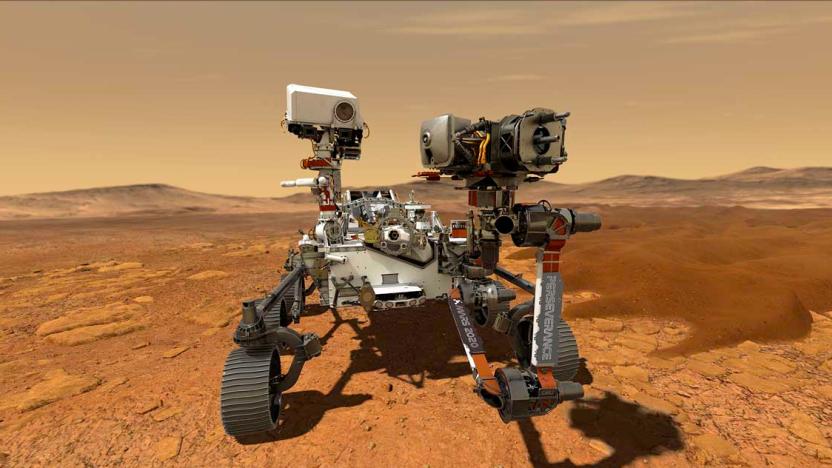
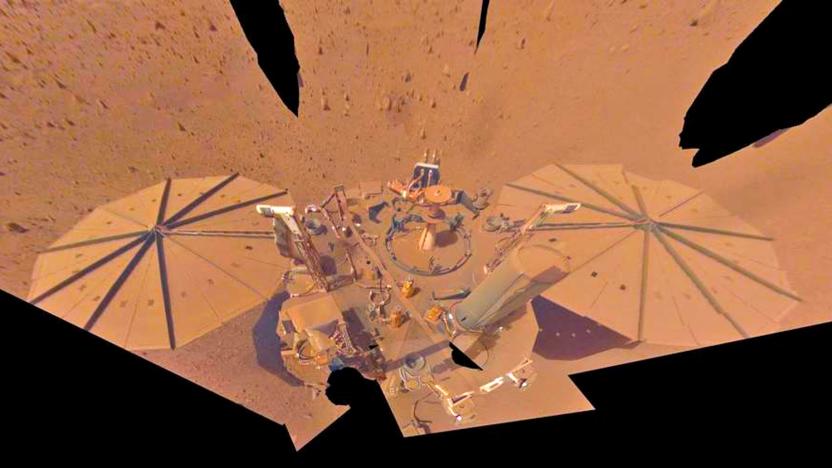
NASA's Mars Opportunity rover has already long outlasted its original 90 day mission, but it looks like the go-getter bot is now really starting to show its age, as NewScientist reports that problems with two key instruments have left the rover "crippled and blinded." As NewScientist points out, however, these latest issues are far from the first to plague Opportunity (and its counterpart, Spirit), and it's still suffering from a malfunctioning wheel and an "arthritic" robotic arm, both problems of which first cropped up in 2005. While NASA has currently suspended all work involving the rover's rock grinding tool and its infrared spectrometer, it's apparently hoping to get the spectrometer back up and running by shaking off some of the dust causing the problems, and at least one NASA official expects both rovers to keep "going for years more."

Scientists show off self-sufficient space habitat design

While there's no shortage of habitat designs out there for potential lunar or Martian missions, a team of Australian scientists seem to think theirs has what it takes to stand out, with it promising to be 90 to 95 percent self-sufficient. According to Cosmos Magazine, the habitat, dubbed Luna Gaia, employs a so-called "closed-loop life support system," which recycles "almost all material within the system" with minimal input from outside sources. Key to that is the Micro-Ecological Life Support System Alternative (or MELIiSSA), which uses microbes to purify water, recycle carbon dioxide and, yes, "derive edible material from waste products. " Apparently, that would allow the system to support a team of 12 astronauts for up to three years, with them relying on a largely vegetarian diet. While the system is still 20 or 30 years from becoming feasible, the researchers say it also has some potential applications here on Earth in the nearer term, including more sustainable farming techniques and improved recycling processes.

[Via Slashdot]

Phoenix Lander gears up to dig in on Mars

While NASA has plenty of long term plans for Mars in the works, most of its attention these days is focused on its Phoenix Lander mission, set to launch this August. After a long, lonely journey through space, the robot craft will (hopefully) ease its way down to the surface near Mars' northern pole on May 25, 2008 and get to work digging up soil samples in search of evidence of past (or present) life on the planet. To accomplish that, the lander's equipped with 7.7 foot long robotic arm capable of digging up to three feet into the ground, which NASA expects will be enough to get at frozen water thought to be hiding beneath the Martian surface. The mission is also notable for being NASA's first attempt at a so-called "soft landing" on Mars in three decades, eschewing the airbags employed as of late in favor of a heat shield/parachute combination, with some rocket engines firing at the last minute to gently set it down Lunar Lander-style.

[Photo courtesy of Corby Waste/Jet Propulsion Laboratory]

NASA's Scarecrow rover to scour Mars in 2009


Just months after learning the truth behind the fall of the late Mars Global Surveyor, NASA is already test driving the next great planetary invader. The vehicle, dubbed Scarecrow for its (current) lack of brain matter, is already conquering terrain in the Mars Yard as it prepares for a scheduled launch in 2009. Its sole mission in life will be to "follow the evidence of water that has already been found on the surface of Mars," and just in case any unforeseen hostiles attempt to sabotage its assignment, the engineers have equipped it with a "laser that can pulverize rock from 20 feet away." So much for a peaceful visit.

[Via The Raw Feed, image courtesy of NASA/JPL-Caltech]

Ill-fated Mars Global Surveyor has human error to blame


While we've no idea how much the Mars Global Surveyor actually cost to construct, launch, and manage whilst hovering around in space, it's entirely likely that a single human error wiped out even more than was initially lost by the Alaska Department of Revenue earlier this year. Sad to say, galaxy geeks everywhere now have a scapegoat to direct their wrath at, as a review board of the mishap found that "a single command (root@mars-surveyor: rm -rf /) that oriented the spacecraft's main communications antenna was sent to the wrong address," subsequently leading to a cataclysmic series of events that finally dismantled its communication system. Interestingly, the command caused the befuddled craft to think that one of its solar panels was "stuck," which eventually led to an autonomous decision to enter "safe mode," followed by a complete shutdown of the unit's onboard batteries. Intelligently, the LA Times report neglected to mention any specific culprit, and hey, living with the guilt of destroying the machine that showed us so much of the Red Planet is probably punishment enough.

[Via Slashdot]

NASA planning methane-sniffing rocket plane for Mars mission

It's often been said that where there's water there's life, but NASA now looks to be seeing if the same can also be said of good 'ol methane, with New Scientist reporting that researchers at the agency have drawn up plans for a rocket plane that could one day sniff out sources of the gas on Mars. If it's given the go ahead, the plane would parachute down to Mars before being cut loose at an altitude of 1.5 kilometers, when the plane's rockets would kick it send it skimming across the Martian surface. On board sensors would then be able to detect methane at levels as low as a few parts per billion, as well as determine the source of the gas, which some speculate could be living micro-organisms. Of course, there's no indication of when that might take place, with the plane already failing to make the shortlist for NASA's 2011 Mars Scout mission.

Motion-sensitive "power skins" could generate power in space

Just in case you ever plan on heading up into space to see your soon-to-be-painted logo on the Y*N*I*S satellite up close and personal, you might be interested in this. Devised by researchers at a Cambridge-based venture, dubbed IntAct Labs, the motion-sensitive "power skin" could be used and worn by humans and inanimate objects alike in order to generate electricity, and the concept was derived from our very ears. After investigating how biological organisms are such "ultra-efficient generators of power," the crew homed in on a tiny protein called prestin, which can "convert electrical voltage into motion or produce electrical charges in response to mechanical stresses," and is actually found in the outer hair cells of the human ear. Ideally, networks of these proteins would be linked in order to form skins that could coat people or objects and generate energy from something as simple as walking around or being in the path of wind gusts, and if everything pans out, a prestin-powered research station could be set up on Mars without a manmade perpetual power source in tow.

[Thanks, Sparky]

Hopes fade for missing Mars Global Surveyor

Break out the tissues fellow space nerds, for it seems our precious Mars Global Surveyor spacecraft has finally fallen silent after long outlasting its life expectancy and, in all likelihood, will not be heard from again. The first sign of trouble came on November 2nd, when the spacecraft reported problems adjusting one of its solar panels -- its only other contact since came on November 5th, when the MGS let out a faint, final signal. (Are you sobbing yet?) Attempts to subsequently locate the craft with the Mars Reconnaissance Orbiter have turned up nothing, with a last ditch effort now planned to listen for the craft's radio beacon using the Opportunity rover on the planet's surface. NASA scientists, however, are not optimistic about their prospects, saying that even if they were able to locate the spacecraft, attempting to fix the problem could actually make things worse. Despite losing contact, NASA says the spacecraft should continue to silently orbit the planet for about 40 years, after which it will finally succumb to the harshness of space and plunge into Mars' atmosphere. So long, MGS. You showed 'em how it's done.

Arizona student envisions giant space mirrors for terraforming Mars

Anyone who's ever read science fiction knows that in addition to space elevators and transporters, there's another futuristic technology that we'd all dig: terraforming. Being able to transform the moon, Mars, or any other barren celestial body into a new Earth would make human interplanetary colonization a bit more feasible. However, instead of terraforming an entire planet, which at current estimates could take centuries, it appears that altering one single square kilometer first might be a bit simpler. Earlier this year, Rigel Woida, an undergraduate at the University of Arizona, received a grant from the NASA Institute for Advanced Concepts to study "reflective balloons," which in theory could raise the surface temperature of Mars on that patch to 68 degrees Fahrenheit (20 degrees Celsius), compared with the typical high of -76 degrees Fahrenheit (-60 degrees Celsius). Woida recently gave a presentation at the NAIC meeting in October and will give another at a second meeting this March, where he will hopefully show NASA how great his concept his, and how the astronauts who study Mars in his little patch of paradise will be able to like, totally, get the best tan ever.

ASUS goes Hermes style with Mars II

If imitation is truly the sincerest form of flattery, HTC must be turning beet red right about now. The Mars II from ASUS follows the HTC Wizard / Hermes formula down to the letter, featuring that fabulous side-opening QWERTY keypad we'd now be lost without, an Intel Xscale PXA270 core making haste at 520MHz, 128MB of ROM, 64MB of RAM, UMTS, 802.11g, Bluetooth 2.0, 2-megapixel shooter, and a 2.8-inch QVGA display (why no love for the VGA?). As you may recall, we were able to correctly call all the specs out last month with the exception of the name and the ODM, which we'd heard would be HTC -- and given the Hermes-esque dimensions and feature list, who could blame us? Look for the Mars II to grace O2's networks before too long as the "Xda Zinc," but thanks to the old-skool tri-band GSM radio sans 850 support, we're going to be putting our import plans on hold.

[Via phoneArena]

O2 Mars and Jupiter, followup to Hermes, Breeze

Oh hell yes, did we call it or did we call it? That mystery device has a keyboard, and it turns out that HTC's totally sick successor to the Hermes / TyTn is the O2 Mars which nails the aesthetics where the Hermes suffers so, and will supposedly come equipped with a 520MHz XScale, GPRS / EDGE / UMTS (sorry, no HSDPA), 64MB ram, 128MB flash, WiFi, Bluetooth, miniSD, and a 2 megapixel camera. Ok, so maybe we're only excited about this thing because it's one of the only QWERTY devices we've seen lately out of HTC that wasn't a little hard to look at (Excalibur, we're lookin' at you, buddy), but we don't need to excuse our love of gadgets, so if you'll let us continue our fawning. Thank you.

P.S. -Sorry, we didn't mean to gloss over the Jupiter, which appears to be the successor to the Breeze -- there's just not a lot of info there. Click on for some pics.

[Via the::unwired]

North Dakota students show off Mars spacesuit prototype

We had assumed that with all the robots being developed for deployment to Mars, the human astronauts would mostly be lounging around inside the comfort of their robot-built habitats and ordering drinks from their robot bartenders, but yesterday's unveiling of a prototype spacesuit for navigating the Martian terrain proves that manned missions might not be as cushy as we anticipated. The 50-pound suit (which they somehow got The Office's Steve Carell to model) was designed by students from five North Dakota colleges in a collaborative project funded by a $100,000 NASA grant, and includes at least three innovative technologies for which patents have been filed. Among the slew of sensors and communications gear designed for the harsh, low-gravity environment are oxygen and carbon dioxide detectors, GPS system, full suite of health monitors, shoulder mounted CCD cam, Bluetooth server to coordinate all the data, and a high-power transmitter for beaming info back to the mothership -- though curiously, there's no mention of an onboard weapons system that would be crucial for encounters with the occasional hostile Martian. Also, as the AP helpfully notes, even with all the research and design that went into this project, the forty-odd students seemed to neglect a key feature of any good full-body suit, which is an "escape hatch" for when the astronauts need to "jettison their waste."

[Via futurismic and abc]


    Weblogs, Inc. Network

    AOL News

    Other Weblogs Inc. Network blogs you might be interested in: