multi-touch
Latest
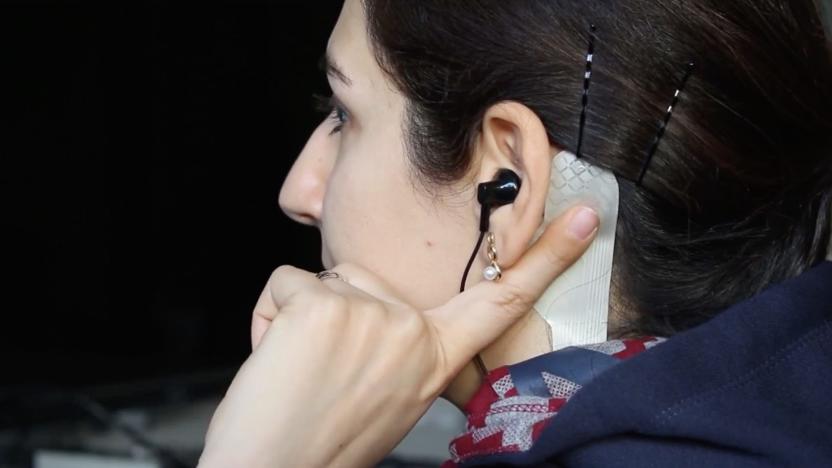
Multitouch 'skin' makes your body the controller
Having a sophisticated computer interface on your body might seem like the stuff of science fiction, but a group of scientists at Germany's Saarland University have announced exactly that. Called Multi-Touch Skin, the material can be inkjet printed onto a plastic sticker and register a touch from multiple points at once, much like your phone or tablet does.

Touch+ turns any surface into a gesture controller for your PC
Haptix (now Ractiv) promised a cheap sensor that would turn any surface into a multi-touch PC controller, and it's making good on its word today by shipping the device worldwide. The $75 add-on has received a new Touch+ name and a sleek redesign, but it otherwise uses the same basic concepts we saw when the project got its crowdfunding a year ago. Put the device on a desktop stand or a laptop and its dual cameras turn your finger movements into gestures; you can play a first-person shooter by swiping across your keyboard, or sketch in Photoshop using your desk as a drawing tablet. It's definitely not for everyone, but it might be up your alley if you'd rather not reach out to a touchscreen (or use Leap Motion's in-air tracking) just to get more advanced input than a run-of-the-mill mouse or trackpad.

Some 2013 Nexus 7 users report buggy multitouch, Google is investigating
A muddled sense of direction isn't the only problem affecting the new generation of Nexus 7 slates, it seems, as some users are also reporting issues with multitouch on the 1,920 x 1,200 display. The clip below the fold demonstrates the bug, and shows the touchscreen registering phantom inputs before freaking out for a couple of seconds. Over the past few weeks, chatter on the XDA Developers and Google Product forums suggests it's fairly common, with a response from Google on the latter stating: "The Android team is aware of this issue and investigating." We haven't had the same troubles with a 2013 Nexus 7 in our possession (running Android 4.3 build JSS15J, FYI), and while the root of the problem is still up for discussion, let's hope funky software is to blame -- no one wants the hassle of replacing faulty hardware, especially Google, when an OTA fix will do.

Dutch court rules that Samsung didn't infringe on Apple multi-touch patent
Once again, a decision has been made on an Apple versus Samsung patent dispute. This time, it's a Dutch court in the Hague, ruling that Samsung does not infringe on a Cupertino patent relating to certain multi-touch commands that the Korean firm implements in some of its Galaxy phones and tablets. This isn't the first time that the Netherlands-based court has found in favor of Samsung, and Apple had already lost a preliminary injunction on this same patent last year. Reuters also reports that the Hague court's decision comes in the same week that the International Trade Commission is expected to decide about further patent disputes between the two firms, which went in favor of Apple the last time around. At the very least, this long and bumpy ride isn't over yet.

Dell announces its first multi-touch monitor, the S2340T, and a wireless trackpad for Windows 8
In addition to trotting out a new Windows 8 Ultrabook and putting its Windows RT tablet up for pre-order, Dell just announced its first multi-touch display along with a wireless trackpad optimized for Win 8. Starting with the 23-inch S2340T, it has 1080p resolution and a 90-degree articulating stand that allows the display to lie nearly face-up. At the base, you'll find various inputs, including USB 3.0, HDMI, DisplayPort and Ethernet. There's also a webcam up top for those of you who plan on giving the new version of Skype a try. Meanwhile, the TP713 (pictured) is a Magic Trackpad-style touchpad designed to support Windows 8 gestures, such as swiping in from the left to toggle through applications. Both are up on Dell's site now, with the monitor priced at $650 and the trackpad going for $70. Both are expected to begin shipping this week.

New Office Web Apps get finalized for SkyDrive, Outlook
As polished and functional as something might be in its preview days, a piece of work isn't done until it is done, and Microsoft's Office Web Apps have finally reached that point. Back in July, Redmond piped out preview versions of OWA and Office 365, focusing on adding tablet-friendly touch controls. Feedback from over 750,000 users and Windows 8's impending deadline helped shaped today's release, readying it for Microsoft's latest operating system, IE10 and iOS 6. A pair of posts on the Office Web Apps Blog detail the new face of Office, including an improved authoring experience, better support for multi-user collaboration, faster performance and more. Read it for yourself at the source link below, or just log into Skydrive and get to work.

Microsoft Touch Mouse gets promised Windows 8 support, works like a Charm
Microsoft vowed that its Touch Mouse would get Windows 8 support in time for the software's big release day, and it's being very true to its word by posting the relevant update with less than a week to go. Mouse and Keyboard Center 2.0 saves time for those not graced with a touchscreen by introducing multi-touch swipes that bring up Windows 8's Charm bar, switch between active apps and invoke Semantic Zoom. Will the Touch Mouse update trick you into thinking you have a Surface? No, but it's certainly much easier on the wallet.

Disney Research develops capacitive touch that detects multiple users through their fingertips (video)
Creating a truly multi-user, multi-touch display is a tricky prospect. How do you know who's who short of turning the screen into one giant fingerprint reader? Chris Harrison, Ivan Poupyrev and Munehiko Sato at Disney Research have suggested in a paper that fingerprinting on a capacitive touchscreen isn't far off -- it's just what we need to fingerprint that matters. Rather than look for physical ridges, the scientists' method sweeps through AC frequencies to find the exact electrical impedances of fingertips in contact with the screen. Different bodies, different clothes and even different shoes give everyone a unique signature that lets the screen identify specific people, even when they each have multiple fingers in play. The researchers propose that the technique would work well in collaborative workspaces, personalized devices and security, but let's not forget that this is Disney we're talking about: it's placing a strong emphasis on the prospects for shared screen gaming without the limitations we know today. While any practical use is still some distance away, it's easy to see future tablets and tables that are designed from the start to encourage a little socializing.

Office Web Apps integrate touch support on iPad and Windows 8, brace us for an Office 2013 world
Touch-friendliness is a centerpiece for the upcoming Office 2013, but don't fret if you prefer to live in the world of Office Web Apps ahead of time. As of new preview versions of both OWA and Office 365, those using at least an iPad or Windows 8 will see larger, more finger-ready controls by default. The switch also tweaks the text selection, contextual menus and numerous other elements to work properly with the fleshier input, even going so far as to support multi-touch gestures like pinching to zoom. Windows users get a Touch Mode toggle if they'd rather flip back to traditional control methods. While the web support is still experimental and doesn't have a completion date on the horizon, those willing to live ever so slightly on the edge can stay hooked on Excel, PowerPoint, OneNote and Word without having to use anything so archaic as a mouse and keyboard. [Thanks, Suraj]

OLPC XO Touch 1.75 to use Neonode tech, take multi-touch on world tour
The One Laptop Per Child's project just got one step closer to updating its venerable XO portable through a newly-struck licensing deal with Neonode. The XO Touch 1.75, a slight rebranding of the as yet unreleased XO 1.75 we saw last year, will use Neonode's MultiSensing to give the laptop a multi-touch screen that's both very responsive and eco-friendly in the same breath. Even as it samples finger input at up to 1GHz, the new OLPC system's 300 DPI display will still use under 2W of power and remain viewable in bright sunlight -- students can even wake up the new model with a gesture instead of using anything so crude as a power button. As important as these advances are to bringing touch to remote schools, we still have some questions about the release schedule and the cost. The XO 1.75 was originally due this year, but we don't know if the Neonode pact will alter the timetable or hike the target price. We've reached out to the OLPC team for comment and will update if there's new details.

Daily Update for July 25, 2012
It's the TUAW Daily Update, your source for Apple news in a convenient audio format. You'll get all the top Apple stories of the day in three to five minutes for a quick review of what's happening in the Apple world. You can listen to today's Apple stories by clicking the inline player (requires Flash) or the non-Flash link below. To subscribe to the podcast for daily listening through iTunes, click here. No Flash? Click here to listen. Subscribe via RSS

N-Trig pen tech whittled down to single DuoSense chips and sensors, shrinks scribblings to travel size
As much as N-Trig is an old hand at supporting styluses, it's had to focus on tablets and other larger devices due to technology limits: the HTC Flyer is about as small as the company has gone to date. A new version of N-Trig's DuoSense chipset family could be the ticket to going to much smaller sizes. The new 4000 series condenses both pen input and multi-touch finger gestures into a combination of one chip and one sensor, letting any entrepreneurial device maker stuff the two control methods into a handheld device with as little as a 5-inch display. Naturally, the chip line scales all the way to 15.6-inch panels for creatives poking at the screens of laptops and larger Ultrabooks. We're told that both Android and Windows slates will get N-Trig's tinier touch tricks before the end of the year -- whether or not that includes phablets with the same girth as the Galaxy Note or Optimus Vu, however, is left to our wild imaginings.

University of Calgary's Fat Thumb trick allows one-handed phone use, jugglers are thankful (video)
Everyone's let it happen at some point -- that moment where we're desperately trying to use our smartphones in one hand while juggling groceries or coffee in the other. There'll be no way to recover those social graces, but six researchers at the University of Calgary have developed a software technique, Fat Thumb, that should at least keep the contortions and dropped phones to a minimum. As the name implies, it's all based around pressure: a light touch performs the usual commands, while squishing the thumb's wider surface area against the screen allows the equivalent of a multi-touch gesture, such as a pinch to zoom. The advantages for comfort and grip virtually speak for themselves; what's surprising is that Fat Thumb may well be faster than other one-handed gestures. Work on the project is so far confined to a research paper stemming from experiments with an iPhone, although it's easy to see this spreading to other platforms and real products before too long. Catch a glimpse of the cleverness in action after the break.

Ideum unveils speedy Platform and Pro multi-touch tables, says PixelSense ain't got nothin' (video)
Who knew giant multi-touch tables would trigger the next big speed race? Ideum clearly thinks that the PixelSense-based Samsung SUR40 is lagging with that AMD Athlon II X2, because it just rolled out a pair of speed demon 55-inch, 40-point touch surfaces (but not Surfaces) in the Platform and Pro. The Platform has a respectable dual 2.2GHz Core i7 and 8GB of RAM, but it also carries a pair of 256GB solid-state drives in case that museum exhibit app won't load quickly enough. Hopping to the Pro switches to two not quite as speedy 500GB hard drives in standard trim. It more than makes up for this with a quad 3.4GHz Core i7 and NVIDIA's Quadro 600 for the truly stressful projects -- the combination can juggle multiple users and tasks even more smoothly than its MT55 Pro ancestor. Outside of raw speed, picking a table depends mostly on svelteness versus expansion: the Pro has a full-fledged HP tower inside that can drop in SSDs and other upgrades you might fancy, while the Platform is half as thick as a SUR40 (at two inches) and sleeker overall than its big brother. We're working to get price quotes, but the early five-digit figures we've seen in the past likely rule out upgrading the family coffee table. You can convince yourself with a video after the break.

Nintendo's Reggie Fils-Aime: Wii U GamePad won't feature multi-touch
The Wii U's 6.2-inch killer feature might look a whole lot like a tablet, but prospective buyers shouldn't expect it to function like one at all. In a recent interview with Kotaku, NOA prexy Reggie Fils-Aime confirmed that multi-touch capabilities will indeed be purposefully absent from the upcoming GamePad. It's a puzzling omission for sure, but not one made lightly on Nintendo's part. According to Fils-Aime, the existence of hardware buttons on the controller itself render that full-blown slate functionality redundant, not to mention cost-prohibitive and "unwieldy." So you see, the Big N giveth and the Big N taketh away, but all in the name of user convenience. You can check out the full blow-by-blow with the House that Mario built's American keeper at the source link below.

ViewSonic teases 22-inch Android ICS 'tablet,' promises more at Computex
Have we finally found a tablet match for the 5.3-inch Galaxy Note? ViewSonic sent around a teaser for its "Touch and Connect" series prototypes, including a 22-inch "smart business tablet monitor," powered by what appears to be Ice Cream Sandwich. The giant touch-enabled device will be joined by a Windows 8 multi-touch display, new cloud computing solutions, high-end laser projectors and some interactive electronic billboards -- all set to make their debut on June 5th at Computex. More details will no-doubt be forthcoming in Taipei, so do stay tuned. And you may want to hold off on those giant tablet acquisitions in the meantime -- we have less than two weeks to wait for what could just be the largest mainstream tablet to date.

Insert Coin: Playsurface open-source multitouch computing table
In Insert Coin, we look at an exciting new tech project that requires funding before it can hit production. If you'd like to pitch a project, please send us a tip with "Insert Coin" as the subject line. A Microsoft Surface in every office? Yeah, fat chance. At $8,000, you may never see Samsung's SUR40 glow in the wild, but budget versions of the backlit HD table have begun popping up, such as the Merel Mtouch, which retails for half the price. Still, four grand is a lot to ask from casual users -- we need a bargain-basement option to help catapult the concept to success. The Playsurface could be one solution, with an open-source design and a much more affordable price tag. The multitouch computing table is the product of Templeman Automation, and its creators have begun promoting their concept on Kickstarter. In its current iteration, the Playsurface will ship in two flavors -- short, to double as a coffee table, and tall for stand-up applications -- with a $1,750 pledge netting backers a complete kit. Setting out to fulfill the goal of widespread adaptation, the creator is promising one Playsurface kit with a $1,750 pledge, including a Windows computer, a short-throw 1280 x 800-pixel DLP projector and a transparent touch surface, all housed within a self-assembled wood enclosure. There's also an infrared LED strip to aid with input recognition and something called a "Blob Board," which serves as a dedicated hardware processor tasked with touch detection and connects to the computer via USB. A $350 pledge gets you a Blob Board alone, while $650 is matched with a table (sans computer and projector) and $1,250 will net you a full kit, less the computer. There's just shy of four weeks left to go to get your Playsurface pledge in -- hit up the source link to make it happen.

Video shows another way Apple could implement text editing on iPad
As noticed by iDownloadBlog, YouTube user danielchasehooper has come up with an idea that would simplify text editing on the iPad by making it even easier to select text. Instead of tap, hold and zoom to select text, you could use a finger swipe to move the cursor and hold shift to select the text. You can check out the concept in the YouTube video embedded below and let us know what you think in the comments. [Via iDownloadblog]

PSA: Interactive Starry Night now available for the iPad (video)
Greek Artist Petros Vrellis is a big admirer of Vincent Van Gogh, which prompted him to produce an interactive version of Starry Night. It took him a patience-sapping six months to produce the original PC version, where finger swipes redirect the painter's famous daubs into a light and sound show. Of course, there was such a clamor from users all desperate to have a go, that he managed to produce an iPad app in a little under a month. Now you can pick it up from the App Store at the source link, or head on past the break to see this new version in action (you really do have to see it).

Van Gogh's Starry Night modded into beautiful interactive light and sound show (video)
This is one of those little projects you wish you could just play with the second you've seen it. Greek Artist Petros Vrellis coded an interactive light and sound show into Vincent Van Gogh's Starry Night -- that you can control with your fingers. With a swipe of a single digit (or hand) you can pull the particles of the artists paint daubs to redirect the swirling mass of night sky in any direction, making music as you do so. After the break we've got video that you really, really should watch -- and afterward start begging the creator to get this onto people's iPads as soon as he can manage it.


