survey
Latest
TikTok is the fastest-growing social platform, but YouTube remains the most dominant
The Pew Research Center has published an updated survey of US adult social media usage. Although YouTube and Facebook retain their dominant status, TikTok is the fastest-growing platform.

Teens don’t seem super concerned about social media’s effects on their lives
How do today's teenagers view social media's role in their lives? A survey released today paints a significantly less dire picture than you may expect.

Game developers say they're working longer hours due to the pandemic
Ahead of the all-digital “GDC Summer,” the Game Developers Conference polled nearly 2,500 game developers to get a sense of COVID-19’s impact on the industry.

Facebook's Viewpoints research app pays you to take surveys
Facebook is once again offering a market research app, but this one appears to avoid some of the privacy concerns from before. The social media behemoth has introduced a Viewpoints app that pays you for completing surveys, research and other tasks that will help refine its products. Unlike Google's Opinion Rewards, you don't get the goods straight away -- instead, you earn points and automatically receive PayPal contributions whenever you reach point milestones. You don't have to worry about your rewards expiring, at least.
Study: Americans believe social networks make the news worse
You're not alone if you think social networks are degrading the quality of news. A Pew study indicates that 62 percent of American adults believe social media companies have "too much control" over news, and 55 percent believe these companies have created a "worse mix" of news through their feed algorithms and other editorial choices. Not surprisingly, the survey respondents pinned it on the quality of the news that surfaced in their social streams.

Two-thirds of online gamers in the US experience 'severe' harassment
It's no secret that online gaming can harbor toxic and abusive behavior. But a new survey by the Anti-Defamation League (ADL) says as many as many as two-thirds of US online gamers have experienced "severe" harassment. More than half of the respondents said they've been targeted based on their race, religion, ability, gender, sexual orientation or ethnicity. Nearly 30 percent claim they've been doxxed in an online game, and nearly a quarter of respondents say they've been exposed to white supremacist ideology.

Scientists used phone accelerometer data to predict personality traits
Our phones contain a disturbing amount of information about us. While calls, messages, app usage and location logs have all been used to profile users, phone accelerometers contain key information, too. Researchers from the Royal Melbourne Institute of Technology (RMIT) University used the tiny sensors that track phone movement for things like step-counting to predict five key personality traits.

Nearly half of game developers want to unionize
Unionization isn't a new idea for the game development industry, but it is a particularly hot and contentious topic right now. A handful of events in 2018 thrust the unionization conversation to the forefront, including Rockstar boss Dan Houser's comments about developers working 100-hour weeks to finish Red Dead Redemption 2, and the tragic implosion and bitter residue of Telltale Games. Groups like Game Workers Unite have been pounding the pavement (physically and digitally) and gathering support for unionization across the globe, with a goal to "bring hope to and empower those suffering in this industry." In December, a UK chapter of Game Workers Unite became a legal trade union.

Survey says teens find some benefit from social media
The Pew Research Center has already given us a look into teens' social media and smartphone use, and in a new survey it's sharing some of the more positive effects of social media, as experienced by teens. While these younger social media users noted some negative aspects -- like feeling overwhelmed by drama and the pressure to post content that will generate likes and comments or make them look good -- more teens reported a number of benefits of participating in social networks.

Snapchat is a popular source for news among college students
A number of studies have shown that people turn to social media for news, and of all of the social networks out there, Facebook consistently leads the pack in this regard. But a new study from the Knight Foundation has turned up a surprising finding -- that among college students, Snapchat is the second most popular social media pathway to news behind Facebook.

Tesla batteries will live longer than expected, survey finds
Tesla batteries retain over 90 percent of their charging power after 160,000 miles, according to data gathered by a Dutch-Belgium Tesla owners group. According to its survey of over 350 owners, the EVs dropped about 5 percent of their capacity after 50,000 miles, but lose it at a much slower rate after that. If the trend holds, most Tesla vehicles will still have 90 percent capacity after around 300,000 km (185,000 miles), and 80 percent capacity after a whopping 800,000 km (500,000 miles).

Facebook asked users if it's okay for adults to sexually harass kids
Facebook is no stranger to blunders and it just added another to its running list. The Guardian reports that the company asked some of its users to take a survey over the weekend, with questions delving into what should or shouldn't be allowed on the site and who should police content. Among these questions was one that read, "There are a wide range of topics and behaviors that appear on Facebook. In thinking about an ideal world where you could set Facebook's policies, how would you handle the following: a private message in which an adult man asks a 14 year old girl for sexual pictures." Survey takers could respond that such content should be allowed and they wouldn't mind seeing it, that it should be allowed but they wouldn't want to see it, that it shouldn't be allowed or no preference.

Facebook feigns accountability with ‘trusted’ news survey
When Facebook announced it was rolling out a major overhaul to its News Feed earlier this month, it did so with the intention of prioritizing interactions between people over content from publishers. It was a notable shift in strategy for the company, which for the past couple of years had been working closely with news outlets to on heavily promote their articles and videos. But, Facebook discovered that people just weren't happy on the site -- likely due to the vast amount of political flame-throwing they've been exposed to since the 2016 US Presidential election. So in order to alleviate this problem, it decided it was best if users saw more posts from friends and family, instead of news that could have a negative effect on their emotions. Because keeping people both happy and informed is, apparently, hard.

Facebook borrows from Twitter this time with Polls feature
Polls check a lot of social media manager boxes like "engagement," "feedback" and "traffic lift." With all those buzzwords, it's truly a wonder that Facebook hadn't yet pilfered, I mean borrowed, the idea from poll-crazy rival Twitter. Expect to see them everywhere in your feeds from now on, however, as Facebook has launched Polls globally on iOS, Android and the web. Starting today, you'll be add surveys on any silly topic you like and add GIFs and photos to make them pop.

51 percent of tech experts say fake news can't be fixed
With content peddlers Facebook and Google still struggling to combat fake news, especially during crises like the Las Vegas shooting, the proliferation of such false content might seem like an unstoppable flow. If that's your opinion, you're in the (slight) majority. A Pew survey of over 1,100 "tech experts" and scholars found that 51 percent believed the fake news problem will continue to get worse in the next decade.
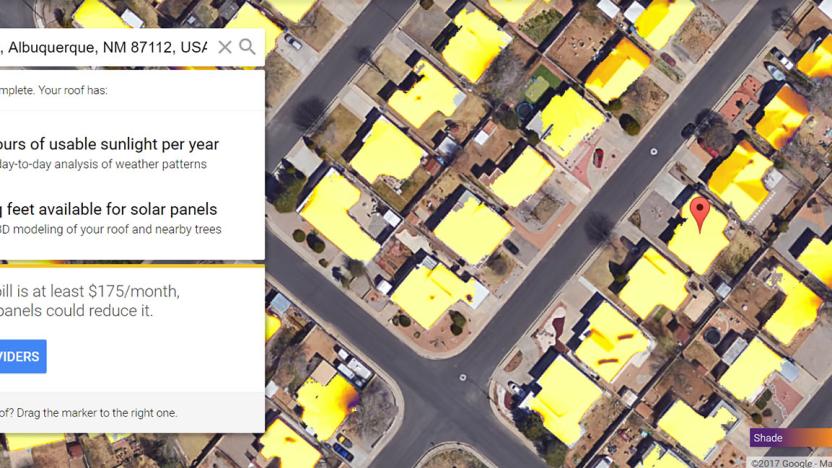
Google: 4 out of 5 US homes have solar power potential
A five kilowatt rooftop solar installation now costs just $12,500 on average after tax credits, and pretty soon, installing one might soon be a matter of re-tiling your roof. Whether it's right for you, however, depends in large part on how much sun your house gets. That's where Google's Project Sunroof comes in -- launched just two years ago, it has now surveyed over 60 million US buildings in 50 states. That means there's a good chance you can see the electricity production potential in your city, neighborhood and even specific house.

23andMe health study needs 5,000 Nevada volunteers
A year after the FDA loosened limitations on what genetic analytics company 23andMe could offer consumers, the company is embarking on a groundbreaking study of 5,000 people across Nevada. In partnership with the not-for-profit healthcare provider Renown Health and the Desert Research Institute (DRI), the survey will combine health, population, genetic and environmental data for a comprehensive look at the various influences nature and nurture have on people's wellness.

Engadget UK asks: Is fitness tech improving your life?
August is almost upon us, and that means we don't have very long before the lighting of the Olympic flame in Rio, Brazil. Team GB has its work cut out: it's expected to bring home between 47 and 79 medals this summer, up from a forecast of between 40 to 70 at the 2012 London Games. While Mo Farah and co. attempt to meet those targets, we want to learn more about what motivates you to get active. Do you use fitness apps? Have you bought a wearable? Is Pokémon Go helping get you off the sofa and out onto the streets? Are these things improving your life for the better? We'd love to hear your thoughts. Answer these simple questions for the chance to WIN a £50 Amazon voucher. Entry closes at midnight on August 2nd.

CDC: Nearly half of American homes no longer have landlines
The Centers for Disease Control and Prevention (CDC) released a new survey Tuesday, showing that nearly half of all American households now use only cell phones rather than older landlines. In total, 47 percent of the 21,000 households queried were cell-only, 41 percent use both, just 8 percent use just a landline, and 3.4 percent have no phone at all. Accounting for demographics, the results are even more staggering -- 71 percent of 24-34 year-olds use only their cells. Additionally, renters were far more likely to not have landlines than landlords and people living with non-family members went cell-only 85 percent of the time.

Chill optional: 51 percent of US internet users watch Netflix
Netflix's robust content library has helped it top nearly 70 million subscribers worldwide. Not surprisingly, the majority of those come from the US, where the streaming service has over 43 million customers alone. And, for the most part, people here seem to be fond of it. According to a survey conducted by research firm RBC Capital Markets, and first reported by Quartz, more than half of US internet users say they've used Netflix to watch a movie or TV show in the past 12 months. The study also asked people about what other video offerings they use regularly: YouTube came in a close second, right behind Netflix, followed by Amazon Instant Video, Hulu and HBO Go, respectively.


