X-ray
Latest

Facebook and NYU trained an AI to estimate COVID outcomes
Complicating the public health response is the fact that we still know so little about how the virus operates -- such as why some patients remain asymptomatic while it ravages others. When the outbreak first reached New York City, “we started trying to figure out what to do, how we could actually help manage the patients,” Moore continued.

Nanox shows off its Star Trek-inspired 'biobed' to the world
The company says it's developed a superior digital cold cathode which, if true, could make x-rays more efficient.

Amazon adds X-Ray features to its music service
The company announced today the Music X-Ray experience is now available for tens of millions of songs in its catalog.

OnePlus will disable a filter that lets the 8 Pro see through some materials
It worked pretty well in showing what’s inside an Apple TV, but it couldn’t show what’s inside most phones, laptops and mice.

Amazon Prime Video will stream 21 Yankees games in four states
Amazon Prime Video is continuing its push into sports by announcing that it will stream 21 New York Yankees games during the 2020 Major League Baseball (MLB) season. There's a large caveat, however, as the games will only be available in four states making up the team's main fan base: New York, Connecticut, northeast Pennsylvania and north and central New Jersey.

Star Trek-inspired medical bed could make X-rays more affordable
X-ray scans are unavailable for most people on Earth (two thirds of them, according to 2012 WHO data), in part due to the sheer cost of the machines themselves. The superheated filament in conventional X-ray machines requires so much energy and heat that it costs millions of dollars just to keep the patient safe. Nanox might just have a way to make these scans widely available, though. It's introducing the Nanox.Arc, an X-ray machine that looks like a Star Trek biobed and promises to lower the cost to low five-digit figures.
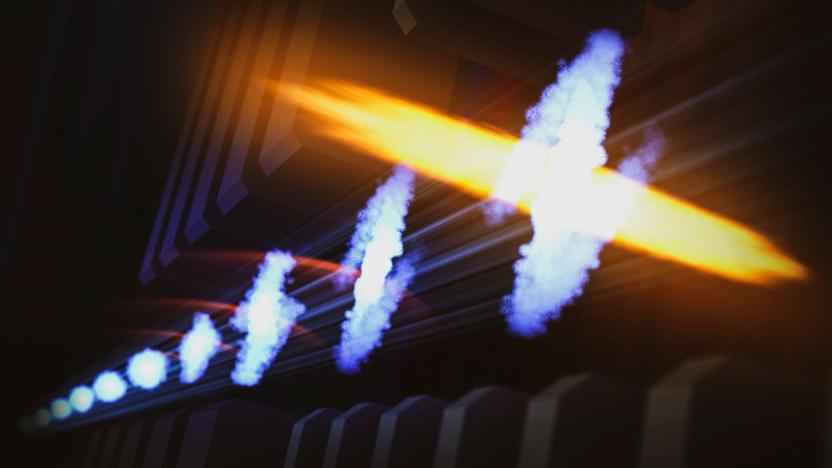
X-ray lasers can spot elusive electron motion
Scientists can track the movements of an atom's nucleus relatively easily, but electrons have proven elusive -- they move so fast that they tend to be reduced to blurs. Now, however, those movements could be crystal clear. Researchers at the SLAC National Accelerator Lab have developed a technique, X-ray laser-enhanced attosecond pulse generation (XLEAP), that can observe even the fastest motions of electrons. The laser pulses at just 280 attoseconds, or billionths of a billionth of a second, and can create snapshots of electrons to track their progress. The trick was to modify the laser in a way that squeezed electrons into tighter groups, making for shorter X-ray bursts.
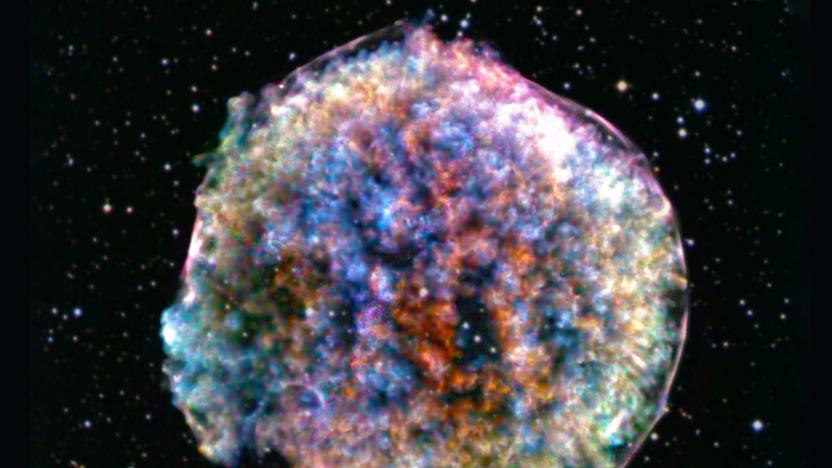
A star died violently and left behind this 'fluffy' ball
Stars die all the time, but the untimely passing of SN 1572, also known as Tycho's Supernova, is possibly the most famous. That's because it's relatively close to us in the Milky Way's Cassiopeia constellation, so when it exploded in the year 1572, it became the second-brightest object in the night sky for a time. It caught the eye of many astronomers of the day, but was named for Danish astronomer Tycho Brahe, who made the most accurate observations.

Russia launches X-ray telescope to find 'millions' of black holes
Russia is back in the business of space observation after losing control of a radio telescope a the start of 2019. The country has successfully launched Spektr-RG, an X-ray telescope co-developed with Germany's help. The vessel will take 100 days to reach its final destination of Lagrange Point 2, where it can conduct studies in stable conditions a million miles from Earth. When it gets there, though, it could significantly reshape human understanding of the universe.
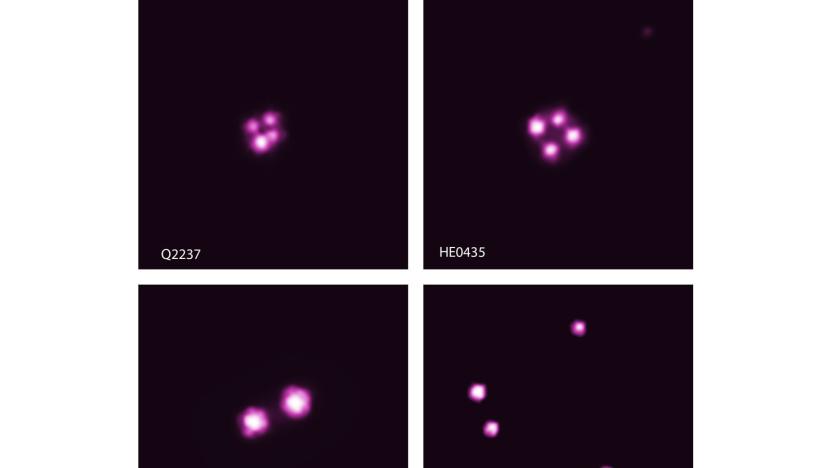
X-rays help astronomers detect spinning black holes
It can be tricky to measure the spin of a black hole, particularly when it's hard to see them, but astronomers have pulled off just such a feat. They've gauged the spins of five supermassive black holes through a combination of data from the Chandra X-ray Observatory and gravitational lensing, or the use of gravity from celestial bodies to magnify very distant objects.

Researchers identify red coloring in an ancient fossil for the first time
For the first time ever, researchers have detected chemical traces of red pigment in an ancient fossil. The discovery, which was published today in Nature Communications, was made using advanced X-ray imaging techniques applied to an exceptionally well-preserved fossil of a 3-million-year-old extinct species of field mouse. It presents a potential breakthrough that could help scientists better reconstruct animals that have long ceased to roam the earth and improve our understanding of evolution.

Amazon Prime Video's X-Ray feature finally comes to Apple TV
Believe it or not, Amazon Prime Video's X-Ray feature hasn't been available on Apple TV. While it hasn't been a huge inconvenience, it's a conspicuous omission when it has long been available on Amazon gear, consoles and other devices. At last, there's some parity -- Amazon has quietly introduced the feature to Apple's set top box. Pause a video or swipe up and you'll get the IMDb-powered info for any show that supports X-Ray. You can identify a familiar-looking actor, learn about the music or discover trivia about a scene.
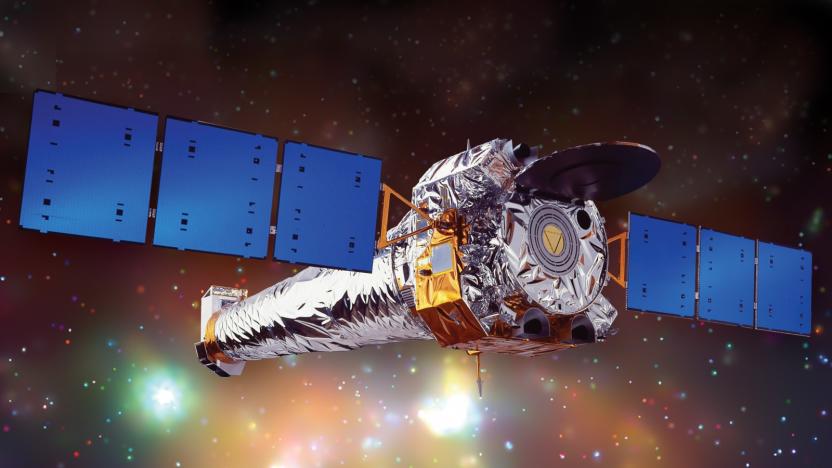
NASA's Chandra telescope follows Hubble into a shutdown
NASA sure hasn't been having a great time with its telescopes. The Chandra X-ray Observatory has gone into safe mode and halted all its science operations a few days after Hubble shut down due a gyroscope failure. According to the agency, Chandra's transition into safe mode was possibly triggered by an issue that also has something to do with its gyroscope, the component in charge of pointing and stabilizing the telescope.

World's quickest laser pulse can track electrons in slow motion
The race to produce ever-faster laser pulses has set a new record, and it could lead to breakthroughs in our understanding of atom-level physics. A team at ETH Zurich has shortened an X-ray pulse to just 43 attoseconds (10-18 seconds), which is quick enough that you can observe electrons moving in slow motion. That, in turn, makes it realistic to study extremely fast processes, such as the formation of chemical bonds or the creation of electricity in solar cells.
For a dollar, an AI will examine your medical scan
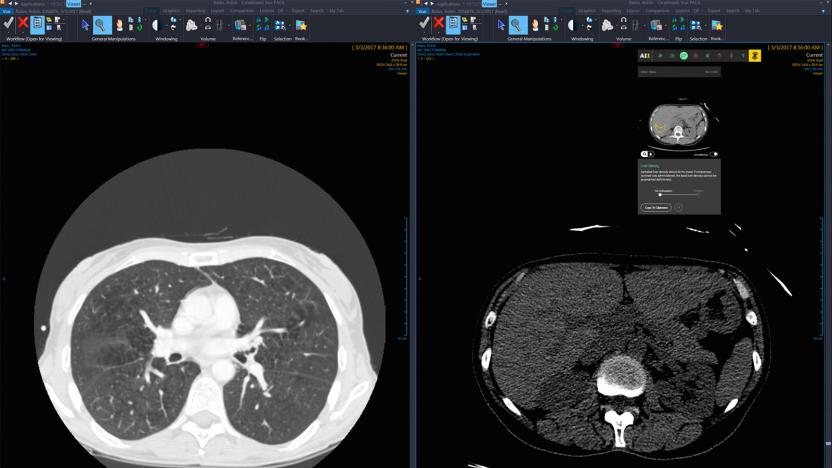
A company called Zebra Medical Vision (Zebra-Med) has unveiled a new service called Zebra AI1 that uses algorithms to examine your medical scans for a dollar each. The deep learning engine can examine CT, MRI and other scans and automatically detect lung, liver, heart and bone diseases. New capabilities like lung and breast cancer, brain trauma, hypertension and others are "constantly being released," the company says. The results are then passed on to radiologists, saving them time in making a diagnosis or requesting further tests.
Museums use CT scans to take the mystery out of mummies
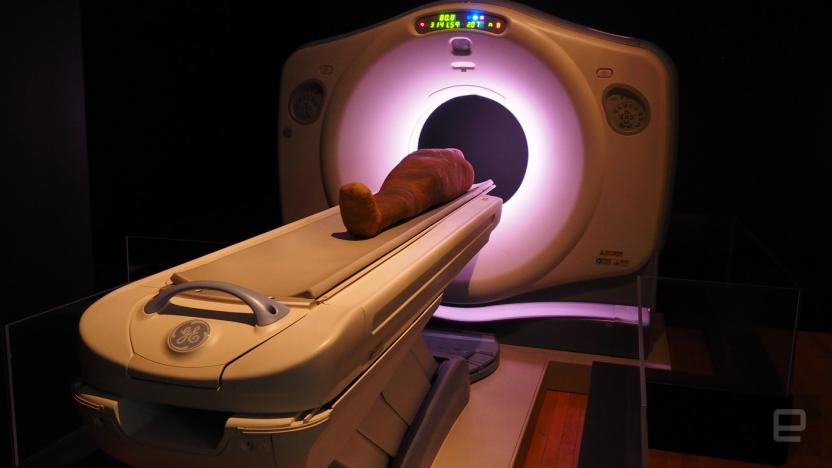
Most of us have a rather cinematic view of mummies: a bandaged body rising out of a sarcophagus, stumbling toward whoever just disturbed their slumber. Of course, this could never happen and not just for supernatural reasons. Mummies are wrapped up pretty tight and are just too old and fragile to do anything. In fact, they're often too delicate for scientists to even study them, meaning many human remains have sat in storage for more than a century. However, an exhibit making its way to New York's American History of Natural History today not only takes them out of the warehouse, but also tells us more about the people wrapped inside, thanks to some help from modern technology.

Supermassive black hole set a record for longest lunch ever
When a black hole eats a nearby star, the resulting X-rays typically fade within a year or so. That's why astronomers are excited about a giant black hole that's been shedding telltale radiation for close to 10 years.
Scientists discover a cosmic-scale particle accelerator
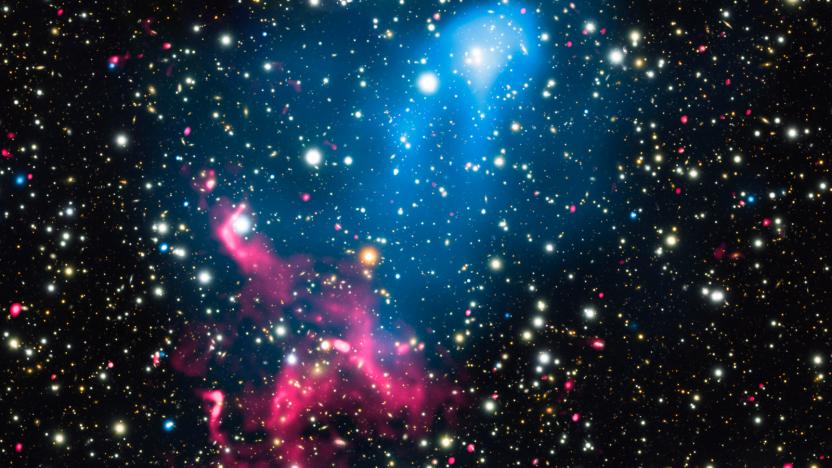
Suddenly, even the Large Hadron Collider seems downright quaint. Researchers have found a combination of cosmic phenomena that's creating the universe's largest known particle accelerator. At least one supermassive black hole in a galaxy cluster has created a electromagnetic tunnel that's accelerating gas to high speeds, only for the gas to travel even faster as it interacts with shock waves from another cluster colliding with the first. The result is particles traveling at a significant portion of the speed of light -- no mean feat for anything that isn't, well, light.
Deepest X-ray image to date uncovers a black hole bonanza
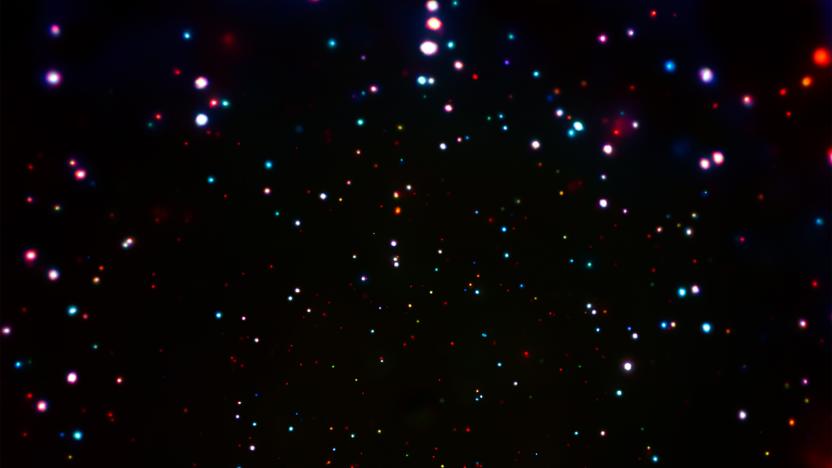
Believe it or not, that's not a star field you're looking at. Researchers have used NASA's Chandra X-ray Observatory to produce an X-ray image of space (the deepest-ever X-ray, in fact) that has uncovered an abundance of supermassive black holes -- they represent 70 percent of the objects in the picture above. Many of these holes would normally be undetectable, especially distant ones from the early universe, and it took 11.5 weeks of total observation time to spot them all. Think of it as a very, very long exposure photo, just for X-ray emissions.

X-ray laser spots photosynthesis in real-life conditions
Humanity has known about the life-giving photosynthesis process for a long time, but studying it in real-world conditions has often been impractical. You've typically had to freeze samples to get a good look, which isn't exactly natural. However, the SLAC National Accelerator Laboratory just managed a breakthrough: it used its x-ray laser to capture detailed snapshots of photosynthesis at room temperature. The trick was to place protein complex samples in a solution, put that on a conveyor belt, light it up with a green laser (to start the water-splitting reaction) and capture images using x-ray pulses. As those pulses are extremely fast -- just 40 femtoseconds long -- you can collect crystallization and spectroscopy data before the sample meets its untimely end.


