Skip to Content

AOL Tech

mac posts

Orb for Mac finally arrives, streams media from OS X to any internet-connected device

Wow, where've you been, Orb? It's been a full year since we heard anything from the once-adored media streaming outfit, and while it's been streaming out content to iPhones for quite some time, those relying on Macs to do it have been left in the damp night air. Until now, that is. Orb for Macintosh has finally hit the streets, bringing with it OS X 10.5 and 10.6 compatibility that enables any and all media from iTunes to be sent out over the internet and consumed on any outside device with access to the web. We're talking laptops, UMPCs, smartphones and even that ancient PC your grandmother still uses with Windows ME. There's no mention of any DRM restrictions, and it'll even allow you to stream live TV if you can manage to connect a tuner card to your Apple. Oh, and did we mention that Orb is completely free? Hit the download link below to get your weekend started off right.

Read - Download Orb
Read - Press release

Apple killing Atom support, dreams of netbook hackintoshers in next Snow Leopard release?

Apple killing Atom support, dreams of netbook hackintoshers in next Snow Leopard release?Nobody said running a netbook hackintosh would be easy -- but nobody said they'd make it this hard. Apple is currently engaged in a war of compatibility with Palm and, if the developer build of Snow Leopard version 10.6.2 is any indication, the Atom processor is next on the smack down list. Word on coder street is that the upcoming revision of OS X will kill support for Intel's little powerhouse. That could certainly change before it hits the world at large, but we wouldn't bet on it. So, if you're viewing this on an netbook install of your own devising, you may be stuck at version 10.6.1 (or earlier) for awhile -- or you may need to do a little custom kernel building. Either way, we're thinking that if Apple ever gets around to making a netbook it probably won't be an Atom-powered one.

[Via OS X Daily]

Media Manager for Mac enables iPhone / iTunes media streaming to FiOS TV DVR (video)

We're hearing that the PC version of this here software still beats out the Mac counterpart, but equality is slowly but surely becoming a reality. The main new feature over on the OS X side, however, is a good one: the ability to stream iPhone and iTunes media directly to your TV via your FiOS TV DVR. Fire up an iTunes playlist and watch the fun roll by on your home TV, and there's even support for photo slideshows and the like. It's available to download right now from the read link, and those still skeptical can catch a demonstration vid just past the break.

[Via Zatz Not Funny]

iTunes goes 9.0.2: adds support for Apple TV 3.0, kills Pre sync

First comes the Apple TV 3.0 update, and next comes the iTunes update to make the two play nice. It's a beautiful thing, we tell ya. As of right now, iTunes 9.0.2 is available via Software Update, and with that comes compatibility with Apple TV 3.0, an "improved look and feel," and an easier-to-explore iTunes Store. Hop on past the break for the full changelog, and feel free to get your download on now if you're still not scared of blindly installing software from Cupertino.

Update: Looks like it killed Pre sync -- now, act like you're surprised!

PhotoTrackr Mini geotagging device shrinks down, adds Mac and RAW support

Looking for a geotagging solution that doesn't discriminate based on what kind of camera you have? Looking for one that can fit snugly into your Fifth Pocket? The PhotoTrackr Mini looks to be that very device, boasting a diminutive thumb drive-esque appearance and the same geotagging technology as found in the original. Put simply, the device works by syncing the time of your camera with bundled software; when you're back from a shoot (a shoot where your device also was), you just allow the application to figure out where a given shot was snapped at what time. There's also Mac and RAW file format support on this model, neither of which were compatible with the prior version. Pre-orders are being accepted now at $69, and the first shipments are expected to go out next month.

Amazon spokesperson affirms that Kindle app for Mac is being 'worked on'

Don't pretend you didn't see this one coming -- just days after Amazon confirmed that a Kindle application was indeed coming soonish for the PC, a company spokesperson has now stated that a Mac version is also in the works. With the explosion of e-reader competition, it's no shock to see Amazon branching out in an effort to spread the Kindle name (and business model) to more areas. To quote the aforesaid spokesperson: "Yes, we are working on a Kindle app for Mac." Unfortunately, no further details were provided, but you can bet that Bezos wants this one out as soon as humanly possible.

[Via TUAW]

ZFS open source project abruptly shuts down, Snow Leopard weeps icy tears

The on-again / off-again love affair between Apple and ZFS seems to be all but over, with a brief but potent message on the Mac OS Forge project site stating the following: "The ZFS project has been discontinued. The mailing list and repository will also be removed shortly." If you'll recall, the implementation of the ZFS file system within Snow Leopard server was so close to happening that Apple actually published it as a feature of the forthcoming OS back in June of 2008. Now, however, all hope has presumably been lost. We'd bother explaining the rumors behind why all of this has suddenly crumbled, but honestly, will knowing the reasons really help the pain? No, no it won't.

[Via TUAW]

Psystar releases Rebel EFI installer, further enrages Apple

When not flying the Hackintosh banner, filing lawsuits, or generally positioning themselves as the gadfly on the ass of Apple, the kids at Psystar have been hard at work developing the software meant to free us all from the iron grip of Cupertino-approved hardware. And now, a mere two weeks since the company announced that it will be licensing its Darwin Universal Boot Loader to third parties, we submit for your approval a little something called Rebel EFI. Available to you -- the consumer -- right this very moment, the app will function as a universal installer for any modern OS -- provided your machine sports an Intel Core 2 Duo, Core 2 Quad, i7 or Xeon Nehalem processor. And of course, "any modern OS" includes Snow Leopard. What are you waiting for? Download the trial version for free (limited functionality, runtime of two hours) or download the full deal for the introductory price of $50 (full retail is $90).

[Via iHackintosh]

Apple updates $19 Remote, predictably coats it in aluminum

Apple's Remote -- which it stopped throwing in with its MacBook Pro machines awhile back -- has also seen a refresh today, ditching the iconic glossy white vibe now associated with the company's lower-end consumer machines and instead donning an all-aluminum coat to match the Mac Pro, MacBook and MacBook Pro range. As always, it's designed to control your iPod, iPhone or Mac from afar, with play / pause, menu, volume and track skip buttons at the ready. If you're looking to use it with your iPod or iPhone, you'll need an iPod Universal Dock ($49) and a device with a dock connector; if you're using it with your Mac, you'll need a compatible machine introduced in 2005 or later with an integrated IR receiver. It'll ship in two to four weeks for $19.

MacBook goes unibody, available today

Like a bat out of hell, Apple has just shuttled a new, unibody MacBook in the gadget world's direction. The new model -- which looks like an arctic, glossy version of the familiar 13-inch MacBook Pro line -- will be landing in stores today (yes, today), with a familiar price tag: $999. In terms of changes, besides the new, high-test plastic casing (built in the same fashion as the aluminum MacBook Pros) the 13-incher boasts a LED-backlit display, new glass multitouch trackpad, and a built-in, "7 hour" battery. Inside the single SKU will be a 2.26GHz Core 2 Duo, 2GB of RAM (upgradable to 4GB), an NVIDIA 9400M GPU, 250GB hard drive and the old standby SuperDrive. We had a chance to play around with the laptop, and it's pretty snazzy for a hunk of plastic. The surface is super slick (AKA super fingerprint friendly), though the base of the laptop utilizes a soft-touch, non-slip surface that's nice to handle. The display certainly is brighter and better looking than the previous model, though the one on the desk we saw was slightly dimmer than we would prefer -- in its defense it was sitting right next to a super bright iMac. As stated, the new model can be picked up right this very second at stores around the globe, and we'll have a much closer look very soon -- so stay tuned! A full spec breakdown is after the break.

Update: Check out our hands-on!

iMac line updated with 16:9 displays, quad-core Core i5 / i7 model

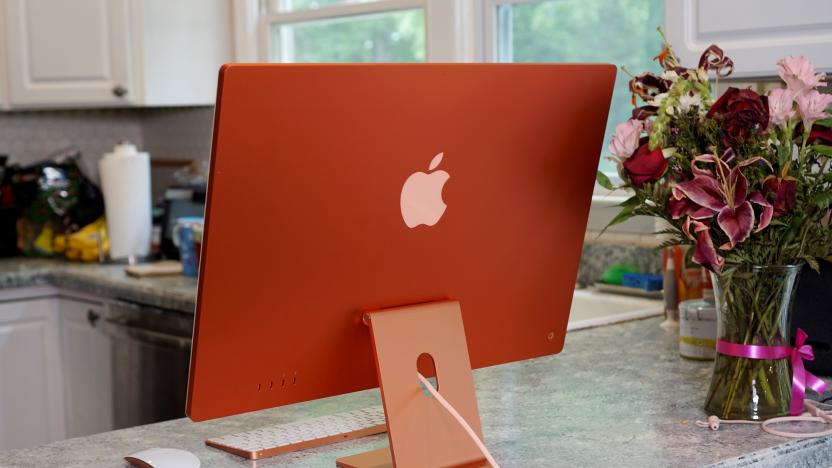
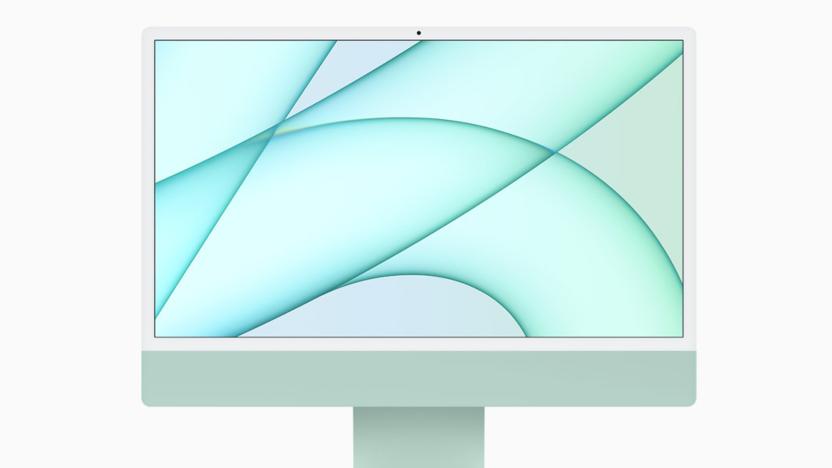
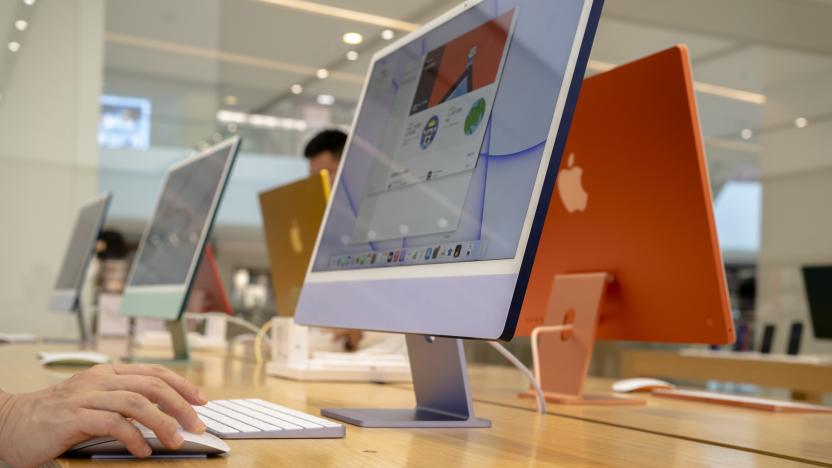
After months of speculation, Apple has unveiled some completely new iMacs, featuring 21.5-inch and 27-inch 16:9 displays and all-aluminum enclosures. The new widescreen IPS panels are LED-backlit and have 178-degree viewing angles -- the 21.5-inch iMac has a 1,920 x 1,080 resolution, while the 27-incher comes in at a staggering 2,560 x 1,440. Ports are the same as the outgoing model with the addition of an SD card slot and video-in on the 27-inch (via a special cable), and the wireless keyboard is now standard (as is the all-new Magic Mouse). Pricing tiers haven't changed much: there's a low-end $1,199 21.5-inch model with a 3.06GHz Core 2 Duo, NVIDIA GeForce 9400M graphics, 4GB of RAM and a 500GB drive, a $1,499 model that bumps things up to 1TB of storage and ATI Radeon HD 4670 graphics, while the base 27-inch config starts at $1,699 with the same bumped specs. All of those can be custom-configured with up to a 3.33GHz Core 2 Duo, but it's the top-end $1,999 27-inch model that'll bring the real heat when it ships in November; it's packing a 2.66GHz quad-core Core i5 processor (with a 2.8GHz Core i7 available for $200 more) and Radeon HD 4850 graphics. Not a bad little refresh -- but it looks like all you Blu-ray fans are going home alone again. Check the full specs list after the break.

Apple gives Mac mini a spec bump, adds dual-HDD Mac mini server

Apple's high-noon extravaganza is touching just about every aspect of the company's consumer lineup today, and considering just how long it's been (okay, so maybe not that long) since the Mac mini saw any love, we're thrilled that it's amongst the crowd seeing updates today. The new $599 Mac mini configuration gets fitted with a 2.26GHz Core 2 Duo CPU (up from 2GHz), 2GB of RAM (up from 1GB) and a 160GB hard drive (up from 120GB). The $799 build features a 2.53GHz Core 2 Duo, 4GB of memory (up from 2GB) and a 320GB hard drive (same as before), and both machines sport the same GeForce 9400M GPU and 8x SuperDrive as they did in March. The most intriguing news on the mini front, however, has nothing to do with the standard rigs.

Apple is today introducing an all new machine in the Mac mini server, a system that's formed in the exact same enclosure as the standard mini but without an optical drive of any kind. Instead, there's room for an additional hard drive, and the $999 model ships with two 500GB HDDs. It also includes Snow Leopard Server (unlimited clients), a 2.53GHz Core 2 Duo processor, 4GB of RAM, a GeForce 9400M GPU and the same port assortment (meaning no mini-DisplayPort) as found on the other guys. It's hard to say just how well something like this will do, but we're guessing Apple doesn't much mind if it remains a niche product. Catch Apple's official blurb after the break.

Apple reports fiscal Q4 earnings: $1.67b profit, Mac sales way up, iPod sales down, 'great new products' for 2010

Apple's fiscal Q4 2009 conference call is just about to begin, but the press release is already out and about. Wondering how Jobs and Company did? Precisely like you thought they would: they're making out like gangbusters over there. While the rest of the world slowly sees profits inching back up, Apple's relishing in $1.67 billion worth of net profit it pulled in from $9.87 billion in revenue. A year ago, the outfit managed to post a quarterly profit of "just" $1.14 billion, and we're also told that gross margin was up 36.6 percent. It should be noted that international sales accounted for a whopping 46 percent of this quarter's revenue, and Mac computer sales managed to shoot up some 17 percent compared to the year-ago quarter. In keeping with Apple's own acknowledgment that the standalone iPod is dying, sales of the iconic media player dipped 8 percent year-over-year (10.2 million units were sold), while 7.4 million iPhones were moved representing a 7 percent uptick from this period a year ago.

Stevie J himself is quoted as saying that Apple is "thrilled to have sold more Macs and iPhones than in any previous quarter," and in case you haven't noticed, the holiday quarter hasn't even been completed yet. Oh, and if you were looking for bread crumbs as for what's on deck, chew on this: "We've got a very strong lineup for the holiday season and some really great new products in the pipeline for 2010." Great new products, you say? Would one of them happen to include some sort of, say, tablet PC?

Catch our updates after the break...

NPD: Mac owners are bigger gadget nerds than PC owners


There's no easy way to say this so we'll just spit it out: Mac owners are bigger gadget nerds than PC owners. At least that's the conclusion drawn in NPD's 2009 Household Penetration Study. NPD concludes that Mac owners not only own more computers than the norm, they also own more types of consumer electronics -- the average Apple household owns 48 consumer electronics devices compared to 24 in the average computer household. In fact, NPD suggests that "Apple household owners' actions and purchases can be used by the industry as leading indicators for hot new products and adoption." Unfortunately, there's no direct mention of Linux PC owners because they usually still live with their parents. Oh!

Kanex Mini DisplayPort Adapter will take your Mac mini to HDMI town

Kanex Mini DisplayPort Adapter will bring your Mac Mini to HDMI town
Your Mac mini cranks out its video via DisplayPort and audio via a mini Toslink. Chances are your home entertainment system doesn't like either of those. It will, however, like the Kanex Mini DisplayPort Adapter, which can turn a DisplayPort video signal into a 1080p signal over HDMI, and will even integrate either digital or analog audio into the mix. It's USB powered, so there's no need for a clunky power adapter, and while $70 isn't particularly cheap for a chubby cable ($50 for the USB analog audio model), it's about the cleanest way to get your Mini pumping tunes and vids through your system.

[Via The Unofficial Apple Weblog]
Zune HD ExposedHTC Hero: Android Evolved
Follow us on TwitterEngadget Video


AOL News

Joystiq

Download Squad

TUAW

Daily Finance

Asylum

Autoblog

Switched.com

FanHouse

Autoblog Green