Skip to Content

Autoblog reviews all the hottest cars
AOL Tech

nissan posts

Tesla, Ford, Nissan all receive electric car development loans from US government


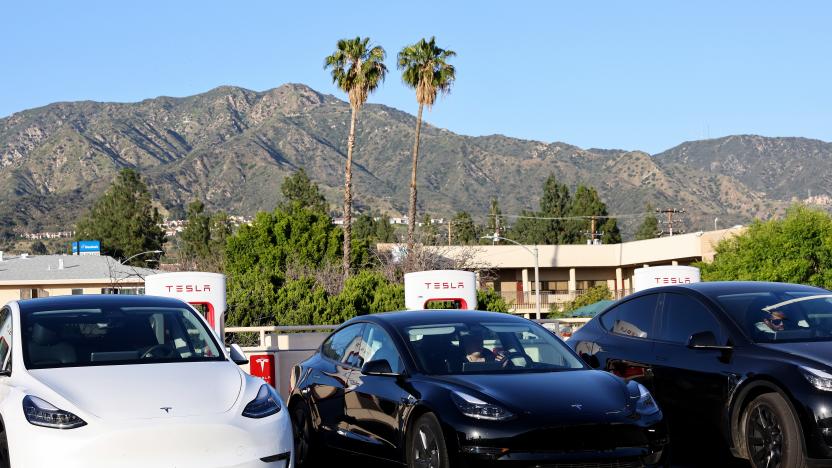
High five, Tesla fans -- everyone's favorite incredibly controversial electric car company has just been granted $465m in loans from the Department of Energy's Advanced Technology Vehicle Manufacturing program. The bulk of the money will go towards that postponed Model S factory, while the remaining $100m will be used to fund an electric powertrain manufacturing facility that will sell parts like motors and battery packs to other carmakers. Tesla wasn't the DOE's only big winner: Nissan received $1.6b (billion!) to build batteries and EVs in Tennessee and Ford received an undisclosed amount to build two upcoming electric cars, but since those companies have largely drama-free upper management that isn't constantly involved in lawsuits, it feels a little more routine. Still, it's an exciting time -- let's hope all these tax dollars turn into affordable, convenient electric transportation sooner rather than later.

Update: A "congressional source" has told the AP that Ford's getting $5.9 billion, so yeah, the Oval's still the big dog.

Read - Tesla
Read - Ford
Read - Nissan

Seattle is latest lucky winner of an electric car partnership with Nissan

Seattle is latest lucky winner of an electric car partnership with Nissan
Nissan's EVs are coming, but if people are really going to buy them in droves they're going to need somewhere other than the rusty outlets in their garages to charge them. So, the company has been working like mad forming partnerships with municipalities around the world, from California to China, to get city-wide charging stations installed. The latest is Seattle, a place that gets much of its power through renewable means (hydro dams), thus making the boxy little car even greener. Only two questions remain: will they use a standardized plug that all manufacturers can share, and what will they call all those recharging hotspots? We vote for spark hydrant.

Nissan turns to technology to keep folks from driving the wrong way


As is becoming increasingly clear, Nissan seems to be intent on having cars do everything short of drive themselves, and it's now taking yet another step in that direction with a proposed system that would prevent drivers from going the wrong way. While it's all still in the planning stages at the moment, the system would apparently make use of a cellular-connected GPS unit that would not only be able to be able to warn the driver if they're headed into the wrong lane, but alert them if they should be slowing down on a downhill stretch, or if they're approaching an area prone to congestion. There's not much else in the way of details just yet, unfortunately, but Nissan has apparently enlisted the help of the West Nippon Expressway Co. (or West NEXCO), and it's promising to demo the system for the press as soon as they have something ready.

Battery wars: automakers seek profits in supplying EV parts


We already knew that Daimler was looking in Tesla's direction for electric vehicle batteries, but we certainly didn't know that those passing glances were only the beginning of an underground battle for supply chain supremacy. As automakers struggle to move cars from lots, it's being reported that some -- Toyota, Tesla, Daimler and Nissan, in particular -- are looking to parts fulfillment for profit. Toyota already has an edge on its rivals by being one of the only companies to actually produce its own batteries, and if demand begins to outstrip supply, other car makers could come running in hopes of stocking up. Of course, you've also got Nissan ramping up production in order to equip some 200,000 electric / hybrid vehicles annually over the next few years, so who knows if all this scheming will eventually backfire. Though, if one firm can somehow figure out how to make their battery stronger, more potent, lighter and cheaper -- well, we needn't tell you how that would play out.

[Image courtesy of AutoBeYours]

Nissan readies pilot for road-cam / slip-hazard alert services


Way back in 2005, we got wind of a Bluetooth-based telematics systems for cars dubbed Carwings. Now, Nissan is gearing up to launch two safety pilots which will rely on -- you guessed it -- Carwings HDD navigation systems. First up is the slip-hazard alert, which marries data from the ITS (Intelligent Transport System) and ABS (Anti-lock Braking System) in order to warn drivers of slippery road conditions. In addition to that, the recently concocted road-cam service can "enhance the effectiveness of the alert service by offering drivers a visual image" of surroundings. The company will make the slip-hazard alert and the new road-cam service available to all Carwings customers (in Japan) beginning next month, with the latter hitting first (in November) and the former second (in December). Oh, and did we mention the upgrades will be completely gratis? Because they will be.

[Via Wired]

Nissan's Nuvu: electric, cartoonish


Nissan's Nuvu is making its debut this week at the Paris motor show, and while it isn't the all-electric vehicle that the company has promised for 2010, it's a step in the right direction. Resembling something from a Pixar movie, the Nuvu has that special mix of "vaguely futuristic" and "somewhat impractical" that we look for in a concept car: it's less than ten feet long, seats three (un)comfortably and the space behind the driver is claimed by what looks like an end table with a conduit extending to the ceiling. Many of the cabin materials are either recycled or made from organic materials and since the vehicle is electric, it should be whisper quiet -- offering maximum clarity for your Medeski, Martin and Wood CDs. More photos at the read link.

Nissan shows off bumblebee-inspired, crash-avoiding robot "car"


Nissan's already hard at work on some crash-avoidance systems for regular, human-driven cars, but it looks like it's not stopping there, with it now also showing off its BR23C robotic "car," which apparently takes its inspiration from the humble bumblebee. That comes in the form of the BR23C's laser range finder (or LRF), which acts like a bee's compound eye to detect obstacles up to two meters away within a 180-degree radius. When combined with the slightly mysterious crash avoidance system, that apparently lets the car react "instinctively" the split second it detects an obstacle and maneuver accordingly. Of course, as you can see above, Nissan doesn't seem to be quite ready to test the system with any human passengers just yet, but the company has some big plans for the future, with it aiming to cut its rate of car crashes in half by 2015 compared to its stats from 1995.

[Via Autoblog]

Sharp's cellphone prototype unlocks, starts your Nissan


In Japan, the hand can be used like a knife. Now, in another Japanese world's first (according to Nissan), you can use your mobile phone to open and start your car thanks to a new twist-up of Nissan Motors, NTT DoCoMo, and Sharp. The Sharp prototype cellphone pictured above integrates with Nissan's Intelligent Key system already fitted in various Nissan vehicles. Look for the device to be demonstrated on September 30th with the opening of the CEATEC Japan show. Hiiiiya!

[Thanks, Stop Spamming]

Nissan shows off two more collision avoidance prototypes


Nissan has a knack for pumping out novel safety advancements every few months, and the latest two are in the same vein as a few previous efforts. Two new technologies, Side Collision Prevention and Back-up Collision Prevention, fit into the auto maker's Safety Shield concept to "help protect the vehicle and its occupants from potential risks coming from multiple directions." As for the first, the tech utilizes side-mounted sensors to activate a warning if an approaching vehicle is detected in the drivers intended lane; from there, a yaw mechanism is "activated through brake control of individual wheels to help prevent a potential collision." For the second, an array of sensors detect potential obstacles and triggers an alarm / puts on the brakes if a collision is about to happen. Per usual, there's no mention of when these brilliant ideas will be implemented into production vehicles, but our insurance bills are pleading for "soon."

[Via Gizmag]

Nissan ECO pedal promises to push back against aggressive drivers


While Nissan hasn't quite cut drivers out of the equation all together (yet), it is making some considerable progress in controlling just how they drive, including preventing folks from driving drunk and, now with its new ECO pedal, preventing people from driving inefficiently. To do that, the pedal simply pushes back against the driver's foot when it detects wasteful acceleration, which Nissan says could improve fuel efficiency by as much as five to ten percent. Of course, the system can be switched off, and it likely won't be making an appearance in all Nissan vehicles right off the bat, although the company says it'll be showing up in at least some of them as early as next year.

[Via Autoblog]

ICP Solar to integrate solar chargers into Nissans, dead batteries be gone

Nah, ICP Solar isn't trying to help create the next solar-powered automobile (at least not with this initiative). Instead, it's looking to all but eliminate the hassle of returning to a vehicle with a dead battery. Said outfit has just entered into a sales agreement with both the European and North American branches of Nissan for OEM solar chargers, which would essentially juice up one's main battery while the sun beams down in a grocery store parking lot. Curiously, there's no mention of what vehicles this will be integrated into, so we'll just throw caution to the wind and expect to see 'em on every last motorcar it produces in 2009.

[Via CNET]

Nissan pledges electric car in U.S. by 2010

Nissan pledges electic car in U.S. by 2010
Car companies have been promising fully electric autos for decades, but it seems like we're finally on the cusp of fuel-free, silent running. The Tesla, Zap, and Six50 EVs will all be on the road within the next year or so (we're betting on "so"), and GM's much-anticipated Volt plug-in will come a year after that. Nissan would like to politely remind you that it too plans to have an all-electric auto in U.S. by 2010, all the while lining up charging stations at places like commuter parking lots and train stations. The company recently showed off an all-electric version of its popular (in Japan) Cube at the NY Auto Show, so it's a safe bet that the above is Nissan's vision for the all-electric future of American highways. Shame they couldn't have picked something a little sportier.

[Via Autoblog]

Nissan, Renault and Better Place team for electric cars, charging points in Israel


While there are many rational and irrational reasons for the delays we've seen in production of a mass-market and massively adopted electric car, most of the major issues seem to be addressed by this new initiative going down in Israel. One of the primary problems with electric cars is refilling, and that's going to be nicely addressed by entrepreneur Shai Agassi's Project Better Place, which will build a charging network of 500,000 plug-in points across the country. Other issues were a bit more easily addressed: since Israel is a small country, the limited range of electric cars isn't as much of an issue, and the government subsidies should make prices competitive -- with the eventual cost of ownership significantly less than gas cars to sweeten the deal even further. Nissan and Renault plan to built the cars, naturally, and hope to port the concepts into other vehicles in other countries in the near future. The plan is to launch the first cars in Israel around 2011.

Nissan GT-R disables speed limiter on race tracks via GPS


We know auto enthusiasts are never too stoked when it comes to contending with those pesky government-mandated speed limiters, but a bit of encouraging news on that front incoming from Japan (as usual). The Japanese Nissan GT-R, street limited to a pedestrian 111mph, can apparently use its built-in GPS unit to detect Japanese race circuits and disable its speed limiter accordingly. Next up: hacked-in geo-feeds of speed limit free roads 'round the world for GT-R owners to patch into their cars?

Nissan's GPS-enabled cruise control foreshadows robot cars


Nissan has really upped the ante when it comes to driver-assisting luxury amenities. While everybody else is busy with souped-up cruise control based on radars (those old things), Nissan has tapped into onboard GPS to allow the car slow down for upcoming turns, and then resume a cruising speed once the turn is done. It's called Intelligent Cruise Control, and will most likely be seen as a happy upgrade to some drivers and a curse upon the road to others. We just want a fully-automated car, so do what it takes, Nissan.


AOL News

Joystiq

Download Squad

TUAW

BloggingStocks

Asylum

Autoblog

Switched.com

FanHouse

Autoblog Green