self-assembling
Latest
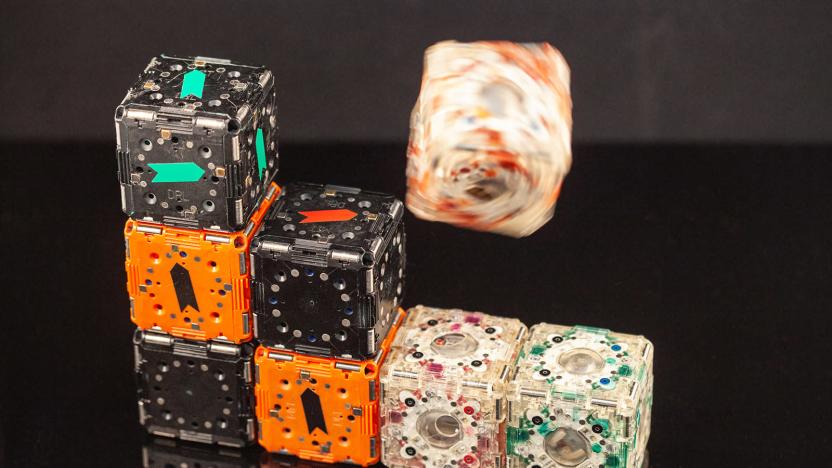
Block-like robots could assemble into emergency staircases
Next to Boston Dynamics' leaping humanoids, the dice-like M-Block robots from MIT might not look very cool. Considering their lack of limbs, though, the latest versions can perform some impressive tricks like jumping, climbing and assembling into larger structures, Big Hero 6 style. Those skills could one day help them assemble themselves into a staircase to rescue survivors trapped in a building, or be used as real-world Minecraft blocks.

Researchers force 3D-printed robots to adapt to their environment
Robots will need to pave the way to Mars before we humans go, but what if they fall apart? Researchers from the University of Oslo have designed bots that can adapt to unforeseen problems and even 3D-print new parts for themselves. For instance, the crawler shown above actually used to have four legs, but it figured out how to propel itself on three when one limb snapped off. Another class of robot would be completely self-designed and self-healing -- the scientists just need to tell it "what we would like it to do, how fast it should walk, its size and energy consumption." An autonomous computer could then consider thousands of options, and 3D-print parts to create a new model.

MIT builds modular robots that self-assemble, dooms humanity (video)
Modular robots have long been a reality, but they often require human intervention to assemble or aren't very clever. MIT's new M-Block robots don't need such help. Each cube-shaped machine includes a flywheel and edge magnets, the combination of which lets it attach to its fellow robots simply by spinning into place; the devices can climb over each other and even jump into position. It's a wonderfully simple solution, although we're a bit frightened by MIT's long-term plans. Researchers are writing algorithms that would let M-Blocks act in concert, and swarms of robots could eventually have a Terminator 2-like ability to assume any shape needed to solve a given problem. If the Robopocalypse starts with a flood of colorful cubes, we'll know who to blame.

HGST unites nanoimprints, self-assembling molecules to double hard drive space
Hard drive makers are in a race to boost capacities and keep spinning disks at least a beat ahead of flash drives on the value curve. We've seen some exotic developments as a result, but HGST wants to go the extra mile by relying on two breakthroughs at once. Its future storage primarily takes advantage of self-assembling polymer molecules that align themselves into rows. By first splitting the molecules into very small lines and then using an equally rare nanoimprinting technology to put them into circular tracks, HGST can create platters with a 10 nanometer-wide bit pattern that's twice as dense as current hard drives. The technique should hold up in the real world despite ditching typical photolithography, the company says: the nanoimprinting remains useful in the error-prone world of storage, and it should scale as the patterns get smaller. If only the drive designer had a roadmap -- while the company has a tendency to bring its research to market, the lack of a timetable hints that we won't see these nanoimprinted drives very soon.

Self-assembling nanodevices could advance medicine one tiny leap at a time
Seems like Harvard wasn't content with making robotic bees, and has taken its quest for miniaturization right down to the nanoscale level. One nanometer-wide, single-stranded DNA molecules are the topic of the university's latest research, which sets out a way they can be used to create "3D prestressed tensegrity structures." Should these theoretical scribblings ever pan out in the real world, we could see the resulting self-assembled nanodevices facilitating drug delivery targeted directly at the diseased cells, and even the reprogramming of human stem cells. Infusing a nanodevice with the relevant DNA data passes instructions on to your stem cells, which consequently turn into, for example, new bone tissue or neurons to augment your fleshy CPU. Yes, we're kinda freaked out, but what's cooler than being able to say you're going to the doctor for a shot of nanotransformers?

Self-assembling DNA circuits could power your next computer
Sick of silicon? It is getting a bit played, so maybe it's time to shift some paradigms, and Duke University engineer Chris Dwyer thinks that pure proteins deoxyribonucleic acids are where it's at. He's demonstrated a way to force DNA to create shapes all by itself, a process he likens to a puzzle that puts itself together: It's like taking pieces of a puzzle, throwing them in a box and as you shake the box, the pieces gradually find their neighbors to form the puzzle. What we did was to take billions of these puzzle pieces, throwing them together, to form billions of copies of the same puzzle. Right now the waffle-shaped structures he can form aren't particularly useful, but going forward the hope is that nearly any type of circuitry could be made to build itself in massive quantities at next to no cost. It sounds exciting, promising, almost utopian -- exactly the kind of research that we usually never hear of again. Update: We've had a few people commenting on the inaccuracy of the word "proteins" above, so it's been fixed and we hereby invite all you armchair molecular biologists to get back to curing cancer already.

Microprocessor mega-shocker: self-assembling silicon chips could lead to ever smaller circuitry
Researchers have been hard at work for the past few years trying to build computer chips using self-assembling circuitry built of molecules -- meaning that they're incredibly teensy. Some researchers at MIT seem to have gotten the hang of this nano-business, according to a paper just published in Nature Nanotechnology (which also happens to be our favorite magazine after Offset Print Enthusiast). They've made a pretty good leap forward recently, by using electron-beam lithography to make patterns of nano-posts on a silicon chip, which are deposited with special polymers, resulting in a hookup between the polymer and the posts which arrange themselves into useful patterns all on their own. The MIT researchers have found the polymers they're testing capable of producing a wide variety of patterns that are useful in designing circuitry. In the short term, uses could include magnetic nanoscale patterns being stamped onto the surfaces of hard disks using the tech, but there's a lot more researching to be done before the self-assemblers get busy in consumer goods.

Self-assembling solar cells built using ancient wisdom, modern technology
Alright, so self-assembling electronics are hardly new in and of themselves, and nanoscale tech tends to always come with bombastic promises, but you don't wanna miss how this latest innovation is built. Two professors from the University of Minnesota have successfully demonstrated a self-assembly technique that arranges microscopic electronic elements in their proper order thanks to the absolute enmity that exists between water and oil. By coating elements with a hydrophilic layer on one side and some hypdrophobic goo on the other, they've achieved the proper element orientation, and the final step in their work was the insertion of a pre-drilled, pre-soldered sheet, which picks up each element while being slowly drawn out of the liquid non-mixture. The achievement here is in finding the perfect densities of water and oil to make the magic happen, and a working device of 64,000 elements has been shown off -- taking only three minutes to put together. If the method's future proves successful, we'll all be using electronics built on flexible, plastic, metal, or otherwise unconventional substrates sometime soon.

Self-assembling nanoscale discovery could catapult data storage capacity
Ready to have your mind blown? What if 250 DVDs could fit onto a storage module no larger than a quarter? According to research conducted by brilliant geeks at the University of California at Berkeley and the University of Massachusetts Amherst, it's all within the realm of feasibility. Reportedly, an easily implemented technique "in which nanoscale elements precisely assemble themselves over large surfaces" could soon blow open the doors to significant improvements in data storage capacity. Without getting too Ph.D on you, the process essentially works by taking advantage of just how precise molecules can self-assemble. The end result has researchers achieving "defect-free arrays of nanoscopic elements with feature sizes as small as 3 nanometers, translating into densities of 10 terabits per square inch." Per square inch, son.[Via TheStandard, thanks Apoc]

Self-assembling polymer arrays could lead to larger hard drives, boastful Badgers
Most folks up in Madison are readying their face paint and stocking up on tailgating supplies, but the geeks among us (bless 'em!) are focusing their attention on something much more relevant to your future RAID array. A team from UW-Madison (along with partners from Hitachi) is getting set to publish a report that details a patterning technology that could offer performance gains over current methods while reducing time and cost of manufacturing. The process builds on existing approaches by "combining the lithography techniques traditionally used to pattern microelectronics with novel self-assembling materials called block copolymers." So, what does all this technobabble mean for you? Huge gains in density on patterned media, or if that's still not straightforward enough, ginormous HDDs in the near future.[Via Protein OS]

Nanowires developed to retrieve data on the double
Those fond of how quickly flash memory reads and writes their data are sure to adore the research that a few University of Pennsylvania scientists have been working on, as Ritesh Agarwal (pictured) and colleagues have crafted "nanowires capable of storing computer data for 100,000 years and retrieving that data a thousand times faster" than existing micro-drives. Moreover, the "self-assembling nanowire of germanium antimony telluride" consumes less energy and space than current memory technologies, and even Agarwal stated that the "new form of memory has the potential to revolutionize the way we share information, transfer data and even download entertainment." Unfortunately, there seems to be no word on if (or when) this creation could be headed to the commercial realm.

IBM apes Mother Nature for faster, more efficient chips
Someone should seriously tell IBM's research and development team to take a much-deserved vacation, as these folks have been cranking out the goods at an alarming rate of late. Most recently, the company has announced the "world's first application of self assembly used to create a vacuum around nanowires for next-generation microprocessors," which just so happens to mimic the natural pattern-creating process that forms seashells, snowflakes, and enamel on teeth. Essentially, the process forms "trillions of holes to create insulating vacuums around the miles of nano-scale wires packed next to each other inside each computer chip," which should aid electrical current in flowing around 35-percent faster while it eats up about 15-percent less energy. This newfangled approach to insulation, dubbed airgaps, creates vacuums that enable the substantial boost in speed, and the self assembling process is reportedly "already integrated" into IBM's manufacturing line in New York. The chips will initially be used in the firm's server lineup sometime near 2009, and shortly thereafter, we can expect IBM to start cranking these out for other companies that rely on its CPUs.[Via BBC, thanks Josh]

Heat-sensitive paper could lead to 3D printers
When you've already got self-assembling robots and Li-ion batteries, you might as well tackle 3D printouts next, right? Apparently that's the mantra being used by physicists in Israel who have purportedly invented a monomer solution that, when heated over 33 degrees Celsius, would bend and form into the object depicted, theoretically turning a flat, 2D photo into a three-dimensional rendition. Eran Sharon and colleagues from the Hebrew University of Jerusalem applied N-isopropylacrylamide to the surface of a prototype "disc," and "created a range of structures varying in complexity, from slightly wavy crisp-like objects to those that look like a sombrero." Interestingly, a scientist not directly involved with the study commented that the discovery could actually be used to craft printers that could pop out 3D printouts when heat was added, which would surely keep kids occupied (and your ink cartridges bone dry) for weeks on end. As expected, there weren't many details hinting that this novel idea would be headed for the commercial realm anytime soon, but considering all the other 3D paraphernalia already out, we can't imagine this taking too long to follow suit.[Via Slashdot]

MIT gurus concoct Li-ion batteries that build themself
It's fairly reassuring that if those rollable, water-powered, paper, and ultracapacitor-based battery ideas don't exactly pan out, we've got yet another idea coming out of MIT that just might gain traction. Apparently, scientists at the university are working on self-assembling Li-ion cells when not thinking about what witty remark they'll plaster on their own spacecraft, and it seems that Yet-Ming Chiang and his colleagues have selected electrode and electrolyte materials that, when combined, "organize themselves into the structure of a working battery." By measuring various forces with "ultraprecise atomic-force microscope probes," the researchers were able to choose materials with just the right combination of attractive and repulsive forces, essentially creating a perfect environment for batteries that could build themselves. Additionally, a current prototype has displayed the ability to be discharged and recharged "multiple times," and while commercial uses aren't nailed down just yet, the backers are already envisioning how the technology could be used in minuscule devices where standard cells won't exactly fit in. Let's just hope this stuff doesn't cause too much friction whilst building itself up, eh?[Via TheRawFeed]


