singularity
Latest

Stephen Hawking makes his doctoral thesis available online
Ever wondered how Stephen Hawking saw the universe as a doctoral candidate, when his theories about black holes were just coming into fruition? You don't have to hear about it second-hand -- you can now go straight to the source. The legendary cosmologist has published his 1966 doctoral thesis online for anyone to read, making it available to the public for the first time. Hawking is posting his work in hopes that it'll spark interests in both space itself and sharing research. "I hope to inspire people around the world to look up at the stars and not down at their feet," he said.
Uber's former self-driving lead is creating an AI religion
In a development that wouldn't be out of place in a Black Mirror episode, we could soon be worshipping an artificially intelligent god figure. And this isn't a satirical take on our existing roles as disciples of social media, or the transcendental joy we feel when an Uber Eats delivery arrives. According to state filings uncovered by Wired, in September 2015 disgraced engineer Anthony Levandowski established a non-profit religious corporation called Way of the Future. Its mission: "To develop and promote the realization of a Godhead based on artificial intelligence and through understanding and worship of the Godhead contribute to the betterment of society." In the last two months alone we've seen robots perform funeral ceremonies and AI chips mimic the human brain -- could a Deus ex Machina really be that far behind?
The US Navy wants gamers to stop the rise of the machines
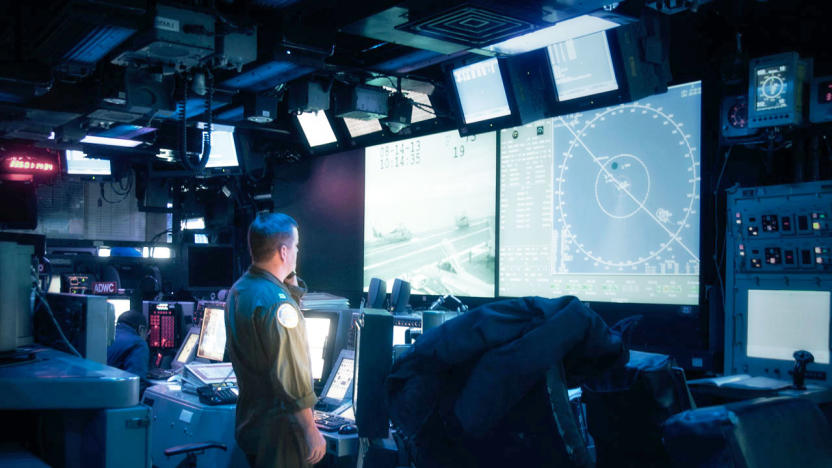
In a bid to help solve its real-world problems, the U.S Navy has called upon the aid of the most dedicated corner of mankind -- gamers. Launching its own week-long online game on March 27th, the Navy plans to crowd-source ideas in a bid to help them tackle the issue of singularity. While this sounds like the plot to a Terminator prequel, technology's rapid advance has caused genuine concern among the office of Naval Research (ONR) over the rise of highly capable AI. In the browser-based game, contributors will be able to post ideas and interact with other players as together they devise solutions to the futuristic problem. Ideas that manage to reach critical mass in the MMOWG (massively multiplayer online war game) have the potential of being adopted by The Navy and put into action.

We don't understand AI because we don't understand intelligence
Artificial intelligence prophets including Elon Musk, Stephen Hawking and Raymond Kurzweil predict that by the year 2030 machines will develop consciousness through the application of human intelligence. This will lead to a variety of benign, neutral and terrifying outcomes. For example, Musk, Hawking and dozens of other researchers signed a petition in January 2015 that claimed AI-driven machines could lead to "the eradication of disease and poverty" in the near future. This is, clearly, a benign outcome. And then there's the neutral result: Kurzweil, who popularized the idea of the technological singularity, believes that by the 2030s people will be able to upload their minds, melding man with machine. On the terrifying side of things, Musk envisions a future where humans will essentially be house cats to our software-based overlords, while Kurzweil takes it a step further, suggesting that humans will essentially be eradicated in favor of intelligent machines.

Seth Rogen is developing a sitcom about the Singularity
If you've never heard of The Singularity, it's the concept made famous by Ray Kurzweil that society's going to be up-ended by the rise of AI. Give it a few years and it might be more well-known as a sitcom created by Seth Rogen and his writing/producing partner Evan Goldberg. Rogen told the Nerdist podcast (as reported by Slashfilm) that they're currently working on a script with a view to shooting a half-hour pilot for FX in 2017.

Bill Gates doesn't get why we're not worried about super intelligent AI
Elon Musk and Stephen Hawking have brought up the potential dangers of super intelligent AI several times over the past few years (Musk even donated $10 million toward cautious AI research), but now Bill Gates is also getting into the mix. In his Reddit "AmA" Q&A session today, Gates made it clear that he agrees with Musk's stance, which basically amounts to being very careful about how we approach the rise of intelligent machines: I am in the camp that is concerned about super intelligence. First the machines will do a lot of jobs for us and not be super intelligent. That should be positive if we manage it well. A few decades after that though, the intelligence is strong enough to be a concern. I agree with Elon Musk and some others on this and don't understand why some people are not concerned.

EVE Evolved: Rubicon 1.1's new deployables
Of all the major changes to EVE Online in the past few years, it's the introduction of personal deployable structures that has had me most excited. I've always been of the opinion that a true sandbox should let individual players and larger organisations build their own personal empires in empty wilderness. If it were up to me, everything from mining and manufacturing to research in EVE would take place in destructible structures and possibly even player-built deadspace dungeons. The Rubicon expansion took an important first step toward this brand of sandbox-style gameplay with the introduction of several new personal deployable structures, including an item hangar and refitting service that can be deployed anywhere in space. Four more structures were initially planned for the Rubicon 1.1 point release to expand the game's tactical possibilities, and this week two of those structures were confirmed. The Mobile micro Jump Unit is a game-changing strategic device that allows players any nearby players to jump their ships 100km forward, and the highly requested Mobile Scan Inhibitor physically hides nearby ships from probes and the directional scanner. Players on the test server have also discovered overview filter options for Mobile Jump Disruptor and Mobile Decoy Unit deployable structures, but developers were unable to confirm whether these would be part of Rubicon 1.1 or even if they'd definitely make it into the game. In this week's EVE Evolved, I look into the tactical possibilities of the Mobile Micro Jump Unit and Mobile Scan Inhibitor and why some players have reservations about these game-changing strategic structures.

Steam weekend deals: Tomb Raider, Rogue Legacy, Activision games
This weekend's frugalfest on Steam is quite tempting. Tomb Raider is down to $12.49 for the standard edition and $14.49 for the Survival edition, which includes select DLC such as ten ditties from the soundtrack, a digital comic, a map, a digital mini art book, an in-game "Guerrilla Skin" outfit for Lara and three weapons plucked from Hitman: Absolution. Punishing retro-inspired roguelike platformer Rogue Legacy is also on the discount block this weekend, down 40% to a mere $9. Finally, there's the Activision publisher sale, which sees discounts for just about every Activision game on Steam: Singularity, Prototype 2, numerous Call of Duty games and Deadpool are all vying for your weekend dollar, so feel free to hop on over and peruse the list. As always, the Steam weekend deals expire on Monday morning at 10am PT.

DUST 514 connects to EVE Online in upcoming closed beta test
CCP Games Executive Producer Brandon Laurino opened up on the features coming to DUST 514's closed beta "precursor" release, which begins August 21st. It will be during this closed beta that DUST 514 and EVE Online will finally meet and shake hands (or try to strangle each other for profit). The team will put DUST 514 on EVE's test server Singularity to see how the games interact in a live environment for the first time. Best part? All EVE Online subscribers now get access to DUST's beta. "We can't wait to see what happens when these games collide in the same shared universe," Laurino wrote. With this move, the team will also be testing out orbital strikes on the battlefield. Players will be able to call down powerful attacks from space onto the heads of their enemies. For right now, the orbital strikes will come from computer-controlled barges, but eventually EVE players will be able to fill the role. Another future feature will be the ability for groundpounders to use orbital artillery to fire on ships in return. The August 21st build of the game will also include new matchmaking features, plenty of additional environments, keyboard and mouse implementation for PlayStation 3 users, and lots of polish. The team says that its Vita companion app, DUST 514: Neocom, is going live at the same time. [Source: CCP Games press release]

EVE Singularity UI test coming tomorrow
It's almost time for the next EVE Online Singularity test. What's Singularity? It's the New Eden equivalent of a test server, and you can connect to it by following the steps for the SisiLauncher tool on the EVE website. This week's test starts tomorrow at 3:00 p.m. Eastern and will last about an hour. CCP says you'll be testing "performance improvements to the overview window and other parts of the UI," and your character will receive two million skillpoints to distribute as you see fit. Further info is available on the (new and improved) EVE web portal.

New EVE Online launcher will simplify patching
EVE Online developer CCP Games has dedicated this winter's expansion to small features, balance changes and small quality-of-life improvements. Most of the changes we've heard about so far have been gameplay features and graphical improvements, from starbase tweaks and blaster balance changes to magnificent new nebula graphics. In a new devblog, CCP Topknot shows off a brand new launcher program designed to simplify the patching process. Currently, players launching an out-of-date client get a pop-up about the latest patch and have to restart the client. This becomes a nuisance when frequent optional updates are released. The new patcher will work like a standard MMO launcher, detecting which files aren't up to date and downloading new versions. "A big-ass progress bar will tell you what's going on and how much work is left," explains Topknot, "and an unnecessarily huge button allows you to play the game once it is ready." The new patcher is currently on the test server and should be making its way to the main game with the winter expansion. In the future, the patcher will be able to download updates in the background and may be able to download content in stages, giving new players access to character creation while the game content downloads.

EVE adds more racial captain's quarters to test server
Those of you chafing under the constraints of the Minmatar captain's quarters released earlier this summer as part of EVE Online's Incarna expansion have reason to celebrate. The other three racially themed quarters have just been deployed to Singularity (that's the test server, for you EVE newbs). When we say racially themed, we don't mean like an Al Sharpton monologue but rather like the Gallente, Caldari, and Amarr races who, along with the Minmatar, make up EVE's four playable factions. A new dev blog hits the highlights of each CQ, and each one boasts a visual aesthetic that mirrors its race. Gallente quarters, for example, are "are slick and streamlined -- comfort through elegant design. The mirror is also prominent, since the Gallenteans are known to spend a lot of time in front of it." The Minmatar pad has also been tweaked, and you can read all the details at the official EVE website. Before you go, check out the preview video after the cut. [Update: CCP has also uploaded a video explaining the new time dilation feature.]

Direct2Drive cuts select Activision game prices in half this weekend
Whether your interests include futuristic technology, automobiles or futuristic technology that can turn into automobiles, Direct2Drive's got your back this weekend. The site's offering Blur, Singularity and Transformers: War for Cybertron for half-off starting today at 10 a.m. PDT.

EVE invites everyone to come Mass Test
Every time we hear of a massive battle in EVE Online, we are reminded of how incredible the game is. EVE has continued to separate itself from the other MMOs by being able to handle an exorbitant number of players in a single area. This unbelievable feat is most likely attributed to the rigorous testing from the Q&A team and dedication of the EVE fans. This week, you can help out the CCP development team by participating in Mass Testing. Mass Testing is CCP's way of gathering a multitude of players in one area to grade server performance before launching new content to the live server. The team checks trend-data, streamlines high-priority changes, and gains critical player feedback. This week's test focuses on the Carbon UI and server remapping. If you would like to take part in this week's Mass Testing, hop on Singularity at 4 p.m. EDT on Thursday 28th. Remember, this is a stress test, so invite everyone you know! Your grandma has an EVE account, right?

EVE invites players back to try out Incursion
As anyone who follows EVE Online should know, Incursion, the 14th expansion to the game, will introduce new avatars. For many MMO players, the graphics-quality -- especially the quality of the player character -- is an enormous draw or repellent. CCP recognizes this, so it has offered something not many companies do. The developers would like former players to come back for five days to try out Incursion on the test server Singularity before the expansion is officially launched. Specifically, they would like you to try the character creator and the social media tools in EVE Gate. This morning many former EVE players received an email asking them to come back. If you had an active account between March 13th, 2009 and November 3rd, 2010, you may want to check the inbox attached to your EVE account, as you probably have an invite in there. Unfortunately, active and expired trial accounts don't count, but Steam is offering a the full downloadable game plus a 30-day subscription. To read more about the character creator, be sure to check out the developer blog, and while you're there, read up on EVE Gate and its mix of social media and gaming. With Incarna releasing next summer, Incursion is a the perfect opportunity to try out the precursor to walk-on stations -- today.

Report: Raven hit with layoffs, 40 let go
According to a report over on Kotaku, Raven Software has dismissed 40 employees. Activision neglected to respond to the purported number in a supposed statement given to the blog, citing Raven is "realigning its workforce to better reflect the studio's upcoming slate." The developer recently concluded work on Singularity. Kotaku offers that this "realigning" is so that Raven can focus on creating downloadable content -- the studio was reported to be working on DLC for Call of Duty: Black Ops back in May. We're currently digging for more and will let you know what we hear back.

New EVE character creation videos prove CCP can make pretty humans too
While some may not care for the sandbox play and politics of EVE Online, we often hear from people about how graphically gorgeous they think the game is. Well, with the new character creator that's been released to the Singularity test server, CCP is showing that it's ready to rock a whole new way -- Incarna! These two videos preview the shiny new creator in testing, showing off a Caldari Achura female and a Minmatar Brutor male character. We'd also note that CCP has made it clear that the character creator is a work in progress and as such is missing some options currently. Of course, we'd be lying if we didn't point out that this character creator preview video also makes us squee for CCP's other title under development: World of Darkness. The character creator for that game will have to be able to balance the ethereal beauty of the Toreador clan with the twistedly horrific looks of the Nosferatu clan all in one -- and we'd say this one shows the promise of having that kind of power. Check out the full videos after the break! [Thanks, CrazyKinux!]

Robots 'to beat world's best' human footballers by 2050 and other things said when high
We're as hopeful about the future as anyone. Sure, we fear robots, but we're bound to have at least a few years of peaceful co-existence before they grow weary of our human insolence and irrational buffoonery. Claude Sammut, professor of computer science at New South Wales University in Australia (and RoboCup regular), believes that robots will surpass the abilities of professional human footballers (aka, soccer players) by 2050. For this to happen, he says that the field will require "major advances in perception, decision making, learning, and co-operative behaviours." Of course, looking at the current field of RoboCup contestants or even around the house at the TV (largely unchanged since 1930), telephone (patented in 1876), and iPod (now 9 years old), it's hard to imagine technology advancing that fast. That is, until the rate of technological change accelerates so fast that we achieve singularity sometime in 2030 or 2050, depending upon who you ask.

Prototype of robot that develops emotions on interacting with humans officially complete
The first prototype of a Nao robot that can develop emotions as it interacts with a human caregiver has been completed. A team across Europe was led by Dr. Lola Cañamero of the University of Herefordshire in the UK to develop the bot, which differs in several significant ways from those that came before it. These robots develop over time in much the way that a child does, learning to interact with and respond to the human beings around them. Modeled after human and chimpanzee childhood development paths, they are programmed to be highly adaptable to the people around them, and to become attached to whatever person is most suited to its needs and 'personality' profile. Over time, the more they interact, the more they learn and bond to the human being. These little ones, moreover, are capable of expressing a wide range of emotions, including anger, frustration, fear and happiness. The next steps are to research the bots' emotional and non-linguistic behavior, and to move toward combining linguistic and non-linguistic communication to become further attached and adapted to them. Yes, we want one.

Singularity (PS3) on sale for $40 on Amazon today
Who pays $60 for a new game? Not you, because you know about deals like the one Amazon has on Raven Software's time-twisting shooter, Singularity. The PlayStation 3 version is currently on sale for $40.


