Skip to Content

WoW Insider is getting ready for BlizzCon!
AOL Tech

solar posts

IDEA's Solar lamp glows like a Sputnik heatshield

While the original Sputnik burnt out after only 3 months in orbit, here's an homage that promises to be rather more resilient. IDEA, Japan's answer to you know who, is offering a 30cm tall (11.8-inches) self-sufficient ambient light that pretty much does its own thing. Integrated sensors detect when the light should be on, while inconveniences like power cords and on/off switches are completely done away with. The light's batteries are recharged by the sun at a rate of 2 to 5 hours sunlight for 8 hours operation, while its waterproof design means it can be dumped outside to collect rays during the day and even provide garden lighting at night. It's quirky, to be sure, but the obvious design cues taken from the Russian satellite should make true geeks smile with glee. You can find a gallery of the various color choices courtesy of Engadget Japanese below, and if you're passing by the land of the rising sun later this month you can snap up your very own solar light ball for ¥1575 ($16).

[Via Engadget Japanese]

Orange's Solar Concept Tent has lots of revolutionary, imaginary features


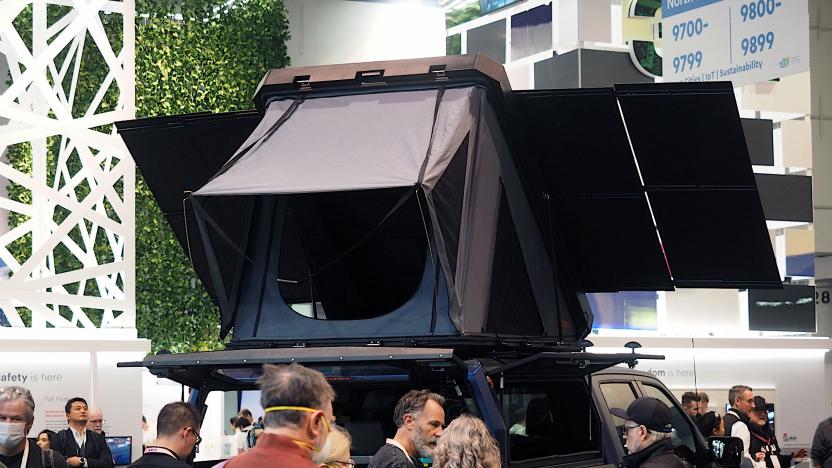
If the promise of Birkenstock-powered phone chargin' wasn't enough to get your ass to Glasto this year (never mind catching Björn Again perform ABBA's greatest hits on the Pyramid Stage), how about an up-close-and-personal peek at Orange's Solar Concept Tent? Designed with help from an American firm called Kaleidoscope, this guy is a refresh of the original Orange Solar Tent you might remember from 2003. Featuring photovoltaic fabric panels up top, an LCD display for keeping an eye on battery levels, a wireless charging pouch (like Palm's Touchstone but, you know, a pouch), a heating element embedded in the tent's groundsheet, the ability to light up if you should get lost while freaky dancing, and WiFi connectivity, this bad boy could conceivably get even the most nature-phobic Engadget editor out into the wild. That is, if it wasn't just a concept.


[Via Textually]

Samsung Blue Earth finally gets a hands-on treatment

We've been hearing about the Samsung Blue Earth -- an eco-phone, if you will -- since way back at MWC. Now CNET's finally gotten its hands on one at CommunicAsia in Singapore, and we have to say that we're pretty intrigued with what we're seeing. The back of the phone is covered with a solar panel, and Samsung says that one hour of sunning time for the mobile equals about 10 minutes of talk time. The handset also has a built-in pedometer to count steps for the Eco Walk carbon footprint app -- certainly something prospective buyers of the Blue Earth might be interested in. We still don't know full specs, pricing or availability for the phone, but we'll let you know when we do. Hit the read link for a video.

Energizer expands Energi To Go charging line with more solar, iPhone options


We've seen Energizer dabble in portable charging solutions before, but we've yet to see it go all out like this. Thanks to a newfound partnership with XPAL Power, the company famous for making drum-toting bunnies famous has issued several new wares in its Energi To Go line. The rechargeable power packs and emergency chargers -- over ten of 'em in all -- will all ship by July of 2009 and will include devices for PMPs, PNDs, portable DVD players, netbooks and digicams. There's even an AP Charger that mounts your iPhone (à la mophie's Juice Pack Air), and the SP line consists only of solar-driven power packs designed to rejuvenated your iPod, camera and pretty much any other handheld device. There's no mention of price just yet, but as with anything Energizer, you can go ahead and brace for sticker shock.

IDT to swap solar cells into LCDs, but not for energy reasons


Solar-powered LCDs? Oh, yeah -- we've got those. Sadly, that's not at all what Integrated Digital Technologies is aiming to improve upon next week at Computex, though we still find its approach to trimming LCD weight and manufacturing costs an interesting one. If we're digesting this correctly, we're hearing that the outfit plans to create interactive displays (or iScreens) that have embedded solar cells in the TFT array rather than extra film or glass with photo sensors. The result? A cost savings of up to 30 percent in manufacturing, not to mention a rather significant decrease in weight. Without any images to go by, it's still a wee bit tough to really wrap our heads around this new take, but hopefully we'll see more next week in Taiwan.

[Via TG Daily]

Solar paneled umbrella will charge your gadgets while you hang in the sun


We see boatloads of solar charging gizmos around here, but they're usually not so... large. What we have here is a big sunning umbrella, for use outdoors (obviously), which has large flexible solar panels made by Konarka on top. The solar collecting panels store the energy in the stem of the Powerbrella as it's called, and it's got outlets at its base for charging your phone, PMP, etc. The 'brellas have already been tested in Florida, and are set to be manufactured by Sky Shades, for release sometime this summer. No word on pricing yet -- but there is one more shot after the break.

[Thanks, The Gadgets Weblog]

Solar-powered Trilobot takes wistful stroll outdoors


A solar-powered robot that's fully autonomous and able to control it's own energy acquisition may seem like a frightening proposition to some. But set aside those preconceptions for a minute and take a look at the Trilobot's video debut after the break, and then try to tell us you don't want to get one, name it Buddy and love it forever.

Sharp slings out industry's thinnest solar modules for cellphones


Timely, no? Just a month after Sharp aided in producing the planet's first waterproof solar cellphone, the aforementioned outfit has just announced the industry's thinnest solar module for handsets. Checking in at just 0.8 millimeters thick, the LR0GC02 shouldn't take up too much space on your daughter's great-granddaughter's smartphone, and while Sharp isn't handing over too many details just yet, we figure it'll pretty much do what it says. You know -- charge the handset it's integrated into whenever sunlight is available. As for when we'll see these in cellphones everywhere? Take a wild guess, tree-hugger.

[Via Akihabara News]

KDDI au unveils summer '09 lineup: e-books, solar power, and 720p recording

Japanese carrier KDDI au has now followed Softbank and NTT DoCoMo in pulling the red velvet cover off its summer 2009 devices, and as always, there are some neat tricks in here. From Toshiba, the Biblio is billed as an e-book reader; granted, it's using an LCD instead of an E-Ink display, but it's a doozy at 3.5 inches at 960 x 480. It features 7GB of user-accessible storage on board for books, and also has a slide-out dynamic keyboard that can display a numeric pad in the portrait orientation or full QWERTY in landscape. Moving on, the Sharp Sportio Water Beat -- as its name suggests -- is a waterproof sports-oriented set with advanced calorie and distance tracking (a la Nike+), but you're still never too far from your true destiny as a couch potato thanks to the phone's one-seg reception. Next, the Hitachi Mobile Hi-Vision Cam Wooo is the latest in the multimedia-centric Wooo series, becoming KDDI's first phone capable of 720p video recording at 30fps -- and there's HDMI-out on board for when the time comes to enjoy your footage. Finally, the SH002 is the realization of Sharp's solar phone concept from earlier this year, delivering one minute of talk time for every 10 minutes of charge time. There are other announcements in the mix here -- eight new phones in total -- but those were the killers of the bunch, and as always, this post is about as close as most North Americans will ever get to them.

[Via Engadget Japanese]

Taiwan's National Stadium gets solar panel roof, hug from Ma Earth


Oh sure, we've seen photovoltaic panels strewn across rooftops before, but this takes things to a whole 'nother level. Taiwan's $152 million National Stadium, which will proudly host the 2009 World Games, is home to no fewer than 8,844 solar panels. With under a month to go before the events kick off, construction on the Toyo Ito-designed arena wrapped just in time, and we're told that some 55,000 observers will soon be spectating underneath the eco-friendly shelter. Early reports have noted that in optimal sunlight, the solar panels can cover around 75 percent of the stadium's energy needs, and on days when the facility is dormant, the power generated is simply fed into the grid in order to help the local community. So, who's down for a trip to Kaohsiung? Sunscreen's on us.

[Via Inhabitat]

Sharp's solar 936SH and 934SH with "memory LCD" headline latest SoftBank lineup


As you might expect, Japanese carrier SoftBank's summer 2009 lineup contains the usual science-fiction array of ridiculously well-equipped handsets -- plus 3G photo frames and a Lenovo IdeaPad S10 with embedded WWAN -- but the real news here might be a pair of lovelies from Sharp. The mirumo 934SH (pictured left) features a 3-inch external display that can display time, date, weather, news, and other information without consuming any power between changes; sounds like E-Ink, though Sharp describes it simply as a "memory LCD." You've also got an 8 megapixel camera, a waterproof shell, and a UV sensor that can help you determine just how quickly you need to slather on the SPF 30. Next up is the Solar Hybrid 936SH, a phone suspiciously similar in concept to the device Sharp is working on for SoftBank competitor KDDI au. Clearly the big draw here is the big solar array up front that'll give you one minute of call time or two hours of standby per 10 minutes of charging, but you've still got IPX7 water resistance, an 8 megapixel camera, and a full wide VGA display at your disposal. Look for the 934SH in June and the 936SH in August -- if you happen to be in Japan, anyhow.

Anokimobi's solar-powered electroluminescent signs light up your eco-friendly bar crawls

Anokimobi's solar-powered electroluminescent signs light up your eco-friendly bar crawlsOkay, so that solar-powered electroluminescent wallpaper never caught on, and neither did the EL sports jerseys that stood poised to make the most boring of events at least look exciting. But, this latest application of the tech seems bound to succeed -- if only because it caters to drinking establishments and their affinity for blinking lights. Anokimobi has released a sign that charges during the day, giving it power for up to 14 hours of light pollution at night. It's totally waterproof and can even be powered by an auxiliary power source should a cloudy spell interrupt a week of drunken debauchery. No prices are advertised, but we're sure the company would be happy to send you a quote.

Eco-friendly Clayton iHouse on sale, coming to a highbrow trailer park near you


Clayton Homes, a US-based company which makes and sells manufactured (prefab) homes, is getting in on the i-naming game with their latest bit of construction. The iHouse is a prefabricated, customizable house that is so energy efficient that Clayton estimates it costs about $1 per day to cover all of its electricity and heating needs. The house makes use of solar panels, energy-efficient appliances, thick walls, heavy insulation, a rainwater-catching system, a tankless water heater, and dual flush toilets to meet its eco-friendly goals. The company, which sold about 30,000 manufactured homes last year, thinks that the iHouse could quickly come to represent about 10 percent of its business. Prototypes of the house -- which at around 1,000 square feet costs $140,000 completely furnished -- are popping up all over the US, and as of last Saturday, are officially on sale nationwide. One more photo after the break.

[Via Yahoo News]

DIY Solar Flyer motorcycle tearing around Phoenix, Arizona


Phoenix area resident and motorcycle enthusiast Richard Gryzch got tired of gassing up his bike all the time, and he decided to do something about it. Rather than getting a fancy electric motorcycle, he modded one for himself -- making an electric bike that is seemingly covered in solar panels. The motorcycle uses no gas, goes up to about 90 miles per hour and has a range of around 50 miles. There are very few details about the inner workings of the bike, so we're loathe to say it's 100 percent solar, but Richard does plan on extending his bike's range of 300 miles. Hit the read link to watch an extremely tiny video of Richard and his bike.

PiSAT Solar's K-Light boasts a one-to-one charging ratio


It's pretty rare that a portable solar-based device offers much more utility than impressing your friends, but PiSAT Solar's K-Light won't only make you the coolest kid on your block: it might actually prove useful the next time you take a hike or find yourself hanging out in a developing country. In 10 hours of daylight charging the unit gathers up to 20 hours worth of battery power for use in the low-power 8 LED mode, or 10 hours of life if used in 16 LED mode. It's also switchable between flashlight and lantern modes. That should be great for campers, but where the K-Light really "shines" (so to speak) is in places like Africa, where villagers without electricity often use makeshift kerosene lanterns for light at night. K-Light is designed for up to 10 years of full daily use in such a scenario, and PiSAT is working on an adapter to let the lantern's battery also charge a cellphone. At $50 a pop, the barrier to entry isn't incredibly high, and PiSAT is working with the Koinonia Foundation to provide start-up grants of K-Lights to groups of African women to create local businesses selling the lights. One-off purchases are also available now online for us non-entrepreneurial types.


AOL News

Joystiq

Download Squad

TUAW

BloggingStocks

Asylum

Autoblog

Switched.com

FanHouse

Autoblog Green