As the military industrial complex surges forward, so do advances in technology for the public sector. At least that's how the cold-war wisdom goes. Case in point: QinetiQ is developing a lens-less, mirror-less, battlefield imaging system with some help from your DARPA's deep pockets. The LACOSTE project (Large Area Coverage Optical Search while Track and Engage) aims to set aloft high-altitude (about 20km) drones and air-ships fitted with a special, thousand-strong microscopic sensor array (a "first of their kind," according to QinetiQ), a "mask," and image processor to decode the scene and extract an image of the quickly changing conditions on the battlefield or, you guessed it, city streets. The resulting lightweight and highly-durable system should feature a "super resolution" mode with the ability to "detect and simultaneously track large numbers of moving vehicles in dense urban areas with a high degree of accuracy, 24-hours a day." And here you thought CCTV was intrusive.
Okay, let's get this straight. If D-Link is marketing its new $499.95 Internet Surveillance Starter Kit (and $399.95 Expansion Kit, for the hardcore snoopers) as a method for spying on someone residing within your domicile (save for your infant), you probably need a family counselor -- not a gimmicky IP camera. Now, if D-Link is hoping to tickle the fancy of geeks who'd rather check out a room in low resolution rather than taking four or five steps down the hall, we're pretty terrified about the fate of humanity. Still, the weird(est) part about this thing is the D-Life website which it ties into. Video of your home piped through someone else's servers -- need we say more?
Around this time last year, we got wind of CCD-based projectors and cameras from Olympus that were outfitted with a curious "axial symmetrical free curved surface lens." Now, said company is finally providing a few details about its current prototype, which essentially enables 360-degree photographs to be taken. Unfortunately (or fortunately, depending on perspective), the sensor isn't quite ready to be pushed out into the world, but as you can certainly imagine, it'll likely make a B-line for surveillance outfits just as soon as it's ready.
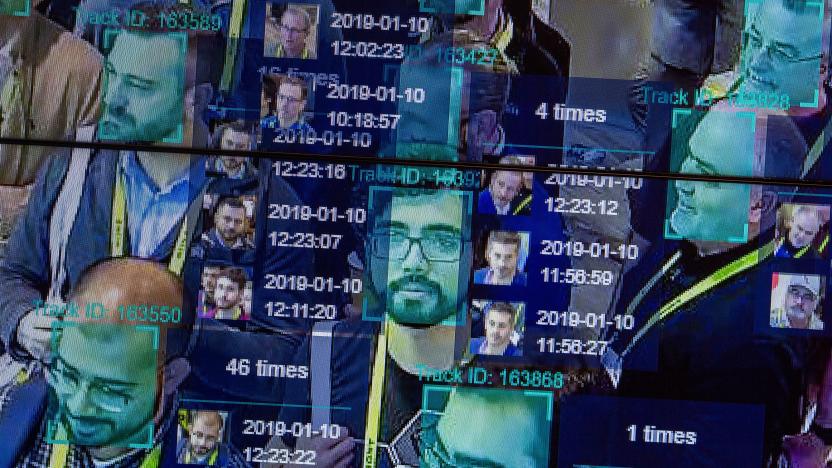
Putting cameras in billboards to measure how many people look at them isn't a new idea, but it's starting to get a little more creepily-high-tech, with several advertisers now using facial-recognition software to record things like age and gender. A company called Quividi has supplied camera-equipped ads to McDonald's in Singapore and Ikea in Europe, and it's now bringing the tech to the States, where it's been deployed in New York in ads for A&E's The Andromeda Strain mini-series and in Philadelphia in train station ads for the Philadelphia Soul. Another company called TruMedia Technologies has supplied similar tech to about 30 locations in the US, including malls in Chesterfield, Missouri, Winston-Salem, North Carolina, and Monroeville, Pennsylvania. None of the systems currently record or store video, but no one's ruling that out as a possibility -- and even worse, there's talk of gathering racial data in an effort to even further target ads. Great, now we have yet another reason to break out the Nixon mask every time we leave the house.
Watch out, battery-powered MAVs -- your viability could be seriously in danger. Based on a patent application from University of Florida aerospace engineer Subrata Roy, he's reckoning that a micro air vehicle could be propelled by plasma. Scientists have known that passing a current or magnetic field through a conducting fluid generates a force, but exploiting it for use in moving an aircraft has proven futile thus far. The phenomenon, simply known as magnetohydrodynamics, has typically been tested on larger crafts, but Mr. Roy's invention would boast a wingspan of less than 15-centimeters and resemble a flying saucer more so than a 747. Of course, this fantastic idea has yet to become much more than just that, but for armed forces and entities obsessed with surveillance, this could undoubtedly be big.
Privacy advocates have long since pointed out that the sniff-ability of Bluetooth signals were cause for concern, but now one University of Bath researcher has a little data to back that up. Vassilis Kostakos placed four Bluetooth receivers in the city's center for four months, during which he and his team tracked over 10,000 BT-enabled mobiles. According to Mr. Kostakos, they were able to "capture and analyze people's encounters in pubs, streets and shops." He continued on to mention that "Bluetooth is now more of a privacy threat than the more frequently publicized RFID chips," and he encouraged worried denizens to turn off the BT function on their phone to help curb the paranoia. Of course, that won't stop Big Brother from seeing your every move whilst in the UK, but whatever helps you sleep better is alright with us.
England is already drowning in CCTV cameras, so it looks like Big Brother is starting to get creative in finding ways to deploy more: local councils are now outfitting crossing guards with camera-equipped stop signs. Yeah, crossing guards. With cameras in their stop signs. The cameras in the £890 ($1765) poles are fairly conspicuous, and the hope is that it'll curb aggressive driving around crossing zones, which resulted in 1,400 incidents last year. There's no word on how anyone plans to measure the effectiveness of the program, but we're certain the crossing guards who get passed over for the poles and end up with the hat-mounted cameras also being deployed will have a few choice words about things.
Ever peered up in a dimly lit parking lot only to spot a smattering of cameras peering at your every move? Now you too can have such a sophisticated monitoring system right around your own home thanks to QNAP's NVR-1012. The network surveillance kit is designed to provide "professional grade" live video recording abilities in homes and offices where hoodlums and malefactors tend to linger. The entire system is Linux-based and comes with a single NVR-101 server and a pair of IP cameras; reportedly, the solution is a breeze to install and every recording function can be carried out via an Internet Explorer window. Best of all, you'll even find 2-way audio capabilities, so you can have a quick chat with any caught-red-handed crooks or mischievous youngsters right before the fuzz / man of the house swarms in for capture. Talk about a thrilling way to spend a Thursday evening.
Quite honestly, we can't imagine anyone finding this the least bit surprising -- after all, aren't CCTV cameras and the UK an inseparable pair by now? Nevertheless, the Examination Officers' Association across the pond is currently mulling the idea of installing surveillance equipment in exam halls in order to keep an eye on test-taking cheaters. Apparently students are turning to their mobiles more and more (no way!) to plug any holes in their memory, and while the project hasn't been set in stone just yet, it seems to be headed in that direction. Ah, whatever happened to those old fashioned cram sessions?
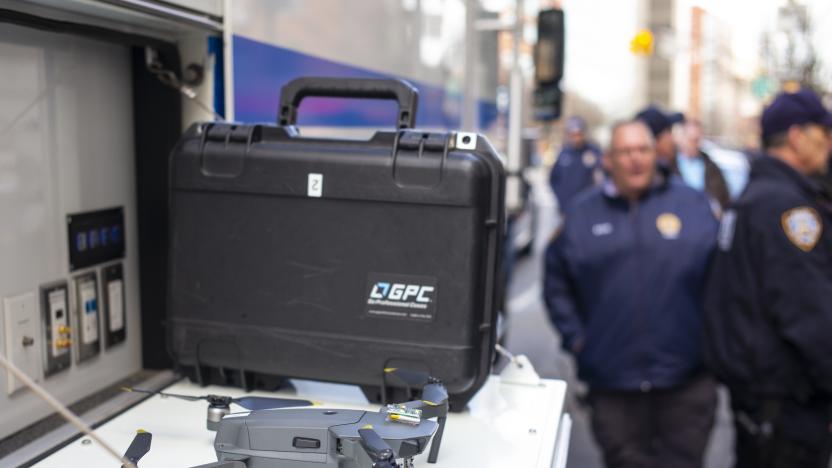
We didn't even flinch when we heard that hovering drones employed by Big Brother were going to work in the UK, but somehow those buggers have managed to wander over to America's east coast. Granted, the pilotless drones -- crafted with good intentions by Honeywell -- that are slated to report in to the Miami-Dade police department aren't exactly the same, but they are expected to be used for similar duties. More specifically, they'll be loosed in order to oversee "urban areas with an eye toward full-fledged employment in crime fighting." According to a department spokesman, the fuzz are only looking to use it in "tactical situations as an extra set of eyes," but don't be shocked to see flashing lights from a vehicle without wheels next time you're rolling (a little too) quick down South Beach.
The University of Michigan's COM-BAT most definitely isn't the first mechanical animal to get its inspirations from the bat, but it's probably the best equipped to play a vital role in modern day warfare. A select group of Wolverines have been blessed with a $10 million grant from the US Army in order to concoct a "six-inch robotic spy plane modeled after a bat [that] would gather data from sights, sounds and smells in urban combat zones and transmit information back to a soldier in real time." Purportedly, the critter will eventually boast a bevy of sensors, miniature microphones and detectors for picking up nuclear radiation and poisonous gases. Even more interesting, creators are hoping to implement "energy scavenging," which would enable the bat to stay charged from wind / solar energy along with vibrations and "other sources." So much for being nocturnal, eh?
Finally, all of your boy- and girlhood dreams of X-ray specs are coming to fruition... sort of. A company called ThruVision has pioneered a camera system which is able to peer beneath clothing using teraherz waves (T-waves). Unfortunately for perved-out snoopers, the 80-foot-ranged camera can't make out "anatomical details," rather, it can only see materials like plastic, metal, and gels or liquids. The company sees use for the surveillance systems in places like airports or government buildings, where the ever-staring eye of Big Brother is most needed. Still, this is certainly preferable to Total Recall-like X-rays, or those strip searches we keep getting when we travel lately. [Warning: PDF read link]
Not only is the British army hoping to make tanks and troops invisible to the naked eye, but it'll soon be honing in on targets way before the mind would normally allow. In a $58.8 million deal, Thales UK has been selected to supply the troops with new Surveillance System and Range Finder (SSARF) technologies, which will reportedly "enable quick identification of enemy locations along with the ability to determine the best mortar or artillery firepower the situation on the ground requires." Best of all, the handheld system will feature integrated GPS, thermal imaging and a five kilometer range, but unfortunately, it won't be giving any Britons in the field an edge until 2009.
It's not like the Japanese government hasn't dabbled in GPS (and RFID, too) tracking before, but the nation's latest idea involving Big Brother is (unsurprisingly) catching a fair amount of criticism. Reportedly, Japan wants to equip senior defense officials with GPS-enabled mobiles, and it's making no bones about the reasoning behind it. Quite frankly, it's looking for ways to keep a more watchful eye on officials' whereabouts after a higher-up was recently "treated to hundreds of expensive rounds of golf by a defense contractor." Reportedly, the handsets would only be given out to senior staff "required to report for duty in the case of a security emergency," but a number of anonymous individuals have already expressed disdain for the plan through local news outlets. Nothing to hide, nothing to fear, right?
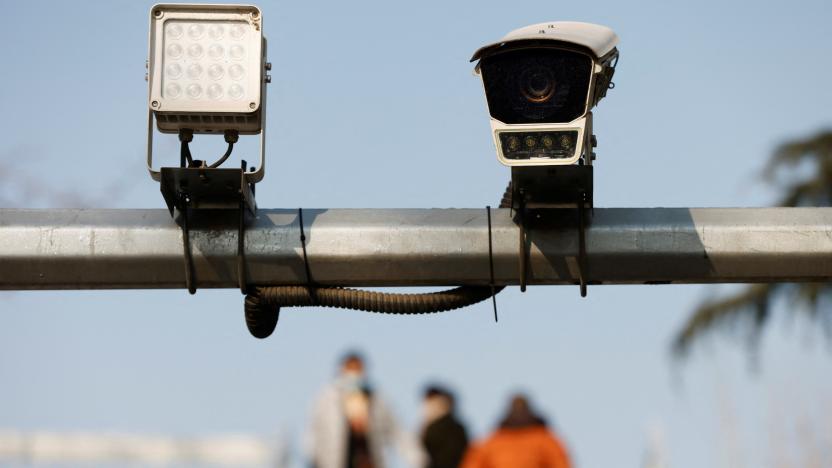
We never thought adding an absurd amount of surveillance cameras to a city (or its public transportation system) would become fashionable, but it seems like Toronto is the next big locale ready to hop on the Big Brother bandwagon. Reportedly, plans are already underway to "ensure every person using Toronto's transit system will be photographed as of next June," which means that some 12,000 cameras will have to be installed on "every [Toronto Transit Commission] bus, streetcar, subway car and at each station." Of course, it's noted that the images acquired will only be used as "crime-busting tools," and the entire system is expected to cost a cool $18 million. Good news for employees / police stationed at the transit system's command center, though -- you'll be able to "view live video or hear audio from any of the security cameras installed on subway cars." Now that's quality entertainment.